

Why Fire Rated Ceilings Are Essential for Building Safety
Fire rated ceilings are specialized ceiling assemblies designed and tested to resist fire for a specific period—typically 30, 60, or 120 minutes. They are a critical component of a building’s passive fire protection system, helping to contain flames, smoke, and heat to protect occupants and structural integrity.
Quick Answer: What You Need to Know About Fire Rated Ceilings
- Purpose: Contain fire and smoke, preventing spread to other areas.
- Common Ratings: 30-minute, 1-hour, and 2-hour fire resistance.
- Key Components: Certified ceiling tiles, suspension grid, and firestopping at penetrations.
- Where Required: Escape routes, multi-family buildings, hospitals, and other high-risk areas.
- Testing Standard: ASTM E119 for complete floor-ceiling or roof-ceiling assemblies.
- Critical Requirement: All materials and installation methods must follow tested, UL-rated assemblies.
When a fire breaks out, a fire-rated ceiling is the first line of defense between occupied spaces and the structure above. Unlike standard decorative ceilings, these systems are engineered to maintain their integrity under extreme heat, buying crucial time for evacuation and firefighting efforts. The minutes gained can be the difference between a contained incident and a catastrophic loss.
Building codes require fire-rated ceiling assemblies in specific locations based on decades of fire testing and real-world data. A compliant assembly includes not just the visible tiles but the entire system: the suspension grid, hangers, insulation, and proper treatment of every penetration for lights and HVAC.
Using non-certified materials or improper installation methods risks code violations, puts lives at risk, and exposes building owners to significant liability. At Western Wholesale Supply, we have extensive experience helping contractors in Idaho and Wyoming specify and install Fire rated ceilings that meet code and ensure occupant safety.
How Fire Rated Ceilings Provide Protection
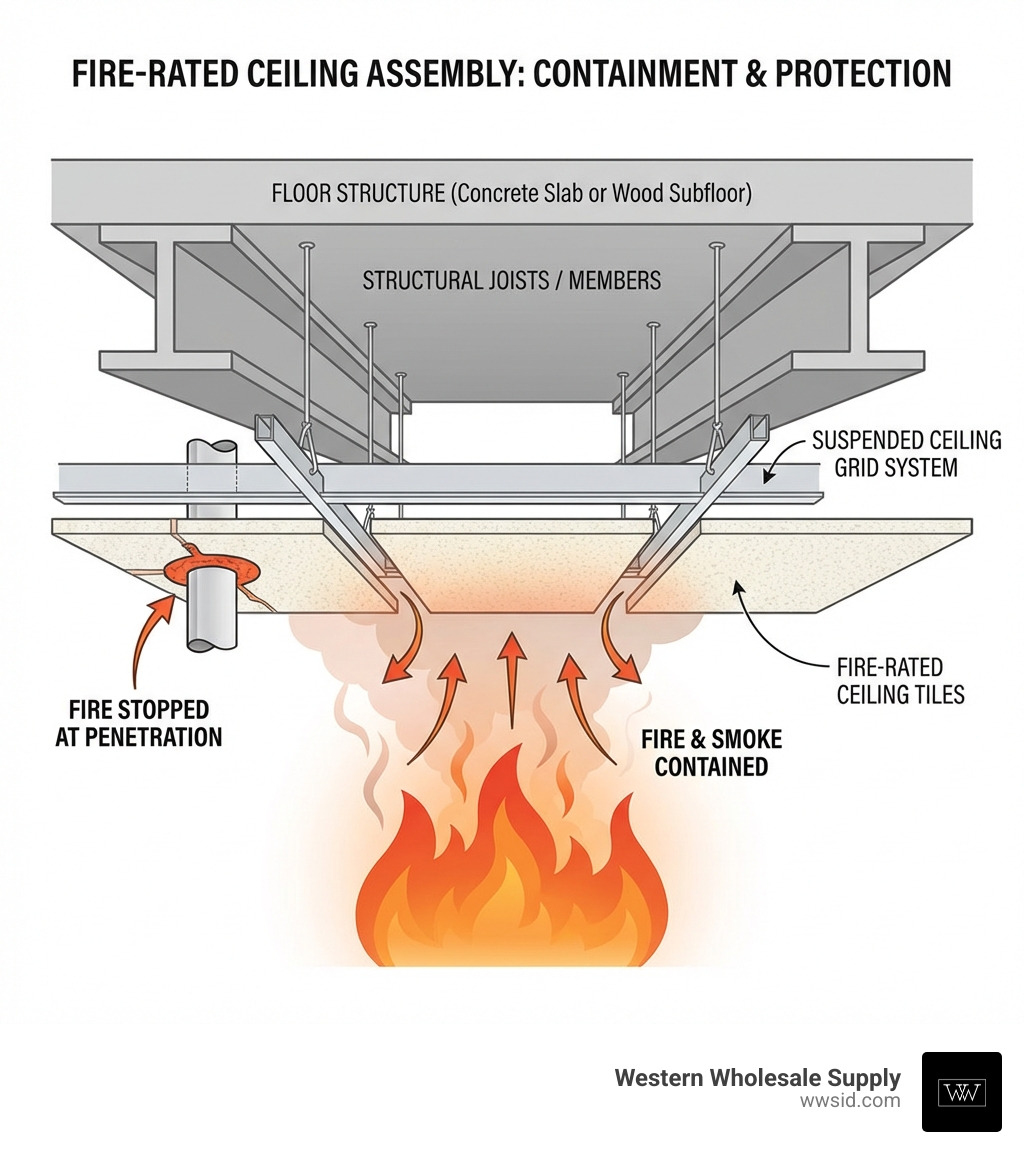
While active systems like sprinklers are well-known, passive systems like fire rated ceilings are the unsung heroes of fire safety. Their primary functions are containment and structural protection.
By containing a fire within a specific room or compartment, these ceilings prevent rapid spread throughout the building. This strategy, known as compartmentation, limits damage and provides critical time for occupants to escape.
Fire-rated ceilings also act as a thermal barrier, shielding structural elements like steel beams and wood joists from intense heat. This protection slows the weakening of the structure, preventing a premature collapse and enhancing safety for firefighters.
Compared to open plenum designs, suspended fire-rated ceilings offer significant safety improvements. They create a barrier that slows fire spread and concentrates heat and smoke below, leading to faster activation of smoke detectors and sprinklers. They also protect vital installations like wiring and plumbing in the ceiling void from fire damage. For a deeper dive, consult this comprehensive Data Sheet on Ceilings and Concealed Spaces. Our acoustical ceiling solutions can also be integrated with these safety features.
The Role of a Complete Fire-Rated Assembly
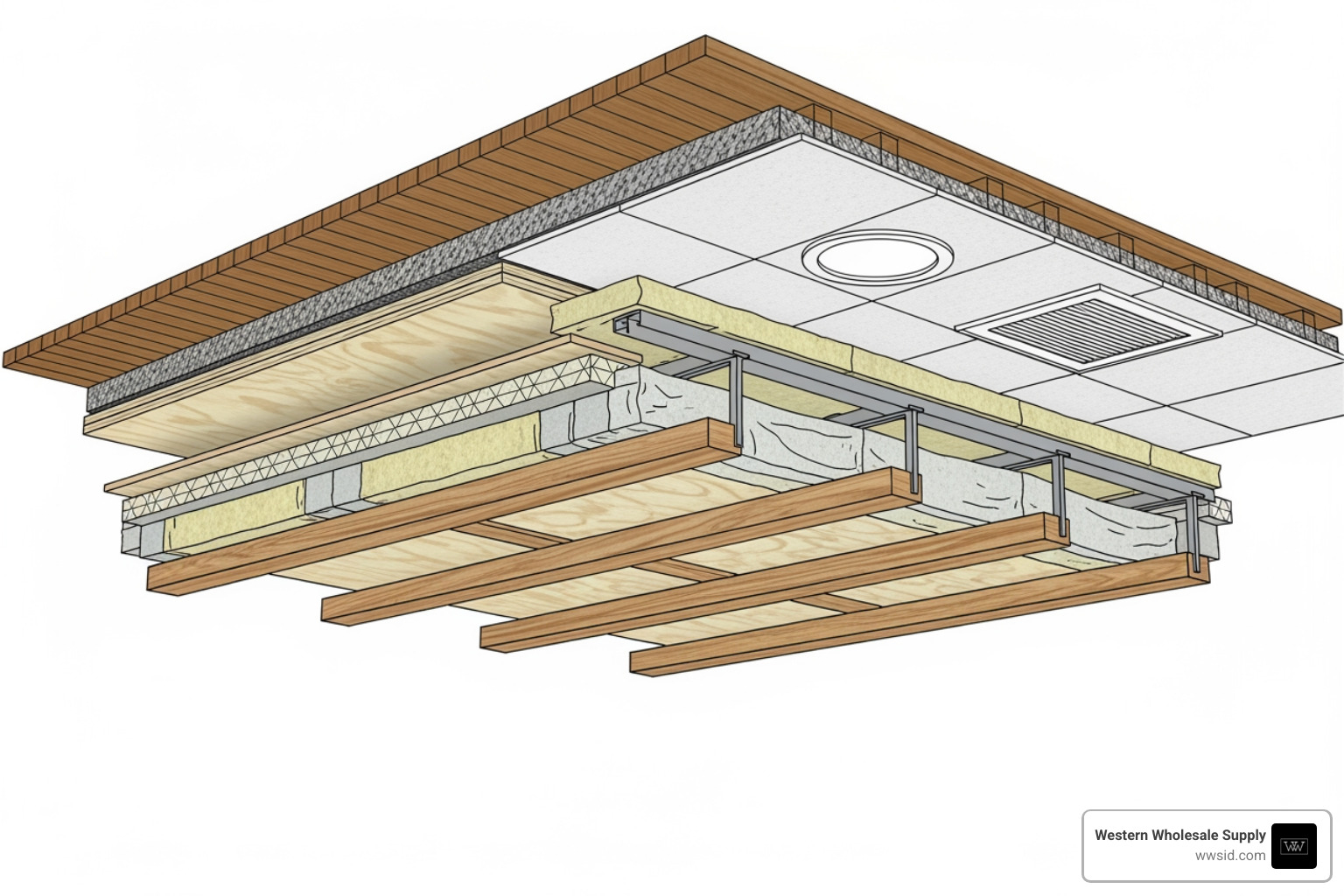
A fire-rated ceiling is not just about the tiles; it’s a complete assembly where every component works together. These floor-ceiling or roof-ceiling assemblies are tested as a whole system, including the structural frame, subfloor, insulation, grid, panels, and any penetrations for lights or HVAC.
A “UL-rated assembly” has been certified by Underwriters Laboratories (UL) to perform as expected in a fire. This certification ensures the system, which may include features like expansion relief to prevent buckling, will maintain its protective barrier for the specified duration. Choosing a UL-rated assembly means investing in a proven system of protection.
How Suspended Ceilings Improve Fire Safety
Properly installed fire-rated suspended ceilings offer several key advantages:
- Physical Barrier: They create a protective layer that delays the spread of flames and hot gases into the plenum space.
- Faster Detection: By concentrating smoke and heat, they help activate smoke detectors and sprinklers more quickly.
- Effective Suppression: Trapped heat ensures sprinklers activate efficiently, directing water where it’s needed most.
- Compartmentation: They help compartmentalize the plenum, preventing fire from spreading horizontally through concealed spaces.
Decoding the Ratings: Understanding Fire Rated Ceilings
Understanding fire ratings is crucial for compliance and safety. In the U.S., the primary standard is ASTM E119, which tests the fire resistance of entire building assemblies. Underwriters Laboratories (UL) is a key third-party service that certifies assemblies that pass these rigorous tests. Building codes in Idaho and Wyoming rely on these UL-rated assemblies to ensure safe construction.
The rating is given in hours (e.g., 1-hour, 2-hour), indicating how long the assembly can contain a fire and prevent excessive heat transfer. It’s critical to distinguish between an assembly’s fire resistance rating and a material’s surface burning characteristics.
| Feature | Flame Spread/Smoke Development (ASTM E84) | Fire Resistance Assembly Rating (ASTM E119) |
|---|---|---|
| What it measures | How quickly flames spread across a material’s surface and how much smoke it produces. | The ability of an entire assembly to contain a fire and prevent heat transfer for a specific duration. |
| Unit of measurement | Index numbers. Class A is the best rating (Flame Spread ≤25, Smoke Developed ≤50). | Time in minutes or hours (e.g., 30 min, 1 hour, 2 hours). |
| Focus | An individual material’s properties. | The performance of a complete system as a barrier. |
| Example | A ceiling tile with a Class A rating. | A floor-ceiling system rated for 1-hour fire resistance. |
Common Fire Resistance Ratings
The most common ratings for ceiling assemblies are:
- 30-minute rating: Often used in less critical areas or as part of a layered fire protection strategy.
- 1-hour rating: A standard requirement for many commercial and multi-family residential buildings, providing a significant window for evacuation.
- 2-hour rating: Specified for high-risk areas like critical infrastructure or high-rise buildings that require improved protection.
Key Differences: Surface Burning vs. Assembly Ratings
It is vital to understand the distinction:
- Surface Burning Characteristics (ASTM E84): This rating applies to a single material, like a ceiling tile. It measures how the material’s surface contributes to fire growth and smoke. A Class A rating is essential for limiting the immediate hazard within a room.
- Fire Resistance Rating (ASTM E119): This rating applies to the entire system (ceiling, grid, structure, etc.). It measures how long the assembly can act as a barrier to stop a fire from spreading to another area.
In short, ASTM E84 tells you how a material reacts to fire, while ASTM E119 tells you how long an entire assembly can contain a fire. Both are essential for a safe building.
Core Components and System Selection
A fire rated ceiling is a complete system where every component matters. Selecting the right certified systems and ensuring proper installation are paramount for projects in Idaho and Wyoming. At Western Wholesale Supply, we offer a range of products that meet these rigorous standards.
Materials Used in Fire-Resistant Ceiling Panels
The panel material is a key factor in a ceiling’s performance. Common options include:
- Mineral Fiber: The most common choice, these tiles are inherently non-combustible and offer excellent fire resistance and acoustical performance.
- Fiberglass: Also non-combustible, fiberglass panels provide good fire resistance, often with superior acoustics and moisture resistance.
- Gypsum (Type X, Type C): A cornerstone of fire-rated construction. Type X and Type C gypsum boards contain additives to improve their fire-resistive properties and are often used in multi-layered assemblies for higher ratings. For more details, see this guide on wood-frame assemblies.
- Composite Panels: These combine materials to achieve specific goals like improved durability, impact resistance, and fire protection, sometimes for use in critical infrastructure.
Integrating Firestopping with Your Fire Rated Ceilings
A fire-rated ceiling is only as strong as its weakest point. Any penetration for pipes, conduits, or ducts creates a potential pathway for fire and smoke. Firestopping systems are essential to seal these gaps.
Key considerations include:
- Seal All Penetrations: Every opening must be sealed with a tested firestopping system (e.g., intumescent sealants, collars, putties).
- Use Rated Materials: Firestopping materials must have appropriate F, T, and L ratings per ASTM E814 or UL 1479 to resist flame, temperature, and air leakage.
- Maintain the Barrier: The goal is to restore the ceiling to a continuous, effective barrier. This requires strict adherence to tested firestop designs. For an in-depth guide, refer to the UFGS guide to firestopping.
Dangers of Using Non-Certified Materials
Using non-certified materials in a fire-rated assembly is a dangerous gamble with severe consequences:
- Premature Failure: Untested materials can fail quickly in a fire, leading to structural collapse and rapid fire spread.
- Toxic Smoke: Non-compliant materials often release higher levels of toxic smoke, the leading cause of fire-related deaths.
- Code Violations & Liability: Using unapproved materials leads to code violations, costly rework, and significant legal and financial liability for owners and contractors.
At Western Wholesale Supply, we stress using only certified, tested materials for all fire-rated applications to safeguard lives and investments.
Key Applications and Maintenance for Lasting Safety
The importance of fire rated ceilings scales with the risk and occupancy of a building. They are a silent guardian, essential for protecting occupants and valuable assets in high-risk areas.
Where are Fire Rated Ceilings Most Important?
While beneficial everywhere, these ceilings are critical in:
- Escape Routes: In corridors and stairwells, they keep exit paths free of fire and smoke.
- Hospitals and Healthcare Facilities: They create safe compartments to protect patients with limited mobility.
- Multi-family Residential Buildings: They prevent fire from spreading between apartments or condos.
- Data Centers: They protect critical IT infrastructure from fire damage, minimizing downtime.
- Commercial Kitchens: They contain high-heat grease fires, preventing spread to other areas.
- Educational Facilities: They help protect large numbers of students and staff by limiting fire spread.
Maintenance Best Practices for Fire Rated Ceilings
Proper maintenance ensures a fire-rated ceiling remains effective.
- Regular Inspection: Periodically check for damage like cracks, stains, or sagging tiles.
- Prompt Repair: Immediately replace any damaged tiles or grid components with identical, certified fire-rated materials. Using non-rated parts compromises the entire system.
- Proper Cleaning: Follow manufacturer guidelines for cleaning. Avoid harsh chemicals or unapproved paints that could alter the material’s fire-rated properties.
- No Unapproved Modifications: Never cut or drill into a fire-rated assembly without ensuring the modification is properly firestopped and maintains the original rating.
- Access Panel Integrity: Ensure any fire-rated access panels are always closed and latched.
Regular maintenance preserves the life-saving capabilities of your ceiling system. Find more helpful information in our Resources section.
Frequently Asked Questions about Fire Rated Ceilings
Here are answers to some common questions we receive from our partners in Idaho and Wyoming about fire rated ceilings.
Can I paint a fire-rated ceiling tile?
It is best to avoid painting fire-rated tiles unless explicitly approved by the manufacturer.
- Altered Performance: Paint can alter the tile’s surface burning characteristics (flame spread and smoke development), potentially voiding its Class A rating and the assembly’s overall fire rating.
- Check Specifications: Always consult the manufacturer’s guidelines. Some offer specific paints that are tested and approved for their products.
- Risk of Violation: Using unapproved paint can lead to code violations and serious liability. The safest option is to order tiles in the desired color from the factory.
How do penetrations for lights and vents affect the fire rating?
Any penetration can compromise a fire-rated assembly if not handled correctly. The integrity of the system must be maintained.
- Use Tested Designs: All penetrations must follow a UL-listed design that specifies how to install fixtures and seal openings.
- Use Rated Components: Use fire-rated light fixtures, protective enclosures (light hoods), and fire dampers for HVAC ducts.
- Properly Firestop: All gaps around penetrations must be sealed with approved firestopping materials to restore the barrier.
What is the difference between a fire-rated ceiling and a fire-rated floor/ceiling assembly?
This is a critical distinction. While “fire-rated ceiling” is often used as shorthand, it almost always refers to a fire-rated floor/ceiling assembly.
- A fire-rated ceiling on its own is just one component (the membrane) of a larger system.
- A fire-rated floor/ceiling assembly is the complete, tested system. This includes the structural floor or roof above, the joists or beams, any insulation, and the entire ceiling system below (grid, panels, and all properly protected penetrations).
The fire-resistance rating (e.g., 1-hour) applies to this complete assembly, which is designed to prevent fire from spreading vertically between floors.
Conclusion
From understanding ratings and materials to proper installation and maintenance, choosing the right fire rated ceilings is a critical decision. These systems are essential for containment, structural protection, and life safety. Ensuring every component is certified and installed according to tested designs is the only way to build safety from the top down.
Since 1963, Western Wholesale Supply has been a trusted partner for contractors and builders in Eastern Idaho and Western Wyoming. With over 60 years of experience, we provide reliable, on-time delivery of quality building materials and the expertise to help you steer complex safety requirements. We are committed to solutions that ensure the long-term integrity and safety of your projects.
Ready to explore your options or need expert advice for your next project? We’re here to help you select the perfect fire-rated ceiling solutions.
