

Understanding the 9/16″ Ceiling Grid Difference
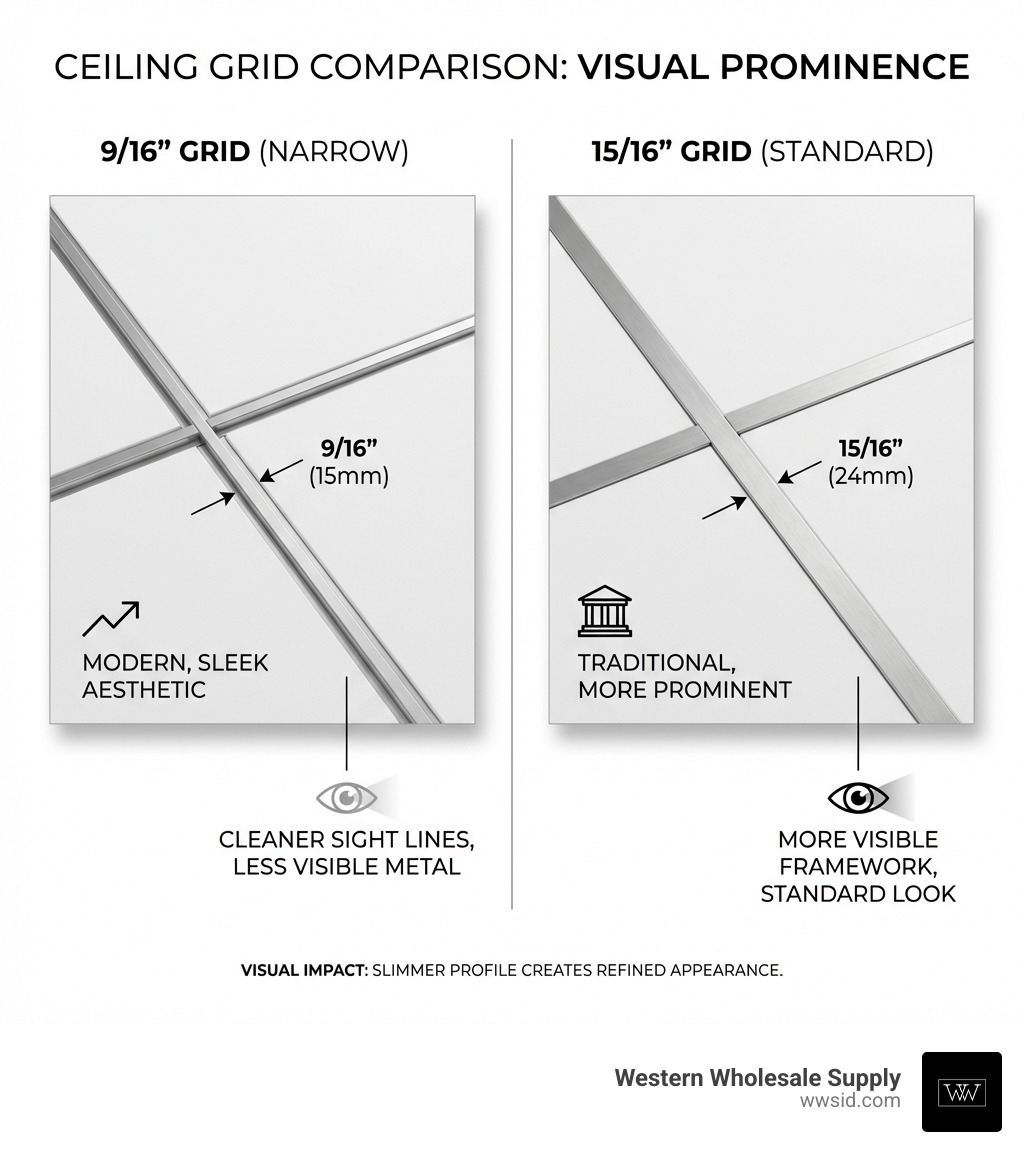
A 9/16 ceiling grid is a narrow suspension system for lay-in ceiling tiles, measuring approximately half the width of traditional 15/16″ grids. This slimmer profile creates a more refined, modern appearance in commercial and residential spaces while maintaining the practical benefits of a standard suspended ceiling system.
Quick Overview: 9/16″ vs. Standard Grid
| Feature | 9/16″ Grid | Standard 15/16″ Grid |
|---|---|---|
| Width | 9/16″ (15mm) | 15/16″ (24mm) |
| Visual Impact | Sleek, modern, less visible | Traditional, more prominent |
| Applications | Offices, retail, upscale commercial | General commercial, residential |
| Growing Trend | Yes, increasingly popular | Standard option |
The standard ceiling grid has been 15/16″ wide for decades – about the diameter of a quarter. But the narrower 9/16″ option is gaining serious traction. At nearly half the width of traditional systems, these grids minimize the visual interruption of the metal framework, letting your ceiling tiles take center stage.
Why the shift matters: Modern commercial design increasingly demands cleaner sight lines and less obtrusive infrastructure. A 9/16 ceiling grid delivers that monolithic, high-end look without sacrificing the easy access and flexibility that makes suspended ceilings so practical.
I’m Jake Bean, a professional at Western Wholesale Supply—an independent, veteran-owned, third-generation building materials business. We’ve helped countless contractors in Eastern Idaho and Western Wyoming steer the transition to modern 9/16 ceiling grid systems. Whether you’re upgrading an office lobby or finishing a retail space, understanding the differences between grid systems helps you deliver projects that meet both aesthetic and functional requirements.
The Anatomy of a 9/16″ Ceiling Grid System
At its core, a 9/16 ceiling grid system is an interconnected framework designed to hold acoustical ceiling tiles, but its precise engineering allows for a distinct aesthetic and robust performance. Understanding these parts is key to the “small grid, big impact” philosophy.
Materials and Construction
The strength of a 9/16 ceiling grid comes from high-quality materials that offer durability and environmental resistance.
- Hot-Dipped Galvanized Steel: This is the primary material, where steel is coated in molten zinc to inhibit red rust, ensuring longevity, especially in humid environments.
- Painted Galvanized Steel: Many grids feature a factory-applied paint finish for added corrosion resistance and custom color options to match interior designs.
- Aluminum: Sometimes used for specialized components, aluminum is lightweight and inherently corrosion-resistant, ideal for highly humid or corrosive areas.
- High Recycled Content (HRC): Many 9/16 ceiling grid products contain a high percentage of recycled content, contributing to sustainability goals and green building certifications like LEED.
- Specialized Clips: Specialized clips, like the CertainTeed Seismic Perimeter clips, ensure a strong, secure connection and fast, accurate alignment, simplifying installation for our contractors in Eastern Idaho and Western Wyoming.
These material choices ensure that a 9/16 ceiling grid is not just visually appealing but also a robust, long-lasting solution that meets stringent building codes.
Core Components Explained
Every 9/16 ceiling grid system is composed of interconnected parts, each playing a vital role.
- Main Beams (or Main Runners): As the primary load-bearing members, main beams are suspended by hanger wires and run the length of the room, providing the backbone for the grid.
- Cross Tees: These shorter members connect perpendicularly to main beams, forming the cells that hold the ceiling tiles. Their narrow face matches the main beams, and staked-on ends allow for a secure but easily removable connection.
- Wall Angle (or Wall Molding): This L-shaped molding is installed on the perimeter walls to support the grid ends, creating a clean, finished edge for the ceiling system.
- Hanger Wires: These galvanized steel wires suspend the entire grid from the overhead structure. Proper tensioning is critical for a level, stable, and safe ceiling.
- System Assembly: Installation involves setting the wall angle, suspending main beams, connecting cross tees, and laying in the tiles. This modular design allows easy plenum access. Tools like QUICKHANG Grid Hooks can simplify installation in low-headroom spaces like basements, requiring only a 2.5-inch drop from the joists.
Visual & Functional Advantages: Why Choose a 9/16″ Grid?
Choosing a 9/16 ceiling grid is a design decision that profoundly impacts a space’s aesthetic. The narrower profile offers a sophisticated, modern look, making it a popular choice for commercial and high-end residential projects across Eastern Idaho and Western Wyoming.
| Feature | 9/16″ Grid | 15/16″ Grid |
|---|---|---|
| Visual Impact | Sleek, minimalist, refined | Traditional, more pronounced grid lines |
| Aesthetic Style | Modern, contemporary, high-end | Conventional, utilitarian |
| Tile Appearance | Tiles appear more prominent, almost floating | Grid lines often define the tile pattern |
| Perceived Height | Can make ceilings feel taller due to less visual clutter | Grid can visually “lower” a ceiling |
| Design Integration | Blends seamlessly with modern architectural elements | Can sometimes feel separate from the overall design |
Creating a Sleek, Monolithic Look
The primary advantage of a 9/16 ceiling grid is its ability to create a sleek, virtually monolithic ceiling appearance. The narrow profile significantly minimizes the visual presence of the grid lines:
- Less Obtrusive Grid Lines: The thinner metal framework recedes, allowing the ceiling tiles themselves to become the dominant visual element.
- Improved Focus on Ceiling Tiles: When the grid is less noticeable, the texture, pattern, and color of your chosen ceiling tiles take center stage, allowing them to be a key design feature.
- Architectural Design Improvement: A 9/16 ceiling grid supports clean, contemporary, and minimalist designs by contributing to an uncluttered, seamless ceiling plane.
- Creating a High-End Feel: In lobbies, executive offices, and upscale retail, the subtle elegance of a 9/16 ceiling grid lifts the perceived quality and luxury of the environment.
Understanding how grid and tile edges interact is crucial for achieving that desired seamless and sophisticated finish, as the relationship between the tile profile and the narrow grid defines the final visual impact.
Applications and Compatible Components
The versatility and refined aesthetic of 9/16 ceiling grid systems make them suitable for a wide array of applications, offering both functional benefits and a modern visual appeal.
Common Applications
We see 9/16 ceiling grid systems specified for projects across Eastern Idaho and Western Wyoming in various sectors:
- Commercial Offices: Modernizing open-plan offices, conference rooms, and executive suites.
- Retail Showrooms: Creating a clean backdrop that highlights merchandise and improves the shopping experience.
- Restaurants and Hospitality: Adding to an upscale ambiance in dining areas, lobbies, and bars.
- Healthcare Facilities: Providing a clean look in waiting rooms and corridors while maintaining easy plenum access.
- Educational Buildings: Updating classrooms, libraries, and administrative spaces with a durable, aesthetic ceiling.
These systems are favored where design is paramount, but the practicality of a suspended ceiling-such as access to HVAC, electrical, and data lines-is still required. To see how these solutions can transform your projects, explore our range of services: Elevate Your Projects: Discover Western Wholesale Supply’s Acoustical Ceiling Solutions.
Compatible Ceiling Tiles
A 9/16 ceiling grid requires specific tile edge profiles to achieve the desired aesthetic and stability. Standard square lay-in tiles are not compatible.
- Tegular Edge Tiles: These tiles have a recessed edge that drops below the grid face, making the grid appear less prominent. Common styles include Reveal Edge, Flush Tegular, Square Tegular, and Beveled Tegular, each creating a different visual effect.
- Vector Edge Tiles: This is a specific type of tegular tile with a minimal reveal (often 1/4″ or 1/8″), creating a nearly seamless, butt-joint appearance.
- Tile and Grid Interaction: The precise interaction between the tile’s edge and the 9/16 ceiling grid is what creates the sophisticated, monolithic look. Always confirm that your chosen tiles are listed as compatible with 9/16 ceiling grid systems.
Key Features of Popular 9/16″ Ceiling Grid Systems
Manufacturers offer a variety of 9/16 ceiling grid systems with unique features to meet specific demands.
- Exposed Tee Systems: The most common type, where the slim 9/16″ grid is visible but minimized. These systems are widely specified for their durability and are often available with strengthening profiles and secure-connection clips that support faster, more accurate installation.
- Bolt-Slot Systems: These feature a narrow slot (commonly 1/8″ or 1/4″) for integrated lighting or partitions, supporting clean lines and a more architectural ceiling appearance.
- Dimensional Tee Profiles: These grids have a unique profile shape or texture, adding a subtle architectural detail to the ceiling.
- Integrated Lighting Capabilities: Many systems are designed to integrate lighting fixtures using slots or specialized clips for a clean, uninterrupted ceiling plane.
- Partition Attachment Slots: Some grids include slots or channels for the attachment of demountable partitions, offering greater spatial flexibility.
- Air Diffusers: Certain systems can incorporate discreetly integrated air diffusers that blend into the grid while efficiently distributing air.
These features ensure there’s a 9/16 ceiling grid system to meet your project’s needs. To compare options and build a complete package for your job (grid, compatible tiles, and accessories), start here: Explore our full range of acoustical ceilings.
Installation and Performance of a 9/16″ Ceiling Grid
While similar to standard grid installation, a 9/16 ceiling grid system requires precision to achieve its signature aesthetic and robust performance.
Installation involves setting the wall angle, suspending and leveling main beams, and clicking in cross tees. Leveling is critical, as the narrow grid highlights any imperfections. Professional installation is often recommended for a perfect finish.
Understanding Duty and Seismic Ratings for a 9/16″ ceiling grid
Beyond aesthetics, the structural performance of a 9/16 ceiling grid is critical, especially in areas like Idaho and Wyoming.
- Duty Ratings: These classifications indicate the grid’s load-bearing capacity. Intermediate-Duty is suitable for standard acoustical panels and light fixtures. Heavy-Duty is designed to support heavier loads like robust lighting, air diffusers, and other components in the plenum.
- Seismic Design Categories (C, D, E, F): In seismic zones, building codes mandate specific performance standards. These categories (C through F) dictate structural requirements for the grid. Many 9/16 ceiling grid systems are tested to meet these stringent codes, often verified by ICC-ES (International Code Council Evaluation Service) evaluation reports.
- Fire-Rated Assemblies: Many 9/16 ceiling grid systems can be part of fire-rated assemblies required in commercial buildings. Fire-rated components are tested to maintain structural integrity during a fire for a specified time, enhancing overall building safety.
Always consult manufacturer specifications and local building codes to ensure your chosen 9/16 ceiling grid meets all necessary duty, seismic, and fire-rated requirements.
Installation Tips and Material Estimation for a 9/16″ ceiling grid
Accurate planning and careful installation are key to a successful 9/16 ceiling grid project.
- Measure Twice, Cut Once: Precisely measure your ceiling area, accounting for any irregularities in the room.
- Planning for Obstacles: Identify and measure all obstacles like lights, sprinkler heads, and vents, as they will influence your grid layout.
- Following Manufacturer Instructions: Strictly follow the manufacturer’s installation guidelines to ensure proper performance, aesthetic integrity, and structural stability.
- Use Estimation Tools: To avoid material shortages or overages, use a reliable grid ceiling calculator to determine the quantities of main beams, cross tees, and wall molding needed. We recommend using the USG Ceiling Material Estimator available on our site.
- Attention to Detail: The narrow profile of a 9/16 ceiling grid makes imperfections more noticeable. Take your time, use precise tools, and ensure every component is properly seated and level.
If you are planning a project in Eastern Idaho or Western Wyoming and want help dialing in quantities or selecting the right duty rating for your application, our Western Wholesale Supply team in Idaho Falls and Pocatello can walk you through the specifics for your job.
Frequently Asked Questions about 9/16″ Ceiling Grids
We often get excellent questions from contractors and designers about 9/16 ceiling grid systems. Here are some of the most common ones we address:
Is a 9/16″ grid more expensive than a 15/16″ grid?
Generally, yes. However, while some specialized 9/16 ceiling grid systems are pricier, many standard options are not a significant premium over standard 15/16″ grids. Several factors influence the cost:
- System Type: A basic exposed tee 9/16″ grid can be very affordable, while complex bolt-slot systems are more expensive.
- Materials and Finishes: Custom colors or special materials can increase the cost.
- Volume and Supplier: Bulk pricing and your relationship with a supplier like Western Wholesale Supply can impact the final cost.
- Overall Project Budget: The aesthetic upgrade often justifies any marginal cost difference when considering the total project budget, including tiles and labor.
Can I use any ceiling tile with a 9/16″ grid?
No. This is a crucial point. A 9/16 ceiling grid system requires tiles with specific edge profiles to fit and perform correctly.
- Tegular and Reveal Edges Required: You must use tiles with a tegular or reveal edge. These are designed to drop below the grid face, making the grid less visible. Common types include square tegular, beveled tegular, flush tegular, and vector edge profiles (which create a very narrow reveal, sometimes as small as 1/8″ or 1/4″).
- Why Standard Lay-in Tiles Don’t Work: Standard square-edge lay-in tiles are made for wider 15/16″ grids. They will not sit properly, look right, or be structurally stable on a narrow 9/16 ceiling grid.
Always confirm that your chosen ceiling tiles are specifically compatible with a 9/16 ceiling grid system to ensure a proper fit and a stunning finished look.
Is installing a 9/16″ grid a good DIY project?
It depends on the project’s complexity and your skill level.
- Project Complexity: A simple, rectangular room with minimal obstacles may be manageable for an experienced DIYer. However, rooms with irregular shapes, numerous obstructions, or advanced features are best left to professionals.
- Required Tools: You’ll need specialized tools for cutting metal grid components, a good laser level, and an understanding of how to properly suspend and square the grid.
- Skill Level: Achieving the precise, high-end finish that a 9/16 ceiling grid is known for requires a high degree of precision. Any misalignment or unevenness will be more apparent with the narrow grid lines.
- When to Call a Professional: For commercial projects, large spaces, installations requiring specific seismic or fire ratings, or if you’re aiming for a truly seamless, architectural finish, we strongly recommend professional installation. Experienced contractors in Eastern Idaho and Western Wyoming have the tools and expertise to ensure a safe, efficient, and aesthetically perfect installation.
Conclusion: Achieve a Modern Look with a 9/16″ Grid
The 9/16 ceiling grid system is a superior choice for projects demanding a clean, modern aesthetic without compromising the practical benefits of a suspended ceiling. Its narrow profile minimizes visual clutter, creating a sophisticated, monolithic look that lifts any commercial or high-end residential space.
With robust construction, options for integrated lighting, and compliance with stringent seismic and fire-rated assemblies, these systems are designed not just for beauty, but for safety and longevity. We’ve seen their transformative impact in offices, retail showrooms, and even residential basements across Eastern Idaho and Western Wyoming.
At Western Wholesale Supply, we’re proud to be an independent, veteran-owned, third-generation family business. We are your trusted partner for quality building materials, backed by over 60 years of experience serving Eastern Idaho and Western Wyoming. Our team in Idaho Falls and Pocatello is here to help you select the perfect 9/16 ceiling grid system for your next project, ensuring reliable, on-time delivery and exceptional customer service.
Ready to bring a modern, high-impact aesthetic to your space? Explore our full range of acoustical ceilings or contact Western Wholesale Supply today to discuss your project and material needs.
