

Why Acoustic Control Matters in Modern Spaces
A sound absorbing ceiling is a specialized ceiling system designed to reduce noise levels and reverberation within a room by converting sound wave energy into heat through friction within porous materials. Here’s what you need to know:
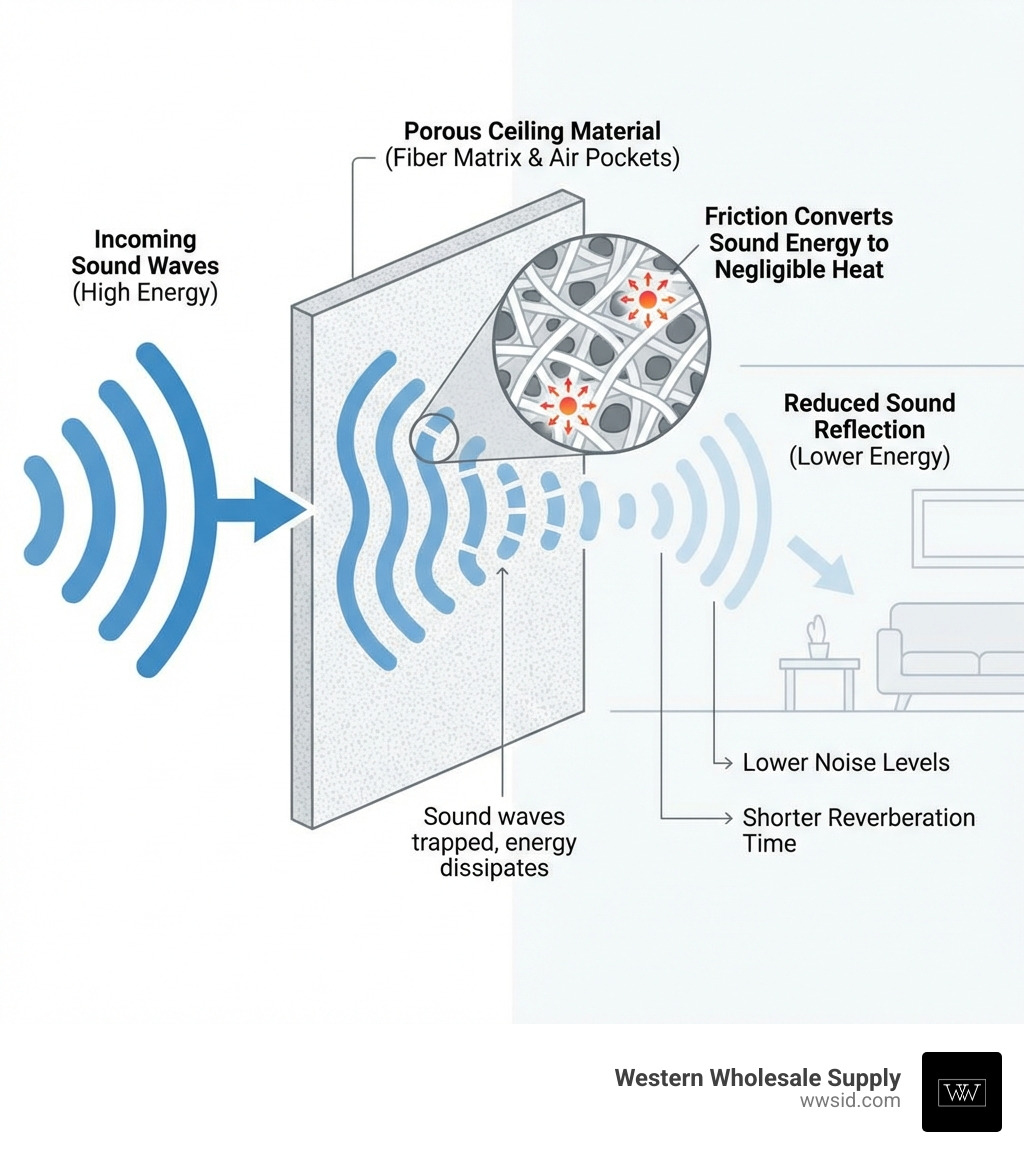
- How it works: Porous ceiling materials trap sound waves in their tiny air pockets, converting sound energy into negligible heat through friction
- What it does: Reduces echo, lowers background noise, and improves speech clarity within a room
- Not the same as soundproofing: Sound absorption controls noise inside a space; soundproofing blocks noise between spaces
- Key metric: Look for a Noise Reduction Coefficient (NRC) rating of 0.70 or higher for effective performance
- Common applications: Offices, schools, healthcare facilities, restaurants, and residential spaces
The numbers tell a sobering story. Noise pollution between 75 and 80 dB is common in many countries. More than half of office workers surveyed cite poor speech privacy as their top workplace complaint. In U.S. classrooms, speech intelligibility ratings average just 75% or less—meaning every fourth word spoken isn’t understood.
These aren’t just comfort issues. Excessive noise impedes concentration, slows healing in healthcare settings, and disrupts learning. The solution often lies overhead: a properly specified sound absorbing ceiling can transform a noisy, reverberant space into one that supports communication, focus, and wellbeing.
The science is straightforward. When sound waves hit a porous ceiling material, they enter tiny air pockets where friction converts the acoustic energy into heat—an insignificant amount, but enough to prevent the sound from bouncing back into the room. This reduces reverberation time, lowers ambient noise levels, and dramatically improves how clearly speech can be heard and understood.
I’m Jake Bean, a third-generation building materials professional who’s worked with contractors and builders across Idaho specifying everything from drywall to sound absorbing ceiling systems for commercial and residential projects. Over the years, I’ve seen how the right acoustic ceiling can turn a problematic space into a productive one.
Understanding Acoustic Fundamentals
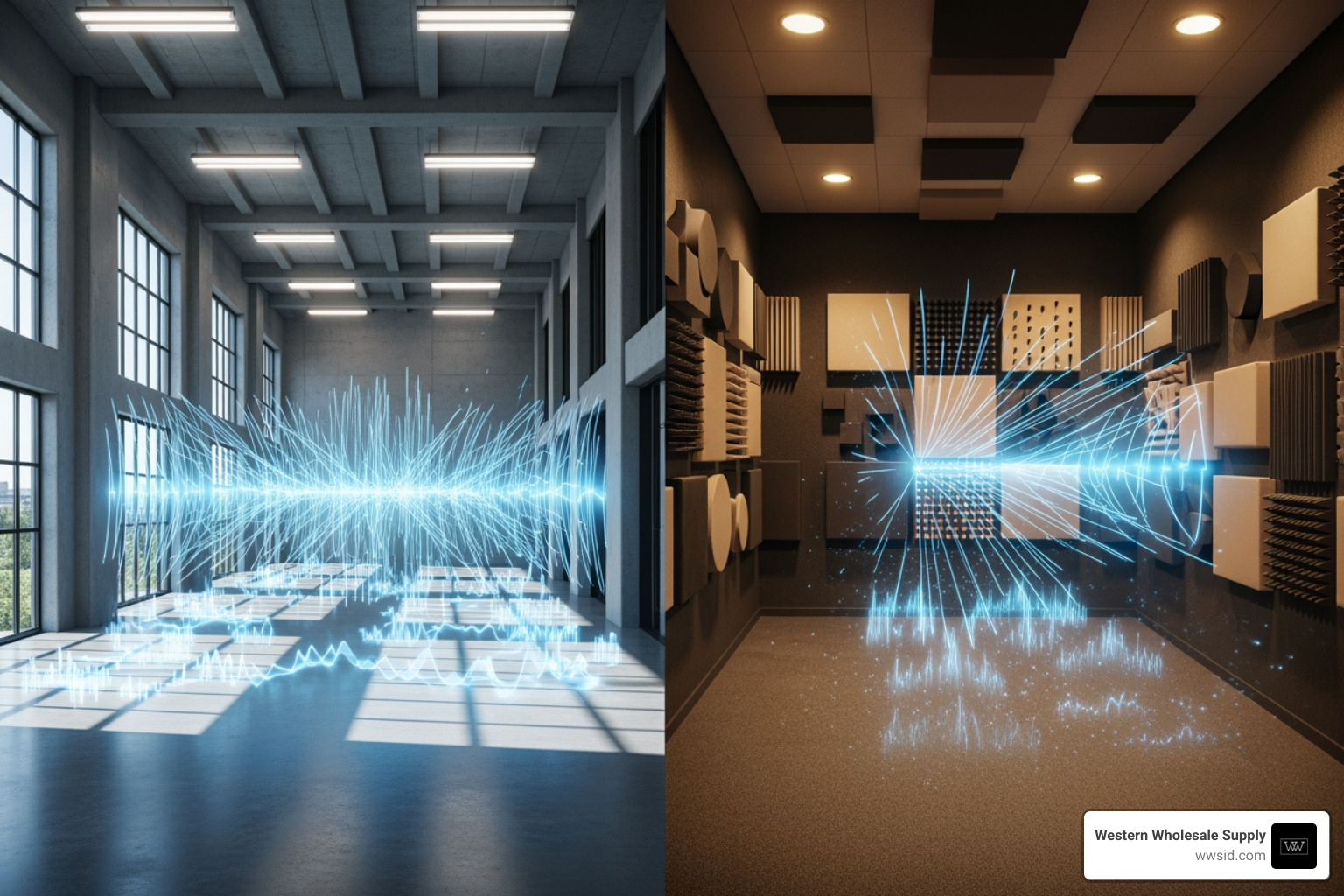
Imagine trying to have a conversation in an empty gymnasium. The sound bounces everywhere, making it hard to hear. Now picture that same conversation in a cozy, carpeted room. Much easier, right? That’s the power of acoustic control, and it starts with understanding the fundamentals.
What is Acoustic Absorption?
Acoustic absorption tames sound by preventing it from bouncing off hard surfaces. Instead of reflecting back into the room and creating echoes, sound waves are “trapped” and converted into heat.
Acoustic absorption happens when a sound wave enters a porous material. As the wave travels through the material’s tiny air pockets and fiber matrix, friction converts the acoustic energy into a negligible amount of heat. This means less sound reflects back, reducing overall noise and creating a calmer space. Effective sound-absorbing materials are therefore lightweight and porous, with an open structure.
How a sound absorbing ceiling reduces reverberation
One of the most significant impacts of a sound absorbing ceiling is its ability to reduce reverberation. But what exactly is reverberation?
Reverberation is the persistence of sound in a particular space after the original sound is produced. Think of it as a prolonged echo, where sound reflections blend together, making speech unclear and noise levels higher. It’s different from a distinct echo, which is a single, clear reflection of sound. When a room is described as “echoey,” it’s often actually reverberant or “lively.”
A key metric we use to quantify this is Reverberation Time (RT). RT is the time it takes for sound energy to decay to one-millionth of its original level (a drop of 60 dB) after the sound source stops. In simple terms, it’s how long sound lingers in a room.
For high speech intelligibility—meaning how well speech can be heard and understood—the RT should ideally be less than 0.60 seconds. In many U.S. classrooms, for example, high reverberation contributes to speech intelligibility ratings of 75% or less, meaning every fourth word is misunderstood. Our goal with a sound absorbing ceiling is to reduce this RT significantly.
The amount of reverberation in a room is influenced by its volume, shape, and the total amount of sound absorption present. Ceilings often present the largest continuous surface area in a room, making them an ideal location to introduce sound-absorbing materials. By installing a sound absorbing ceiling, we introduce a large, highly absorptive surface that effectively “soaks up” sound waves, dramatically shortening the RT and creating a much clearer, quieter acoustic environment.
Sound Absorption vs. Soundproofing and Attenuation
It’s easy to confuse acoustic absorption with soundproofing or sound attenuation, but they serve different purposes in acoustic design. Understanding the distinction is crucial for selecting the right solution for your project in Idaho or Wyoming.
Sound absorption primarily deals with noise within a room. As we discussed, it reduces reflections and reverberation, making the space quieter and improving speech clarity. Materials for high sound absorption are typically lightweight and porous, designed to convert sound energy into heat.
Soundproofing, on the other hand, is about preventing sound from traveling between spaces. If you’re trying to block the noise from a busy street outside or the sounds from an adjacent office, you’re looking for soundproofing. This usually involves adding mass and density to construction elements. For instance, using multiple layers of Drywall or specialized sound-blocking panels helps create a barrier that sound struggles to penetrate. Soundproofing materials are generally massive and impervious, the opposite of the porous materials used for absorption.
Sound attenuation is a term often used interchangeably with sound reduction, particularly in the context of suspended ceilings. It refers to the control of sound transmission between adjacent rooms, often via the plenum (the space above a suspended ceiling) or through the ceiling structure itself. So, while sound absorption controls reflections inside a room, sound attenuation controls sound transmission through or around the ceiling system to another space.
In essence:
- Absorption = controls sound inside the room (think soft, porous materials).
- Soundproofing/Blocking = controls sound between rooms (think heavy, dense barriers).
- Attenuation = controls sound transfer through the ceiling assembly to adjacent spaces.
For truly effective acoustic control, especially in commercial or multi-unit residential buildings across Idaho and Wyoming, a combination of these strategies is often necessary. We work to find the right balance for your specific needs.
How Sound Absorption is Measured
When we talk about the effectiveness of a sound absorbing ceiling, we rely on specific metrics and ratings. These help us quantify how well a material performs and ensure we’re choosing the right products for your project.
Key Acoustic Ratings: NRC, CAC, and Sabins
Three primary ratings help us understand a ceiling material’s acoustic performance:
- Noise Reduction Coefficient (NRC): This is the most common rating for sound absorption. The NRC is a single-number value that represents the average of a material’s sound absorption coefficients at four specific sound frequencies (250, 500, 1000, and 2000 Hz octave bands). Measured according to ASTM C423 standards, the NRC rating ranges from 0 (no absorption, like a concrete wall) to 1 (perfect absorption, where all sound hitting the surface is absorbed). A higher NRC means more sound is absorbed. For a highly effective sound absorbing ceiling, we typically look for an NRC of 0.70 or higher.
- Ceiling Attenuation Class (CAC): While NRC measures sound absorption within a room, CAC measures a ceiling’s ability to block sound from traveling between adjacent rooms through a shared plenum (the space above the ceiling). A higher CAC rating indicates better sound blocking performance, helping to maintain speech privacy and reduce noise transfer between spaces.
- Sabins: This unit is used to measure the sound absorption of discrete, non-continuous elements, such as acoustic baffles or islands. One Sabin is equivalent to one square foot of a perfectly absorptive surface. While NRC applies to large surfaces like a full ceiling, Sabins help us quantify the absorption added by individual acoustic elements that might be suspended below a structural ceiling.
Here’s a quick overview of these key metrics:
| Metric | What it Measures | Application | Ideal for |
|---|---|---|---|
| NRC | Sound absorption within a room | Large surfaces (ceilings, walls, carpets) | Reducing echo, lowering noise, improving speech clarity |
| CAC | Sound blocking between rooms via plenum | Suspended ceiling systems | Enhancing speech privacy, reducing noise transfer |
| Sabins | Sound absorption of discrete elements | Baffles, islands, acoustic panels | Targeted sound absorption, aesthetic flexibility |
Other Important Metrics
Beyond NRC, CAC, and Sabins, other metrics and guidelines contribute to comprehensive acoustic design:
- Articulation Class (AC): This rating is specifically important for open-plan environments. AC measures a ceiling’s ability to attenuate speech reflecting over partial-height cubicle walls, indicating its contribution to speech privacy. Measured according to ASTM E1110 and E1111 standards, a higher AC (e.g., 180 or higher) means better speech privacy. Importantly, NRC and AC are highly correlated, so a high NRC generally implies a good AC rating.
- Building Standards and Guidelines: Many modern building projects, from schools to healthcare facilities, must comply with stringent acoustic absorption criteria. Organizations like the Facilities Guidelines Institute (FGI) for healthcare and The WELL Building Standard for offices provide guidelines for acoustic performance to ensure occupant health and comfort. Similarly, the Collaborative for High Performance Schools (CHPS) emphasizes the importance of good acoustics for student learning outcomes. We stay up-to-date on these standards to help you meet compliance in your Idaho or Wyoming projects.
Understanding these metrics allows us to precisely tailor our acoustic solutions. For more in-depth information, explore our Acoustic design resources.
Benefits of a Sound Absorbing Ceiling for Wellbeing and Productivity
It’s not just about making a room sound better; it’s about making the people in that room feel better and perform better. A sound absorbing ceiling is an investment in human wellbeing and productivity, creating environments where people can thrive.

Enhancing Human Wellbeing and Comfort
Imagine a peaceful waiting room, a quiet hospital corridor, or a serene home environment. This is the comfort a sound absorbing ceiling can bring.
- Reduced Stress: Constant exposure to unwanted noise, or noise pollution (which can regularly reach between 75 and 80 dB in many countries), contributes significantly to stress, fatigue, and even adverse health effects. By absorbing sound, our acoustic ceilings create a calmer atmosphere, reducing the cognitive load and promoting relaxation.
- Improved Healing Environments: In healthcare settings, a quiet environment is critical for patient recovery. Acoustic ceilings contribute to improved comfort, safety, and healing by reducing disruptive noise from footsteps, medical equipment, and conversations.
- Quieter Residential Spaces: Whether it’s a basement conversion in Idaho Falls or a new home in Western Wyoming, a sound absorbing ceiling can transform a noisy space into a peaceful retreat, protecting against sound transfer from above or below.
By managing noise, we improve the overall quality of life within a space. That’s why we at Western Wholesale Supply are passionate about providing effective Acoustical Ceilings for our communities.
Boosting Productivity and Concentration
Noise is a notorious enemy of focus. In today’s world, distractions are everywhere, and sound is one of the most impactful, even if not the first consideration.
- Fewer Distractions: Unwanted noise, whether it’s chatter in an open office or the rumble of traffic, fragments attention and makes it harder to concentrate. Acoustic ceilings reduce these distractions, allowing individuals to focus more effectively on their tasks.
- Improved Focus in Offices: More than half of office workers report dissatisfaction with speech privacy, making it the leading complaint in offices everywhere. This lack of privacy and constant background chatter severely impacts concentration. A sound absorbing ceiling helps reduce ambient noise and improve speech privacy, fostering an environment conducive to deep work and collaboration.
- Better Learning in Schools: We believe every child in Idaho and Wyoming deserves the best learning environment. Yet, classrooms often struggle with poor acoustics, leading to speech intelligibility ratings of 75% or less. When every fourth word isn’t understood, learning suffers. Acoustic ceilings improve speech intelligibility, ensuring students can clearly hear and comprehend their teachers, leading to better academic outcomes.
Improving Speech Intelligibility
Clear communication is the bedrock of effective collaboration, learning, and service. Long reverberation times and high background noise are major culprits in poor speech intelligibility.
A sound absorbing ceiling directly addresses this by reducing reflections and lowering the overall noise level. This allows spoken words to be heard more clearly, without being muddled by echoes or competing sounds.
- Clarity of Communication: In conference rooms, lecture halls, and customer service areas, clear communication is paramount. Acoustic ceilings ensure that every word spoken is crisp and understood, preventing misunderstandings and increasing efficiency.
- Reducing Background Noise: When the amount of effective sound absorption in a room is doubled, the noise level will be reduced by 3dB. While a 3dB change is barely detectable by the human ear, a difference of 5dB is noticeable. By significantly increasing sound absorption, we can achieve noticeable reductions in background noise, making conversations easier and less tiring.
Our acoustic ceiling solutions help create environments where everyone can hear and be heard, fostering better interactions and a more pleasant experience for all.
Choosing and Installing Your Acoustic Ceiling
Selecting and installing the right sound absorbing ceiling involves considering various factors, from acoustic performance to aesthetics and practical installation. With over 60 years of experience serving Eastern Idaho and Western Wyoming, we are here to guide you through the process.
Factors for Selecting the right sound absorbing ceiling tile
When choosing a sound absorbing ceiling tile, several elements come into play to ensure you get the perfect solution for your space:
- NRC Rating Selection: This is often the first consideration. As experts, we recommend prioritizing high NRC ratings. Sacrificing high NRC for other attributes can do more harm than good, as low-performing panels (below 0.70 NRC) often fail to meet modern building standards or user expectations. We categorize NRC levels:
- Best: NRC 0.90 – For high-noise, high-sensitivity areas (e.g., open offices, call centers, music rooms).
- Better: NRC 0.80 – For moderate noise, moderate-sensitivity areas (e.g., general offices, classrooms).
- Good: NRC 0.70 – For low-sensitivity areas where some noise reduction is beneficial (e.g., lobbies, retail spaces).
- Material Types: Acoustic ceiling tiles come in a variety of materials, each with unique properties:
- Mineral Fiber: A common and versatile option, offering good absorption and durability.
- Stone Wool: Known for excellent acoustic properties, fire resistance, and humidity resistance.
- Wood/Wood Wool: Provides natural aesthetics and good sound absorption, often used for design-focused spaces.
- Recycled Materials/Felt: Increasingly popular for their sustainable benefits and diverse design options.
- Design and Aesthetics: A sound absorbing ceiling does not have to be purely functional. Many options offer beautiful designs, textures, and colors that can improve the overall aesthetics of a room. We can help you find solutions that blend seamlessly with your interior design, even offering bespoke acoustic pieces.
- Fire Rating: Safety is paramount. Ensure your chosen acoustic ceiling tiles meet local fire safety regulations.
- Humidity Resistance: In areas with high humidity (like bathrooms or kitchens), selecting tiles with good humidity resistance is crucial to prevent sagging and maintain performance.
Here is a general guide for best ceiling types in different spaces:
- Offices (Open Plan, Conference Rooms): High NRC (0.80-0.90) mineral fiber or stone wool tiles. Consider options with high CAC for speech privacy.
- Schools (Classrooms, Libraries, Cafeterias): Durable, high NRC (0.70-0.80) tiles. Easy-to-clean and impact-resistant options are beneficial.
- Healthcare (Patient Rooms, Waiting Areas): High NRC (0.70-0.90) tiles with superior hygiene properties (cleanable, mold/mildew resistant) and good light reflectance.
Comparing Ceiling Tiles, Baffles, and Islands
While a full sound absorbing ceiling of tiles is a highly effective solution, other acoustic elements like baffles and islands can also play a crucial role, especially in modern designs or spaces with specific needs.
- Wall-to-Wall Suspended Ceilings: These are the most common and comprehensive solution, covering the entire ceiling area. They offer maximum sound absorption and can also contribute to sound attenuation between spaces. This is a go-to for general noise control and reverberation reduction.
- Acoustic Baffles and Islands: These are discrete acoustic elements suspended vertically (baffles) or horizontally (islands) from the structural ceiling. They are often chosen for aesthetic reasons, to maintain an exposed ceiling aesthetic (like exposed concrete slabs for thermal mass), or when a full suspended ceiling is not feasible due to existing ductwork or lighting.
- Aesthetic Considerations: Baffles and islands offer design flexibility, allowing for creative patterns, colors, and shapes.
- Absorption Efficiency: Baffles and islands can achieve the same amount of acoustic absorption as a full suspended ceiling using only 50% to 75% of the room’s area. This is because sound can reach all sides of these elements, increasing their absorptive surface.
- Open Plenums: They are excellent for spaces with open plenums (the open area above the ceiling) where a continuous ceiling might interfere with airflow or building systems.
The choice between a full tiled ceiling and baffles/islands often comes down to a balance of acoustic requirements, aesthetic preferences, and coordination with other building systems. For more detailed information on selecting the right solution for your project, explore More info about our acoustical ceiling solutions.
The Role of Insulation and Installation
Achieving optimal acoustic performance often involves more than just the visible ceiling tiles. The right acoustic ceiling insulation and proper installation techniques are equally vital.
- Acoustic Ceiling Insulation: While acoustic ceiling tiles provide surface absorption, adding insulation above them, or within ceiling joists, significantly improves overall sound control. Products like stone wool insulation can boost both sound absorption and sound blocking, especially when dealing with noise transfer from above or below. We offer a wide range of Acoustic Ceiling Insulation products that perform well acoustically, also offering thermal benefits and fire protection. For instance, using thicker, higher-density acoustic insulation in ceiling cavities is highly effective.
- Installation Considerations:
- Drop Ceiling Grid Systems: This is the most common installation method for acoustic ceiling tiles. It involves installing wall molding, attaching hanger wires, setting up main beams and cross tees, and then simply dropping the tiles into the grid. It allows for easy access to the plenum above for maintenance of utilities.
- Surface Mount Options: For certain applications, tiles can be attached directly to the deck above using adhesive or specialized installation systems.
- Sealing Perimeters: A critical step in acoustic installation is sealing all gaps and perimeters with acoustic sealant. This prevents sound flanking paths where noise can move around the acoustic treatment, compromising its effectiveness.
- Decoupling: For soundproofing applications, decoupling (isolating the new ceiling from the existing structure using sound isolation clips) is crucial to reduce vibration transfer.
Whether you are planning a large commercial project or a residential renovation in Idaho or Wyoming, our team can help you estimate your material needs precisely. Use our USG Ceiling Material Estimator to get started.
Frequently Asked Questions about Acoustic Ceilings
We often hear similar questions from our customers in Idaho and Wyoming when they’re considering acoustic solutions. Here are some of the most common ones, answered by our experts.
What is the difference between sound absorption and soundproofing?
This is a key distinction! Sound absorption is about controlling sound within a space. Think of it like a sponge soaking up water; a sound absorbing ceiling soaks up sound waves, reducing echoes and reverberation. This makes the room quieter and improves speech clarity. It uses porous, lightweight materials.
Soundproofing, on the other hand, is about stopping sound from traveling between spaces. If you want to block noise from an upstairs neighbor or an adjacent room, you need soundproofing. This relies on adding mass and density to construction elements to create a barrier that sound struggles to penetrate.
So, while both deal with noise, absorption improves the sound quality inside a room, and soundproofing prevents sound from entering or leaving a room. They are two different strategies, often used in combination for comprehensive acoustic control.
Can I paint acoustic ceiling tiles?
Technically, yes, you can paint acoustic ceiling tiles, but we generally advise against it, or at least to proceed with caution. The effectiveness of a sound absorbing ceiling comes from the porous nature of its materials. When you paint these tiles, especially with thick paint, you risk clogging these tiny pores. This can significantly reduce the tile’s Noise Reduction Coefficient (NRC) performance, making it less effective at absorbing sound.
Furthermore, repainting can affect other technical performance factors and will often invalidate the manufacturer’s warranty. If a color change is desired, it’s usually best to select tiles that come in the desired color or explore acoustic products designed to be painted without compromising performance. Always check with the manufacturer’s guidelines before painting.
How much do acoustic ceiling tiles cost?
The cost of sound absorbing ceiling tiles can vary quite a bit, depending on several factors like the material, the NRC rating, the design, and the brand. Just like cars, there’s a wide range!
Based on our experience and industry data, Armstrong acoustic ceiling tiles, for example, can cost anywhere from approximately $0.97 per square foot for basic options to over $13.09 per square foot for high-performance, specialized, or designer tiles. Other product listings show prices ranging from $2 to $12 per square foot, with some premium options exceeding this.
Factors that drive up the cost include:
- Higher NRC ratings: More effective sound absorption often means more specialized materials and manufacturing.
- Premium materials: Stone wool, wood, or designer felt options typically cost more than standard mineral fiber.
- Special features: Tiles with improved humidity resistance, fire ratings, specific hygiene properties (for healthcare), or unique aesthetic designs will be at the higher end of the spectrum.
While it might seem like an upfront investment, a high-performing sound absorbing ceiling can significantly improve wellbeing, productivity, and overall comfort, often outweighing the initial cost through long-term benefits.
Conclusion
In a world filled with constant noise, creating quieter, more acoustically balanced environments is no longer a luxury – it is a necessity. A properly designed sound absorbing ceiling is the secret weapon against unwanted noise, changing spaces into havens of calm and productivity. From reducing stress and enhancing wellbeing to boosting concentration and improving communication, the benefits are profound and far-reaching.
For over 60 years, Western Wholesale Supply has been a trusted, independent, and veteran-owned, third-generation family business, proudly supplying quality building materials across Eastern Idaho and Western Wyoming. Our commitment to reliable, on-time delivery and exceptional customer service, backed by decades of expertise, means you can trust us to help you find the perfect acoustic solutions for your next project. We understand the unique needs of our communities in places like Idaho Falls, Pocatello, and throughout Eastern Idaho and Western Wyoming, and we are dedicated to helping you create better, quieter spaces.
Ready to invest in a better environment for your home, office, school, or healthcare facility? Let us help you Find the right acoustic products for your project and experience the transformative power of a sound absorbing ceiling.
