

The Primary Benefits of Using Quick Set Joint Compound
At Western Wholesale Supply, we’ve seen how the right materials transform a job site from a stressful race against the clock into a streamlined operation. The primary reason professionals reach for quick set joint compound—often referred to as “hot mud”—is the control it offers over the construction schedule.
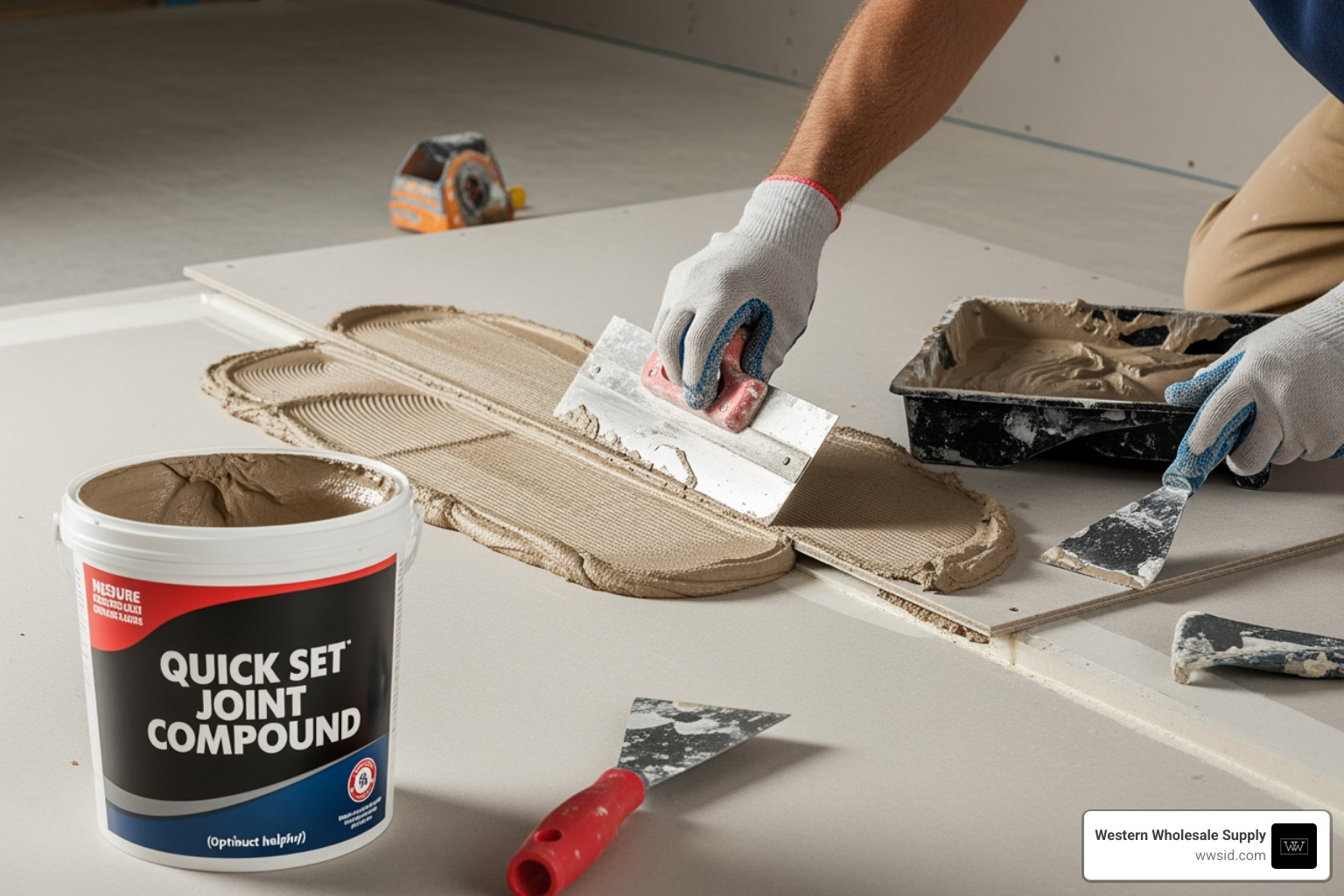
Unlike ready-mix compounds that rely on the air to evaporated moisture, setting compounds harden through a chemical reaction. This leads to several distinct advantages:
- Minimal Shrinkage: Because it doesn’t lose volume through evaporation in the same way ready-mix does, it is the superior choice for “heavy fills.” If you have a wide gap or a deep bead to fill, this compound stays put without cratering.
- Humidity Resistance: In our neck of the woods—from the humid summer mornings in Jackson, WY, to the damp winters in Idaho Falls—drying times for standard mud can be unpredictable. Quick set joint compound is virtually unaffected by humidity once the chemical “snapset” begins.
- Superior Joint Strength: These compounds provide an exceptional bond, making them ideal for embedding tape and reinforcing the structural integrity of the wall.
- Mold Resistance: Products like ProForm Quick Set Lite Setting Compound are specifically formulated to resist mold growth. They often achieve the highest possible scores (10 on ASTM D3273 and 0 on ASTM G21), which is a massive benefit for basement or bathroom applications.
- Weight Reduction: Modern “Lite” versions are roughly 30% lighter than conventional setting compounds. This means less fatigue for the finisher and easier sanding once the product has dried.
By using these materials, you can often apply two or even three coats in a single day. As soon as the first coat hardens—even if it still feels damp to the touch—you can “knock down” any high spots and immediately apply the next layer. Check out more info about joint treatments to see how these fit into your overall finishing strategy.
Choosing the Right Setting Time for Your Project
One of the most common questions we get at our counters in Rexburg or Twin Falls is: “Which bag should I grab?” The number on the bag (5, 20, 45, 90, or 210) represents the approximate time in minutes the product remains workable.
Choosing the right one is a balance between the size of the project and your own speed.
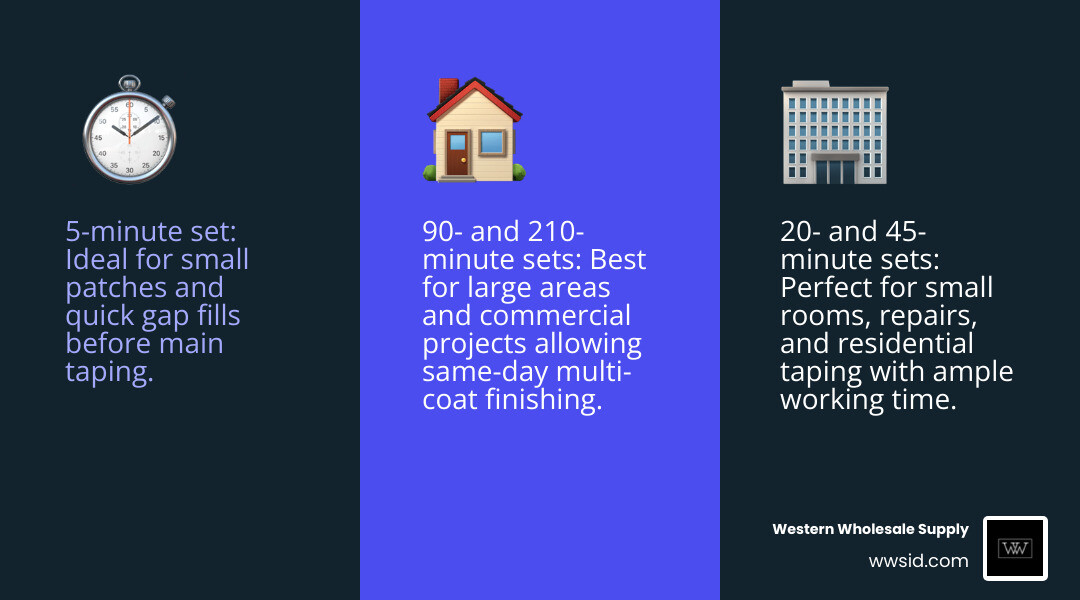
- 5-Minute: Best for very small patches or “filling the gaps” before you start your main taping run. You have to move fast!
- 20-Minute: Great for small rooms or single-wall repairs. It’s the “gold standard” for quick maintenance work.
- 45-Minute: The sweet spot for many professional residential hangers. It gives you enough time to walk a room and bed your tape without the mud hardening in the pan.
- 90-Minute: Ideal for larger areas or for those who prefer a more relaxed pace. It still allows for same-day finishing but offers a generous window for adjustments.
- 210-Minute: Used for massive commercial runs where a large batch is mixed at once to cover significant square footage.
For a deeper dive into the technical specs of these varieties, you can review the Setting Compound Literature and Specs.
Understanding Working Time vs. Setting Time for Quick Set Joint Compound
There is a critical distinction between these two terms that every finisher must master.
Working Time is the period during which the compound is creamy, spreadable, and usable. Thanks to features like “snapset,” high-quality compounds stay consistent for almost the entire duration listed on the bag rather than getting progressively stiffer.
Setting Time is the point at which the compound has chemically hardened. At this stage, it is no longer workable, but it has gained enough structural strength to support the next coat. You don’t necessarily need the wall to be “bone dry” to recoat; you just need it to be “set.”
Selecting Compounds for Specific Substrates
Not all walls are created equal. While quick set joint compound is designed for standard gypsum board, it is also incredibly versatile for specialty substrates. If you are installing high-performance acoustic walls using Quietrock EZ Snap, a setting compound ensures the joints are as dense and strong as the board itself.
We also recommend these compounds for:
- Interior Concrete: Filling voids or cracks in above-grade interior concrete.
- Exterior Soffits: Finishing joints on exterior soffit boards in sheltered areas.
- Laminating: Bonding gypsum panels to other panels or sound-deadening boards.
Explore our full product range to find the right board-and-mud combination for your specific Idaho or Wyoming climate.
Master the Mix: Preparation and Consistency
Mixing is where the magic (or the mess) happens. Because quick set joint compound is a chemical product, the way you mix it directly impacts how it performs on the wall.
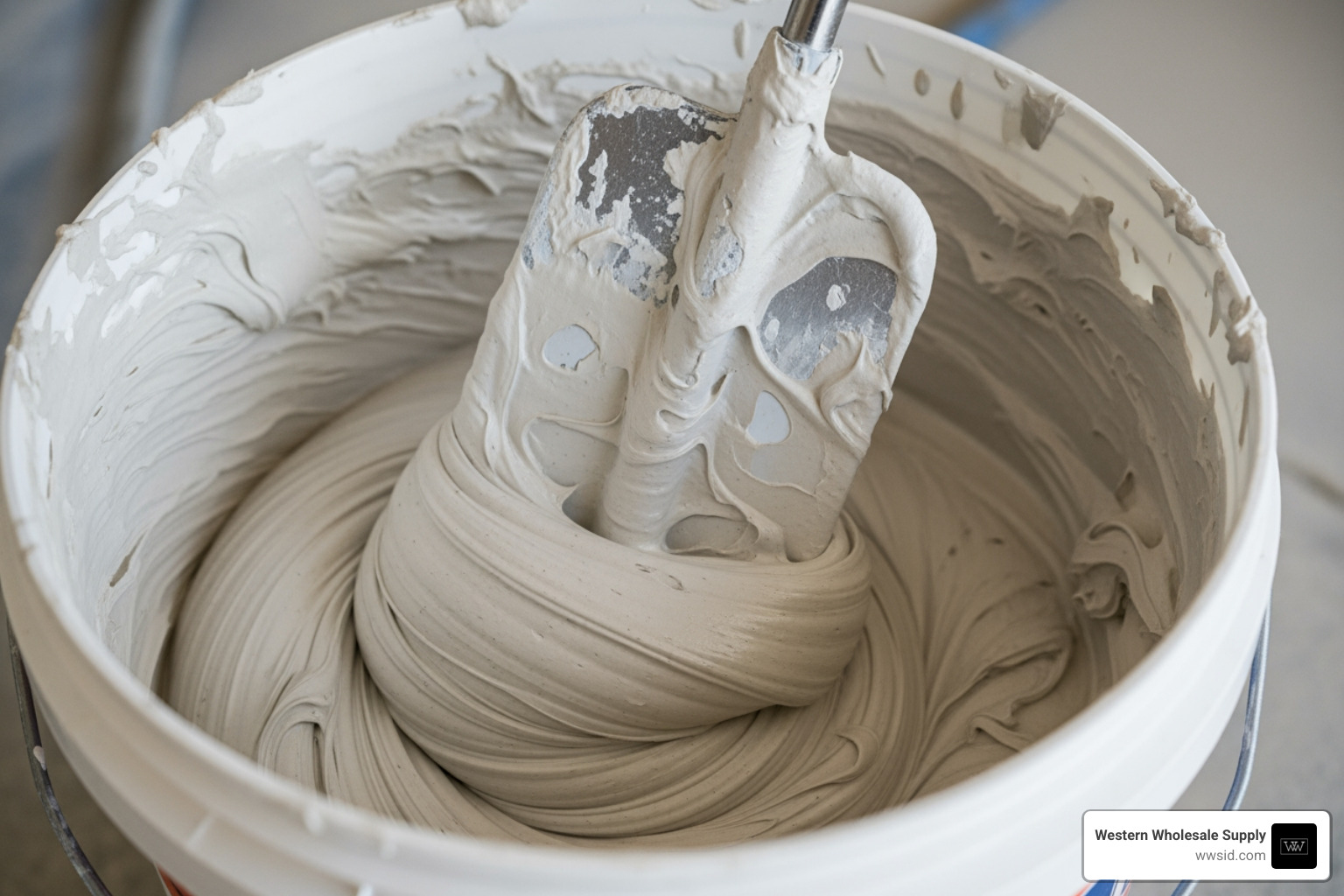
The standard mixing ratio for an 18-lb bag is approximately 11 to 12 pints (5.2 to 5.7 liters) of clean, drinkable water. Your goal is a smooth, creamy consistency—think thick cake frosting or sour cream.
For more technical guidance on material prep, you can view our resources.
Pro-Tips for Mixing Quick Set Joint Compound
- Water First, Then Powder: Always add the compound to the water, never the other way around. Adding water to a pile of powder is a one-way ticket to “Lump City.”
- The One-Minute Soak: After your initial stir, let the mixture sit (or “slake”) for about one minute. This allows the water to fully penetrate the powder particles. Then, give it a final remix.
- Temperature Matters: Use room-temperature water. Hot water will drastically accelerate the chemical reaction, causing the mud to “flash set” in your bucket. Cold water can delay the set time, which might throw off your schedule.
- Avoid Overmixing: Mechanical mixing is efficient, but don’t overdo it. Excessive or high-speed stirring can shorten your working time.
- Cleanliness is Godliness: This is the most important rule. Any dried bits of “hot mud” from a previous batch will act as a catalyst, causing your new batch to set almost instantly. Always use a clean bucket and clean tools.
Troubleshooting and Best Practices for Application
Even the pros run into hiccups occasionally. If your quick set joint compound isn’t behaving, it’s usually due to an environmental factor or a mixing error.
- Flash Setting: If the mud hardens in 10 minutes when the bag says 45, check your tools. Dirty water or leftover residue in the bucket are the usual suspects.
- Weak Bond: This usually happens if the mixture was too watery or if foreign materials (like soap or dust) were introduced.
- Sanding Difficulties: Setting compounds are much harder than ready-mix. If you wait too long to sand, you’ll be working twice as hard. We recommend “wet sanding” with a damp sponge or “knifing” off high spots while the mud is still relatively fresh.
For more hands-on help with your specific job site challenges, learn more about our services.
Application Techniques for Professional Results
To get that Level 5 finish our clients in Jackson and Sun Valley expect, follow these best practices:
- Taping: Use the compound to bed your tape and immediately apply a thin “skim” over the top. The high bond strength ensures the tape won’t peel or bubble.
- Prefilling: If you have gaps wider than 1/8 inch, prefill them with a 20-minute compound and let it harden before you start your main taping.
- Ventilation: Even though it sets chemically, you still need air circulation to remove the remaining moisture. Ensure the room is at least 50°F (10°C) and has steady ventilation.
- Priming: Because setting compounds have different absorption rates than the paper on the drywall, always use a high-quality primer-sealer before painting to avoid “flashing” (where the joints are visible through the paint).
Frequently Asked Questions about Setting Compounds
Why is my compound setting faster than the bag says?
The most common reason is contamination. If there is even a tiny amount of old, hardened compound in your bucket or on your mixer, it triggers the chemical reaction in the new batch prematurely. Other factors include using hot water or over-mixing with a high-speed drill.
Can I use quick set compound in humid environments?
Absolutely. In fact, that is one of its best uses. Because it hardens via hydration (a chemical bond with water) rather than evaporation, it will get hard even in a damp basement or during a rainy Idaho spring. It is the reliable choice when standard mud just won’t dry.
Why is the mixture lumpy after I stirred it?
Lumps usually happen if you poured the water into the powder. This creates dry pockets that are hard to break up. Always start with water in the bucket, sift the powder in gradually, and never skip the “one-minute soak” before your final stir.
Conclusion
Mastering quick set joint compound is a rite of passage for any serious drywaller. It allows you to work faster, fill deeper, and ignore the humidity levels that slow everyone else down. Whether you’re patching a small hole in a Rexburg rental or finishing a high-end commercial space in Jackson, these products are your best friend for a professional finish.
At Western Wholesale Supply, we’ve been supporting the builders of Eastern Idaho and Western Wyoming since 1963. As a veteran-owned, third-generation family business, we pride ourselves on more than just our inventory. We provide the expertise and reliable, on-time delivery you need to keep your project moving.
Ready to gear up for your next drywall project? Contact our expert team today at one of our locations in Idaho Falls, Pocatello, or Twin Falls. We’ll make sure you have the right compound, the right tools, and the 60 years of experience standing behind you.
