

Why Choosing the Right Commercial Construction Fasteners Makes or Breaks Your Project
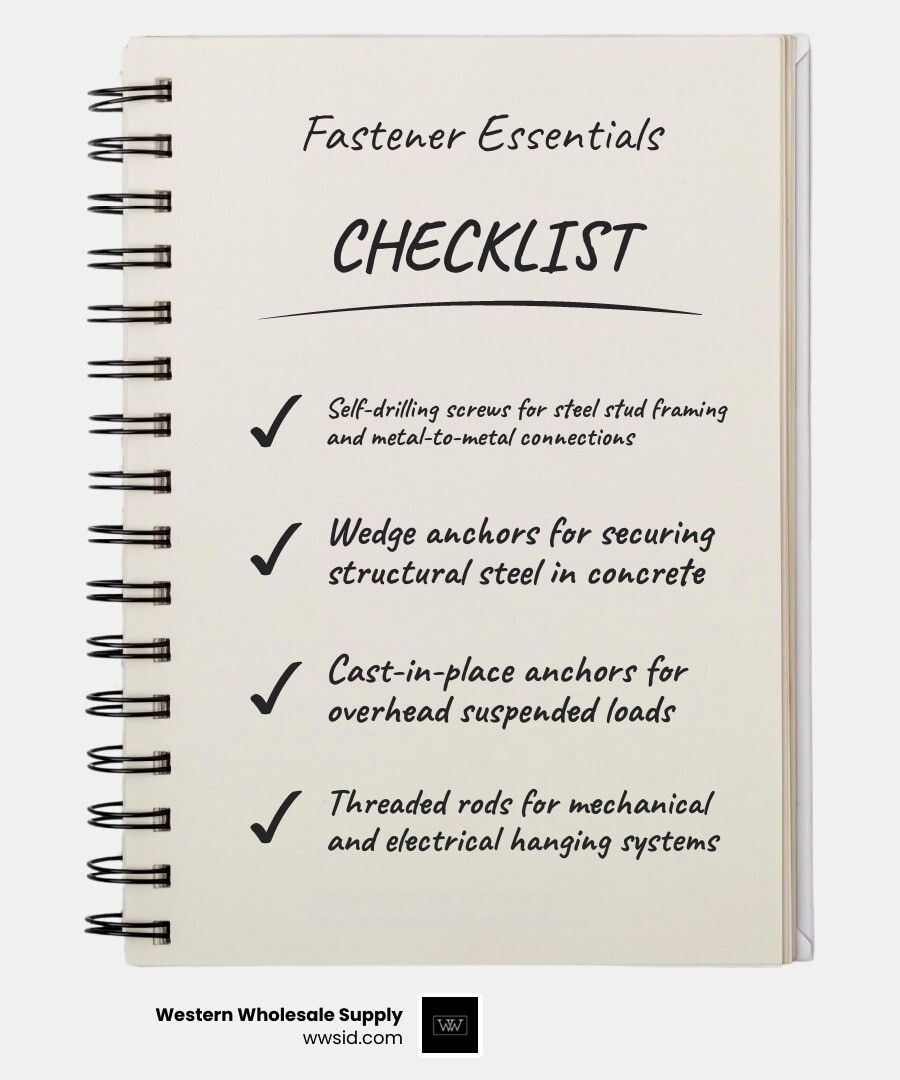
Commercial construction fasteners are the backbone of every structural connection on a jobsite — from steel framing and Quietrock EZ Snap drywall to concrete anchors and CertainTeed suspended ceilings. Here is a quick overview of the most common types and where they are used:
| Fastener Type | Common Applications |
|---|---|
| Self-drilling screws | Steel stud framing, metal-to-metal connections |
| Self-piercing screws | Thin metal framing under .050 inches thick |
| Wedge anchors | Structural steel, rails, and equipment in concrete |
| Cast-in-place anchors | Overhead and suspended loads in concrete |
| Threaded rods | Hanging systems, mechanical and electrical support |
| Drive pins | Joining concrete and structural steel |
| Wood screws / lag screws | Timber and wood-to-wood connections |
Getting the wrong fastener means callbacks, failed inspections, and costly rework. Getting the right one means faster installs, code compliance, and a structure that holds.
At Western Wholesale Supply, we are third-generation building materials professionals serving commercial contractors across Idaho and Wyoming — and commercial construction fasteners are one of the most detail-sensitive product categories we work with every day. In this guide, we’ll walk you through exactly what to look for so you can order with confidence.
Selecting the Right Commercial Construction Fasteners for Your Project
When we talk to contractors from Idaho Falls to Jackson, the first question isn’t usually “what’s the cheapest screw?” but rather “what does the spec call for?” In commercial work, the specifications drive everything. Whether you are hanging CertainTeed acoustical ceilings or framing out a massive warehouse with heavy-gauge steel, the load-bearing requirements and shear strength of your commercial construction fasteners are non-negotiable. For insulation projects, using the correct fasteners is vital to maximize thermal benefits in warehouse environments and ensure long-term energy efficiency.

Project specifications often dictate the exact type of fastener based on the substrate. For example, are you attaching metal lath to 33-68 mil steel studs? Or are you securing a heavy HVAC unit to a concrete slab? Each scenario requires a specific engineered solution.
High-Performance Screws and Bolts as Commercial Construction Fasteners
In metal framing, high-quality self-drilling screws are a go-to for speed and reliable holding power. Product lines from trusted suppliers like Brighton Best and Grabber help crews drill, tap, and fasten in one step, which cuts labor time and keeps installation moving. These are purpose-built commercial fasteners, not basic hardware store screws, and they are designed for consistent performance in demanding jobsite conditions.
For those of us working in the high-desert climate of Southeast Idaho or the snowy peaks of Western Wyoming, speed and reliability matter. When you’re up on a lift in November, you want a screw that bites immediately.
Key varieties include:
- Self-Drilling Screws: Ideal for thicker gauges of metal where pre-drilling would be too time-consuming.
- Fine-Thread Screws: Often used in metal-to-metal framing to provide a tighter grip in steel studs.
- Modified-Truss Head: These have a wider head surface, which is perfect for attaching metal lath or other thin materials without the head “pulling through.” Brands like Grabber offer specialized #8 x 3 in. modified-truss screws specifically for these 33-68 mil applications.
You can Explore professional-grade screws and anchors to find the exact match for your gauge of steel. Using a screw meant for wood in a steel application is a recipe for a structural failure—and a very unhappy building inspector.
Material Selection and Corrosion Resistance
Why does it matter if a fastener is zinc-plated or stainless steel? In our neck of the woods, the environment is a major factor. While Idaho is generally dry, we deal with significant road salt, snow melt, and varying humidity levels in commercial kitchens or wash-down areas.
Here is a breakdown of the materials you’ll encounter:
- Carbon Steel with Zinc Plating: This is the “standard” for interior commercial construction. It offers decent corrosion resistance for dry environments but shouldn’t be used where it will be exposed to the elements or high moisture.
- Stainless Steel (304 or 316): The gold standard for corrosion resistance. If you are building a food processing plant in Twin Falls or a high-end resort in Jackson Hole with exposed exterior fasteners, stainless is the way to go.
- Hot-Dip Galvanized: These have a thick, dull coating of zinc. They are excellent for exterior wood-to-wood connections, especially with pressure-treated lumber, which can be chemically aggressive toward standard steel.
- Silicon-Bronze: Less common in general commercial work but vital for specific architectural applications or marine-adjacent environments due to its incredible resistance to salt.
Choosing the right material ensures the longevity of the structure.
Specialized Fastening Systems for Steel and Concrete
Not all metal is created equal, and neither are the screws that go into them. One of the most common mistakes we see is using a self-drilling screw when a self-piercing screw is required—or vice versa.
| Feature | Self-Drilling Screws | Self-Piercing Screws |
|---|---|---|
| Point Type | Drill-bit shaped tip | Needle-sharp point |
| Material Thickness | Heavy gauge steel | Thin metal (<.050 inches) |
| Primary Use | Structural framing, decking | Light-duty framing, metal lath |
| Pre-drilling | Never required | Never required |
If you are working with 33-68 mil (20-14 gauge) steel studs, you need a screw with precision thread geometry. Grabber’s fine-thread self-drillers are designed specifically for this. They provide a smooth start and controlled torque, which prevents the screw from stripping out the hole in the stud.
For concrete and structural steel, sometimes a screw isn’t enough. That’s where powder-actuated systems come in. Brands like Ramset use a small explosive charge to drive pins directly into dense concrete or structural steel. These pins are fabricated for extreme toughness.
Compliance, Certifications, and Sustainability
In commercial construction, “close enough” isn’t good enough. Fasteners must meet specific building codes and safety standards. When you’re looking at a box of anchors or screws, look for these certifications:
- ICC-ES (International Code Council Evaluation Service): This is the gold standard. An ICC-ES report (ESR) proves that the fastener has been independently tested and meets the requirements of the International Building Code (IBC).
- FM Approved (Factory Mutual): Important for fire protection and roofing systems.
- UL Listed: Critical for electrical and hanging systems.
- LEED Compliance: If you are working on a “green” building, your fasteners can actually contribute to LEED points.
Sustainability is becoming a bigger part of the conversation. Manufacturers like SFS Group are leading the way by focusing on waste reduction and optimizing their manufacturing processes to reduce their carbon footprint. By choosing high-quality fasteners that don’t fail, you’re also reducing the environmental impact of rework and material waste.
Frequently Asked Questions about Fasteners
What is the difference between self-drilling and self-piercing screws?
Self-drilling screws have a tip that looks like a drill bit. They are designed to “drill” their own hole in heavier gauge metal. Self-piercing screws have a very sharp, needle-like point designed to “pierce” through thin sheet metal (usually less than .050 inches thick) without tearing the material.
Conclusion
At the end of the day, commercial construction fasteners might be the smallest items on your manifest, but they carry the heaviest burden. Whether you’re securing Quietrock EZ Snap drywall in a hospital or hanging a CertainTeed ceiling in a new office complex, the quality of your fasteners determines the quality of your build.
At Western Wholesale Supply, we’ve been a part of the Eastern Idaho and Western Wyoming community since 1963. As a veteran-owned, third-generation family business, we know that our reputation is built on the success of your projects. From our locations in Idaho Falls and Pocatello to our service areas in Jackson, Rexburg, and Twin Falls, we pride ourselves on reliable, on-time delivery and expert advice.
Don’t leave your structural integrity to chance. Shop our full selection of commercial construction fasteners today and let us help you get the job done right the first time.
