

Why Engineered Lumber Products Are Changing How Builders Frame
Engineered lumber products are manufactured wood materials made by bonding wood fibers, strands, or veneers together with structural adhesives under heat and pressure. Unlike traditional sawn lumber, they are designed for predictable strength, dimensional stability, and longer spans.
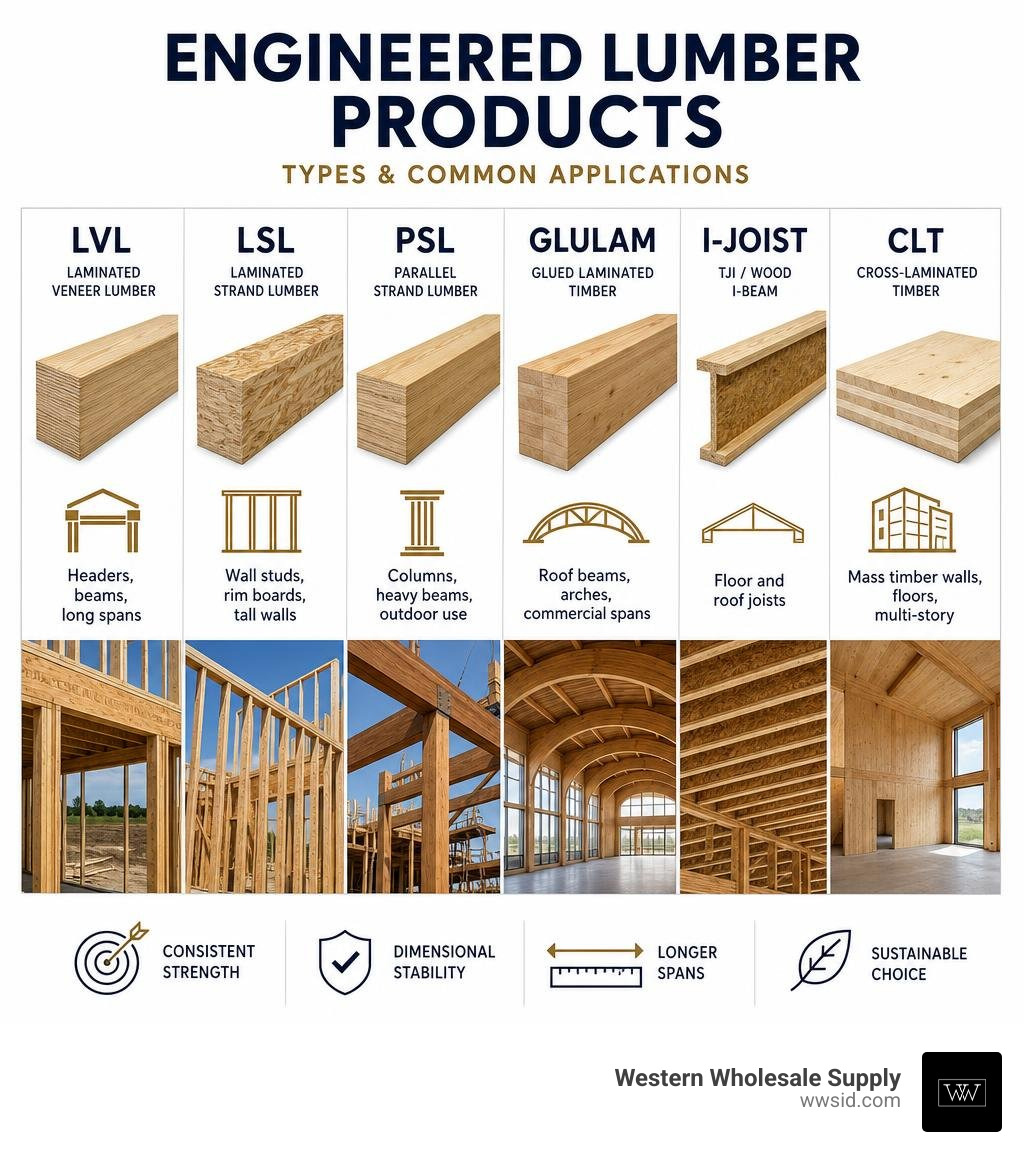
Here is a quick overview of the most common types:
| Product | Common Name | Best Used For |
|---|---|---|
| LVL | Laminated Veneer Lumber | Headers, beams, long spans |
| LSL | Laminated Strand Lumber | Wall studs, rim boards, tall walls |
| PSL | Parallel Strand Lumber | Columns, heavy beams, outdoor use |
| Glulam | Glued Laminated Timber | Roof beams, arches, commercial spans |
| I-Joist | TJI / Wood I-Beam | Floor and roof joists |
| CLT | Cross-Laminated Timber | Mass timber walls, floors, multi-story |
Each type serves a different structural role, and choosing the right one can save time, reduce waste, and help your project meet code requirements.
Traditional dimensional lumber has served builders for generations. But it warps. It shrinks. It forces crews to sort through bundles looking for usable boards. Engineered lumber was developed to solve exactly those problems — giving builders consistent, reliable material every time.
According to the National Association of Home Builders, an average job site generates over 8,000 pounds of waste, much of it framing scrap. Engineered products help cut that number down significantly. Builders using engineered wood systems have reported up to 30% savings in waste management costs alone.
Whether you are framing a single-family home, a multi-family complex, or a light commercial structure, the right engineered lumber products can make a measurable difference in speed, quality, and long-term performance.
At Western Wholesale Supply, we are a third-generation building materials team that has spent decades working with contractors and builders across residential and commercial projects — including specifying and supplying engineered lumber products for a wide range of structural applications. In the sections below, we’ll break down every major product type, how they compare to dimensional lumber, and how to choose the right one for your specific job.
What Are Engineered Lumber Products?
At Western Wholesale Supply, we have watched the framing landscape evolve over our 60-plus years of serving Eastern Idaho and Western Wyoming. Today, when we talk about engineered lumber products, we are referring to high-performance materials that take natural wood fibers, strands, or veneers and reassemble them to maximize structural integrity.
Unlike traditional solid-sawn lumber, which is limited by the natural growth patterns and defects of a single tree, engineered wood is a manufactured system. By peeling, slicing, or stranding logs and then bonding the pieces back together using high-strength structural adhesives, manufacturers can virtually eliminate natural defects like knots, splits, and slope-of-grain issues.
This category of materials is broadly referred to as Structural Composite Lumber (SCL). SCL includes Laminated Veneer Lumber (LVL), Laminated Strand Lumber (LSL), and Parallel Strand Lumber (PSL). The manufacturing process relies on extreme precision, high heat, and waterproof adhesives to create large billets of wood that are later sawn to standard framing dimensions. For a deep dive into the technical classification of these materials, you can explore the APA – The Engineered Wood Association: Structural Composite Lumber specifications.
By optimizing the orientation of the wood fibers, manufacturers can design these products to handle specific directional forces. The result is a structural member that is incredibly uniform, predictable, and strong. For builders in our region—from the windy plains of Idaho Falls and Pocatello to the heavy snow-load zones of Jackson, Wyoming, and Driggs, Idaho—this structural predictability is not just a luxury; it is a necessity.
Laminated Veneer Lumber (LVL) as Engineered Lumber Products
Laminated Veneer Lumber (LVL) is one of the most widely used structural composite lumber products on modern job sites. It is manufactured by stacking thin wood veneers (usually about 1/10 to 1/6 of an inch thick) with the grain of all veneers running parallel to the length of the member. These layers are glued together under intense pressure using waterproof phenol-formaldehyde resins.
Because the veneers are layered systematically, any natural defect in a single veneer sheet is randomized and offset by the surrounding clear veneers. This makes LVL highly uniform and dramatically stronger than traditional solid wood of the same dimensions.
LVL is the premier choice for high-load headers, structural beams, and long spans where sagging or deflection cannot be tolerated. Whether you are framing a wide garage door header in Rexburg or a spacious open-concept kitchen in Rigby, LVL provides the bending strength and stiffness required to keep floors quiet and ceilings flat.
For detailed design values, span calculations, and load capacity tables, builders can consult comprehensive technical resources for 3100Fb-2.1E grade LVL members. Additionally, innovative products like Boise Cascade VersaWorksTM Veneer Laminated Timber showcase how veneer-laminated technology can be utilized in advanced cross-banded layouts to provide incredible dimensional stability for structural panels.
Laminated Strand Lumber (LSL) and Other Engineered Lumber Products
If LVL is the heavy-lifter for beams and headers, Laminated Strand Lumber (LSL) is the ultimate solution for straight, stable framing. LSL is manufactured from wood strands that are typically up to 12 inches long. These strands are coated with a waterproof polyurethane-based adhesive (frequently MDI resin) and formed into a dense mat before being pressed into solid billets.
One of the greatest benefits of LSL is its versatility. Because it is made from smaller wood strands, manufacturers can utilize fast-growing, highly renewable species like aspen. This makes LSL an eco-friendly choice that does not compromise on structural capacity.
In residential and light commercial construction, LSL is highly valued for:
- Tall Wall Framing: LSL studs do not bow or twist, making them perfect for grand entryways, stairwells, and balloon-frame walls.
- Kitchen and Bathroom Walls: Installing tile or high-end cabinetry is infinitely easier when your wall studs are perfectly plumb and straight.
- Rim Boards: LSL rim boards provide excellent vertical load-bearing capacity and a solid nailing surface for joist hangers.
For more information on the physical properties and architectural versatility of LSL, you can check out the Tolko Laminated Strand Lumber (LSL) | Engineered Wood Products resources. These guides provide an in-depth breakdown of how these strand-based products perform under real-world building conditions, including specific dimensions, warranties, and mechanical properties.
Parallel Strand Lumber (PSL) and Glued Laminated Timber (Glulam)
For heavy timber aesthetics and massive structural capacities, builders look to Parallel Strand Lumber (PSL) and Glued Laminated Timber (Glulam).
Parallel Strand Lumber (PSL)
PSL is manufactured from long, narrow veneer strands laid in a parallel formation and bonded with a waterproof adhesive. This creates a dense, high-strength structural member with a unique, textured wood-grain appearance. PSL is often used for heavy-duty columns, long-span post-and-beam configurations, and highly loaded beams. It is particularly well-suited for applications where the framing remains exposed as an architectural feature.
Glued Laminated Timber (Glulam)
Glulam consists of individual layers of dimensional lumber (usually 1-1/2 inches thick) selected and positioned based on their performance characteristics. These laminations are bonded together with moisture-resistant adhesives to form large structural beams, columns, and curved arches.
Because the outer laminations of a glulam beam handle the highest bending stresses, high-grade wood is placed on the top and bottom, while lower-grade wood is utilized in the center. This strategic layup makes glulam highly efficient.
Glulams are ideal for:
- Large open-concept residential spaces.
- Vaulted ceilings in commercial or religious buildings.
- Floor girders and roof ridges.
To explore high-performance options for structural beams, you can review the technical details of Glulam Beams — Canfor, which highlights Southern Yellow Pine and Douglas Fir configurations engineered for superior strength and architectural versatility.
Cross-Laminated Timber (CLT) and Mass Plywood Panels (MPP)
As we look toward the future of building in 2026, mass timber is revolutionizing how we think about mid-rise and commercial construction. The two frontrunners in this space are Cross-Laminated Timber (CLT) and Mass Plywood Panels (MPP).
Cross-Laminated Timber (CLT)
CLT consists of several layers of kiln-dried lumber stacked in alternating orthogonal directions (at 90-degree angles) and glued together. This cross-lamination provides exceptional two-way structural properties, allowing CLT panels to function as solid wood walls, floors, and roofs. It acts as a lightweight, highly sustainable alternative to concrete and steel in buildings up to 18 stories tall.
Mass Plywood Panels (MPP)
A relatively recent and highly innovative development in the mass timber sector is the Mass Plywood Panel. Rather than using solid-sawn dimensional lumber as laminations, MPP is constructed from layers of density-graded Douglas Fir veneers. This veneer-based mass timber product offers incredible dimensional stability, a slower and highly predictable char rate in fires, and a lighter weight-to-strength ratio compared to traditional CLT.
For projects requiring massive structural panels, floor systems, or heavy timber columns, you can read more about these veneer-based mass timber systems at Mass Plywood – Plywood Paneling | Freres Engineered Wood.
Engineered Lumber vs. Traditional Dimensional Lumber

When deciding between traditional dimensional lumber and engineered lumber products, it helps to look at the numbers and physical properties. While green or kiln-dried sawn lumber is suitable for basic framing, engineered wood consistently outperforms it in structural integrity, predictability, and efficiency.
Here is a detailed comparison of how these materials stack up:
| Performance Metric | Traditional Dimensional Lumber | Engineered Lumber Products |
|---|---|---|
| Strength-to-Weight Ratio | Moderate; limited by natural growth defects. | Exceptionally high; optimized fiber alignment. |
| Dimensional Stability | Prone to shrinking, twisting, bowing, and warping as moisture levels change. | Highly stable; manufactured at low moisture contents (typically 4–8%). |
| Span Capabilities | Limited; spans over 16–20 feet require massive, expensive solid timbers. | Extremely long; easily spans 40–60 feet depending on product depth. |
| Consistency | Highly variable; requires manual sorting on-site to discard warped crowns. | 100% consistent; every piece is straight, true, and meets exact design values. |
| Job Site Waste | High; average framing waste can exceed 10–15% of delivered materials. | Extremely low; pre-cut lengths and precise sizing reduce waste by up to 30%. |
Because engineered wood is dried to a uniform moisture content during manufacturing, it does not shrink or warp after installation. This means fewer drywall cracks, no squeaky floors, and significantly fewer callbacks for builders. In our local climate—where dry mountain air in places like Victor, Idaho, or Jackson, Wyoming, can quickly twist wet sawn lumber—using stable engineered wood is a massive advantage.
Key Structural Applications for Engineered Wood

Engineered wood products are designed to work together as an integrated structural system. By choosing the right product for each specific application, you can optimize both your budget and your building’s performance.
Floor Joists
Engineered wood I-joists (often referred to as TJI joists) are the standard for high-quality floor systems. Featuring an oriented strand board (OSB) web sandwiched between solid wood or LVL flanges, I-joists are lightweight, incredibly strong, and capable of long, clear spans. This eliminates the need for intermediate load-bearing walls or columns, giving architects and homeowners complete design freedom.
Rim Boards
To support the floor joists at the perimeter of the foundation, engineered rim boards (made of LSL or high-performance OSB) are used. They match the exact depth of the I-joists and provide the high vertical load-bearing capacity needed to transfer roof and wall loads down to the foundation.
Tall Wall Framing and Studs
For soaring great rooms, window walls, or stairwells, traditional 2×6 or 2×8 studs are prone to bowing over long vertical distances. Using LSL studs ensures that these tall walls remain perfectly flat, making window installation seamless and preventing unsightly waves in the finished drywall.
Stair Stringers and Treads
Stairs are notorious for squeaking and creaking over time as solid wood stringers shrink and expand. Utilizing LSL stair stringers and engineered treads provides a rock-solid, quiet staircase that will not warp, split, or squeak.
If you are sourcing materials for a project in Teton County, Eastern Idaho, or Western Wyoming, our team at Western Wholesale Supply is fully equipped to deliver these premium structural systems directly to your job site. We provide reliable, on-time delivery and exceptional customer service across our entire service area, ensuring your project stays on schedule and within budget.
Installation Best Practices and Limitations
To ensure that engineered lumber products perform as designed, builders must follow strict installation guidelines. Because these are highly engineered systems, field modifications can easily compromise their structural capacity if not done correctly.
1. Moisture Protection
While engineered wood uses highly water-resistant adhesives, it is designed for dry service conditions (where the moisture content of the wood remains below 16%). During construction, protect the materials from standing water and allow them to dry completely before enclosing the framing. For exterior applications, ensure that any exposed timbers are properly treated or rated for outdoor exposure.
2. Precise Hole Drilling
One of the greatest benefits of engineered joists and beams is the ability to run plumbing, electrical, and HVAC lines through them. However, you must adhere strictly to the manufacturer’s drilling charts:
- Never cut, notch, or drill the top or bottom flanges of an I-joist.
- Keep holes centered vertically in the web.
- Ensure that large holes are located in low-shear zones (generally toward the middle third of the span, away from structural supports).
3. Multi-Ply Beam Fastening
When combining multiple plies of LVL or LSL to create a thick structural beam, the plies must be fastened together correctly to act as a single, cohesive unit. Always use approved fastening patterns with high-quality structural screws or nails. We highly recommend utilizing professional-grade Grabber fasteners to achieve secure, code-compliant multi-ply connections.
Frequently Asked Questions About Engineered Lumber
Can you drill holes in engineered wood beams?
Yes, but with strict limitations. You can drill small holes through the web of an I-joist or the center of an LVL beam, but you must consult the manufacturer’s span tables and hole-chart guides first. Never drill close to structural supports, and never cut into the top or bottom flanges of an I-joist or the tension zone of a structural beam.
How does engineered lumber perform in a fire?
Engineered lumber actually performs exceptionally well in fire conditions. Because products like LVL, PSL, and glulam are dense and thick, they char on the outside at a highly predictable rate. This char layer insulates the inner core of the wood, allowing the beam to maintain its structural integrity far longer than light-gauge steel or unprotected solid wood. Additionally, products like Tolko T-TEC LSL meet the strict Fire Protection of Floors requirements in the IRC without needing extra chemical treatments or fire-resistive coatings.
Is engineered lumber more sustainable than traditional lumber?
Absolutely. Engineered wood manufacturing processes utilize up to 80% to 90% of the log, compared to only about 40% to 50% for traditional solid-sawn lumber. By using smaller, fast-growing trees and wood fibers that would otherwise go to waste, manufacturers create high-value structural components. Most major manufacturers hold Sustainable Forestry Initiative (SFI) or Forest Stewardship Council (FSC) certifications, ensuring that the wood fiber is responsibly sourced. Furthermore, wood naturally sequesters carbon, locking it away for the lifetime of the building.
Conclusion
Choosing the right engineered lumber products is one of the smartest decisions a builder can make. From reducing job site waste and preventing costly callbacks to achieving massive, open-concept spans, engineered wood offers a level of precision that traditional sawn lumber simply cannot match.
At Western Wholesale Supply, we have spent more than six decades helping builders across Eastern Idaho and Western Wyoming get the high-quality materials they need to build structures that last. As an independent, veteran-owned, third-generation family business, we pride ourselves on reliable, on-time delivery and exceptional customer service.
Whether you are framing a home in Jackson, Wyoming, or a commercial warehouse in Idaho Falls, we are here to support your project from start to finish. If you are planning a commercial warehouse space, don’t forget to pair your structural framing with high-performance insulation to maximize thermal efficiency (we recommend aiming for R-30+ in ceilings and R-13+ in walls).
Ready to elevate your next build with the ultimate structural system? Contact our team today, or read our comprehensive guide on Construction Supply in Idaho to learn how we can streamline your material sourcing.
