

What is a Metric Threaded Rod and How Does It Differ from Imperial?
Metric threaded rod is a fully threaded metal rod — no head, no end point — used to fasten, support, and connect materials in construction, manufacturing, and industrial work. Here’s a quick overview before we dive in:
| Feature | Details |
|---|---|
| What it is | A headless rod threaded along its entire length |
| Common diameters | M6 through M36 |
| Standard lengths | 1m, 2m, and 3m (custom cutting available) |
| Common materials | Carbon steel, stainless steel, brass, aluminum, nylon |
| Strength classes | 4.6, 8.8, 10.9, 12.9 (ISO); B7 (ASTM) |
| Thread standard | ISO metric (DIN 975 / DIN 976-1) |
| Used with | Matching metric nuts and washers by diameter and pitch |
Whether you’re anchoring into concrete, building a support frame, or connecting structural components, getting the right rod — the right size, material, and coating — makes a real difference on the job site.
At Western Wholesale Supply, we are a third-generation building materials supplier with decades of experience sourcing and supplying fasteners, including metric threaded rod, to contractors and builders across the region. Our hands-on distribution experience shapes every recommendation in this guide.
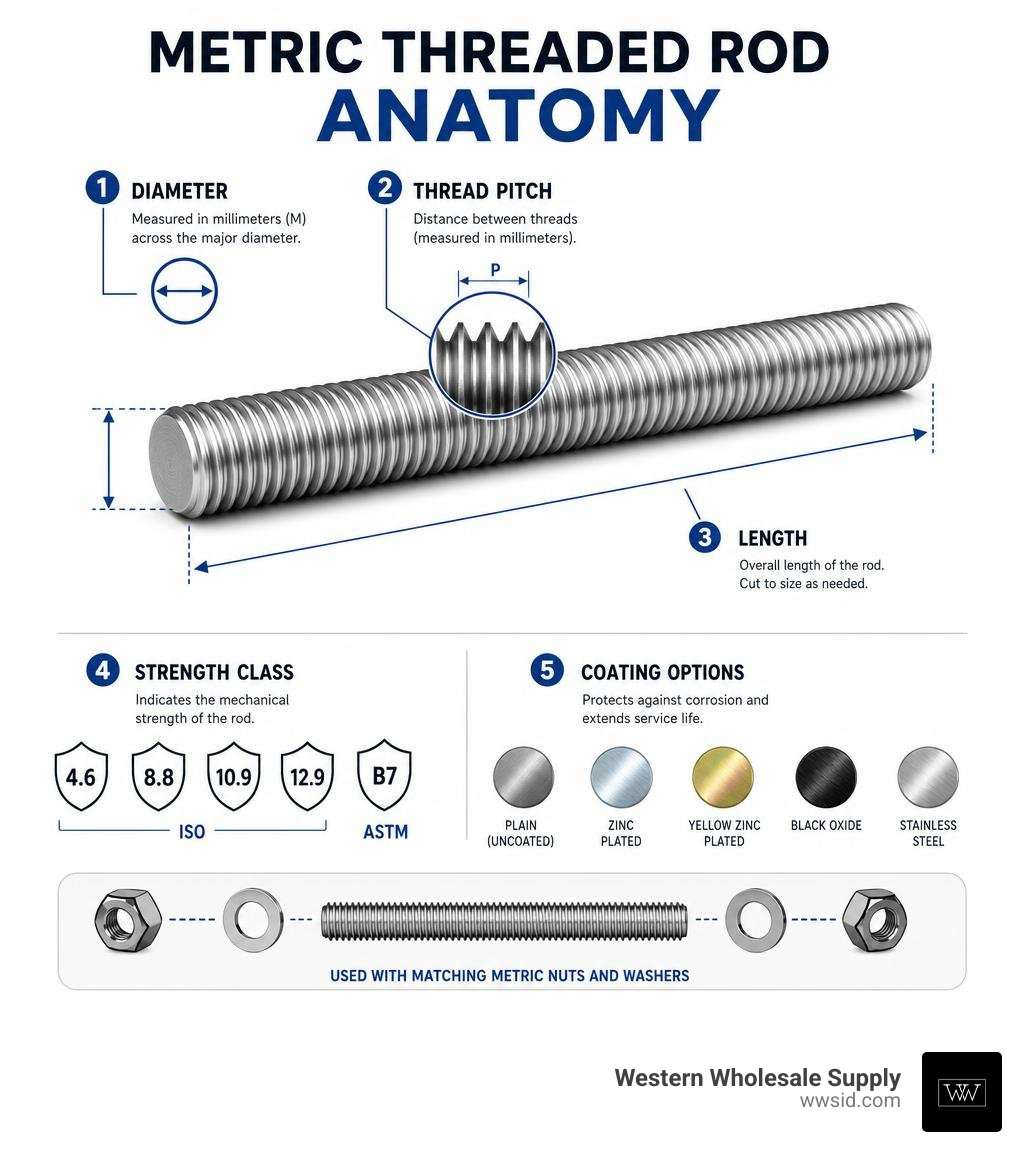
To understand how a metric threaded rod functions, it helps to look at its structural anatomy. Unlike a standard bolt, which has a forged head on one end, a threaded rod (frequently called all-thread or a stud) is threaded continuously from end to end. This structural simplicity allows you to cut it to any length and secure it with nuts and washers on both sides, making it incredibly versatile for hanging mechanical systems, anchoring heavy equipment, or framing structures.
The fundamental difference between metric and imperial threaded rods lies in the thread geometry and measurement standards:
- Measurement Units: Imperial rods are measured in inches for diameter and Threads Per Inch (TPI) for pitch. Metric rods follow the International Organization for Standardization (ISO) metric screw thread system, where dimensions are measured in millimeters.
- Thread Pitch: In the imperial system, thread pitch is defined by how many threads fit into a single inch (such as 1/4″-20 UNC, which means a quarter-inch diameter with 20 threads per inch). In the metric system, thread pitch is the actual distance between the peaks of two adjacent threads (for example, an M10 x 1.5 rod has a 10mm nominal diameter and a 1.5mm distance between each thread).
- Thread Profiles: Both systems use a 60-degree V-thread profile, but their tolerances, major diameters, and pitch diameters are calculated differently.
- Global Compatibility: Because the vast majority of modern industrial machinery, automotive components, and international construction designs rely on ISO standards, using a metric threaded rod ensures seamless global compatibility. If you are working on commercial projects in Eastern Idaho or Western Wyoming that feature imported equipment or standardized structural designs, metric fasteners are often non-negotiable.
Technical Specifications, Materials, and Strength Classes
When ordering metric threaded rod, you will encounter two primary German standards that govern their manufacturing: DIN 975 and DIN 976-1. While DIN 975 historically referred to one-meter-long threaded pieces, DIN 976-1 (specifically Shape A) is the modern standard covering metric threads cut to various specific lengths with standard ISO metric thread profiles.
To ensure your structural calculations are accurate, you must match the thread diameter, pitch, and length to your application’s specific mechanical demands.
Standard Sizes of Metric Threaded Rod
Metric rods are highly standardized to eliminate guesswork. They are widely stocked in diameters ranging from M6 up to M36, though smaller precision sizes like M3 and massive industrial sizes exceeding M36 are also manufactured for specialized applications.
Standard stock lengths typically include 1-meter, 2-meter, and 3-meter configurations. For example, the BN 30602 – Threaded rod metric thread 1 meter | Bossard America is a standard 1-meter utility rod used across various industrial assemblies. If you require a longer run for high-ceiling suspensions, you can source options like the Buy Threaded rod DIN 976-1 (shape A) with standard metric ISO thread, steel 4.8, plain (0950003) | WÜRTH which comes in lengths up to 3 meters.
Below is a reference table outlining the standard metric coarse thread pitches for common diameters:
| Nominal Diameter (Size) | Standard Coarse Pitch (mm) | Pitch Diameter (Approx. mm) |
|---|---|---|
| M6 | 1.00 | 5.35 |
| M8 | 1.25 | 7.19 |
| M10 | 1.50 | 9.03 |
| M12 | 1.75 | 10.86 |
| M16 | 2.00 | 14.70 |
| M20 | 2.50 | 18.38 |
| M24 | 3.00 | 22.05 |
| M30 | 3.50 | 27.73 |
| M36 | 4.00 | 33.40 |
Note: While coarse thread pitches are the default for construction and general mounting, fine thread pitches are available for high-vibration environments or applications requiring extremely precise adjustments.
High-Strength Metric Threaded Rod Options
The load-carrying capacity of a metric threaded rod is determined by its property class (often stamped or color-coded on the end of the rod). Unlike imperial grades, metric property classes are expressed as two numbers separated by a decimal point (e.g., 4.6, 8.8, 10.9, 12.9).
The first number represents one-hundredth of the nominal tensile strength in Megapascals (MPa). The second number represents the ratio of yield strength to tensile strength. Here is how these classes compare in tensile strength:
- ISO Class 4.6 (Low Carbon Steel): A mild, highly ductile steel with a tensile strength of approximately 400 MPa (60,800 psi). It is ideal for light-duty hanging, light framing, and general utility work.
- ISO Class 8.8 (Medium Strength Heat-Treated Steel): Often referred to as “structural grade,” this medium-carbon steel is quenched and tempered to achieve a tensile strength of 800 MPa (110,000 psi). It is widely used in automotive, machinery, and structural construction.
- ASTM A193 B7 (Medium Strength 4140 Alloy Steel): Engineered for high-temperature and high-pressure environments, this chromium-molybdenum alloy steel delivers a minimum tensile strength of 125,000 psi.
- ISO Class 10.9 (High Strength Heat-Treated Alloy Steel): Quenched and tempered alloy steel providing a tensile strength of 1,000 MPa (150,000 psi). This class is reserved for heavy-duty structural connections and high-load mechanical systems.
- ISO Class 12.9 (Extra High Strength Heat-Treated Alloy Steel): The strongest standard carbon steel class, boasting a tensile strength of 1,200 MPa (170,000 psi), used in extreme mechanical assemblies.
- A2 Stainless Steel (Class 70): An excellent corrosion-resistant option with a tensile strength of 700 MPa (102,000 psi), perfect for standard outdoor or wet environments. You can view specifications for this grade on the RS PRO Plain Stainless Steel Threaded Bar, Metric, 1 m | RS product page.
- A4 Stainless Steel (Marine Grade): Contains molybdenum for superior resistance to chlorides and acids, making it the standard choice for chemical processing, water treatment, and marine environments.
To prevent field errors, metric rods are often marked on their ends with a standardized color-coding system:
- Unmarked: Class 4.6 / 4.8
- Yellow: Class 8.8
- White: Class 10.9
- Green: A2 Stainless Steel
- Red: A4 Stainless Steel
For a complete inventory of these property classes, sizes, and materials, refer to the comprehensive Threaded Rod – Metric & Multistandard Components catalog, which highlights specialized options like brass, aluminum, and nylon rods alongside high-strength steels.
Coatings, Finishes, and Corrosion Resistance
Choosing the right finish for your metric threaded rod is just as important as selecting the correct strength class. Without adequate surface protection, environmental exposure can lead to rapid oxidation, compromising the structural integrity of your assembly.
Plain (Self-Color / Black Oxide)
Plain steel rods have no protective coating. They are oily to the touch from the manufacturing process and offer virtually no corrosion resistance. They should only be used in dry, climate-controlled indoor environments, or in applications where they will be completely submerged in oil or welded.
Bright Zinc Plating (BZP)
This is the most common commercial finish. A thin layer of zinc is electroplated onto the steel rod, providing a bright, shiny appearance and basic protection against moisture and rusting. The RS PRO Zinc Plated Steel Threaded Rod, M3, 1 m | RS is an excellent example of a zinc-plated rod designed for clean indoor installations, commercial retail spaces, or temporary outdoor setups.
Hot-Dip Galvanizing (HDG)
For heavy-duty outdoor use in Eastern Idaho’s snowy winters or Western Wyoming’s mountain climates, hot-dip galvanizing is highly recommended. The steel rod is submerged in molten zinc, creating a thick, durable alloy layer that is significantly thicker than electroplating (typically 43 to 50 microns compared to just 3 to 5 microns for standard zinc plating). This thick layer provides sacrificial protection, meaning the zinc will corrode before the underlying steel is touched.
Note: Because hot-dip galvanizing adds a thick layer of zinc, you must use oversized galvanized nuts to accommodate the increased thread thickness.
Stainless Steel (A2 and A4)
When coatings aren’t enough, solid stainless steel is the ultimate solution. A2 stainless steel handles typical outdoor rain and snow beautifully. For highly corrosive environments, such as agricultural chemical storage facilities or wastewater treatment plants in our service areas, A4-grade marine stainless steel provides the highest level of chemical and chloride resistance.
Best Practices for Cutting, Installing, and Maintaining Threaded Rods
Working with metric threaded rod requires proper technique to avoid stripping threads, weakening the metal, or compromising safety.
How to Cut Threaded Rod Cleanly
Cutting a threaded rod can easily crush or burr the delicate helical threads, making it impossible to spin a nut onto the cut end. Follow these steps for a perfect cut:
- The Nut Trick: Before making any cut, thread two standard metric hex nuts onto the rod, positioning them just past your intended cut line.
- Secure the Rod: Clamp the rod securely in a vise, using soft jaw covers or wooden blocks to protect the existing threads from being flattened by the vise jaws.
- Make the Cut: Use a high-quality hacksaw, a portable band saw, or an angle grinder fitted with a thin metal-cutting abrasive wheel. Cut slowly and keep your tool perpendicular to the rod.
- Debur the Edge: Use a metal file, bench grinder, or a specialized deburring tool to chamfer the cut edge at a 45-degree angle. This removes sharp metal burrs and recreates the lead-in thread.
- Back the Nuts Off: Back the two hex nuts off the cut end of the rod. As they pass over the cut area, they will act as a die, straightening out any minor thread deflections caused by the saw.
Installation and Fastener Matching
When installing metric threaded rod, you must ensure that all mating fasteners match the thread profile exactly. A common mistake on regional job sites is attempting to force an imperial nut onto a metric rod (such as trying to spin a 3/8″-16 nut onto an M10 rod). While they look similar to the naked eye, the mismatched thread pitches will quickly gall, strip, and fail under load.
Always source high-quality, certified metric nuts and washers. At Western Wholesale Supply, we recommend pairing your metric rods with trusted, industry-standard fasteners from Brighton Best or Grabber. Matching a Class 8.8 rod with a Class 8 metric nut ensures that the entire assembly maintains its rated structural capacity.
Frequently Asked Questions about Threaded Rods
Can metric threaded rods be used outdoors?
Yes, but you must select the appropriate material and finish. Plain carbon steel will rust rapidly when exposed to rain, snow, or high humidity. For outdoor applications in Eastern Idaho and Western Wyoming, always specify hot-dip galvanized steel, A2 stainless steel, or A4 marine-grade stainless steel. Bright zinc-plated (BZP) rods can be used outdoors only for temporary installations or in highly sheltered, dry conditions.
How do you cut a metric threaded rod without damaging the threads?
The most reliable method is to thread two hex nuts onto the rod before cutting. Make your cut using a band saw or hacksaw, file a clean 45-degree chamfer on the freshly cut end to remove burrs, and then back the nuts off over the cut. The movement of the nuts cleans and reshapes the lead-in threads, allowing for smooth future assembly.
Are nuts and washers universal across metric threaded rods?
Nuts and washers are universal only if they share the exact same nominal diameter and thread pitch as the rod. For example, an M12 x 1.75 nut will fit any M12 x 1.75 metric threaded rod, regardless of the manufacturer. However, they will not fit an M12 x 1.25 (fine thread) rod or an imperial 1/2″ rod. Always verify both the diameter and the pitch before assembly.
Conclusion
Understanding the engineering behind metric threaded rod ensures that your commercial and residential builds are safe, compliant, and built to last. From selecting the proper ISO strength class (like Class 8.8 or 10.9) to choosing the right corrosion-resistant coating for our rugged mountain climate, using the right fastener is key to structural success.
At Western Wholesale Supply, we are an independent, veteran-owned, third-generation family business that has been supplying premium building materials to Eastern Idaho and Western Wyoming since 1963. Backed by over 60 years of local experience, we pride ourselves on providing reliable, on-time delivery and exceptional customer service to job sites across Idaho Falls, Pocatello, Jackson, Driggs, Victor, Rexburg, and beyond.
Ready to secure your next project with high-quality fasteners, drywall, steel framing, or CertainTeed ceiling systems? Explore our full range of professional-grade products at WWS Tools and Fasteners or contact our team today to get a quote and schedule your next delivery.
