

Why Warehouse Insulation Materials Matter for Your Building’s Performance
Warehouse insulation materials are specialized products designed to control temperature, reduce energy costs, and protect your building and inventory. The most common types include:
- Spray Foam Insulation – Provides the highest R-value per inch and excellent air sealing (closed-cell: R-6 to R-7 per inch)
- Rigid Foam Boards – EPS, XPS, and polyiso panels ideal for walls, roofs, and foundations (R-3.8 to R-6.8 per inch)
- Fiberglass & Mineral Wool – Cost-effective batts and rolls with excellent fire resistance (R-2.2 to R-4.3 per inch)
- Loose-Fill Insulation – Cellulose or fiberglass blown into attics and hard-to-reach spaces (R-2.5 to R-3.8 per inch)
- Reflective Barriers – Reduces radiant heat transfer in hot climates
The stakes are high, as heating and cooling can account for 50-70% of a building’s energy use. Poor insulation wastes money, creates condensation, compromises product integrity, and leads to uncomfortable working conditions.
Industrial facilities have unique challenges like large open spaces and metal components, requiring specialized solutions. The wrong material or poor installation can cause thermal bridging, moisture issues, and significant energy loss.
This guide breaks down the primary warehouse insulation materials, explaining how to evaluate them based on R-value, fire resistance, and moisture control. We will also look at which products work best for specific parts of your building throughout Eastern Idaho and Western Wyoming, from spray foam to rigid boards and mineral wool.
The material you choose impacts your operation for decades. Proper insulation significantly reduces HVAC costs, maintains stable temperatures to protect inventory, and improves productivity. The investment pays for itself through lower utility bills, reduced equipment wear, and better overall building performance.
Western Wholesale Supply is a third-generation building materials company based in Idaho Falls. For over 60 years, we have supplied insulation products across Eastern Idaho and Western Wyoming. We have seen how the right insulation material choices can make or break a warehouse project’s long-term performance.
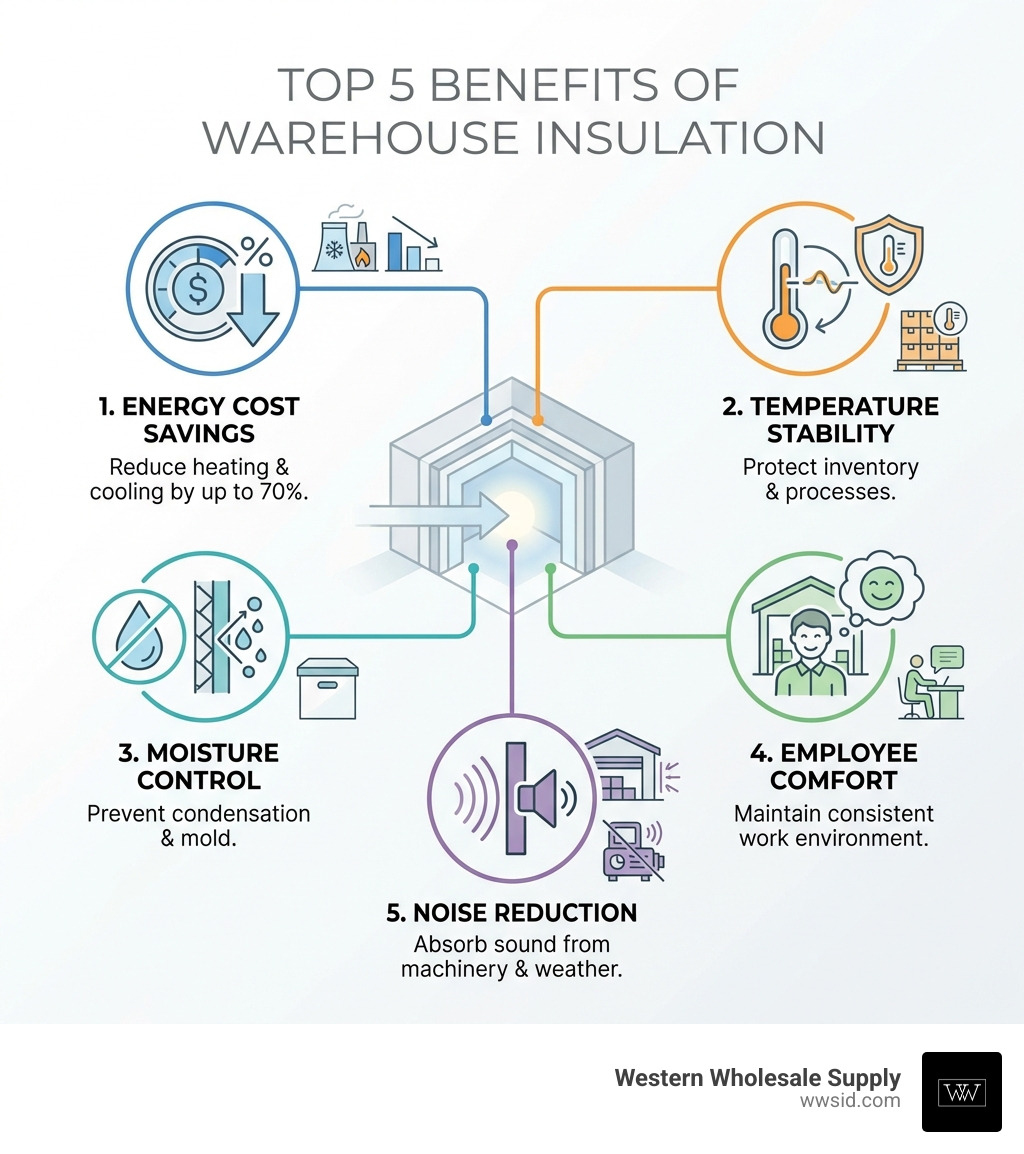
Why Insulate Your Warehouse? The Core Benefits
Insulating your warehouse is a strategic investment that offers a multitude of benefits for your operations in Idaho and Wyoming, from your bottom line to employee well-being.
Energy Savings and Reduced HVAC Costs
A primary reason to invest in warehouse insulation materials is the significant reduction in energy consumption. Heating and cooling are major operational expenses. Effective insulation creates a thermal barrier, reducing the workload on your HVAC systems and lowering utility bills. With heating and cooling accounting for 50-70% of energy use in an average building, the savings in a large warehouse are substantial.
Stable Temperature Control and Product Integrity Protection
Many products, from electronics to food, require specific temperature ranges. Insulation creates a stable internal environment, preventing extreme fluctuations that can damage sensitive goods. This protection reduces waste and preserves inventory value. For specialized facilities like cold storage, high-performance insulation is the first line of defense.
Employee Comfort and Productivity
A comfortable work environment boosts morale and productivity. In uninsulated warehouses in Idaho and Wyoming, employees face extreme temperatures. Proper insulation ensures a more consistent and comfortable indoor climate, reducing heat or cold stress. Comfortable employees are more focused, efficient, and less prone to illness.
Condensation Control
Condensation is a destructive problem in warehouses, especially in our region’s fluctuating temperatures. When warm, moist air meets cold uninsulated surfaces like metal roofs, water forms. This leads to rust, mold, and slippery floors. Effective insulation, paired with air sealing and vapor barriers, keeps interior surfaces warmer, preventing condensation and protecting your assets.
Noise Reduction
Warehouses can be noisy from machinery, vehicles, and weather. Certain warehouse insulation materials, like fiberglass and mineral wool, offer excellent sound absorption. Insulating walls and ceilings reduces both internal reverberation and external noise, creating a quieter and safer work environment.
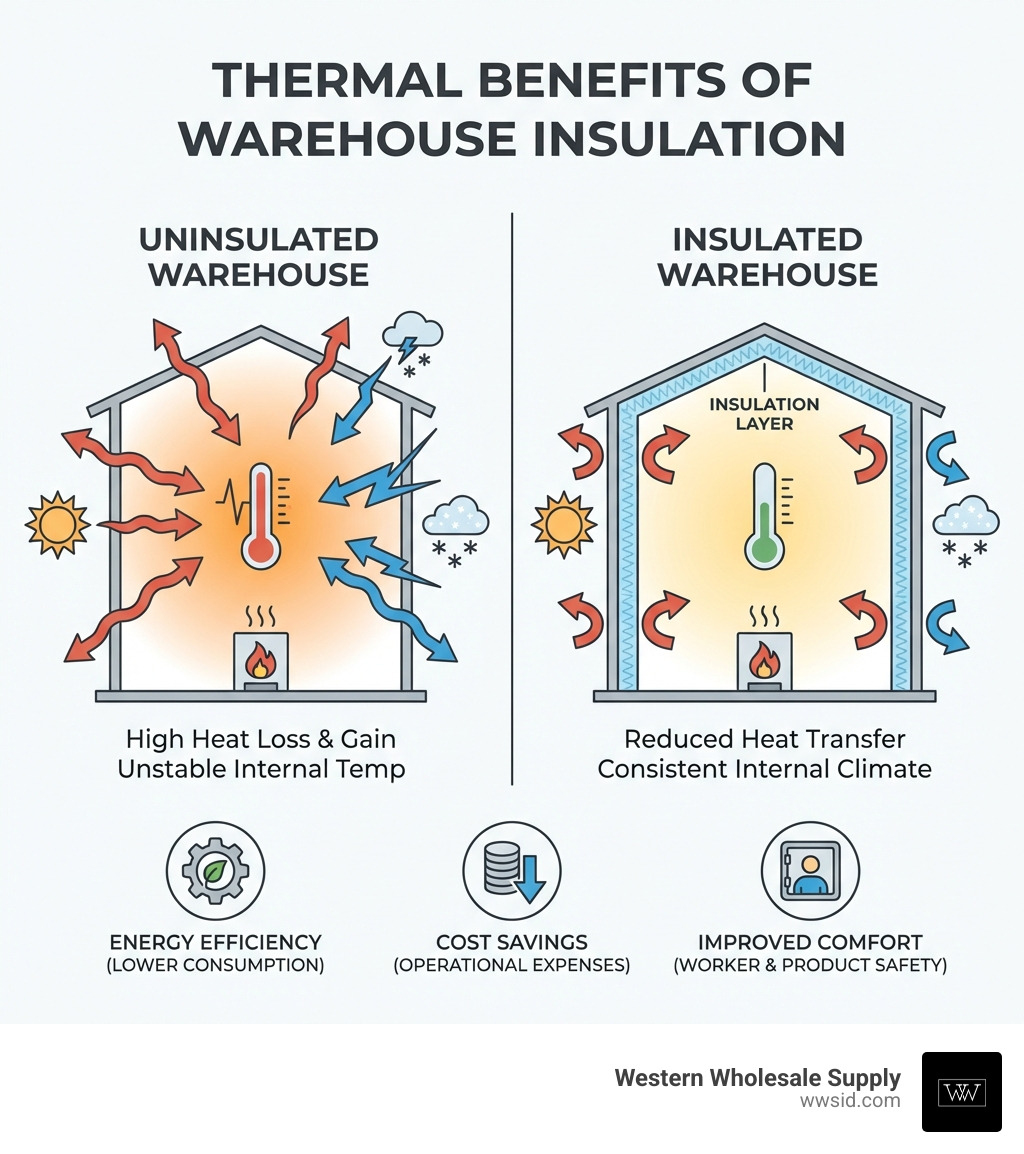
Primary Types of Warehouse Insulation Materials
Choosing the right warehouse insulation materials is crucial for energy efficiency. Here at Western Wholesale Supply, we offer solutions suited for warehouses across Idaho and Wyoming.
Spray Foam Insulation (SPF)
Spray foam insulation (SPF) is a modern solution known for its superior air sealing and high R-value. It’s applied as a liquid that expands to create a seamless thermal barrier.
- Open-cell foam: Has a spongy texture, offering an R-value of around R-3.7 per inch. It’s excellent for air sealing and sound dampening but is permeable to water vapor.
- Closed-cell foam: Denser and more rigid, providing a higher R-value (R-5.2 to R-6.5 per inch). It acts as an air and vapor barrier, adds structural strength, and has superior moisture resistance.
Application: SPF is ideal for metal buildings, as it molds to any surface, fills irregular gaps, and reduces thermal bridging. You can learn more about our comprehensive insulation solutions.
Rigid Foam Board Insulation
Rigid foam boards are lightweight, durable panels offering high R-value per inch. They are ideal for continuous insulation on walls, roofs, and foundations to prevent thermal bridging.
- Expanded Polystyrene (EPS): The most common type, with an R-value of ~R-3.8 per inch. It’s permeable to vapor but resists water.
- Extruded Polystyrene (XPS): Denser than EPS, with an R-value of ~R-5 per inch and superior moisture resistance, making it great for below-grade use.
- Polyisocyanurate (Polyiso): Offers the highest R-value (R-5.5 to R-6.8 per inch). Foil-faced versions can act as a radiant barrier.
Ideal Applications: Rigid boards are excellent for unfinished walls, floors, and low-slope roofs. All plastic foam boards must be covered by a fire-resistant material like drywall on interior surfaces.
Fiberglass & Mineral Wool Insulation
These traditional materials come in batts, rolls, and loose-fill.
- Fiberglass: A cost-effective option made from spun glass fibers, offering an R-value of R-3.1 to R-4.3 per inch. It’s non-combustible but requires careful installation to avoid compression.
- Mineral Wool (Rock Wool): Made from molten rock, it has a similar R-value to fiberglass but offers superior fire resistance, making it a top choice for fire safety. It also provides good sound absorption and moisture resistance.
Best for: Both are suited for filling cavities in unfinished walls, floors, and ceilings. Mineral wool is especially valuable for high-temperature applications.
Loose-Fill & Blown-In Insulation
This method involves blowing fibrous materials into cavities.
- Cellulose: Made from recycled paper treated for fire resistance. It can be dense-packed in walls for air sealing, with an R-value of R-3 to R-3.8 per inch.
- Fiberglass Loose-Fill: A loose version of fiberglass batts, offering an R-value of R-2.2 to R-3.7 per inch.
Ideal for: Filling existing walls, unfinished attics, and other hard-to-reach spaces where it conforms to irregularities.
Reflective & Radiant Barrier Insulation
These materials work by reflecting radiant heat rather than resisting conductive heat flow.
- Mechanism: Thin sheets of reflective aluminum foil reduce heat gain in hot climates by reflecting solar radiation. They require an adjacent air space to be effective.
- Effectiveness: In colder climates like Idaho and Wyoming, their primary benefit is reducing summer heat gain in roof systems, complementing other insulation types.
Typically Installed: In attics or roof systems to reduce solar heat gain.
How to Choose the Right Insulation: Key Performance Factors
Selecting the optimal warehouse insulation materials requires considering several performance factors beyond upfront cost, including long-term savings, safety, and durability for our climate in Idaho and Wyoming.
| Material Type | R-Value (per inch) | Fire Resistance | Moisture Resistance | Typical Cost (Relative) |
|---|---|---|---|---|
| Spray Foam (Closed-Cell) | R-5.2 to R-6.5 | Good (can be fire-resistant) | Excellent (air & vapor barrier) | High |
| Spray Foam (Open-Cell) | R-3.7 | Good | Moderate (vapor permeable) | Medium |
| Rigid Board (XPS) | R-5 | Good (needs thermal barrier) | Excellent | Medium-High |
| Rigid Board (Polyiso) | R-5.5 to R-6.8 | Good (needs thermal barrier, high temp. use) | Good (especially foil-faced) | High |
| Fiberglass Batt | R-3.1 to R-4.3 | Non-combustible | Low (absorbs water, loses R-value) | Low |
| Mineral Wool Batt | R-3.1 to R-4.3 | Excellent (high temp. & fire-retardant) | Good (resists water, dries out) | Medium |
| Loose-Fill (Cellulose) | R-3 to R-3.8 | Good (treated for fire resistance) | Moderate (absorbs water, can settle) | Low-Medium |
Understanding R-Value and Thermal Performance
The R-value measures a material’s resistance to heat flow—a higher R-value means better insulation. While thickness generally increases R-value, over-compressing materials like fiberglass batts can reduce their effectiveness.
- Thermal Bridging Explained: This occurs when heat bypasses insulation through more conductive materials like steel studs, significantly reducing overall thermal performance. Continuous insulation (CI), such as rigid foam boards installed on the exterior, is the most effective way to stop thermal bridging. For more details, the U.S. Department of Energy website is a great resource.
Fire Resistance and Safety Codes
Fire safety is paramount in industrial buildings, and local codes in Idaho and Wyoming are non-negotiable. Materials are rated on flame spread and smoke development.
- Non-Combustible Materials: Mineral wool and fiberglass are non-combustible. Mineral wool is especially valued for its ability to withstand very high temperatures.
- Covering Foam Plastics: For safety, all plastic-based insulation (rigid boards and spray foam) must be covered with a fire-resistant thermal barrier like drywall when installed on interior surfaces.
Moisture Resistance and Durability
Moisture can lead to mold, structural damage, and reduced insulation performance. Choosing moisture-resistant insulation is crucial in our climate.
- Preventing Damage: Closed-cell spray foam and XPS rigid boards offer excellent moisture resistance and can act as vapor barriers, making them ideal for damp areas like foundation walls.
- Durability: Denser materials like rigid foam and closed-cell spray foam also offer better durability against pests and physical impact compared to softer batts.
Sustainability and Cost-Effectiveness of Warehouse Insulation Materials
Beyond performance, consider the long-term value and environmental impact.
- Embodied Carbon: This refers to the emissions from manufacturing and transporting materials. Plant-based materials like cellulose generally have lower embodied carbon than mineral-based or synthetic products.
- Calculating ROI vs. Upfront Cost: While high-performance materials like spray foam have a higher upfront cost, their superior R-value and air sealing often lead to greater long-term energy savings. A cost-benefit analysis is essential to evaluate the return on investment over the building’s lifespan.
Application and Installation Best Practices
Even the best warehouse insulation materials won’t perform optimally without proper installation. Meticulous attention to detail ensures maximum energy efficiency and longevity for your warehouse in Idaho or Wyoming.
Insulating Different Parts of the Warehouse
Different parts of a warehouse require different strategies.
- Roof Insulation Strategies: The roof is a major source of heat transfer. For low-slope roofs, rigid foam boards (Polyiso, XPS) installed above the deck provide continuous insulation. For attics, loose-fill insulation (cellulose or fiberglass) is excellent for filling irregular spaces, while spray foam can be applied to the underside of the roof deck.
- Wall Insulation Techniques: For cavity walls, fiberglass or mineral wool batts are common. For superior performance, especially with steel framing, continuous exterior insulation using rigid foam boards is recommended to stop thermal bridging. Spray foam can be applied to open wall cavities for a perfect air seal.
- Foundation and Slab Insulation Methods: To prevent heat loss to the ground, use XPS rigid foam boards on exterior foundation walls and under concrete slabs. This is crucial for energy efficiency and comfort in our cold climate.
The Critical Role of Air Sealing and Vapor Barriers
Insulation’s performance depends on proper air sealing and vapor barriers.
- Air Barriers vs. Vapor Barriers: An air barrier stops uncontrolled air movement, which can carry moisture into wall assemblies. A vapor barrier (or retarder) slows the diffusion of water vapor. In cold climates like Idaho and Wyoming, the vapor barrier is placed on the warm (interior) side of the insulation to prevent condensation within the wall.
- Sealing Joints and Penetrations: It is critical to seal all joints, seams, and penetrations around pipes, windows, and doors to maintain the integrity of the air and vapor barriers. Spray foam excels at sealing complex gaps.
- Preventing Interstitial Condensation: Together, a continuous air barrier and a properly placed vapor barrier prevent interstitial condensation—moisture that gets trapped inside walls or roofs, leading to hidden damage.
Climate Considerations and Specialized Warehouse Insulation Materials
The climate of Idaho and Wyoming dictates specific insulation strategies.
- Hot vs. Cold Climate Strategies (Focus on Idaho/Wyoming): We need a balanced approach for our cold winters and hot summers. High R-values and robust air sealing are key for winter, while reflective barriers in roofs can help reduce heat gain in summer. The main goal is to resist heat flow in both directions and manage moisture.
- Insulation Needs for Cold Storage and Freezers: These require extremely high R-values and perfect vapor control. Layered closed-cell spray foam and rigid boards (Polyiso, XPS) are used to achieve the necessary performance and prevent ice buildup.
- High-Temperature Storage Solutions: For facilities that generate heat, insulation must withstand high temperatures. Mineral wool is an excellent choice, offering both thermal performance and superior fire resistance.
Frequently Asked Questions about Warehouse Insulation
Here are answers to some of the most common questions we get from contractors and builders in Idaho and Wyoming.
What is the best type of insulation for a metal warehouse?
Metal buildings are highly conductive, so a combination approach is best.
- Spray Foam for Air Sealing: We recommend closed-cell spray foam applied directly to the metal panels. It creates a seamless air and moisture barrier, preventing condensation and air leaks. It also helps reduce thermal bridging through secondary framing like girts and purlins.
- Continuous Rigid Board Insulation: To stop thermal bridging through the primary steel framing, install continuous rigid insulation (like XPS or Polyiso boards) on the exterior of the structure. This creates an unbroken thermal layer, dramatically improving the building’s overall energy performance.
How much does it cost to insulate a warehouse?
The cost varies, but it’s an investment with a strong return.
- Factors Affecting Cost: Key factors include the material type (spray foam is more expensive than batts), warehouse size and complexity, and labor rates. Retrofitting an existing building can also be more costly than new construction.
- Long-Term Energy Savings: A well-insulated warehouse provides substantial long-term savings on heating and cooling costs, which can account for 50-70% of energy use. The investment often pays for itself quickly through lower utility bills.
Can I install warehouse insulation myself?
DIY feasibility depends on the material.
- DIY Feasibility for Some Materials (Batts): An experienced DIYer might handle installing fiberglass or mineral wool batts in simple, accessible areas. However, ensuring a proper fit without gaps or compression is crucial for performance.
- Why Large-Scale Projects and Spray Foam Require Certified Professional Installers: Large-scale projects and all spray foam applications require certified professionals. SPF installation involves specialized equipment, safety protocols, and technical expertise to ensure correct application and curing. Professional installation guarantees safety, compliance with local codes, and that the insulation performs at its rated R-value, protecting your investment.
Conclusion
Choosing the right warehouse insulation materials is a critical decision for your facility’s efficiency, cost, and environmental impact. We’ve covered a range of materials, from high-performance spray foams to traditional fiberglass, each suited for different needs.
The key benefits—significant energy savings, stable temperatures, product protection, and employee comfort—show why insulation is a vital investment, not just an expense. Understanding R-value, fire resistance, and moisture control empowers you to make an informed choice that will benefit your business for decades.
For over 60 years, our third-generation, veteran-owned family business, Western Wholesale Supply, has provided high-quality materials for critical projects across Idaho Falls, Pocatello, Eastern Idaho, and Western Wyoming. Our commitment to reliable, on-time delivery and exceptional service means you have a trusted partner from design through completion.
Ready to start your warehouse insulation project? Explore our comprehensive insulation solutions to find the right materials for your needs.
