

Why Understanding Gypsum Board Standards Matters
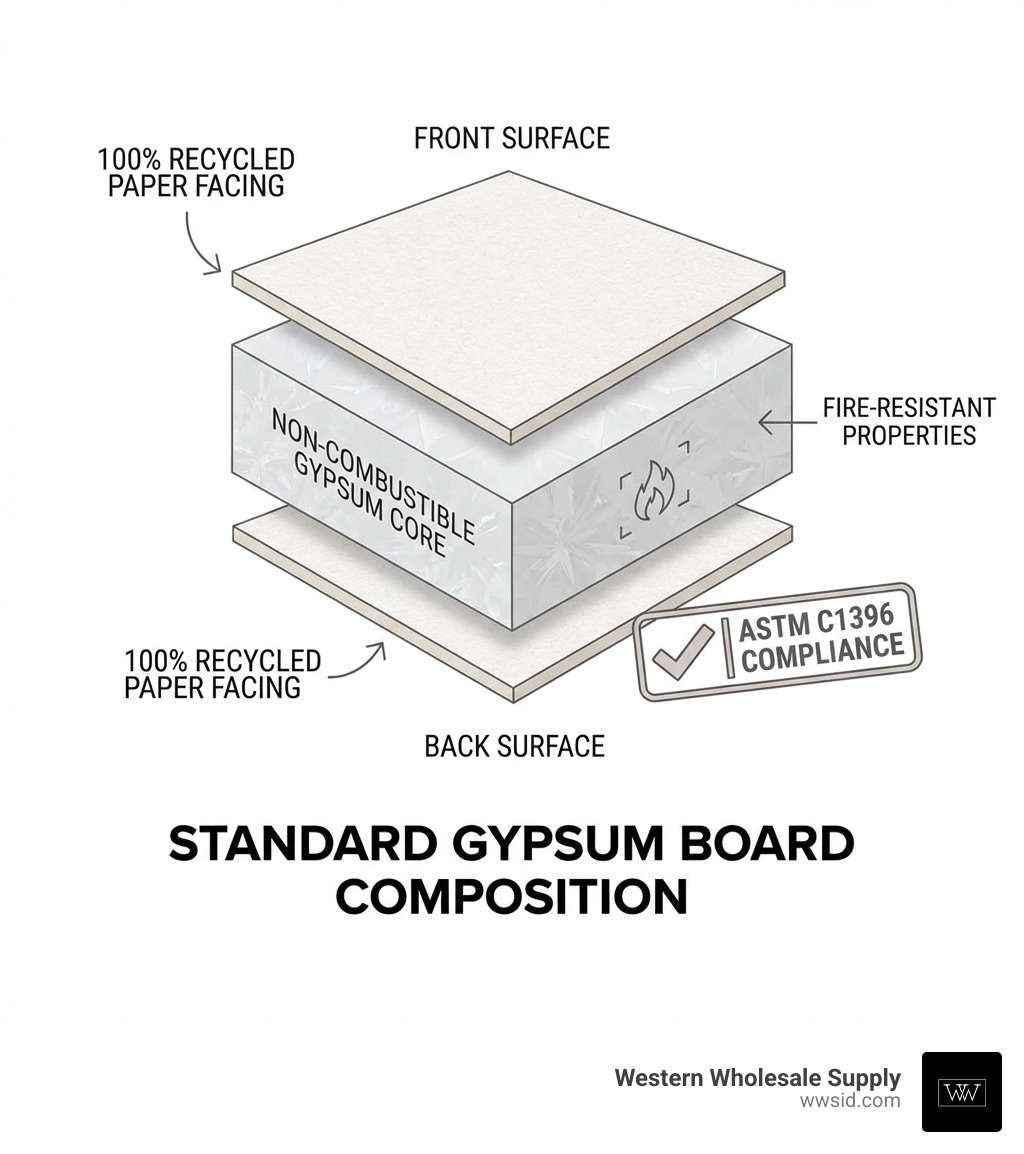
Standard gypsum board is a building material consisting of a non-combustible gypsum core encased in 100% recycled paper facing on both sides, manufactured to meet ASTM C1396 specifications for interior walls and ceilings.
Quick Answer for Contractors:
- Composition: Fire-resistant gypsum core + recycled paper facing
- Standard Sizes: 1/4″, 3/8″, 1/2″, 5/8″ thick × 4 ft wide × 8-12 ft long
- Key Standard: ASTM C1396 defines manufacturing requirements
- Common Types: Regular, Type X (fire-rated), Type C (improved fire-rated), moisture-resistant
- Applications: Interior walls, ceilings, partitions requiring decoration or fire protection
Every construction project relies on materials meeting specific performance standards. When you order gypsum board—also known as drywall or wallboard—you expect a product manufactured to precise specifications. These specs are defined by ASTM C1396, the industry standard ensuring every sheet delivers consistent quality, fire resistance, and structural integrity.
Understanding what “standard” means can prevent costly delays, failed inspections, and callbacks. The ASTM C1396 specification covers core composition, paper bonding, and physical properties like flexural strength and humidified deflection. This allows you to confidently spec 5/8″ Type X board for a one-hour fire-rated assembly or 1/2″ regular board for standard interior partitions.
This standard also drives manufacturing quality control. ASTM C1264 requires each panel to be marked with the manufacturer, production date, and country of origin. These details are vital for verifying code compliance or tracking product information for an inspector.
At Western Wholesale Supply, we’ve helped contractors across Idaho and Wyoming source the right standard gypsum board for their projects since 1994. Our experience in operations and distribution has taught us that understanding the standards behind the materials you install makes every job smoother—from ordering to final inspection.
Decoding the “Standard”: What ASTM C1396 Means for Gypsum Board
Standard gypsum board refers to products adhering to ASTM C1396, the “Standard Specification for Gypsum Board.” This critical framework from ASTM International develops technical standards for various materials. For contractors in Eastern Idaho and Western Wyoming, this standard ensures the drywall we supply meets baseline quality and performance for building codes.
The manufacturing process begins with calcined gypsum (gypsum heated to remove most of its water). This is mixed with water and additives to form a slurry, which is poured between two sheets of 100% recycled paper. As the gypsum core sets and dries, it forms a rigid, non-combustible panel with the paper bonded to its core. This composite design gives gypsum board its unique balance of strength, fire resistance, and workability.
ASTM C1396 dictates the composition, physical properties, and dimensions that this final product must achieve. It ensures that every sheet you get from us is consistent, reliable, and ready for your project. This dedication to standards means that when you’re working on a residential development in Idaho Falls or a commercial build in Pocatello, you’re using materials that have been rigorously defined for quality assurance.
Learn more about drywall products from Western Wholesale Supply.
What Standards Govern Gypsum Board?
Beyond ASTM C1396, several other standards and organizations play a crucial role in governing the manufacturing and performance of standard gypsum board:
- ASTM International: ASTM C1396 is the primary specification for the board itself. However, other ASTM standards cover application procedures (like C840), sampling, inspection, and marking (C1264). ASTM C1264 is particularly important, as it mandates specific information—manufacturer’s name/code, date/time of manufacture, and country of origin (USA or CAN)—to be clearly printed on the back of each panel. This helps us ensure traceability and compliance.
- The Gypsum Association (GA): This organization actively participates in standards-setting and publishes valuable resources. Their GA-223 publication, “Gypsum Panel Products Types, Uses, Sizes, and Standards,” provides a comprehensive listing of ASTM standards related to gypsum panel products. Another invaluable resource is the GA-600 “Fire Resistance and Sound Control Design Manual,” which is referenced by major building codes. This manual details over 600 systems for fire-rated walls, partitions, and floor/ceiling assemblies, and it’s updated every three years.
- UL Type Designations: Underwriters Laboratories (UL) provides specific type designations for fire-rated gypsum board products. These designations (like Type X or Type C, which we’ll discuss more below) identify products that have undergone rigorous testing to meet specific fire-resistance standards. They are crucial for architects and builders in Idaho and Wyoming to ensure their projects comply with fire safety codes. These UL type designations are stamped on the back of classified gypsum board products, providing clear identification.
These standards ensure uniformity, establish a quality baseline, and contribute to the construction of safe and high-performing buildings across our service areas.
Gypsum Panel Products Types, Uses, and Standards (GA-223).
Sustainability and Composition
The environmental aspects of standard gypsum board are increasingly important. We’re proud to offer products that contribute to more sustainable building practices.
The core of most standard gypsum board is, of course, gypsum. This natural mineral is non-toxic and recyclable. Many manufacturers now encase this gypsum core in 100% recycled face and back papers. This commitment to using recycled materials helps reduce waste and conserve natural resources.
Beyond recycled content, the focus on indoor air quality is paramount. Many standard gypsum board products, including those we carry, achieve UL GREENGUARD Gold Certification. This certification means they qualify as low VOC (Volatile Organic Compound) emitting materials, meeting stringent standards like California Specification 01350. This is a significant benefit for any project in Idaho or Wyoming, as it contributes to healthier indoor environments for occupants.
For those looking for even deeper dives into a product’s environmental footprint, some manufacturers provide Health Product Declarations (HPDs) and Environmental Product Declarations (EPDs). These documents offer transparent, third-party verified information about a product’s ingredients and its life-cycle environmental impacts, aligning with green building certifications.
Key Properties and Common Types of Standard Gypsum Board
Standard gypsum board is engineered with specific properties to perform reliably in various construction applications. Understanding these characteristics helps us guide you to the right product for your project.
A critical property is fire resistance. The non-combustible gypsum core contains chemically combined water (CaSO₄·2H₂O). When exposed to fire, this water is released as steam, retarding heat transfer and slowing flames. The core won’t support combustion or transmit temperatures above 212°F (100°C) until completely calcined (all water is driven off). This inherent fire resistance is a cornerstone of building safety.
Dimensional stability is another key property. Gypsum board resists warping, rippling, or buckling under normal changes in temperature and humidity, ensuring walls and ceilings remain smooth.
While not designed for heavy structural loads, gypsum board offers a good strength-to-weight ratio for interior finishes. It’s sturdy enough to create solid walls and ceilings, yet light enough for efficient handling and installation.
For projects requiring improved quiet, sound control is a property we can achieve with specific gypsum board applications. For example, using 1/4 inch panels as an additional layer in partitions can improve sound attenuation.
Finally, the ease of installation is a huge benefit. Gypsum board is designed to be lightweight, easy to score and snap, and simple to fasten, which speeds up construction and reduces labor costs.
Understanding Standard Gypsum Board Dimensions
When ordering standard gypsum board, knowing the common dimensions is key to efficient planning and minimizing waste.
Thicknesses:
The most common thicknesses you’ll encounter for walls and ceilings are:
- 1/4 inch (6.4 mm): This lightweight option is often used for overlaying existing interior wall surfaces (think remodeling an old, uneven wall) or in double layers to form curved surfaces with short radii. It can also be used as an additional layer for sound control in partitions.
- 3/8 inch (9.5 mm): Also lightweight and cost-effective, 3/8 inch board is suitable for single-layer applications on interior walls or over existing gypsum board or masonry walls. It’s often used in double-wall systems over wood framing and for repair and remodeling projects.
- 1/2 inch (12.7 mm): This is the most common thickness for general interior wall and ceiling applications in residential construction.
- 5/8 inch (15.9 mm): Often referred to as “Type X” (which we’ll cover next), 5/8 inch board provides improved fire resistance and is frequently specified for fire-rated assemblies, commercial projects, and sometimes for ceilings to minimize sag.
Widths:
The standard widths for most standard gypsum boards are 4 feet (48 inches) and 4.5 feet (54 inches) 54 inch wide boards are often stacked on top of each other for ease of installation on 9 ft tall walls.
Lengths:
While widths are fairly consistent, lengths can vary depending on the manufacturer and the project’s needs. Common lengths include:
- 8 feet
- 10 feet
- 12 feet
These dimensions, along with tight tolerances for thickness, width, length, and edge squareness (as detailed in ASTM C36/C36M-03, for example), ensure that panels fit together accurately and consistently, leading to a smooth, professional finish.
Different Types of Gypsum Board and Their Uses
While “standard” typically refers to regular gypsum wallboard, ASTM C1396 covers a variety of gypsum board types, each custom for specific applications. Here’s a quick look at the most common types you’ll encounter on projects in Idaho and Wyoming:
| Board Type | Key Features | Common Applications |
|---|---|---|
| Regular Gypsum Board | Non-combustible gypsum core, paper-faced, general-purpose. | Standard interior walls and ceilings where no special fire, moisture, or abuse resistance is required. |
| Type X (Fire-Rated) | Improved fire-resistant core (often 5/8″ thick), defined by ASTM C1396. | Fire-rated wall and ceiling assemblies (e.g., 1-hour fire-rated walls), often required in garages, multi-family dwellings, and commercial buildings. |
| Type C (Improved Fire-Rated) | Type X with special additives for even greater fire resistance, not ASTM-defined but UL-classified. | More demanding fire-rated assemblies, especially horizontal applications like floor/ceiling or roof/ceiling systems, where higher fire resistance is needed in a thinner board. |
| Water-Resistant Board | Water-resistant core and paper facing, often green or blue. | As a base for bathrooms, kitchens, and other areas with potential moisture exposure. |
| Shaftliner Board | Thicker, often specialized core, used in shaft wall assemblies. | Vertical shaft enclosures (e.g., elevator shafts, stairwells) where high fire ratings and structural integrity are crucial. |
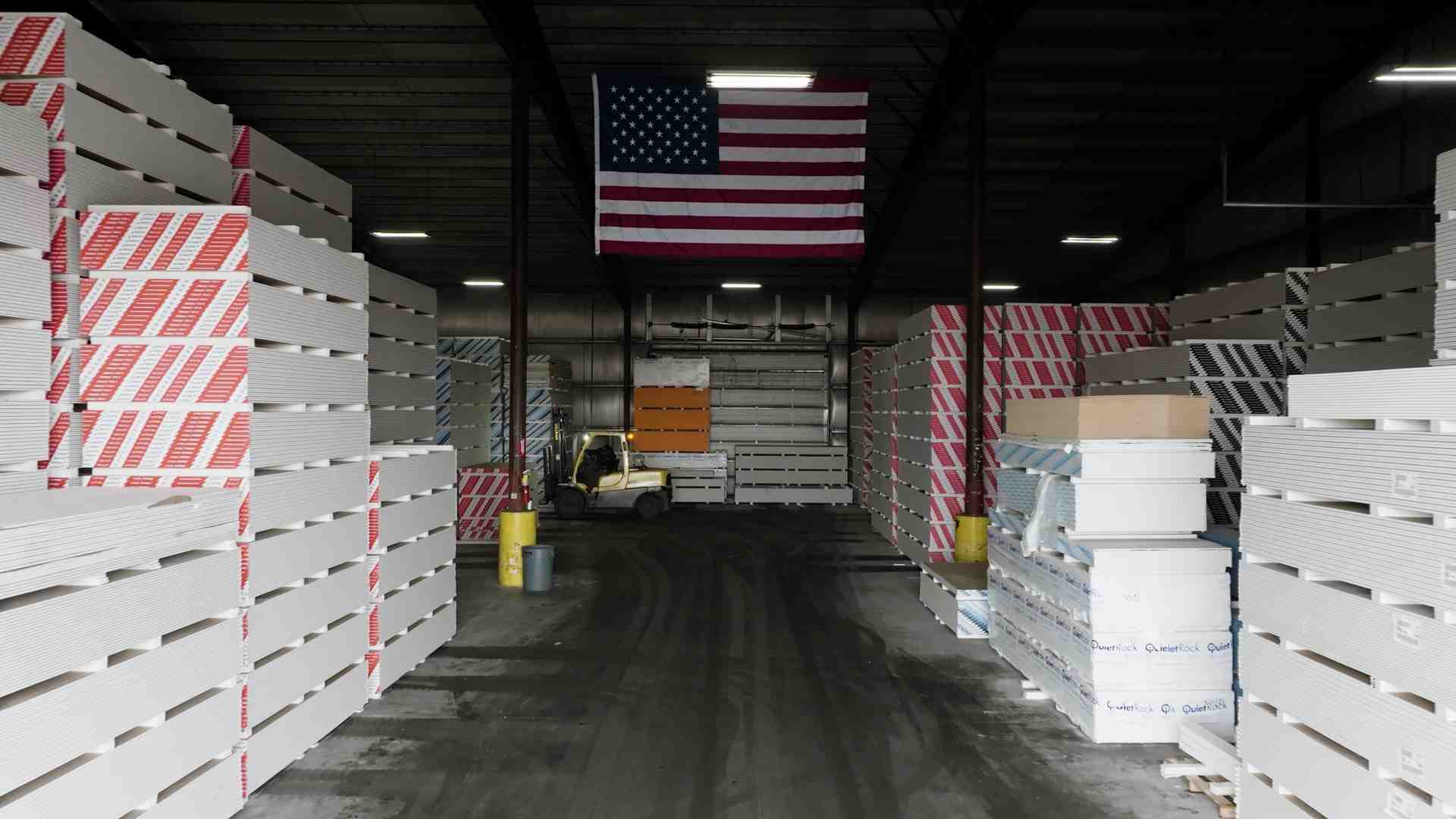
We stock a range of these specialized boards to ensure you have the right material for every part of your project, from a standard living room wall to a fire-rated shaft.
Benefits of Using Standard Gypsum Board
The widespread use of standard gypsum board is a testament to its numerous advantages in construction:
- Cost-Effective: Compared to many other wall and ceiling finishing materials, gypsum board is relatively inexpensive to purchase and install, making it a budget-friendly option for most projects.
- Versatility: From flat walls to gentle curves (with thinner panels), and from basic partitions to specialized fire-rated assemblies, gypsum board can adapt to a vast array of design requirements. It readily accepts a wide range of decorative finishes, including paint, wallpaper, and textures.
- Quick Installation: Its lightweight nature, ease of cutting (score and snap!), and standard sizes contribute to rapid installation, saving significant labor time on the job site. Features like GridMarX® guide marks on some boards further accelerate and improve accuracy during installation.
- Smooth Finish: When properly installed and finished, gypsum board provides a seamless, smooth surface that is ideal for decorative treatments.
- Fire Safety: As we’ve highlighted, the non-combustible gypsum core provides inherent fire resistance, a critical safety feature that protects occupants and structures. This property is a primary reason for its universal adoption in building codes.
- Acoustic Performance: While not an acoustic panel itself, gypsum board can contribute to sound control, especially when used in multi-layered assemblies, installed with RC-1 or furring channel with sound isolation clips, and/or with specific insulation, helping to create quieter interior spaces.
These benefits combine to make standard gypsum board an indispensable material for residential and commercial construction across Idaho and Wyoming.
Installation, Finishing, and Best Practices
Proper installation and finishing are essential for standard gypsum board to perform and look its best. With over 60 years of experience, we know how to ensure a smooth drywall job.
Handling and storage are crucial. Gypsum board should always be stored flat on a dry, level surface, preferably off the ground, to prevent sagging, warping, and moisture damage. Protect it from the elements, especially rain and excessive humidity, which can compromise the board’s integrity.
For cutting, the “score and snap” method is fastest. Score the face paper with a utility knife, snap the board back, and cut the back paper. This is much cleaner than sawing.
Fastening the board securely to the framing (wood or metal studs and joists) is paramount. Proper screw or nail length and spacing are critical to prevent “nail pops” and ensure the board is held firmly. Always ensure fasteners penetrate the framing adequately.
For framing, standard practice involves spacing studs 16 or 24 inches on center. The edges of the gypsum board should typically fall on the center of a stud or joist.
Taping and finishing creates the final look. The tapered long edges of standard gypsum board are designed to create a slight recess when two panels are butted together. This recess is filled with joint compound and reinforced with joint tape for a smooth, invisible seam. Butt joints (where the non-tapered ends meet) require more feathering with compound.
The quality of the finish is often categorized into Level 0 to Level 5 finish standards:
- Level 0: No finishing, just installed board.
- Level 1: Tape embedded in joint compound, primarily for fire rating in concealed areas.
- Level 2: Thin coat of joint compound over tape and fasteners, for areas to be covered by heavy textures.
- Level 3: Two coats of compound over tape and fasteners, suitable for light textures or heavy-grade wallcoverings.
- Level 4: Three coats of compound over tape and fasteners, for smooth finishes that will be painted with flat paint. This is the most common finish for residential and commercial spaces.
- Level 5: A skim coat of joint compound over the entire surface, providing the smoothest possible finish, ideal for glossy paints or critical lighting conditions.
Achieving these levels requires skill and attention to detail, ensuring a professional and durable finish.
Learn more about joint treatments and trims.
Installation Considerations
A few features and techniques can make your standard gypsum board installation even smoother:
- GridMarX® Guide Marks: Some manufacturers incorporate GridMarX® guide marks directly on the board. These marks help identify stud locations and cut lines, allowing for faster and more accurate installation.
- Tapered Edges: Always use the tapered long edges for joints that will be visible. These edges are specifically designed to be reinforced and concealed with joint treatment systems, creating a perfectly flat wall surface.
- Butt Joints: For ends that don’t have a taper, known as butt joints, you’ll need to feather out the joint compound over a wider area to avoid a noticeable hump. Some installers slightly bevel the edges of butt joints to help with this.
- Proper Fastener Spacing: Follow manufacturer recommendations and local building codes for screw or nail spacing. Typically, fasteners are placed every 7 inches on ceilings and every 12 inches on walls. Over-driving fasteners can break the paper face, reducing holding power, while under-driving them can lead to popped fasteners later.
For estimating the materials you’ll need, tools like the USG Sheetrock Wallboard Estimator can be incredibly helpful.
Common Issues and How to Address Them
While standard gypsum board is a durable material, it can encounter issues. Knowing how to prevent and address them is key:
- Moisture Damage: This is a primary concern for standard gypsum board. Prolonged exposure to moisture can cause the gypsum core to soften, the paper to delaminate, and mold to grow.
- Prevention: In areas prone to moisture (like bathrooms, laundry rooms, or kitchens), always use water-resistant gypsum board or specialized mold-resistant panels behind tile or in shower enclosures. Ensure proper ventilation.
- Addressing: For minor water stains, ensure the source of moisture is fixed, then cut out and replace the damaged section. For extensive damage, full panel replacement is necessary.
- Cracks: Cracks can appear in joints or the field of the board.
- Prevention: Proper framing, correct fastening, and thorough joint finishing with adequate drying time are key. Structural movement in the building can also cause cracks.
- Addressing: Small cracks can be re-taped and re-finished. Larger cracks may indicate underlying structural issues that need to be addressed before repair.
- Popped Nails/Screws: This happens when fasteners work their way out from beneath the joint compound, creating unsightly bumps.
- Prevention: Ensure fasteners are driven just below the surface of the paper, not breaking it, and securely into the framing. Use appropriate length fasteners. Wood framing that dries and shrinks can also contribute.
- Addressing: Drive the popped fastener back in (or add a new one nearby), then cover with joint compound and feather smoothly.
- Dents and Holes: Accidents happen on job sites and in finished homes.
- Prevention: Careful handling during installation and protection of finished surfaces.
- Addressing: Small holes can be patched with joint compound. Larger holes (up to a few inches) can be repaired with a patch kit or by cutting out a square and inserting a new piece of drywall.
By understanding these common challenges and implementing best practices, you can ensure your gypsum board installations are long-lasting and beautiful.
Frequently Asked Questions about Gypsum Board
What is the difference between Type X and Type C gypsum board?
- Type X Gypsum Board: This is the most common fire-rated standard gypsum board. It’s defined by ASTM C1396 and typically comes in 5/8-inch thickness, though 1/2-inch Type X also exists. The key is its specially formulated core with glass fibers, which helps the board maintain its integrity longer when exposed to fire. When installed in specific assemblies, 5/8-inch Type X can provide a 1-hour fire resistance rating, while 1/2-inch Type X can achieve a 3/4-hour rating.
- Type C Gypsum Board: Think of Type C as “Type X Plus.” It’s not explicitly defined by an ASTM standard in the same way Type X is, but it’s recognized by UL as a Type X product with additional additives in its core. These special additives provide even greater fire resistance, often allowing for thinner panels or fewer layers to achieve the same or higher fire ratings. Type C is frequently used in demanding fire-rated assemblies, particularly in horizontal applications like floor/ceiling or roof/ceiling systems, where its improved performance can be critical.
Both offer fire resistance, but Type C provides superior performance due to its advanced core composition. Always check the specific UL assembly requirements for your project to determine which type is needed.
How does standard gypsum board compare to traditional plaster?
While standard gypsum board is the modern standard, it’s helpful to compare it to its predecessor, traditional plaster:
-
Standard Gypsum Board:
- Construction: “Dry construction” method. Panels are cut, fastened, and then joints are taped and finished.
- Installation: Much faster and less labor-intensive. Requires fewer specialized skills than traditional plastering.
- Drying Time: Relatively quick, primarily involving the drying of joint compound, typically 24-48 hours per coat.
- Finish: Provides a smooth, uniform surface, though a Level 5 finish may be needed for truly flawless results.
- Repair: Relatively easy to patch and repair.
-
Traditional Plaster:
- Construction: “Wet construction” method. Involves applying multiple coats of wet plaster over a lath (wood, metal, or gypsum lath).
- Installation: Highly labor-intensive, requiring skilled plasterers and taking significantly longer due to multiple coats and drying times.
- Drying Time: Much longer, often weeks, as each wet coat must cure properly.
- Finish: Can achieve a very hard, durable, and seamless finish, often seen as having a unique depth or character.
- Repair: More complex and typically requires specialized plastering skills to match existing finishes.
While traditional plaster offers exceptional durability and a unique aesthetic, standard gypsum board dominates modern construction due to its speed, cost-effectiveness, and ease of installation, making it the practical choice for most projects.
Can I use standard gypsum board in a bathroom?
The short answer is: standard gypsum board should not be used in areas directly exposed to moisture or as a tile backer.
Standard gypsum board is designed for general interior use and is not inherently water-resistant. If it gets wet, the paper facing can delaminate, and the gypsum core can soften and lose integrity, leading to mold growth and structural failure.
For bathrooms, especially around showers, tubs, and behind sinks, we strongly recommend using:
- Water-Resistant Gypsum Board: This type of board (often green or blue colored) has a water-resistant core and paper facing. It’s designed to resist moisture, but it’s not waterproof and should not be used in direct water immersion areas (like inside a shower pan without a waterproof membrane).
- Tile-Backer Board: This type of board is a water resistant gypsum-based panel designed specifically as a substrate for tile. It is a rigid panel with a built-in waterproof coating on the face. It is lighter and easier to cut than cement board. Tile can be installed directly on the coated face, no separate vapor barrier is required on the surface.
Always ensure proper ventilation in bathrooms to manage humidity, regardless of the wall material. Using the right material in the right place prevents costly water damage and ensures a long-lasting, healthy environment.
Conclusion
From ASTM C1396 specifications to its many applications, we’ve seen that standard gypsum board is far from basic. The term “standard” signifies a product adhering to rigorous industry benchmarks for quality, performance, and safety.
Its versatility, ease of installation, and inherent fire resistance make it an invaluable material in modern construction. ASTM C1396 serves as our quality benchmark, ensuring that the gypsum board you purchase from us, and install in your projects across Eastern Idaho and Western Wyoming, will perform as expected.
As your trusted partner at Western Wholesale Supply, we understand the importance of choosing the right type of gypsum board for each specific application. With over 60 years of experience, we pride ourselves on reliable, on-time delivery and exceptional customer service. We’re here to help you steer the options and ensure your projects are built to last.
Find the right drywall for your project in Idaho or Wyoming.
