

Why Guessing on Materials Costs You More Than You Think
A construction material calculator is a digital tool that estimates the exact quantity of materials — concrete, lumber, drywall, insulation, roofing, and more — needed for a construction project based on your dimensions and project type.
Quick answer: Here are the most common construction material calculators and what they solve:
| Calculator Type | What It Estimates |
|---|---|
| Concrete Calculator | Cubic yards, bag counts, slab/footing volumes |
| Framing Calculator | Studs, top and bottom plates, waste factor |
| Drywall Calculator | Panel count, coverage area, fastener needs |
| Ceiling Grid Calculator | Main runners, cross-tees, ceiling wire |
| Insulation Calculator | R-value requirements, square footage coverage |
| Roofing Calculator | Shingles, sheathing, pitch adjustments |
Every one of these tools exists to solve the same core problem: ordering too much or too little material wastes time and money on every job.
Contractors who skip material calculators often end up making expensive last-minute runs to the supply house or sitting on leftover materials they can’t use. Neither outcome is good for your bottom line or your schedule.
At Western Wholesale Supply, we are third-generation building materials professionals, and we’ve seen how a reliable construction material calculator prevents the costly ordering errors that slow projects down. In the sections below, we’ll walk through the most useful calculators for every phase of your build.
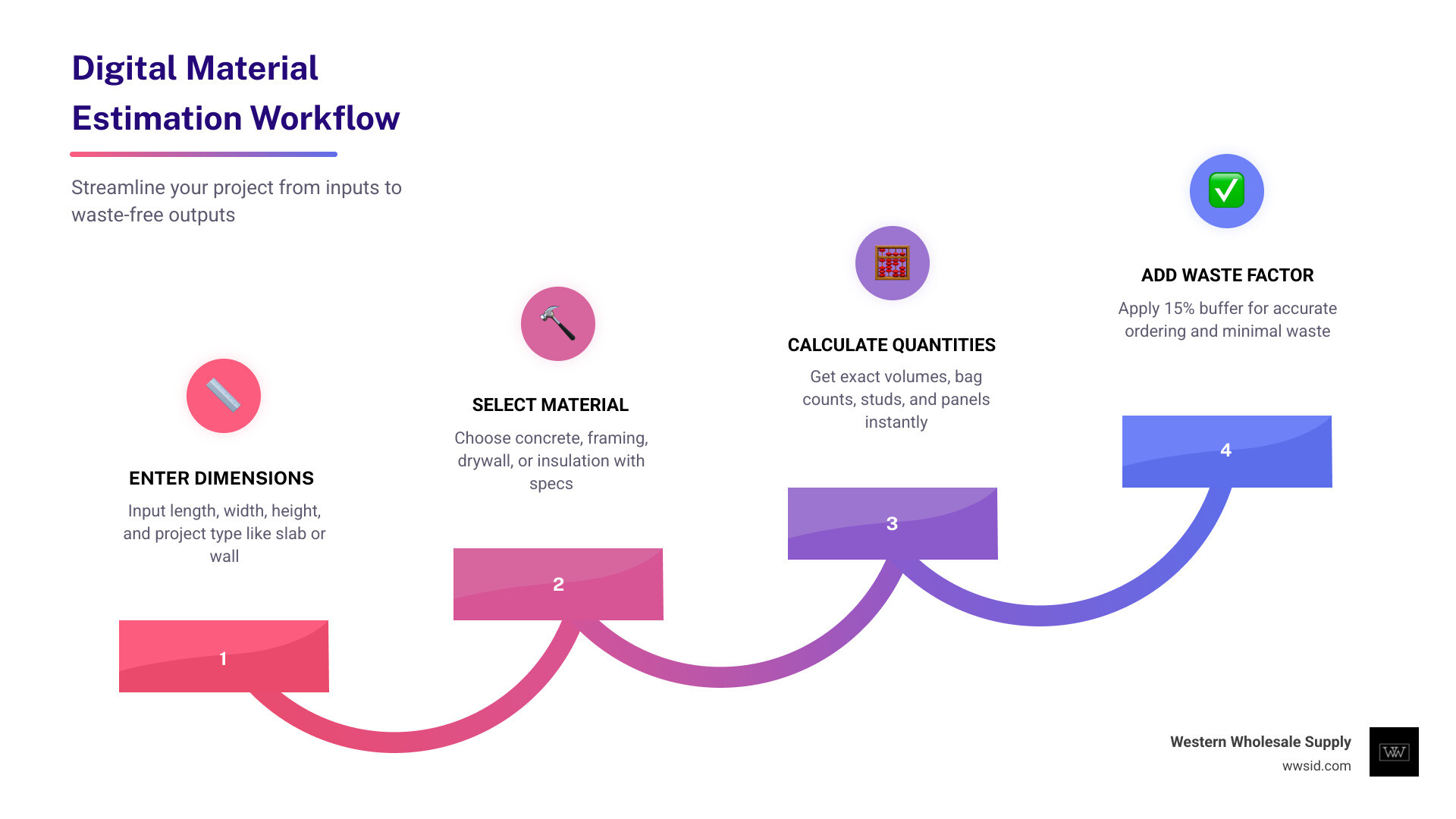
The Essential Role of a Construction Material Calculator in Modern Building
In the world of construction across Eastern Idaho and Western Wyoming, precision isn’t just a goal; it’s a requirement for staying profitable. At Western Wholesale Supply, we’ve seen how the right construction material calculator transforms a rough guess into a professional bid. Whether you are a professional contractor or a dedicated DIYer, these tools bridge the gap between architectural plans and the physical materials staged for delivery.
The primary benefit of using a Construction Materials Calculator – Estimate Building Materials is the drastic reduction in waste. In our 60 years of experience, we’ve observed that a standard 15% material waste factor is common, but without a calculator, that number often balloons to 25% or more. These tools handle complex unit conversions—like turning square footage into pounds of cement or linear feet of wall into the number of studs—with clicks instead of confusing mental math.
For the professional, a digital estimate provides a level of transparency that builds trust with clients. For the DIY enthusiast, it ensures that your weekend project in Jackson, WY, or Idaho Falls doesn’t involve five extra trips to the store because you forgot to account for the top and bottom plates in your framing.

Concrete Volume and Bag Requirements for Every Shape
Concrete is one of the most unforgiving materials in construction. If you order too little, you face the dreaded “cold joint,” where new concrete is poured against already-hardened material, creating a structural weak point. If you order too much, you’re literally throwing money away.
A reliable Concrete Calculator – Volume, Bags & Cost Estimator is essential for determining cubic yards for slabs, footings, and walls. For example, a standard 10ft x 10ft x 4-inch slab requires exactly 1.23 cubic yards of concrete. But how does that translate to bags if you aren’t using a ready-mix truck?
Using a Concrete Construction Material Calculator for Accurate Bag Counts
When you’re working on smaller projects like a patio in Rexburg or a sidewalk in Rigby, you’ll likely use pre-mix bags. Yield rates vary significantly by bag weight:
- 80 lb bags: Yield approximately 0.60 cubic feet (requires ~45 bags per cubic yard).
- 60 lb bags: Yield approximately 0.45 cubic feet (requires ~60 bags per cubic yard).
- 40 lb bags: Yield approximately 0.30 cubic feet (requires ~90 bags per cubic yard).
Beyond simple slabs, calculators help you account for irregular shapes and sloped areas. If you are pouring a sloped driveway, you must use the average thickness—calculated by adding the minimum and maximum thickness and dividing by two—to get an accurate volume. Don’t forget the reinforcement! While rebar or wire mesh doesn’t change the volume of concrete needed, it is vital for structural integrity in our fluctuating Idaho climate.
Always remember the curing timeline: concrete reaches 70% strength at 7 days and its full design strength at 28 days. Keep it damp during those first few days to ensure it doesn’t crack under the Western Wyoming sun.
Framing and Drywall: Estimating Studs, Plates, and Quietrock EZ Snap
Wall construction requires more than just counting the studs you see. A proper construction material calculator for framing must account for vertical studs, top plates, and bottom plates.
For a standard wall with 16-inch on-center (OC) spacing, the formula is generally: (Wall Width / On-Center Spacing) + 1. However, you must also add plate studs. Since most residential and commercial walls use double top plates and a single bottom plate, you need to factor in three horizontal runs of lumber for every wall length. We recommend adding a 15% waste factor to account for scrap and framing around windows or doors.
When it comes to finishing those walls, the USG Sheetrock Wallboard Estimator is a lifesaver. It calculates the number of panels needed based on total square footage. For projects requiring superior sound dampening—like a home theater in Victor or a multi-family unit in Chubbuck—we highly recommend Quietrock EZ Snap. It provides high-performance soundproofing without the need for complex multi-layer drywall installations.
To ensure your drywall stays put, use the National Gypsum Drywall Materials Calculator to estimate joint compound and fasteners. Using specialized tools like the Max Savings Calculator can even show you how specific fastener patterns can reduce labor and material costs.
Optimizing Specialized Installs: Acoustical Ceilings and Insulation
In large-scale commercial projects or warehouses in the South East Idaho region, efficiency is king. This is where specialized calculators for ceilings and insulation become indispensable.
Streamlining Projects with a Ceiling Construction Material Calculator
Installing a suspended ceiling is a puzzle of main runners, cross-tees, and wire. The USG Ceiling Material Estimator or the USG Ceiling Material Estimator Tool allows you to input room dimensions and perimeter length to generate a complete material list.
A pro tip we always share: use four pieces of ceiling wire per 12-foot main runner. Ensure the wire length is the distance from the ceiling to the anchor plus an extra two feet for secure tying. At Western Wholesale Supply, we carry premium CertainTeed ceiling tiles that pair perfectly with these calculated grid layouts for a clean, professional look.
For insulation, calculating the correct R-value is critical for managing the HVAC workload in our cold winters. In warehouse environments, high-performance insulation provides massive thermal benefits, keeping the space usable year-round while slashing energy bills. By using an insulation calculator, you can determine the exact square footage of batts or blown-in material needed to meet local building codes in Jackson or Twin Falls.
Avoiding Costly Mistakes in Material Takeoffs
Even with the best construction material calculator, human error can creep in. Here are the most common pitfalls we see:
- Underestimating Waste: Never assume a “perfect” fit. Always add 5-10% extra for concrete and up to 15% for lumber and drywall.
- Ignoring Site Prep: Uneven subgrades or over-excavation can lead to a concrete shortage. Always round up your concrete order.
- Weather Impacts: Pouring concrete in extreme heat or cold without proper additives can lead to structural failure.
- Price Volatility: Lumber is a commodity. A material list from three months ago might fit your dimensions, but it won’t fit your current budget.
- Measurement Errors: Mixing up inches and feet is the fastest way to ruin a project. Always double-check your inputs.
Frequently Asked Questions about Material Calculation
How much extra material should I order for waste?
For most framing and drywall projects, a 15% waste factor is the industry standard. This covers scrap, mistakes, and breakage during transport. For concrete, we recommend a 5-10% overage to account for spillage and uneven ground.
How many 80lb bags of concrete are in a cubic yard?
There are approximately 45 bags of 80lb pre-mix concrete in one cubic yard. Each 80lb bag yields about 0.60 cubic feet. If your project requires more than one cubic yard, we often suggest looking into ready-mix delivery to save on labor.
How do I calculate materials for irregular room shapes?
The best method is “sectional volume.” Break the irregular space down into simple rectangles, triangles, or circles. Calculate the volume for each section individually and then add them together for your total.
Conclusion
At Western Wholesale Supply, we believe that being a great contractor starts with great planning. As a veteran-owned, third-generation family business, we’ve spent over 60 years helping builders in Eastern Idaho, Western Wyoming, and beyond get the job done right. From the first stud to the final CertainTeed ceiling tile, we are here to provide the quality materials and reliable, on-time delivery you need.
Ready to start your next project with precision? More info about our products is just a click away. Whether you’re in Idaho Falls, Pocatello, or Jackson, let us help you turn those calculator estimates into a reality.
