

Why Choosing the Right Building Insulation Materials Matters
Building insulation materials form the thermal envelope of every structure, reducing heat transfer and directly impacting energy costs, occupant comfort, and long-term building performance. With heating and cooling accounting for 50 to 70% of energy use in the average home, inadequate insulation and air leakage remain leading causes of energy waste.
Main types of building insulation materials:
- Batts and Blankets – Fiberglass or mineral wool fitted between studs (R-3.1 to R-4.3 per inch)
- Loose-Fill – Blown cellulose or fiberglass for attics and hard-to-reach areas (R-2.2 to R-3.8 per inch)
- Rigid Board – Polystyrene or polyisocyanurate for continuous insulation (R-3.6 to R-6.8 per inch)
- Spray Foam – Closed-cell (R-5 to R-8 per inch) or open-cell (R-3 to R-4 per inch) polyurethane
- Structural Systems – Insulating concrete forms (ICFs) and structural insulated panels (SIPs) for integrated construction
Key factors when selecting building insulation materials include R-value per inch, moisture sensitivity, ease of installation, fire safety requirements, and environmental impact. Closed-cell spray foam provides the highest thermal resistance but costs more than fiberglass batts, while cellulose offers excellent value for attic retrofits at 80% recycled content.
Different materials suit different applications. Fiberglass batts work well in standard stud spacing with few obstructions, while loose-fill excels in irregular spaces and existing walls. Rigid board provides continuous insulation over framing to eliminate thermal bridging, and spray foam seals air leaks while insulating simultaneously.
Western Wholesale Supply is a third-generation building materials provider serving contractors across Eastern Idaho and Western Wyoming with hands-on experience sourcing and supplying building insulation materials for residential and commercial projects. This guide breaks down the performance characteristics, installation requirements, and real-world applications of each insulation type so you can match the right material to your project’s specific needs.
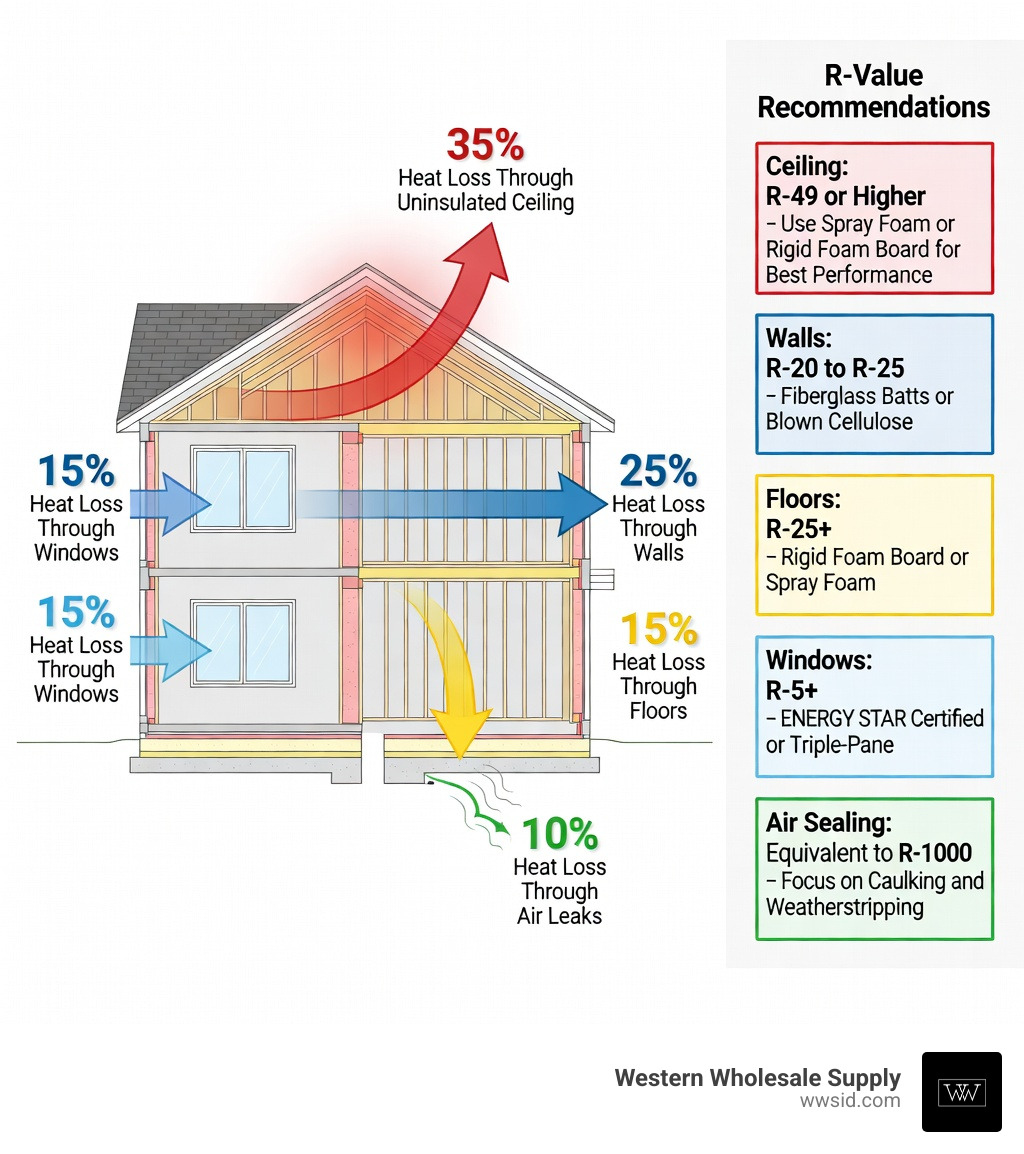
Understanding R-Value and Thermal Performance
When we talk about how well building insulation materials work, we use a term called “R-value.” Simply put, R-value measures a material’s thermal resistance—its ability to resist the flow of heat. The higher the R-value, the better the material is at keeping the heat in during a cold Jackson hole winter or keeping it out during a hot summer in Twin Falls.
In some technical guides, especially those from our neighbors in Canada, you might see “RSI” values. This is just the metric version of R-value. To convert RSI to R-value, you multiply by 5.678. Whether you are looking at R-value or RSI, the goal is the same: creating a barrier that stops conductive heat flow.
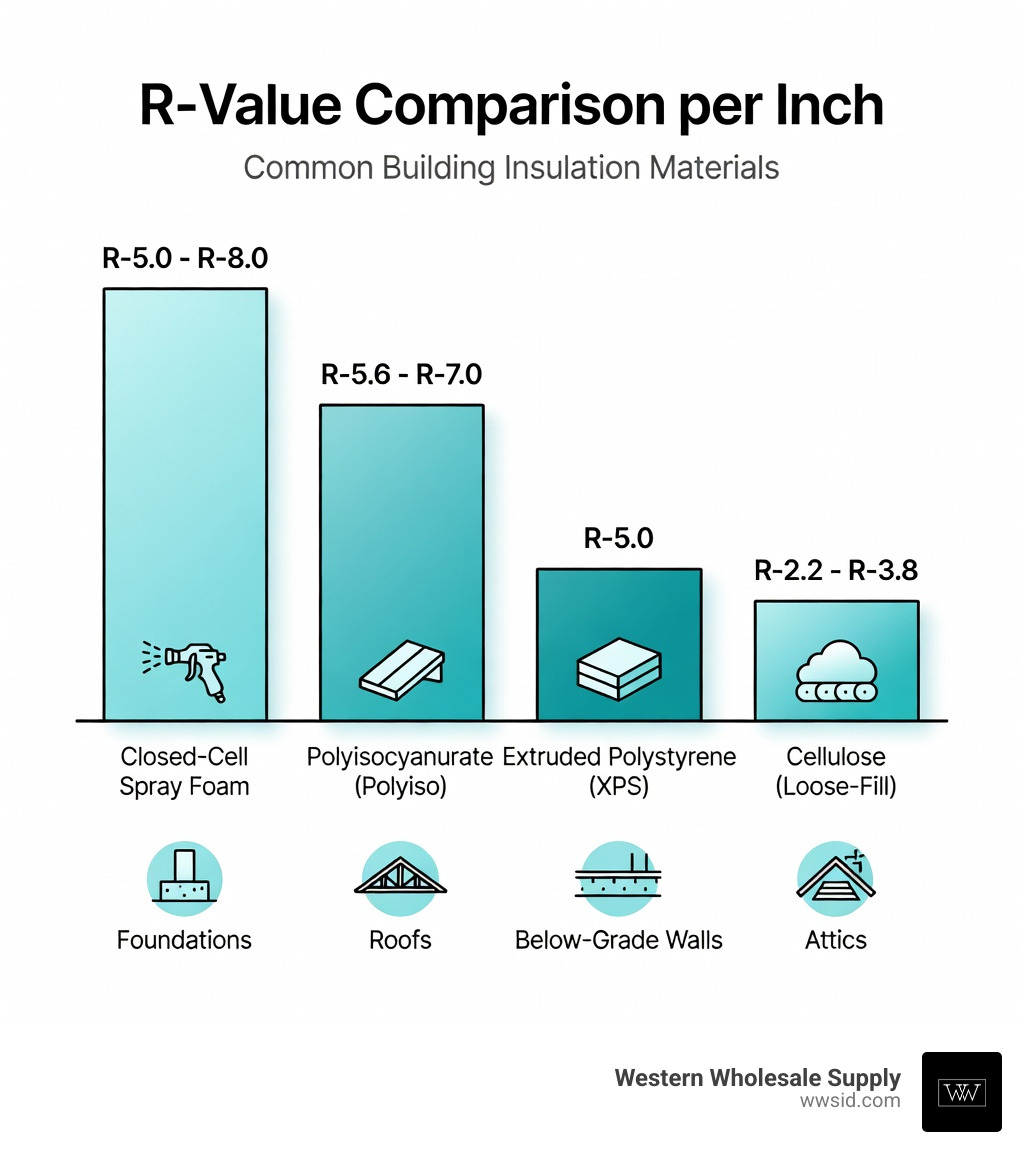
| Material Type | Typical R-Value (per inch) | Common Applications |
|---|---|---|
| Closed-Cell Spray Foam | R-5.0 to R-8.0 | Foundations, exterior walls, unvented attics |
| Polyisocyanurate (Polyiso) | R-5.6 to R-7.0 | Roofs, continuous wall insulation |
| Extruded Polystyrene (XPS) | R-5.0 | Below-grade walls, slabs |
| Expanded Polystyrene (EPS) | R-3.6 to R-4.0 | SIPs, insulated siding, foundations |
| Cellulose (Loose-fill) | R-3.2 to R-3.8 | Attic floors, enclosed wall cavities |
| Fiberglass (Batts/Rolls) | R-3.1 to R-4.3 | Standard stud walls, floors, ceilings |
| Mineral Wool (Batts) | R-3.1 to R-3.4 | Fire-rated assemblies, soundproofing |
For a deeper dive into these metrics, the Energy.gov guide to insulation materials provides excellent technical background on how these values are calculated across the industry.
Factors Influencing Building Insulation Materials Performance
It isn’t just about the material itself; how it’s installed in your Idaho Falls or Pocatello home matters just as much. Several factors can “cheat” you out of the R-value you paid for:
- Thickness and Density: If you squeeze an R-19 fiberglass batt into a 3.5-inch wall cavity, you’re actually losing R-value because you’ve removed the air pockets that do the heavy lifting.
- Temperature: Some materials, like polyiso, can actually see a dip in performance when it gets extremely cold—a major consideration for our Western Wyoming customers.
- Moisture Accumulation: Wet insulation is often useless insulation. For example, fiberglass loses significant performance if it becomes damp.
- Thermal Bridging: This is a big one. Heat flows more readily through wood studs and metal framing than through insulation. This “bridge” allows heat to bypass your insulation entirely.
At Western Wholesale Supply, we emphasize the importance of professional insulation services and proper selection to mitigate these issues.
Long-Term Thermal Resistance (LTTR)
If you’re looking at high-performance foams, you need to know about “thermal drift.” When closed-cell polyurethane or polyiso is first made, the bubbles (cells) are filled with a special blowing gas that insulates better than plain air. Over time—usually within the first two years—some of that gas escapes and is replaced by ordinary air.
This is why we use Long-Term Thermal Resistance (LTTR) values for these products. It represents a 15-year time-weighted average, giving you a more honest look at how the building will perform over its lifespan. For instance, closed-cell spray foam might start at an R-8 but stabilize around R-6.5.
Comparing Common Building Insulation Materials
Choosing between building insulation materials often feels like a balancing act between budget, space, and performance. In the high-desert climate of Eastern Idaho, we often recommend a “hybrid” approach—using different materials where they work best.
Batts, Blankets, and Loose-Fill Options
Fiberglass Batts and Rolls These are the “bread and butter” of the industry. We carry high-quality brands like CertainTeed, which are designed for standard 16-inch or 24-inch stud spacing. They are affordable and relatively easy to install. However, they struggle in cavities with lots of wiring or plumbing because any gap or compression reduces their effectiveness.
Mineral Wool Often called “rock wool,” this material is a favorite for those prioritizing fire safety and soundproofing. It has a higher melting point than fiberglass and is much denser, making it excellent for keeping a home office quiet or protecting a mechanical room. For superior sound control, we recommend pairing it with Quietrock EZ Snap. It’s also rot-proof and doesn’t lose R-value when damp. You can learn more about the safety of these fibers in the NIOSH Pocket Guide on mineral fibers.
Cellulose If you’re looking for an eco-friendly option, cellulose is king. Made from about 80% recycled paper and treated with borates for fire and insect resistance, it’s a fantastic choice for attic retrofits. In “dense-pack” applications, it can be blown into existing wall cavities to reduce air infiltration. For larger commercial projects, check out our warehouse insulation guide for specific application tips.
Rigid Board and Structural Systems
When you need high R-value in a thin profile or need to stop thermal bridging, rigid boards are the answer.
- Expanded Polystyrene (EPS): The most affordable rigid foam. It’s breathable and works well for foundation walls.
- Extruded Polystyrene (XPS): Usually blue or pink, this is denser and more moisture-resistant than EPS, making it the standard for below-grade applications.
- Polyisocyanurate (Polyiso): This has the highest R-value per inch of any rigid board. It almost always comes with a foil facing, which can act as a radiant barrier if installed next to an air gap.
- Structural Systems (SIPs and ICFs): These aren’t just insulation; they are the structure itself. Structural Insulated Panels (SIPs) use a foam core sandwiched between OSB, while Insulating Concrete Forms (ICFs) act as stay-in-place forms for concrete walls, providing a massive amount of thermal mass and insulation in one step.
The Science of Spray Foam: Open-Cell vs. Closed-Cell
Spray Polyurethane Foam (SPF) has revolutionized how we seal and insulate buildings in places like Driggs and Victor. It’s applied as a liquid and expands into a foam, filling every nook and cranny. We’ve seen many contractors find success expanding into framing and insulation by adding spray foam to their service offerings.
Choosing the Right Spray-Applied Building Insulation Materials
There are two main types of SPF, and choosing the wrong one can be a costly mistake:
Open-Cell Spray Foam
- Density: Very light (0.5 lbs per cubic foot).
- Expansion: It expands massively—up to 100 times its volume in seconds.
- R-Value: Typically R-3.5 to R-3.7 per inch.
- Vapor Permeability: It’s “open,” meaning it allows moisture vapor to pass through. This is good for roof decks where you want to be able to spot a leak.
- Best Use: Interior walls and underside of roof decks in certain climates.
Closed-Cell Spray Foam
- Density: Much denser (2.0 lbs per cubic foot).
- R-Value: The heavyweight champion at R-6.0 to R-7.0+ per inch.
- Vapor Barrier: At 2 inches thick, it acts as its own vapor retarder.
- Structural Strength: It actually adds structural rigidity to the walls.
- Best Use: Foundations, crawlspaces, and exterior walls where space is limited.
For those concerned about the environment, we look for products utilizing Ecomate eco-friendly blowing agents, which have zero ozone depletion potential.
Cementitious and Alternative Foams
For specialized projects, cementitious foams like AirKrete offer a unique alternative. These are magnesium-oxide-based foams that have the consistency of shaving cream when applied. They are completely non-toxic and fireproof. However, they are friable (meaning they can crumble if vibrated) and have no structural strength, so they are mostly used in specific commercial retrofits or for customers with extreme chemical sensitivities.
Barriers, Safety, and Environmental Impact
Insulation is only one part of the “control layers” in a building. To work correctly, it needs friends.
- Air Barriers: These stop air from moving through the envelope. Many spray foams are air barriers, but fiberglass is not.
- Vapor Barriers: These prevent moisture from diffusing through materials and condensing on cold surfaces. In our cold Eastern Idaho climate, the vapor barrier usually goes on the “warm-in-winter” side (the interior).
- Radiant Barriers: These are shiny foils that reflect heat rather than absorbing it. They are most effective in hot attics to keep cooling costs down.
Prohibited Materials and Health Risks
Safety is paramount when handling building insulation materials. We strictly follow modern regulations and ensure our customers have access to the right PPE.
- Asbestos: Prohibited in new products since 2018, but still found in older homes in Rexburg or Rigby (often in vermiculite attic insulation). If you suspect it, don’t touch it—call a pro.
- UFFI (Urea-Formaldehyde Foam Insulation): Popular in the 70s, this was discontinued due to formaldehyde off-gassing. It looks like crumbly yellow foam in old wall cavities.
- Modern PPE: When installing fiberglass, you need a N95 mask, goggles, and gloves to avoid “the itch.” For spray foam, professional installers must use supplied-air respirators to avoid isocyanate exposure. You can find detailed safety data on the OSHA chemical sampling page.
Installation Best Practices for Maximum Performance
Whether you are a DIYer in Shelley or a pro in Burley, follow these rules:
- No Gaps, No Folds: Even a 1% gap in your insulation can lead to a 25% loss in effective R-value.
- Fire Safety: All plastic-based foams (EPS, XPS, Polyiso, Spray Foam) must be covered with a thermal barrier, usually 1/2-inch gypsum board (drywall), to meet building codes.
- Seal Before You Insulate: Insulation stops heat, but it doesn’t always stop air. Use caulk or canned foam to seal penetrations (wires, pipes) before laying down batts or blowing cellulose.
- Avoid Compression: We can’t say it enough—don’t squash your batts!
Frequently Asked Questions about Building Insulation Materials
Which insulation material has the highest R-value per inch?
Closed-cell spray foam and Polyisocyanurate (Polyiso) lead the pack. Closed-cell spray foam can reach R-7 or higher per inch, while stabilized Polyiso boards typically offer around R-6.0 to R-6.8. Vacuum insulated panels (VIPs) are higher but are rarely used in standard residential construction due to cost.
How do moisture and condensation affect different insulation types?
It varies wildly. Fiberglass and open-cell spray foam can hold water, which leads to mold and loss of R-value. Conversely, mineral wool and XPS are highly moisture-resistant. Sheep’s wool is unique—it can actually absorb up to 40% of its weight in moisture without feeling wet or losing much insulating power, though it’s a specialty item in our region.
What is the difference between an air barrier and a vapor barrier?
An air barrier stops the physical movement of air (drafts), while a vapor barrier (or retarder) stops moisture from moving through materials at a molecular level (diffusion). Some materials, like closed-cell foam, do both. In Eastern Idaho, we generally want to stop air everywhere, but we are very specific about where we put vapor barriers to avoid trapping moisture inside our walls.
Conclusion
At Western Wholesale Supply, we know that the right building insulation materials make the difference between a house and a comfortable home. As a veteran-owned, third-generation family business, we’ve been helping builders and homeowners across Eastern Idaho and Western Wyoming since 1963.
From the rugged winters of Jackson and Driggs to the growing communities of Twin Falls and Rexburg, we provide the expertise and the inventory to get your project done right. Whether you need CertainTeed fiberglass batts, rigid foam for a foundation, or specialty soundproofing materials, we offer reliable, on-time delivery and the kind of customer service only 60 years of experience can provide.
Ready to upgrade your thermal envelope? Contact our insulation experts today at one of our many locations across the region, and let’s build something that lasts.
