

Why Sound-Dampening Drywall Matters for Modern Construction
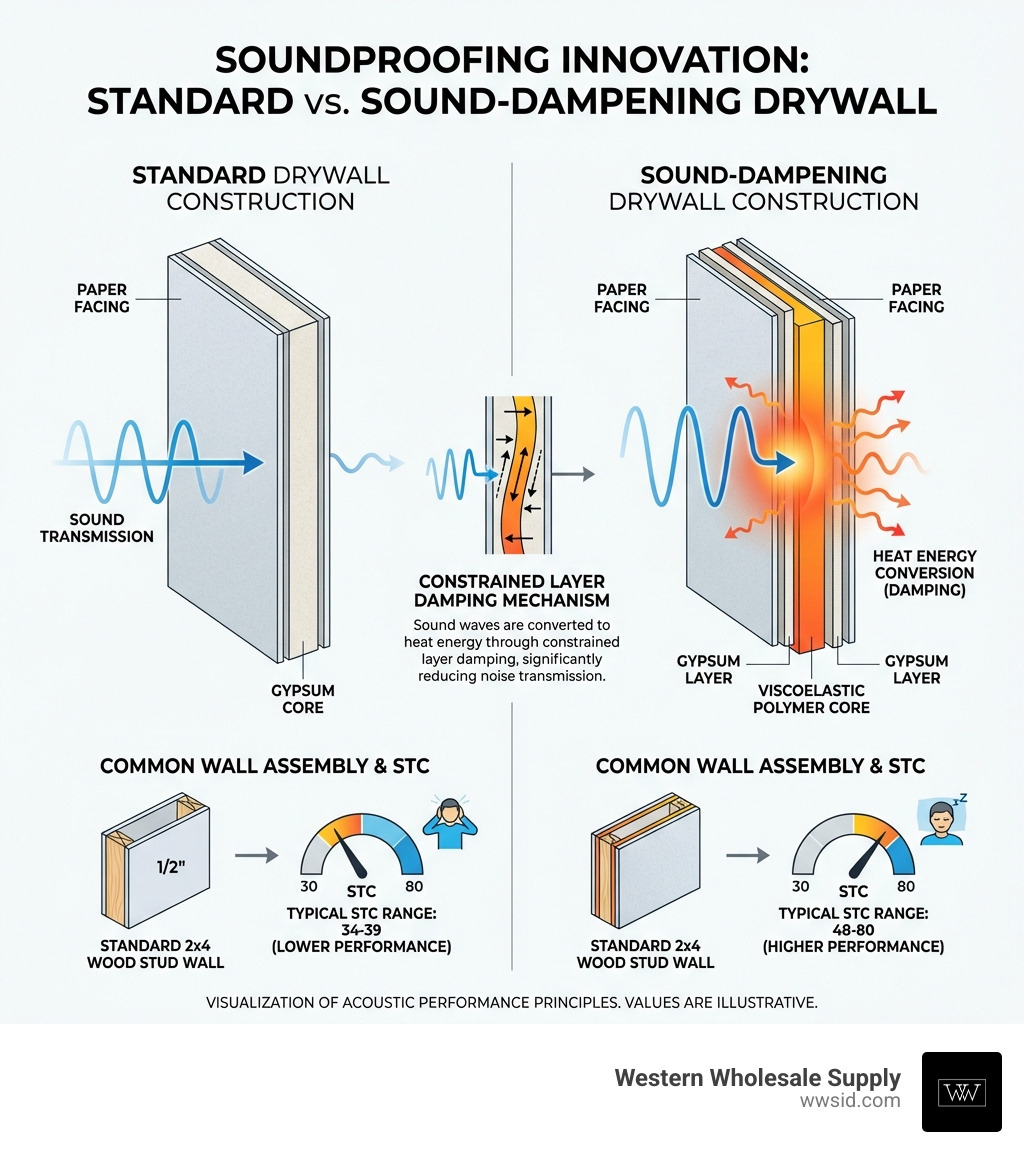
Soundproof drywall sheets are specialized gypsum panels engineered with a viscoelastic polymer layer sandwiched between two layers of high-density gypsum to significantly reduce noise transmission between spaces. Here’s what you need to know:
Key Differences from Standard Drywall:
- Construction: Multi-layer design with sound-absorbing polymers vs. simple gypsum core
- Performance: Achieves STC ratings of 48-80 vs. 34-39 for standard drywall
- Thickness: Similar profile (1/2″ to 5/8″) but superior acoustic performance
- Installation: Hangs and finishes like regular drywall—no special tools required
Common Applications:
- Multi-family party walls (code compliance)
- Home theaters and media rooms
- Bedrooms and home offices
- Commercial spaces (hotels, healthcare, offices)
As soon as unwanted noise becomes an issue—whether it’s neighbor complaints, loud mechanical systems, or the need for privacy in commercial spaces—sound-dampening drywall transforms from a luxury into a practical necessity. The challenge for contractors isn’t just whether to use it, but which product delivers the right performance for the application without overcomplicating the build.
The science is straightforward: traditional soundproofing required multiple layers of standard drywall, resilient channels, and acoustical compounds—adding thickness, weight, labor hours, and complexity to every project. Sound-dampening drywall consolidates that performance into a single panel that installs just like the standard material your crews already know.
What determines performance? The STC (Sound Transmission Class) rating measures how well a wall assembly blocks sound. A standard 2×4 wood stud wall with 1/2″ drywall on both sides typically achieves STC 34. Swap in a specialized sound-dampening panel, and that same assembly can jump to an STC rating of 52—equivalent to eight layers of standard drywall, but in a fraction of the thickness.
But here’s the reality: not all projects need premium panels rated to STC 80. A bedroom wall might only require STC 50-55, while a recording studio demands the highest performance available. Understanding these distinctions saves money and prevents over-specifying materials where they aren’t needed.
I’m Jake Bean, and through my work at a regional building materials supply company, I’ve helped contractors steer the practical trade-offs of sound-dampening drywall sheets across residential and commercial projects. My focus is on matching the right product to the actual acoustic requirements—without the guesswork or wasted material.
The Science of Silence: What is Sound-Dampening Drywall?
Imagine trying to have a peaceful conversation while a heavy metal band practices next door. Not ideal, right? That’s where sound-dampening drywall, often called soundproof drywall sheets, comes in. It’s not just a fancy name; it’s a specialized building material designed to bring tranquility to our homes and workplaces across Eastern Idaho and Western Wyoming.
At its core, standard drywall is a simple affair: a rigid mineral gypsum core sandwiched between layers of paper. It’s effective for creating walls and ceilings, but when it comes to blocking noise, it’s about as effective as a tissue paper umbrella in a downpour. Sound waves travel directly through its solid, uniform structure with little resistance. For more details on standard gypsum board, you can explore our guide on What is Standard Gypsum Board? Decoding ASTM C1396.
Sound-dampening drywall, on the other hand, is built differently to tackle noise head-on. The magic lies in its layered construction. Most sound-dampening panels feature an inner layer of gypsum, viscoelastic material, and sometimes ceramics, all engineered for improved sound dampening. Many sound-dampening products, for instance, use a multi-layer design where two layers of gypsum drywall are sandwiched around viscoelastic sound-absorbing polymers.
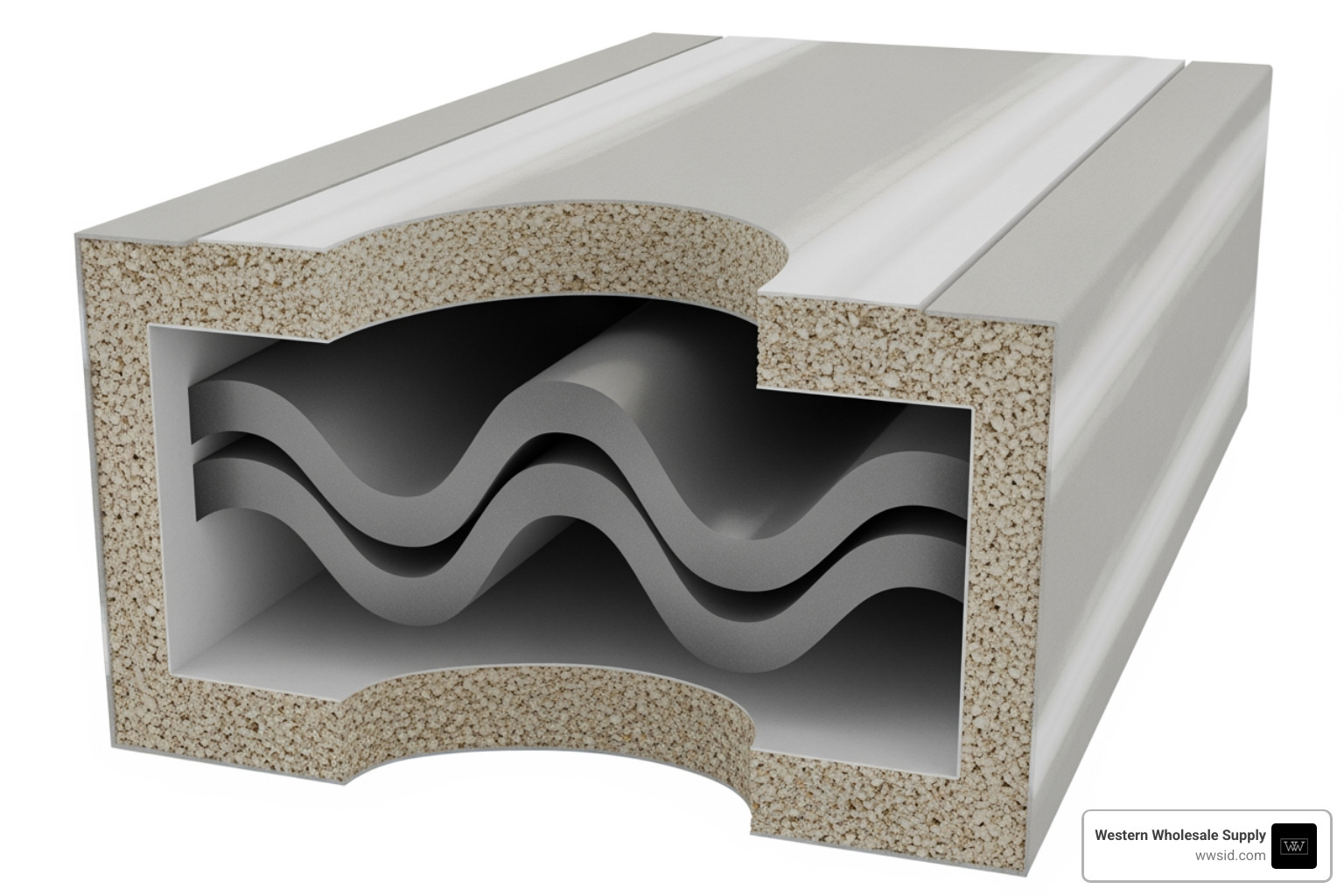
This innovative design works on a principle called constrained layer damping. When sound waves hit the panel, they cause the layers to vibrate. The viscoelastic core, acting like a squishy buffer, converts the vibrational energy of these sound waves into tiny amounts of heat. This dissipation of energy means less sound passes through the wall, effectively reducing noise transmission. It’s a bit like a shock absorber for sound!
The key benefits of using soundproof drywall sheets are clear:
- Reduced Noise Transmission: The primary goal, creating quieter, more comfortable spaces.
- Thinner Wall Assemblies: Achieving high acoustic performance often requires fewer layers than traditional methods, saving valuable square footage.
- Increased Floor Space: Because sound-dampening drywall can deliver superior STC ratings in a thinner profile, it means more sellable or usable floor space in a project. For instance, a single layer of a high-performance sound-dampening panel on one side of single wood studs can exceed code for STC ratings, potentially eliminating the need for bulky double-stud construction.
How It Differs from Traditional Soundproofing Methods
Before the advent of specialized soundproof drywall sheets, achieving significant noise reduction involved more complex and often bulkier methods. These traditional approaches included:
- Adding Extra Layers of Drywall: Stacking multiple sheets of standard drywall on a wall. While this adds mass and helps block some sound, it also increases the wall’s thickness, weight, and requires more labor, material, and electrical box bump-outs. It’s like trying to stop a flood with sandbags – effective, but cumbersome.
- Resilient Channels (RCs): These metal channels are attached to the studs before drywall is installed, creating a decoupling effect that reduces sound transfer through the studs. They can be effective but are prone to installation errors, which can “short-circuit” their performance.
- Sound Clips: Similar to resilient channels, these specialized clips mechanically decouple the drywall from the framing, improving sound isolation.
- Acoustic Sealants and Compounds: Viscoelastic damping compounds are applied between layers of standard drywall to add mass and damp vibrations.
Soundproof drywall sheets offer an all-in-one, streamlined solution. Instead of combining multiple components and hoping they work together perfectly, these panels integrate the sound-dampening technology directly into the drywall itself. This means:
- Labor Savings: Installation is often as straightforward as hanging standard drywall, reducing the need for specialized soundproofing labor or complex layering. Many sound-dampening products install and finish just like conventional gypsum panels, requiring no special tools.
- Material Reduction: Achieving a high STC rating with a single layer of sound-dampening drywall can eliminate the need for multiple layers of standard drywall, resilient channels, or additional damping compounds. This saves on material costs and simplifies procurement.
- Space Efficiency: As mentioned, a thinner wall assembly translates to more usable interior space, a significant advantage in both residential and commercial projects.
While traditional methods certainly have their place, especially in retrofit scenarios where tearing out walls isn’t an option, for new construction or significant renovations in our service areas of Eastern Idaho and Western Wyoming, soundproof drywall sheets often present a more efficient, reliable, and cost-effective path to superior acoustics.
Decoding the Ratings: Understanding STC and Sound Performance
When we talk about how well a wall, floor, or ceiling blocks sound, we’re really talking about its Sound Transmission Class (STC) rating. This isn’t just some arbitrary number; it’s a standardized measurement, determined by the ASTM E90 standard, that helps us understand the effectiveness of a building element in reducing airborne sound. Think of it as a quality score for quietness.
The STC rating is a logarithmic scale, which means that even a small increase in the STC number represents a significant improvement in sound isolation. For example, an increase of 10 STC points halves the perceived loudness of sound.
It’s crucial to remember that the STC rating applies to the entire wall construction system, not just a single panel of drywall. This means the framing (whether wood or steel framing), insulation, and how everything is sealed all contribute to the final STC rating. A single layer of a 1/2-inch sound-dampening gypsum panel applied vertically on each side of 2 x 4 wood studs with 3 1/2-inch thick glass fiber insulation, for instance, can achieve an impressive STC of 52.
Insulation plays a vital role too, filling cavities and absorbing sound waves that might otherwise reverberate within the wall. Furthermore, we must also consider flanking paths—these are indirect routes sound can take around a wall, such as through adjacent walls, floors, ceilings, or even ductwork. Ignoring these can severely compromise the overall sound isolation, even with the best drywall. For deeper insights into acoustic considerations in design, refer to Special Design Considerations for acoustics.
What is a Good STC Rating?
Understanding what different STC numbers mean can help us set realistic expectations for a project:
- STC 25-30: This is typical for a standard interior wall with a single layer of drywall. Normal speech is easily understood through such a wall. You might as well be in the same room!
- STC 35-40: This level offers a moderate reduction. Loud speech can be heard but not clearly understood. Think of a standard hotel room wall, where you know your neighbors are talking, but you can’t quite make out the gossip.
- STC 45-50: Here, loud speech is barely audible, and music or TV sounds are muffled. This is generally considered a good level for privacy in residential settings like bedrooms or home offices, and it’s often the minimum code requirement for multi-family housing (e.g., party walls between apartments). For example, certain mid-grade panels can deliver STC ratings of 49-70, making them an excellent choice for these applications.
- STC 60+: At this level, even very loud sounds are virtually inaudible. This is the field of professional recording studios, home theaters, or spaces requiring extreme quiet. High-performance panels can achieve STC ratings up to 80, offering superior low-frequency mitigation perfect for these demanding environments.
Beyond airborne sound, we also consider Impact Insulation Class (IIC) ratings, especially for floor and ceiling assemblies. IIC measures how well a floor system reduces impact sounds, like footsteps or dropped objects, from traveling to the space below. For comprehensive solutions that include both airborne and impact noise, exploring options like Quiet Comfort: A Comprehensive Guide to Acoustic Ceiling Solutions can provide valuable insights.
Choosing the Right Soundproof Drywall Sheets for Your Project
Selecting the ideal soundproof drywall sheets for your project in Eastern Idaho or Western Wyoming isn’t just about picking the highest STC rating. It’s about a careful analysis of your project’s specific needs, budget, and desired level of quiet. Just as you wouldn’t use a sledgehammer to hang a picture, you don’t always need the most powerful sound-dampening solution for every wall.
We start by asking: what’s the noise source? Is it loud music from a home theater, chatter from an adjacent office, or the gentle hum of a nursery? What level of quiet are we aiming for? A whispered conversation, or absolute silence? These answers guide our choices.
Comparing Types of Soundproof Drywall Sheets
The market offers a range of soundproof drywall sheets, each with its own strengths and ideal applications:
1. Entry-Level Panels:
- Characteristics: These are cost-effective options that still offer a significant upgrade over standard drywall. A typical entry-level panel is 1/2-inch thick, provides solid STC performance, and is ideal for residential and remodel applications. It’s designed to install and finish just like standard drywall, requiring no special tools.
- Applications: Perfect for upgrading existing walls in bedrooms, home offices, or laundry rooms where moderate noise reduction is desired without extensive demolition. It’s also UL classified for use in fire-rated assemblies, adding an extra layer of safety.
2. Mid-Grade Panels:
- Characteristics: These panels offer improved performance and often include additional features. Some feature technology that allows them to be scored and snapped like standard gypsum panels, significantly improving installation speed. Many are 5/8-inch thick and 1-hour fire rated (Type X). A single layer of a mid-grade panel on one side of single wood studs can exceed code for multi-family party walls, delivering STC ratings of 49-70 and potentially saving on labor and materials. Other versatile panels in this category can deliver STC ratings of 52-74 and may also be shear-rated and impact-resistant. There are even optional RF shielded versions for spaces needing radio frequency and noise shielding.
- Applications: Excellent for multi-family housing, commercial spaces like hotels and offices, and higher-performance residential areas where both sound reduction and other features like fire or impact resistance are important.
3. High-Performance Panels:
- Characteristics: These are the heavyweights, designed for maximum sound isolation, especially across a broad frequency range and for low-frequency mitigation. These panels can be thicker (e.g., 1-3/8 inches) and can achieve STC ratings up to 80.
- Applications: Reserved for the most demanding environments, such as professional recording studios, high-end home theaters, music rooms, or specialized commercial spaces where absolute quiet and critical listening are paramount.
Beyond STC, consider other key features:
- Thickness: While many soundproof panels maintain a 1/2-inch or 5/8-inch profile, some high-performance options can be thicker (e.g., 1-3/8 inches).
- Fire Resistance: Many soundproof drywall sheets are UL fire-rated (Type X equivalent), offering 1-hour or 2-hour fire resistance in approved assemblies. This is critical for safety and code compliance.
- Moisture and Mold Resistance: Certain sound-dampening products offer mold and moisture resistance, making them suitable for environments prone to humidity. Achieving UL GREENGUARD Gold Certification for low emissions is also a valuable feature for indoor air quality.
- Impact Resistance: Some panels are specifically designed to resist impact, which can be beneficial in high-traffic commercial spaces.
Best Applications for Sound-Dampening Drywall
Where do soundproof drywall sheets truly shine? Here are some of the most recommended applications:
- Home Theaters and Media Rooms: To keep the cinematic experience in and outside noise out. High-performance panels are ideal here.
- Bedrooms and Nurseries: For restful sleep and quiet study areas, improving privacy and reducing stress. Entry-level or mid-grade panels are great choices.
- Home Offices: To minimize distractions from household activities and ensure clear audio for video calls.
- Laundry Rooms: Containing the rumble and clatter of appliances.
- Multi-Family Party Walls: Essential for meeting building codes and ensuring tenant satisfaction in apartments, condos, and duplexes. Mid-grade panels are often specifically designed for this.
- Commercial Spaces: Including hotels (guest room privacy), schools (quieter classrooms), offices (reducing inter-office noise), and hospitals (elevating patient wellness, privacy, and reducing stress for faster recovery).
- Recording Studios and Practice Rooms: Where precise acoustic control is non-negotiable.
Installation and Cost: What to Expect
One of the most appealing aspects of modern soundproof drywall sheets is their ease of installation. Many brands are designed to “hang and finish like standard drywall,” meaning your crews in Eastern Idaho and Western Wyoming won’t need to learn entirely new techniques or invest in specialized tools. This is a huge win for project efficiency!
Many sound-dampening products can be scored and snapped just like conventional gypsum panels. This familiar process helps maintain project timelines and keeps labor costs predictable. Once installed, these panels can be finished with standard joint compound and paint, just like any other drywall. Need to estimate materials for your next project? Our USG Sheetrock Wallboard Estimator can help.
However, achieving optimal soundproofing goes beyond just hanging the panels. There are a few special considerations:
- Acoustical Sealant: Gaps are the enemy of soundproofing. A bead of acoustical caulk should be applied at all junctures—where the drywall meets the floor, ceiling, and adjacent walls—and around electrical boxes and penetrations.
- Putty Pads for Outlets: Electrical outlets and switch boxes create direct pathways for sound. Acoustical putty pads should be used to wrap these units, sealing any gaps and preventing sound from leaking through.
- Minimizing Gaps: Strive for tight seams between panels and minimize any openings. Even small gaps can significantly reduce the overall STC rating of a wall assembly.
- Staggering Joints: When using multiple layers or combining sound-dampening drywall with other materials, stagger the joints to avoid creating continuous sound paths.
Cost vs. Benefit Analysis
Let’s address the elephant in the room: cost. There’s no sugarcoating it – soundproof drywall sheets are significantly more expensive per sheet than conventional drywall. A sheet of conventional 1/2-inch thick drywall might be a fraction of the cost of a sound-dampening panel. This initial sticker shock is often the biggest hurdle for contractors.
However, it’s crucial to look beyond the per-sheet price and consider the total installed cost and the long-term benefits. When we factor in:
- Reduced Labor: Eliminating the need for multiple layers of standard drywall, resilient channels, or additional damping compounds can save considerable labor hours.
- Fewer Materials: Less material handling, fewer types of materials to purchase and store.
- Thinner Assemblies: Gaining valuable square footage (and thus potential revenue) in a project.
- Faster Installation: Some products are specifically designed for quicker installation.
When you weigh these factors, the cost difference narrows considerably. Certain mid-grade panels, for instance, provide superior noise reduction at a lower total installed cost than other sound damping methods by allowing elimination of added material and labor costs for double-stud construction.
The long-term value is also undeniable. Installing soundproof drywall sheets can:
- Increase Property Value: Quieter homes and commercial spaces are highly desirable.
- Improve Quality of Life: For residents, it means better sleep, more privacy, and a more peaceful environment. For commercial occupants, it translates to increased productivity and comfort.
- Ensure Code Compliance: Meeting stringent STC requirements for multi-family housing becomes much more straightforward.
While the upfront cost per sheet is higher, the overall investment often pays dividends in efficiency, space optimization, and improved acoustic performance that adds lasting value.
Beyond the Panel: Limitations and Common Misconceptions
While soundproof drywall sheets are fantastic tools in our arsenal against unwanted noise, understand what they can and cannot do. The term “soundproof” itself can be a bit misleading. We prefer “sound-dampening” or “sound-reducing” because, in reality, no material can completely block 100% of all sound. Achieving absolute silence in a built environment is practically impossible and incredibly expensive.
Common Misconceptions About Soundproof Drywall Sheets
Let’s clear up some common myths we’ve heard over the years:
Myth 1: “It blocks all noise.”
- Reality Check: As discussed, sound-dampening drywall significantly reduces noise transmission, often to an inaudible level for typical sounds. However, extremely loud low-frequency sounds (like a bass drum thumping) or structural vibrations might still be perceptible. The goal is attenuation, not absolute eradication.
Myth 2: “It’s too difficult for DIY installation.”
- Reality Check: Many modern soundproof drywall sheets, particularly entry-level and mid-grade options, are specifically designed to install and finish just like standard drywall. This means scoring, snapping, hanging, and finishing can be done with familiar tools and techniques. While careful attention to detail (like sealing gaps) is important, it doesn’t require specialized skills beyond typical drywall installation.
Myth 3: “It’s the only thing you need for soundproofing.”
- Reality Check: This is perhaps the biggest misconception. Even the highest-rated soundproof drywall sheets are just one component of an effective soundproofing system. A wall is only as soundproof as its weakest link. We need a holistic approach that addresses:
- Air Gaps: Sound travels through air. Any unsealed crack, gap, or penetration (around electrical boxes, pipes, vents) will allow sound to leak through, negating the drywall’s benefits. This is why acoustical sealant and putty pads are so crucial.
- Doors and Windows: These are often the biggest culprits for sound leakage. A high-performance wall with a standard hollow-core door or single-pane window will still transmit a lot of noise. Consider solid core doors, acoustic seals, and double-pane windows for comprehensive sound control.
- Flanking Noise Transmission: As mentioned earlier, sound can bypass a wall by traveling through adjacent structures (floors, ceilings, connecting walls). This “flanking noise” needs to be addressed through proper construction practices. For instance, using acoustical ceilings can significantly reduce sound transfer between floors or adjacent rooms through the ceiling plenum. Good wall insulation also plays a critical role in absorbing sound within wall cavities.
In summary, while soundproof drywall sheets are a powerful and efficient solution, they are best used as part of a well-designed acoustic assembly that considers all potential sound paths.
Conclusion
We’ve journeyed beyond the buzz to explore the practical realities and immense benefits of soundproof drywall sheets. From their innovative layered construction that converts sound waves into harmless heat, to their impressive STC ratings that transform noisy environments into serene sanctuaries, these specialized panels are truly a game-changer for modern construction in Eastern Idaho and Western Wyoming.
We’ve seen how they differ from traditional, often cumbersome, soundproofing methods by offering an all-in-one, efficient solution that saves on labor, materials, and precious floor space. We’ve decoded the STC ratings, understanding what constitutes “good” sound isolation for various applications, from quiet bedrooms to high-performance recording studios. And we’ve learned how to choose the right panel, weighing factors like thickness, fire resistance, and mold resistance, alongside the project’s specific acoustic needs.
While the initial cost per sheet is higher than standard drywall, the total installed cost and the long-term value in terms of property appreciation and improved quality of life make them a wise investment. Most importantly, we’ve debunked common misconceptions, emphasizing that while no material is truly “soundproof,” these panels are a high-performance solution that, when integrated into a holistic acoustic design, can deliver remarkable results.
At Western Wholesale Supply, we understand the nuances of building materials and the critical role they play in creating comfortable, functional spaces. With over 60 years of experience serving Eastern Idaho and Western Wyoming, our veteran-owned, third-generation family business is committed to providing reliable, on-time delivery and exceptional customer service. We’re here to offer expert guidance, helping you match the right sound-dampening drywall solution to your project’s precise needs, ensuring efficiency and acoustic excellence.
Ready to bring more quiet to your next build? Explore our full range of drywall products and resources and let us help you build beyond the buzz.
