

Why Bulk Drywall Matters for Contractors and Builders
Bulk drywall purchasing can save contractors 15-20% per sheet compared to retail pricing, while ensuring material consistency across large projects and reducing delivery delays. Here’s what you need to know:
Quick Facts About Bulk Drywall:
- Cost Savings: 20% discount when buying 60+ sheets from most suppliers
- Common Types: Standard (1/2″), Fire-Rated Type X (5/8″), Moisture-Resistant, Flexible
- Typical Pricing: Standard 1/2″ sheets range from $13.80-$23.75 depending on size
- Minimum Orders: Usually 60 sheets or more to qualify for bulk pricing
- Delivery Options: Most wholesalers offer on-site delivery, some provide evening service
Key Benefits:
- Fewer trips to the supplier
- Consistent material batches from the same production run
- Access to contractor pricing programs
- Direct wholesale pricing vs. retail markup
The difference between retail and bulk pricing isn’t just about dollars per sheet. When you’re framing out a 3,000 square foot commercial space or managing multiple residential builds, buying in volume means fewer delivery delays, better inventory management, and the peace of mind that comes from working with a single supplier who knows your project timeline.
Most wholesale suppliers require minimum purchases of 60 sheets or more to open up bulk discounts. Some offer price matching on complete quotes, while others provide additional savings on complementary materials like steel studs and framing components when purchased together.
I’m Jake Bean, and I’ve spent my career in the building materials supply business, working directly with contractors on bulk drywall orders for both residential and commercial projects across the region. My experience has shown me that choosing the right supplier for bulk drywall can make or break a project’s timeline and budget.
The Financial and Logistical Advantages of Bulk Purchasing
When it comes to building or renovating in Eastern Idaho and Western Wyoming, every smart contractor knows that planning ahead is key. And for materials like drywall, planning ahead often means buying in bulk. Why? Because the financial and logistical advantages are simply too significant to ignore.

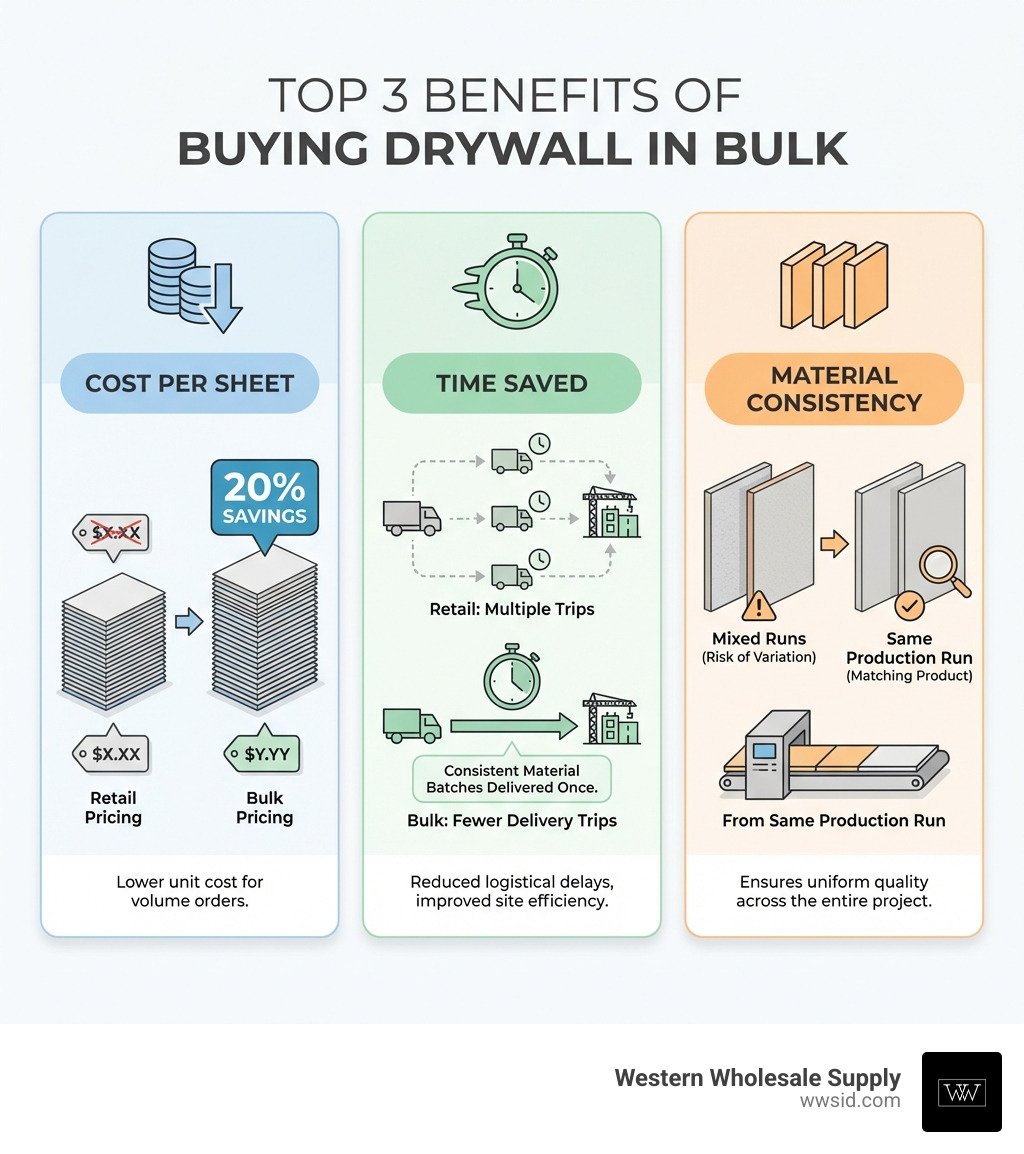
First and foremost, let’s talk about the bottom line: cost. The most compelling benefit of buying bulk drywall is the significant reduction in cost per sheet. While standard retail pricing might seem convenient for smaller jobs, it rarely offers the competitive edge needed for larger projects. Wholesale pricing, on the other hand, is designed to reward volume. Many suppliers offer substantial volume discounts, with some promotions even reaching 20% off when purchasing a minimum quantity, such as 60 or more units of certain materials like steel studs.
Let’s put this into perspective. For example, a 1/2″ regular lite drywall sheet might cost anywhere from $13.80 for a 4’x8′ panel to $23.75 for a 4’x12′ panel at wholesale. Compare that to retail, and you’re looking at considerable savings, especially when you multiply that across hundreds or even thousands of sheets for a major construction project. Similarly, 5/8″ Type X fire-rated drywall, a common requirement for many commercial and residential builds, could range from $27.00 for a 4’x8′ to $45.20 for a 4’x12′ when purchased in bulk. Even specialized options like mold and water-resistant drywall, essential for bathrooms and kitchens, see significant price breaks, perhaps $26.00 for a 4’x8′ x 1/2″ sheet up to $42.40 for a 4’x10′ x 5/8″ sheet. These savings quickly add up, allowing us to pass on better value to our clients and remain competitive.
Beyond the immediate price tag, bulk purchasing offers crucial logistical benefits. Imagine the time and fuel saved by making fewer trips to the store. For extensive projects, multiple small orders can quickly become a logistical nightmare, leading to delays, increased labor costs for fetching materials, and unnecessary wear and tear on vehicles. A single, large delivery of bulk drywall means less hassle for our crew and more time spent on the actual work.
Another often overlooked advantage is material consistency. When we purchase bulk drywall from a reliable supplier, we’re more likely to receive sheets from the same production batch. This consistency is vital for achieving a uniform finish, as slight variations in color, texture, or even gypsum density can occur between different manufacturing runs. For us, ensuring a consistent product throughout a project means fewer headaches during finishing and a higher quality end result for our customers.
Finally, bulk purchasing often open ups access to exclusive contractor pricing programs and promotions. These aren’t just about lower prices; they can include perks like dedicated account managers, priority delivery slots, and even special discounts on related materials. For example, some suppliers offer a 20% saving on select in-stock steel studs when purchased in bulk, often requiring a minimum purchase of 60 or more units. These bundled savings can significantly reduce overall project costs. We even know of instances where leaving a review on Google can lead to a discount on a future order! It pays to build a relationship with your supplier.
For more information on the range of products we offer and how bulk purchasing can benefit your next project, explore our More info about our products.
How to Evaluate and Choose the Right Bulk Drywall Supplier
Choosing the right supplier for your bulk drywall needs is a critical decision that impacts your project’s budget, timeline, and overall success. It’s not just about finding the lowest price; it’s about finding a partner who understands the demands of construction in Eastern Idaho and Western Wyoming and can deliver consistently.

When we evaluate suppliers, we look beyond the surface. There are typically two main types of bulk suppliers: large national retailers and local wholesalers. While national chains might offer convenience, local wholesalers, like us, often provide more personalized service, better understanding of regional project needs, and greater flexibility. Our deep roots in Idaho Falls and Pocatello mean we know the terrain, the climate, and the specific challenges our local contractors face.
Key factors to consider include minimum purchase requirements. Many suppliers, to offer competitive bulk pricing, will stipulate a minimum order quantity. As mentioned, this often hovers around 60 sheets or more to qualify for significant discounts. It’s essential to clarify these requirements upfront to avoid surprises.
Delivery options are paramount. For large quantities of drywall, on-site delivery is non-negotiable. We need to know that our materials will arrive directly at the job site, ready for our crew to unload. The best suppliers offer flexible delivery schedules, sometimes even including evening delivery options, to accommodate tight project timelines and avoid daytime site congestion. We also consider the supplier’s ability to handle the logistics of unloading, such as whether they offer boom truck services for multi-story projects or difficult-to-access sites.
Return policies are another practical consideration. While we always strive for accurate ordering, unforeseen circumstances can arise. Knowing a supplier’s stance on returns or refunds for bulk orders, even if it’s a strict “no returns,” helps us manage our inventory and budget more effectively.
The best suppliers offer exceptional customer service. This includes knowledgeable staff who can provide specialist advice, whether it’s for complex commercial applications or guiding DIYers through their first major project. A supplier who offers price matching on a complete quote from a competitor demonstrates confidence in their pricing and a commitment to their customers. Building a strong relationship with a local supplier can be a game-changer for contractors looking to gain a How to Outbid the Competition: Tips for Contractors in Our Region.
Checklist for Vetting a Bulk Drywall Supplier
To ensure you’re partnering with the right supplier for your bulk drywall needs, we recommend running through this checklist:
- Pricing Transparency: Does the supplier clearly outline their bulk pricing tiers and any associated discounts? Are there hidden fees? Always get a detailed, complete quote.
- Delivery Capabilities: Can they deliver directly to your job site in Eastern Idaho or Western Wyoming? What are their lead times? Do they offer flexible scheduling or evening options?
- Inventory Availability: Do they consistently stock the types and quantities of drywall you need? In-stock availability is crucial for avoiding project delays.
- Staff Knowledge: Do their staff understand the different types of drywall and their applications? Can they offer expert advice on material selection and quantity estimation?
- Price Matching Policies: Do they offer price matching on competitor quotes? If so, what are the conditions (e.g., must be a complete quote for identical materials)?
- Contractor Pricing Programs: Do they have specific programs or discounts for contractors, beyond just bulk pricing? These can include loyalty programs or additional savings on related materials.
Understanding Shipping and Delivery for Bulk Drywall Orders
Shipping and delivery are often the unsung heroes—or villains—of a construction project. For bulk drywall, these logistics are magnified. A smooth delivery can keep your project on schedule, while a botched one can set you back days, costing time and money.
When placing a bulk order, always inquire about lead times. How long from order placement to delivery? This is crucial for synchronizing material arrival with your crew’s readiness to install. Delivery fees are another important consideration; while some bulk orders might include free delivery, others may charge based on distance or order size. Always factor these costs into your overall budget.
Site accessibility is paramount, especially for large deliveries in our region. Is your job site easily accessible for a large flatbed truck or a boom truck? Are there any weight restrictions for roads or bridges leading to the site? Communicating these details upfront with your supplier can prevent costly delays and re-delivery attempts.
Finally, discuss unloading services. Will the delivery include a boom truck for lifting drywall to upper floors or into tight spaces? Or will your crew need to be prepared to unload the truck manually? Some suppliers offer evening delivery options, which can be incredibly useful for contractors who want to avoid daytime traffic or have materials ready for an early start the next morning. Our goal is always reliable, on-time delivery, ensuring our partners in Eastern Idaho and Western Wyoming have the materials they need, exactly when they need them.
Navigating Your Drywall Options for a Bulk Purchase
When buying bulk drywall, knowing your options is crucial. It’s not a “one-size-fits-all” product; different applications demand different types of gypsum board. Understanding the characteristics of each type will ensure we choose the most effective and compliant materials for our projects.
Let’s break down the common types you’ll encounter:
Standard Gypsum Board (Regular Lite): This is the most common and economical choice for general wall and ceiling applications in residential and commercial buildings. It typically comes in 1/2″ thickness, but 1/4″ and 3/8″ are also available for specific uses like curved walls or overlays, and 5/8″ for added rigidity or fire resistance. Its primary application is for non-wet areas where no special fire or moisture resistance is required. To dive deeper into its specifications, you can review the official ASTM C1396 standard or read our simplified guide, What is Standard Gypsum Board? Decoding ASTM C1396.
Moisture-Resistant Drywall (Green Board/M2 Tech): Often recognizable by its green or blue paper facing, this type of drywall has a special coating or core treatment that helps resist moisture and mold growth. It’s essential for areas with liftd humidity, such as bathrooms, kitchens, laundry rooms, and utility spaces. While it’s not waterproof, it provides an added layer of protection against incidental moisture. Some suppliers offer 1/2″ and 5/8″ thicknesses in this type, with prices for a 4’x8′ x 1/2″ sheet around $26.00.
Fire-Rated Drywall (Type X/Type C): This drywall is engineered with special additives (like fiberglass) in its gypsum core to increase its fire resistance.
- Type X is thicker, usually 5/8″, and provides a 1-hour fire rating when installed in approved assemblies. It’s commonly required for garages, furnace rooms, multi-family dwellings, and commercial spaces. Prices for 5/8″ Type X can range from $27.00 for a 4’x8′ to $45.20 for a 4’x12′.
- Type C offers an even higher level of fire resistance, sometimes achieving a 45-minute fire rating in a thinner 1/2″ profile or extended ratings in 5/8″ applications. It’s used in specific fire-rated assemblies where Type X might not meet code.
Soundproof Drywall (Silent FX Sound Drywall): Designed to reduce sound transmission between rooms, this specialty drywall typically features a viscoelastic polymer layer between two gypsum boards. It’s ideal for home theaters, bedrooms, offices, and any area where noise control is a priority. A 4’x8′ x 1/2″ sheet of Silent FX Sound Drywall might be priced around $114.80, reflecting its specialized construction.
Flexible Drywall (Bendable Drywall): Thinner than standard drywall, typically 1/4″ or 3/8″, flexible drywall is designed to bend without breaking, making it perfect for creating curved walls, arches, and other architectural features. Prices for 4’x8′ sheets can range from $23.50 to $28.10 depending on thickness.
Tile Backer Boards (Denshield, Cement Board Durock): While not technically gypsum drywall, these are crucial for tile installations in wet areas like showers and tub surrounds. Products like Denshield (a fiberglass mat-faced gypsum board) and Cement Board Durock (a cement-based board) provide a stable, water-resistant substrate for tile. Prices for a 4’x8′ x 1/2″ Cement Board Durock might be around $59.00, while Denshield could be $66.00 for the same size.
Abuse-Resistant Drywall: For high-traffic areas prone to dents and scuffs, such as hallways in schools or hospitals, abuse-resistant panels offer increased durability.
Understanding these options is key to ensuring we select the correct materials for each part of our project, optimizing both performance and cost. For a comprehensive look at all the drywall types we offer, please visit our Drywall page.
Here’s a quick comparison of some common drywall types:
| Drywall Type | Key Features | Common Thickness | Typical Application |
|---|---|---|---|
| Standard Gypsum Board | Most common and economical choice for general wall and ceiling applications. | 1/2″, 1/4″, 3/8″, 5/8″ | General purpose, non-wet areas. |
| Moisture-Resistant Drywall | Special coating to resist moisture and mold. | 1/2″, 5/8″ | Bathrooms, kitchens, laundry rooms. |
| Fire-Rated Drywall (Type X/C) | Engineered with additives like fiberglass for increased fire resistance. | 5/8″ (Type X), 1/2″ or 5/8″ (Type C) | Garages, multi-family dwellings, commercial spaces. |
