

Your Guide to Buying Drywall

Drywall sheets for sale are available from a range of suppliers, offering everything from basic 4×8 half-inch panels to high-performance specialty options like sound-dampening boards. Here’s what you need to know:
| Drywall Type | Common Sizes | Best For |
|---|---|---|
| Regular/Lite | 4×8, 4×10, 4×12 | Standard walls and ceilings |
| Mold & Moisture-Resistant | 4×8, 4×12 | Bathrooms, kitchens, basements |
| Fire-Rated (Type X) | 4×8, 4×10, 4×12 | Garages, furnace rooms, multi-family, ceilings |
| Sound-Dampening | 4×8, 4×10, 4×12 | Home theaters, offices |
Common thicknesses: 1/4-inch, 3/8-inch, 1/2-inch (most common), and 5/8-inch (fire-rated applications)
Whether you’re framing out a basement, finishing a commercial space, or coordinating a multi-unit residential project, choosing the right drywall matters. The wrong type can lead to mold issues in moisture-prone areas, code violations in fire-rated assemblies, or callbacks that eat into your margins.
But navigating the options isn’t always straightforward. You’ve got regular, lightweight, moisture and mold-resistant, fire-rated Type X and Type C, flexible panels for curved walls, and sound-dampening sheets that cost ten times more than standard board. Then there are the practical questions: Do you need 1/2-inch or 5/8-inch? Should you order 4×8 or spring for the longer 4×12 sheets to reduce seams? And where do you find competitive pricing with reliable delivery that won’t leave your crew standing around?
This guide breaks down everything you need to know about drywall sheets for sale, from decoding the color-coded edges that indicate different types to understanding when you actually need specialty products versus when standard board will do the job just fine.
At Western Wholesale Supply, we have over 60 years of experience helping contractors and builders steer drywall decisions across residential and commercial projects. Our experienced team can help clarify what actually matters when you’re ordering material for a job site. Let’s walk through how to find the best drywall deals without compromising on quality or delivery reliability.
Decoding Drywall: A Guide to the Different Types
When you step into a building supply store, you might think drywall is just, well, drywall. But trust us, there’s a whole world of gypsum panels out there, each designed for specific applications. Understanding these differences is crucial for any successful project, whether you’re tackling a small repair or a large construction job in Eastern Idaho or Western Wyoming.
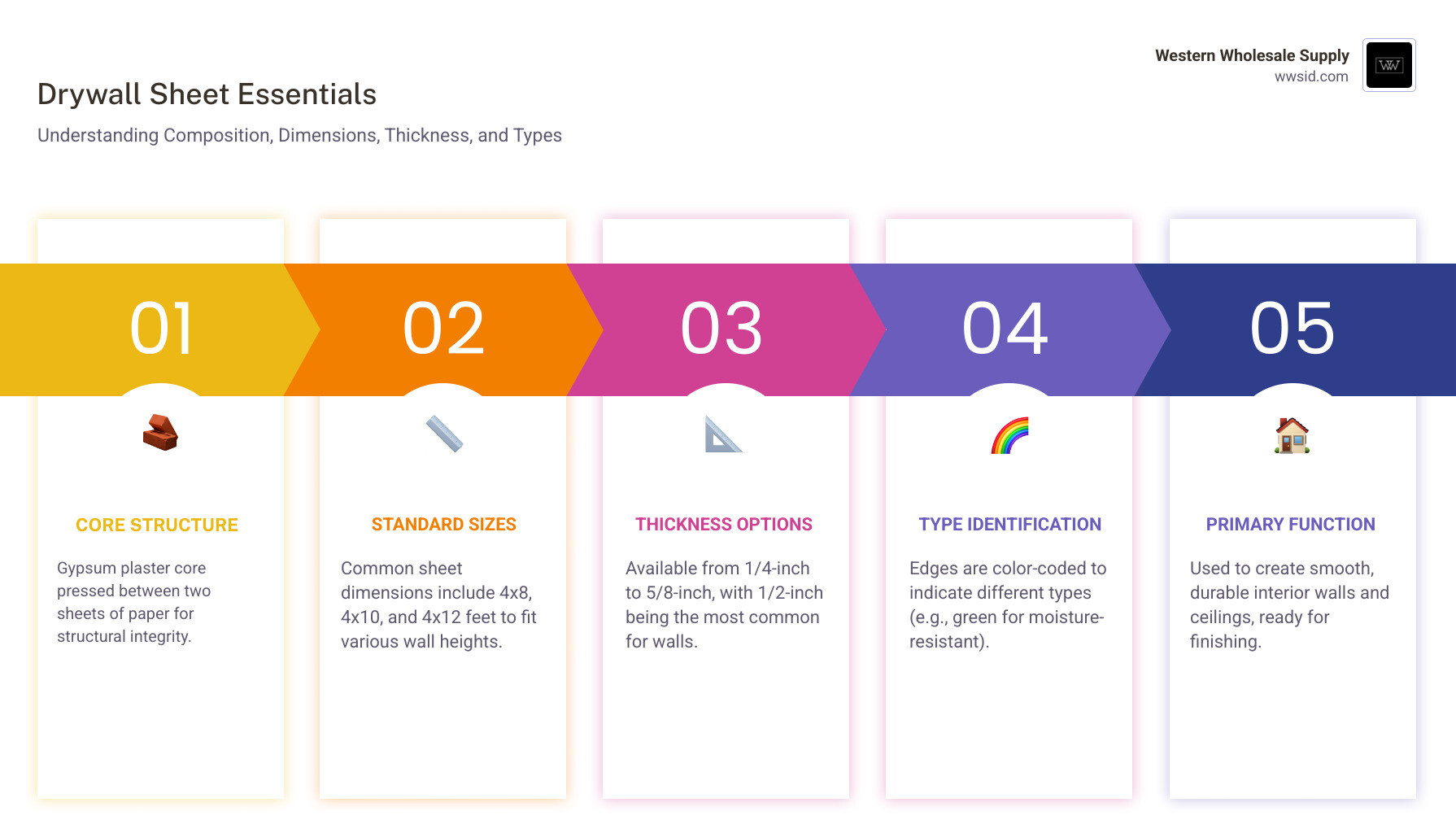
At its core, all drywall is made from gypsum plaster pressed between two sheets of paper. This basic composition, often referred to as standard gypsum board, is governed by specifications like the ASTM C1396 standard. This standard dictates everything from the board’s dimensions to its core properties, ensuring consistency and performance across the industry. For More info about standard gypsum board, you can dive deeper into the technicalities.

However, manufacturers have innovated far beyond the basic gypsum panel, creating specialized products that address common construction challenges. These specialty boards often have unique additives in their gypsum core or different types of paper facing, and they’re usually identifiable by color-coded edges or distinct branding. Knowing these types will help you select the best drywall sheets for sale for your needs.
Regular vs. Specialty Drywall
Let’s break down the main categories of drywall you’ll encounter.
| Drywall Type | Features | Common Use Cases |
|---|---|---|
| Regular (Standard) | Basic gypsum core, standard paper facing. Often “Lite-Weight” for easier handling. | General walls and ceilings in living areas, bedrooms, hallways. |
| Mold & Moisture-Resistant | Improved additives in core and paper to inhibit mold growth. Often combined with moisture resistance. | High-humidity areas, basements, bathrooms, kitchens, anywhere mold is a concern. |
| Fire-Rated (Type X/C) | Denser gypsum core with glass fibers for increased fire resistance. | Garages, furnace rooms, multi-family dwellings, commercial buildings, between living units. |
| Sound-Dampening | Multi-layered with viscoelastic polymers to absorb sound waves. | Home theaters, recording studios, offices, multi-unit residential for noise reduction. |
| Abuse-Resistant | Denser core, sometimes with fiberglass mesh, to resist dents and impacts. | High-traffic areas like hallways, corridors, commercial spaces, schools. |
| DensShield Tile Backer | A built-in moisture barrier with fiberglass mats. Faster to install, easier to cut, and more durable against moisture than traditional cement board. | Substrate for tile in wet areas like showers, tub surrounds, kitchen backsplashes. |
Moisture, Mold, and Fire Resistance Explained
These are some of the most critical features when choosing drywall sheets for sale.
-
Mold & Moisture-Resistant Drywall: Often called “green board” (though some brands use blue), this type has a water-repellent paper facing and a treated core. These panels incorporate special additives in both the gypsum core and the paper facing to actively inhibit mold growth. This is a step up from basic moisture resistance and is highly recommended for any area prone to humidity or potential moisture exposure like bathrooms, kitchens, and basements. While it resists moisture, it’s not waterproof and should not be used in direct contact with water, such as inside a shower stall without a proper waterproof membrane.
-
Fire-Rated Drywall (Type X and Type C): This is where safety gets serious. Fire-rated drywall features a denser gypsum core reinforced with glass fibers. When exposed to fire, the gypsum slowly calcifies, releasing water vapor that helps to slow down the spread of flames.
- Type X drywall (often pink or red-edged) provides a minimum of 1-hour fire resistance when installed as part of a rated assembly.
- Type C drywall is an even more advanced fire-resistant product. It uses special additives that retain more water, allowing it to withstand fire for longer periods—often 45 minutes to 1 hour or more, depending on the assembly.
Choosing the correct fire rating is often a matter of local building codes and specific project requirements, particularly for garages, furnace rooms, or shared walls in multi-unit buildings. You can explore these and other options at Drywall Sheets at Western Wholesale Supply.
Advanced Options: Flexible and Sound-Dampening Panels
Sometimes, standard drywall just won’t cut it. That’s when you turn to the specialized cavalry.
-
Flexible Drywall: Ever tried to bend a regular sheet of drywall? It usually ends in a loud snap and a trip back to the store. Flexible drywall, however, is thinner (often 1/4-inch) and designed to be more pliable. This allows it to conform to curved surfaces, making it perfect for creating neat arched doorways, rounded walls, or other unique architectural features.
-
Sound-Dampening Drywall: If you’ve ever wished for a quieter space, sound-dampening drywall is your friend. Products like Quietrock EZ snap are engineered with a viscoelastic polymer core. This layer absorbs sound energy, significantly reducing noise transmission between rooms. It’s a game-changer for:
- Home theaters
- Recording studios
- Offices needing privacy
- Bedrooms next to noisy areas
- Multi-unit dwellings to reduce neighbor noise
- Conference rooms
While more expensive, the peace and quiet it provides can be priceless.
Here’s a list of other specialty drywall applications we often see in Eastern Idaho and Western Wyoming:
- Abuse-Resistant Panels: For high-traffic areas in homes or commercial buildings where impacts are common, like hallways, corridors, or schools.
- Tile Backer Boards: Such as Denshield or Durock Cement Board. These are essential for tile installations in wet areas like showers, tub surrounds, and kitchen backsplashes, providing a stable, water-resistant base.
- Sheathing Panels: Like Densglass Gold, designed for exterior use as a substrate for claddings, offering moisture and mold resistance.
Sizing It Up: Common Drywall Dimensions and Thickness
Once you know what kind of drywall you need, the next step is figuring out how much and what size. This isn’t just about calculating square footage; it’s about optimizing for installation ease, minimizing waste, and ensuring structural integrity.

Estimating materials accurately is key to staying on budget and preventing frustrating delays. You’ll need to measure your walls and ceilings carefully, accounting for openings like doors and windows. Thankfully, tools like the USG Sheetrock Wallboard Estimator and the National Gypsum Drywall Materials Calculator can help with this.
Standard Drywall Sheet Sizes
The most common dimensions for drywall sheets for sale are designed to fit standard construction practices.
- 4×8 sheets: At 4 feet wide by 8 feet long, these are the most common and easiest to handle, especially for DIY projects or smaller rooms. They fit well in standard pickup trucks and are less cumbersome to maneuver through doorways. Our 1/2″ Lightweight 4′ x 8′ panels are a staple for many projects.
- 4×10 sheets: A bit longer, these can reduce the number of seams in rooms with 10-foot ceilings, leading to a smoother finish and less taping.
- 4×12 sheets: These are ideal for larger rooms or commercial spaces, as they drastically minimize butt joints (where the ends of two sheets meet), which are notoriously harder to finish smoothly than tapered edges.
- 54-inch width sheets: While 4-foot wide sheets are standard, some manufacturers offer 54-inch wide panels. These can be particularly useful for covering 9-foot walls with two horizontal sheets, again reducing seams. We stock 54″ x 8′, 54″ x 10′, and 54″ x 12′ options in both regular and Type X fire-rated.
When considering sizes, think about the room dimensions, ceiling height, and how you’ll transport and handle the sheets. Longer sheets can save time on finishing but require more careful handling and often a second person.
Choosing the Right Thickness
Drywall thickness isn’t just a random choice; it impacts structural performance, sound insulation, and fire resistance.
- 1/4-inch: This is the thinnest option, often used for covering existing damaged walls, creating curved surfaces (like our flexible drywall), or as a base layer in multi-layer soundproofing applications. It’s too flimsy for most standalone wall applications.
- 3/8-inch: A step up, 3/8-inch drywall is sometimes used for repairs or in non-structural applications where weight is a concern. It’s lighter than 1/2-inch but still not typically recommended for new wall construction due to its susceptibility to sagging.
- 1/2-inch: This is the workhorse of the drywall world, the most common thickness for interior walls and ceilings in residential construction. It provides good rigidity, is relatively easy to install, and offers a balance of cost and performance.
- 5/8-inch: The thickest common option, 5/8-inch drywall offers superior rigidity, improved sound attenuation, and, most importantly, improved fire resistance (Type X). It’s required by code in many commercial buildings, between garages and living spaces, and in multi-family dwellings. The increased density also makes it less prone to sagging on ceilings, especially when studs or joists are spaced at 24 inches on center.
When selecting thickness, consider the spacing of your wall studs or ceiling joists. For 16-inch on-center framing, 1/2-inch is generally fine for walls. For 24-inch on-center framing, especially on ceilings, 5/8-inch is often preferred or required to prevent sagging. Always consult local building codes for specific requirements.
Where to Find Drywall Sheets for Sale and What to Expect
Finding the right drywall sheets for sale is only half the battle; getting them to your job site efficiently and affordably is just as important. In Eastern Idaho and Western Wyoming, you have several options, but not all suppliers are created equal when it comes to service and selection.
Typical costs for drywall sheets can vary significantly based on type, thickness, and size. As we’ve seen, a standard 4’x8’x1/2″ panel will generally be at the lower end of the cost range, while a specialized 4’x8’x5/8″ QuietRock EZ Snap sound-dampening panel will sit at the higher end. Specialty boards like mold- and moisture-resistant or fire-rated options usually fall in the middle, with pricing that reflects their added performance and protection.
When you’re looking for drywall sheets for sale, you’ll want to consider local building material suppliers like us, Western Wholesale Supply. While large chain stores might have some basic options, specialized suppliers often offer a wider variety of specialty products, better bulk pricing, and superior delivery services custom to construction projects. You can always check out our selection of Drywall Sheets at Western Wholesale Supply.
Key Considerations When Looking for Drywall Sheets for Sale
Beyond the product itself, the purchasing process can make or break your project timeline and budget.
- Commercial Quotes: For larger projects, the price per sheet can drop significantly with bulk purchases. We understand that contractors and builders need competitive commercial quotes. Don’t hesitate to contact us directly with your quantity requirements. We offer bulk pricing options and can provide detailed quotes to help you manage project costs effectively. This is especially true for our partners in Eastern Idaho and Western Wyoming who rely on us for consistent supply.
- Delivery Options: Getting large, heavy sheets of drywall to a job site can be a logistical challenge. Reliable, on-time delivery is one of our unique selling propositions. We ensure that your materials arrive when and where you need them, preventing costly delays.
- Project Scale: Whether you’re ordering a few sheets for a small renovation or hundreds for a commercial build, the supplier’s capacity to handle your project scale matters. We’re equipped to handle projects of all sizes, from residential remodels to large-scale commercial developments.
- Availability: Nothing is more frustrating than a material shortage. We strive to maintain robust inventory levels of common and specialty drywall types so your project can stay on track.
For more information about our range of products and how we can support your project, check out More info about our products.
Finding Local Drywall Sheets for Sale
Working with a local supplier like Western Wholesale Supply in Idaho Falls, Pocatello, and across Eastern Idaho and Western Wyoming offers distinct advantages.
- Local Inventory: We stock products specifically suited to the needs and building codes of our region. This means you’re more likely to find what you need readily available, without long shipping delays from distant warehouses.
- Supporting Local Business: When you buy from us, you’re supporting a veteran-owned, third-generation family business that has been serving the community since 1963. We take pride in our roots and our commitment to our neighbors.
- Expert Advice: Our knowledgeable staff has years of experience with local projects. If you’re unsure which type of drywall is best for your specific application, we’re here to provide expert guidance. We can help you steer the nuances of fire ratings, moisture resistance, and even specialized applications like soundproofing. Just ask!
- Regional Availability: We are dedicated to serving our specific service areas: Idaho Falls, Pocatello, Eastern Idaho, and Western Wyoming. This focused approach ensures that we understand the unique challenges and requirements of construction in these areas, offering personalized service that national chains often can’t match.
So, when you’re ready to secure your drywall sheets for sale, remember to connect with a local expert. You can Find drywall at Western Wholesale Supply and experience the difference that over 60 years of dedicated service makes. For custom service and local expertise, we’re here for you.
Gearing Up: Essential Tools for Drywall Installation
So, you’ve chosen the perfect drywall sheets for sale for your project. Fantastic! But the drywall itself is just one piece of the puzzle. To ensure a smooth, professional finish, you’ll need the right tools and supplies. Think of it like cooking: you can have the best ingredients, but without the right utensils, you’re going to make a mess!
Here’s a breakdown of the essentials, categorized by task, to help you get started:
Cutting and Hanging
This phase is all about precision, speed, and getting those sheets up onto the studs and joists.
- T-square: This oversized ruler is indispensable for making straight, accurate cuts across drywall sheets. Line it up with your mark, score with a utility knife, and snap for a clean break.
- Utility knife: A heavy-duty utility knife with plenty of sharp, replaceable blades is your best friend for scoring drywall, cutting paper backing, and trimming edges.
- Drywall saw: For cutting irregular shapes, electrical outlets, or curved lines that a utility knife can’t handle, a jab saw (often called a drywall saw) is essential. Its pointed tip and aggressive teeth make quick work of gypsum.
- Screw gun or drill with drywall bit: While a regular drill can work, a dedicated drywall screw gun or a drill equipped with a drywall dimpler bit will ensure screws are driven to the perfect depth – just below the paper surface without tearing it. This prevents “blow-outs” and makes finishing much easier.
- Drywall screws: These specialized screws have a coarse thread for gripping wood studs and a bugle head that countersinks cleanly into the drywall. Make sure you use the correct length for your drywall thickness and stud type.
- Measuring tape: You can’t hang drywall without accurate measurements! A good quality, durable tape measure is a must.
- Drywall lifter/panel lift: For ceilings or awkward wall sections, a drywall lifter (a foot-operated lever) or a mechanical panel lift can save your back and make one-person installation much more manageable.
Finishing and Sanding
This is where the magic happens, changing raw panels into smooth, paint-ready surfaces. Patience and practice are key here!
- Joint compound (mud): This is the plaster-like material used to cover screw heads, fill seams, and create a smooth transition between sheets. It comes in various formulations, including lightweight all-purpose, topping, and setting-type compounds (which harden chemically and are great for quick repairs).
- Drywall tape: This reinforces seams, preventing cracks. Paper tape is traditional and strong, while fiberglass mesh tape is self-adhesive and often preferred for repairs or certain types of joint compound.
- Mud pan: A metal or plastic pan specifically designed for holding joint compound. Its angled sides make it easy to scoop mud onto your knife.
- Taping knives/Drywall knives: You’ll need a selection of these, typically in 6-inch, 10-inch, and 12-inch widths. The smaller knife is for applying tape and filling screw heads, while the wider knives are for feathering out joint compound over seams for a seamless finish.
- Sanding sponges or pole sander: After the mud dries, sanding creates a perfectly smooth surface. Sponges are good for small areas and corners, while a pole sander (with abrasive screens or paper) makes quick work of large wall and ceiling areas. Always wear a mask when sanding drywall mud!
Having these tools and supplies on hand before you start will ensure your drywall installation goes as smoothly as possible. Don’t forget safety gear like gloves, safety glasses, and a dust mask!
Conclusion: Build with Confidence
Navigating drywall sheets for sale might seem daunting at first, but with the right knowledge, it’s entirely manageable. From understanding the nuances of regular versus specialty boards to choosing the correct size and thickness for your application, making informed decisions ensures a project that stands the test of time.
The success of your project, whether it’s a small renovation or a large commercial build, hinges on careful planning, selection of quality materials, and reliable support from your suppliers. At Western Wholesale Supply, we’ve been helping contractors and builders in Idaho Falls, Pocatello, Eastern Idaho, and Western Wyoming achieve their goals since 1963. Our commitment to reliable, on-time delivery and exceptional customer service, backed by over six decades of experience, means you can build with confidence.
We’re not just selling drywall sheets for sale; we’re providing the foundation for your next successful project. Don’t let material choices or logistical challenges slow you down.
Ready to get started or need a personalized quote? Our team is here to help you select the best materials and ensure they arrive exactly when you need them.
