

What Is an FRP White Wall Panel — and Do You Need One?
FRP white wall panels are flat sheets made from fiberglass-reinforced plastic, designed to cover interior walls in commercial and industrial spaces. They are tough, moisture-resistant, and easy to clean — which is why they show up everywhere from hospital corridors to food processing plants.
Here is a quick breakdown of what they are and why contractors choose them:
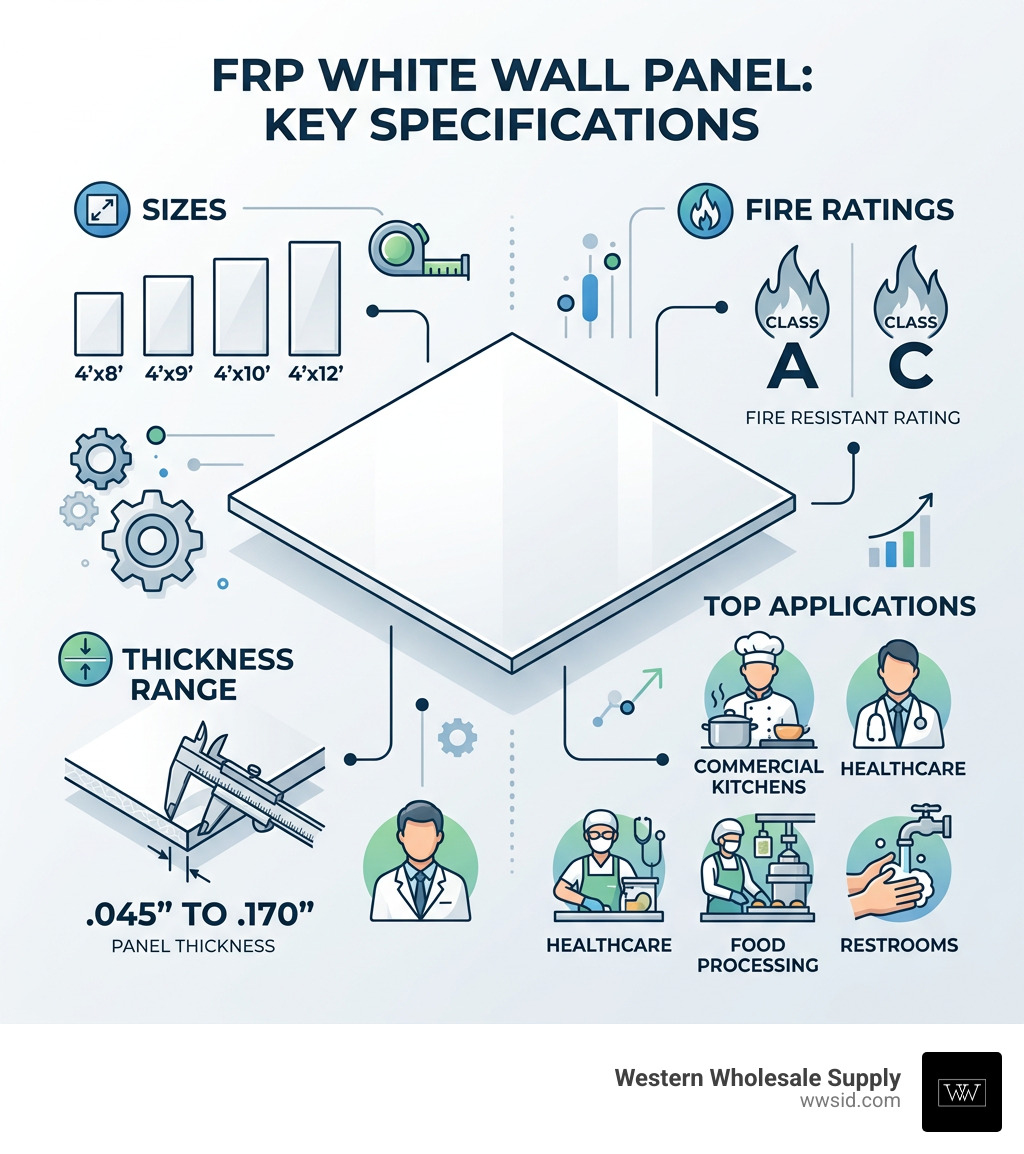
| Feature | Details |
|---|---|
| Material | Fiberglass reinforced plastic (fiberglass + resin + calcium carbonate) |
| Standard Sizes | 4’x8′, 4’x9′, 4’x10′, 4’x12′ |
| Thickness Range | .045″ to .170″ |
| Fire Ratings | Class A or Class C |
| Common Uses | Commercial kitchens, healthcare, food processing, restrooms, cleanrooms |
| Key Benefits | Moisture resistance, impact resistance, easy sanitation, durability |
If you need a wall surface that holds up in wet, high-traffic, or sanitary environments — and installs faster than tile — FRP panels are the go-to solution professionals have relied on for decades.
This guide covers everything you need to know: material specs, fire ratings, sizes, applications, and how to pick the right panel for your project.
At Western Wholesale Supply, we are third-generation building materials professionals who have worked with frp white wall panel products across countless commercial and industrial projects through our regional supply business. In the sections below, we’ll break down exactly what separates a good panel choice from a costly mistake on the job site.
Understanding the FRP White Wall Panel and Its Core Characteristics
When we talk about an frp white wall panel, we are referring to a highly engineered building material designed for environments where Drywall simply won’t cut it. While standard Sheetrock is the backbone of most construction in Eastern Idaho and Western Wyoming, certain rooms demand a surface that can take a literal beating and a daily soaking.
The core characteristic of FRP Panels is their non-porous surface. Unlike paint or wood, these panels do not absorb moisture, which means they won’t rot, mold, or mildew. This makes them the ultimate “armor” for your walls. They are typically manufactured using a combination of high-strength fiberglass reinforcement embedded in a polyester resin, often stabilized with fillers like calcium carbonate.
One thing to keep in mind for safety compliance is that, like many industrial building materials, these products are subject to www.P65Warnings.ca.gov WARNING regarding chemicals that may cause cancer or reproductive harm. However, once installed, their primary job is protection—specifically impact resistance against carts, equipment, and heavy foot traffic.

Material Composition and Strength
The “strength” of an frp white wall panel isn’t just marketing talk; it’s backed by rigorous technical data. In our experience supplying projects from Idaho Falls to Jackson, WY, we see a wide range of specs depending on the intensity of the environment.
- Tensile Strength: These panels typically range from 60 Mpa to 97 Mpa. To put that in perspective, the thicker the panel, the higher the tension it can withstand before failing.
- Glass Content: The “Fiber” in Fiber Reinforced Plastic comes from glass. Standard panels contain between 19% and 30% glass content. Higher glass content generally equates to better structural integrity and impact resistance.
- Weight Ratios: Despite their toughness, they are surprisingly lightweight. A 1.0mm thick panel weighs about 1.3 Kg/m2, while a heavy-duty 3.0mm panel reaches up to 4.0 Kg/m2. This makes them much easier to handle on a job site than heavy sheets of stainless steel or ceramic tile.
Key Benefits and Advantages in Industrial Settings
In the industrial world—think food processing workshops in Burley or refrigerated warehouses in Twin Falls—the walls need to do more than just look good. They need to perform. An frp white wall panel provides a level of durability that helps facility managers sleep better at night.
Beyond just being “tough,” these panels offer significant thermal benefits. When used in conjunction with high-quality insulation, they help maintain stable temperatures in large warehouse environments. This is particularly important in our region, where winters are harsh and heating costs can skyrocket. By creating a sealed, moisture-proof barrier, FRP helps protect the underlying insulation from degrading due to humidity or condensation.
Sanitation and Ease of Maintenance
The biggest “win” for an frp white wall panel is sanitation. In healthcare facilities or commercial kitchens, hygiene isn’t optional—it’s the law.
- Sanitary Surfaces: The non-porous nature means bacteria and viruses have nowhere to hide. There are no grout lines to scrub and no paper facing to peel.
- Easy Cleanup: Most messes can be handled with mild soap and a pressure washer or a simple wipe-down.
- Stain and Scratch Resistance: Whether it’s food splatter in a kitchen or a stray cart in a hospital hallway, these panels resist the permanent staining and deep gouging that would ruin a painted wall.
Technical Specifications: Sizes, Fire Ratings, and ISO Grades
Choosing the right panel starts with understanding the “menu” of available Products. While we often think of them as standard 4’x8′ sheets, the variety is actually quite extensive.
| Specification | Standard Options | Custom Capabilities |
|---|---|---|
| Width | 4′ (48″) | Up to 5′ (60″) |
| Length | 8′, 9′, 10′, 12′ | Reels up to 500′ – 1200′ |
| Thickness | .045″, .060″, .090″, .120″, .135″ | Up to .170″ |
| Fire Rating | Class A or Class C | N/A |
Choosing the Right FRP White Wall Panel for Your Facility
Fire safety is a top priority for any commercial build. When you are looking for an frp white wall panel, you will likely choose between a Class A and a Class C fire rating.
- Class A Rating: This is the gold standard for safety. A Class A panel has a Flame Spread index of 25 or less and a Smoke Developed index of 450 or less (some high-performance models go as low as 20 Flame Spread / 100 Smoke). This is usually required in public hallways, hospitals, and schools.
- Class C Rating: These are more economical and suitable for areas where building codes are less stringent, such as smaller residential utility rooms or certain agricultural buildings.
You also need to consider the finish. A pebbled texture is excellent for hiding small scratches and dispersing light, while a smooth finish is often preferred in cleanrooms because it is even easier to wipe down and doesn’t trap microscopic particles.
Certified ISO Grade Designs for Specialized Environments
For high-tech manufacturing or pharmaceutical labs, “clean” isn’t enough. You need “ISO Certified.” High-performance FRP Panels are available in Certified ISO Grade™ Designs, including ISO 5, ISO 6, ISO 7, and ISO 8. These are specifically tested to ensure they don’t off-gas or shed particles, making them the industry standard for cleanroom construction.
Common Applications and Customization Options
Where exactly do we see the frp white wall panel in action? If you live in South East Idaho or Western Wyoming, you’ve likely walked past them today without even realizing it. They are the backbone of:
- Commercial Kitchens: For walls that can handle heat, steam, and grease.
- Healthcare Facilities: Providing sterile, impact-resistant surfaces in exam rooms.
- Restrooms and Car Washes: Where 100% moisture resistance is a requirement.
- Agricultural Facilities: Including pet houses and farms where durability is key.
Why the FRP White Wall Panel is the Standard for Cleanrooms
In a cleanroom, every detail matters. The installation of an frp white wall panel in these environments often involves specialized division moldings and seam joints to ensure there are no gaps where contaminants can collect. Using a smooth texture ensures that the cleaning process is 100% effective, meeting the strict standards required for ISO compliance.
Custom Colors and Aesthetic Versatility
While “White” is the most popular choice because it looks clean and reflects light, it’s far from your only option. We can actually source FRP in over 1,700 custom colors. Whether you need “Military Blue” for a school locker room or a “Silver” finish for a modern retail space, the options are nearly limitless.
We also offer various trim options, including vinyl molding for a seamless look or aluminum trim for added durability at the corners. For our pro customers, we offer reliable job site delivery throughout our service area, ensuring your materials arrive when your crew is ready to hang them.
Conclusion
At Western Wholesale Supply, we’ve spent over 60 years helping contractors find the right materials for the job. Whether you’re building a new restaurant in Rexburg or retrofitting a clinic in Jackson, we know that the right frp white wall panel can make the difference between a project that lasts decades and one that needs constant repairs. We are a veteran-owned, third-generation family business, and we pride ourselves on being the reliable partner you need for FRP Panels and beyond.
If you’re still Finding the Best Drywall Deals or need a specialized liner for a commercial space, we’re here to help.
What is the standard size for an FRP white wall panel?
The most common size is 4’x8′, but they are also readily available in 4’x10′ and 4’x12′ sheets. For large-scale industrial projects, custom lengths up to 50 feet or even long reels are available to minimize seams.
Are FRP panels fire-rated?
Yes. Most commercial-grade FRP panels come with either a Class A or Class C fire rating. Class A is typically required for commercial interiors and cleanrooms, offering a flame spread of 25 or less.
How do you maintain FRP panels?
Maintenance is simple: use mild soap and water. Because they are highly resistant to chemicals, you can use stronger disinfectants in healthcare or food-service environments without worrying about damaging the surface. Avoid abrasive cleaners that might scratch the finish over time.
