

Why Cold-Formed Steel Framing is Transforming Modern Construction
By Western Wholesale Supply
Cold formed steel framing is a construction system that uses thin sheets of galvanized steel rolled into C-shaped studs, tracks, joists, and other structural members—all without applying heat. Here’s what you need to know:
Quick Answer: Cold-Formed Steel Framing Basics
- What it is: Structural members made from zinc-coated sheet steel formed at room temperature into studs, joists, and tracks
- Key advantage: Higher strength-to-weight ratio than wood, in some instances allowing 24-inch spacing instead of 16-inch
- Common applications: Interior partitions, load-bearing walls, floor systems, roof trusses in low- to mid-rise buildings
- Standard sizes: Web depths from 2-1/2″ to 14″, thicknesses from 33 mil to 97 mil
- Yield strength: 33 ksi for lighter gauges (33-43 mil), 50 ksi for heavier (54-97 mil)
- Sustainability: Minimum 25% recycled content, 100% recyclable at end of life
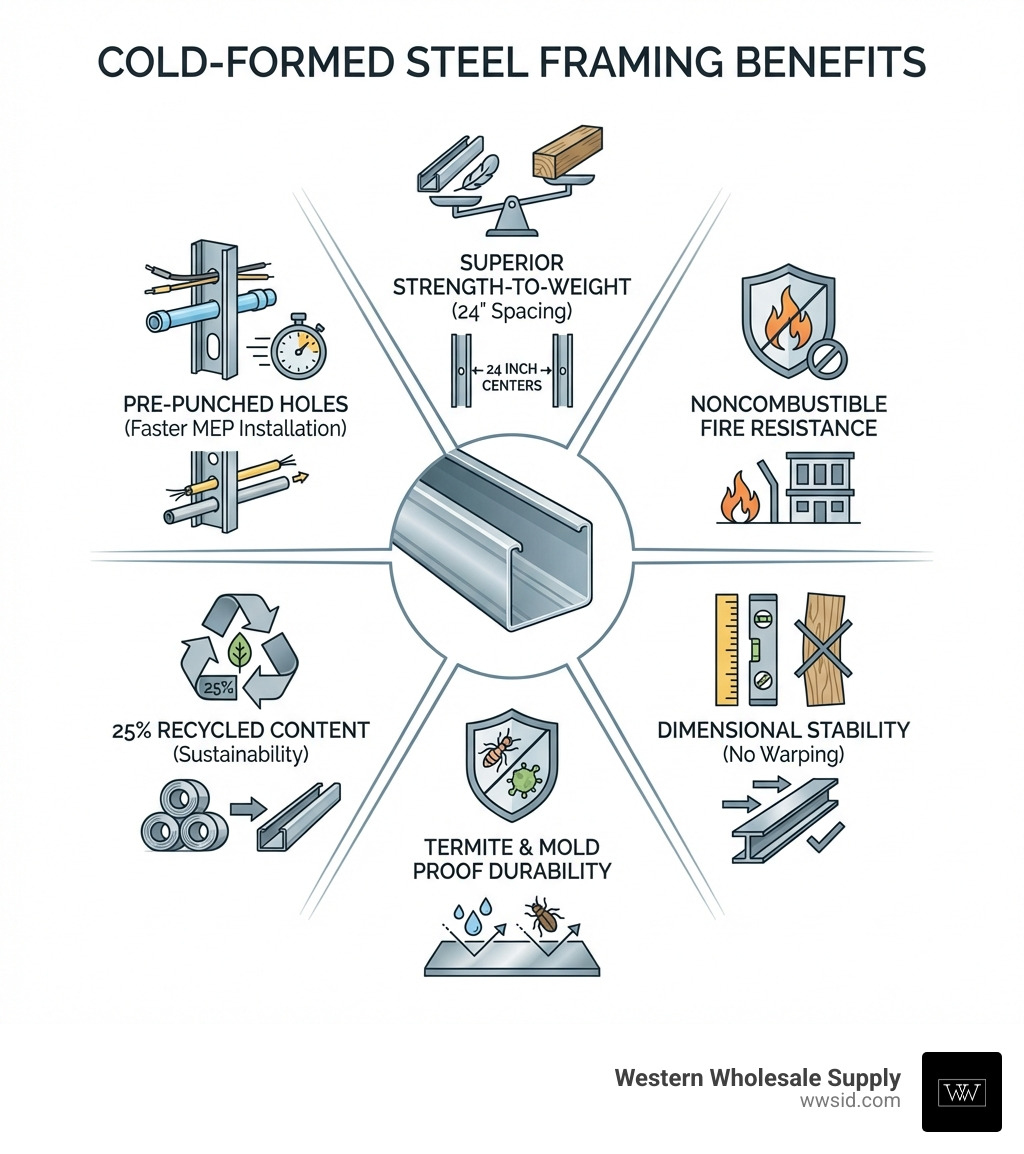
If you’re a contractor or builder evaluating framing options for your next project, cold-formed steel offers compelling advantages over traditional wood framing: dimensional consistency, fire resistance, termite and mold immunity, and faster installation with pre-punched holes for MEP runs.
The shift to steel is real. Cold-formed steel now dominates commercial interior partitions and is rapidly gaining ground in residential and mid-rise construction. Why? Because builders are discovering that steel studs installed on 24-inch centers require fewer members than wood at 16-inch spacing—meaning less labor, faster installation, and predictable material costs without the volatility of lumber markets.
Unlike hot-rolled structural steel (the heavy beams and columns you see in skyscrapers), cold-formed steel uses much thinner material—typically under 1/8 inch thick. Manufacturers take coils of galvanized steel and run them through roll-forming machines that bend the flat sheets into structural shapes without heating. This cold-working process actually increases the steel’s strength, creating members that are surprisingly rigid despite their light weight.
Western Wholesale Supply is a third-generation building materials provider that has been helping contractors across Idaho and Wyoming specify and install cold formed steel framing for residential and commercial projects for years. Our team brings decades of hands-on experience with everything from load-bearing exterior walls to interior partition systems, and we’ve seen how proper material selection and installation practices make the difference between a smooth project and costly callbacks.
Quick cold formed steel framing definitions:
Understanding Cold Formed Steel Framing: Manufacturing and Standards
To truly master cold formed steel framing, we have to look at how it’s born. Unlike the glowing orange beams you see in a heavy steel mill, CFS is a “cold” process. We start with thin sheets of metallic-coated steel—essentially giant rolls of high-quality sheet metal.
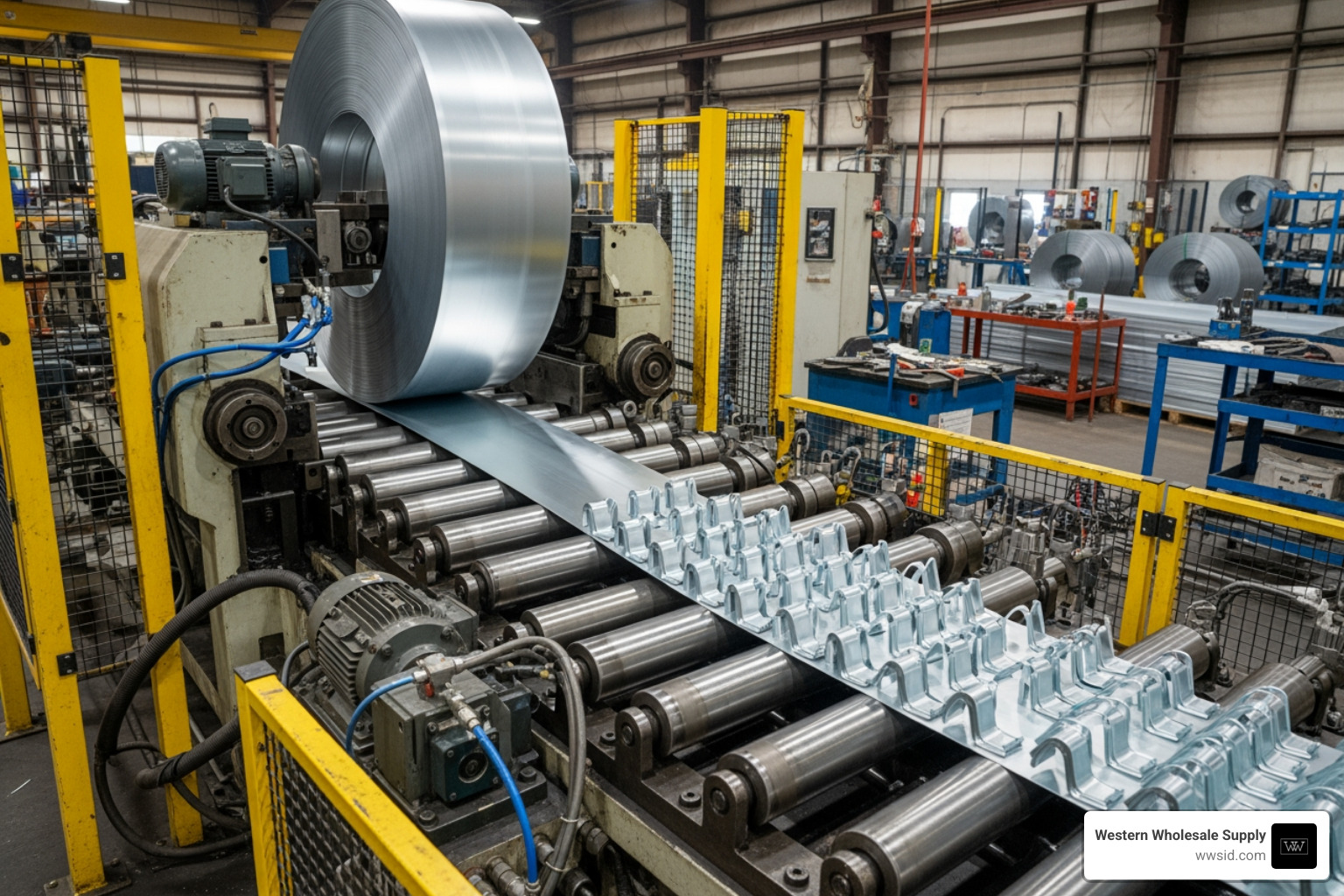
These coils are fed into a roll-forming machine at room temperature. As the steel passes through a series of dies, it is incrementally bent into the familiar “C” or “U” shapes we use on the jobsite. This room-temperature processing is key because it induces “strain hardening,” which actually increases the yield strength of the steel.
The steel itself is typically zinc-coated (galvanized) to provide a lifetime of corrosion protection. In our neck of the woods—from the dry air of Idaho Falls to the snow-heavy winters of Jackson, WY—this protection is vital. Most CFS products come with a yield strength of either 33 ksi or 50 ksi. Generally, the thinner “drywall” studs are 33 ksi, while the heavy-duty structural members used for load-bearing walls are 50 ksi.
For those of us who like to dive deep into the technical weeds, you can access Free AISI Standards for design and construction to see exactly how these members are engineered to perform.
Structural vs. Nonstructural Standards
In cold formed steel framing, not all studs are created equal. We divide them into two main camps:
- Nonstructural (AISI S220): These are your interior partition walls. They aren’t designed to carry the weight of the roof or the floors above; their job is to hold up the drywall and provide a straight, true surface. These often follow ASTM C645 standards.
- Structural (AISI S240): These are the heavy hitters. These members are designed to carry axial loads (weight from above) and lateral loads (wind or seismic forces). If you are building a mid-rise hotel in Rexburg or a residential home in Driggs, these are the members that keep the roof over your head.
The International Building Code (IBC 2024) has fully adopted these AISI standards, meaning as long as you follow the book, your steel-framed building is fully compliant and safe.
Selecting the Right Components: Sizes, Gauges, and Designations
Choosing the right stud is like choosing the right tool for a job—you wouldn’t use a sledgehammer to hang a picture frame. In steel framing, we use a specific “STUFL” nomenclature to keep things organized.
- S = Stud or Joist (with a return lip)
- T = Track (no lip, used at the top and bottom of walls)
- U = U-channel (cold-rolled channel)
- F = Furring channel (hat channel)
- L = L-header (angle)
If you see a designation like 600S162-43, don’t panic. It’s a simple code:
- 600 means a 6-inch web depth (the “fat” part of the stud).
- S means it’s a Stud.
- 162 means a 1-5/8″ flange width (the part you screw the drywall into).
- 43 means it is 43 mils thick (18 gauge)
For more hands-on tips, check out our guide on steel framing components.
Standard Sizes for Cold Formed Steel Framing
We stock a wide range of sizes to fit every project in Eastern Idaho and Western Wyoming. Standard web sizes (the “D” dimension) typically include:
- 250S: 2-1/2 inches (Great for narrow partitions)
- 362S: 3-5/8 inches (The “standard” wall size)
- 600S: 6 inches (Common for exterior or load-bearing walls)
- 1400S: Up to 14 inches (Used for heavy floor joists or rafters)
While tracks usually come in standard 10-foot or 12-foot lengths, studs can be ordered in lengths ranging from 8 feet to 24 feet. This is a huge advantage over wood—you don’t have to go hunting for a straight 20-foot 2×6; every steel stud comes off the truck perfectly straight.
Understanding Mils and Material Thickness
In the old days, people talked about “gauge,” but that was imprecise. Today, the industry uses mils (1/1000th of an inch).
| Mil Thickness | Equivalent Gauge (Approx) | Yield Strength | Identification Color |
|---|---|---|---|
| 18 mil | 25 ga | 33 ksi | None/Black |
| 30 mil | 20 ga (Drywall) | 33 ksi | Pink |
| 33 mil | 20 ga (Structural) | 33 ksi | White |
| 43 mil | 18 ga | 33 ksi | Yellow |
| 54 mil | 16 ga | 50 ksi | Green |
| 68 mil | 14 ga | 50 ksi | Orange |
| 97 mil | 12 ga | 50 ksi | Red |
Using this color-coding system makes it easy for our delivery teams in Pocatello or Jackson to ensure you’re getting exactly what you ordered. For the full spec sheets, the SSMA Technical Library is an invaluable resource.
The Strategic Advantages of CFS Over Traditional Materials
At Western Wholesale Supply, we’ve seen many contractors switch from wood to cold formed steel framing, and they rarely look back. The most immediate benefit is dimensional stability. Wood shrinks, warps, and twists as it dries out (especially in our high-desert climate). Steel stays exactly where you put it.
Steel also offers an incredible strength-to-weight ratio. Because steel is much stronger than wood, we can often space studs at 24 inches on center rather than the traditional 16 inches. This means fewer pieces to handle, fewer screws to drive, and a lighter overall building. Plus, steel is naturally resistant to termites and mold—two things that can quietly destroy a wood-framed building over time. You can read more about the benefits of prefabricated framing on our blog.
Construction Efficiency and Cost Benefits
Efficiency isn’t just about the price of the material; it’s about the “installed cost.” Using cold formed steel framing can drastically reduce labor time.
- Pre-punched holes: Steel studs come with factory-punched holes (knockouts) for electrical and plumbing. No more spending hours with a hole saw.
- Reduced waste: Steel is manufactured to exact lengths. On a typical wood jobsite, you might have a 20% waste factor. With steel, it’s closer to 2%.
- Insurance savings: Because steel is noncombustible, many developers find that “Builder’s Risk” insurance is significantly cheaper compared to wood-frame projects.
- Panelization: CFS is perfect for off-site prefabrication. Walls can be built in a controlled shop environment and trucked to sites in Rigby or Shelley, then craned into place in hours rather than weeks.
Discover more about our steel framing services and benefits to see how we can help your bottom line.
Step-by-Step Guide to Installing Cold Formed Steel Framing
Installing steel is different than wood, but once your crew gets the rhythm, it’s often faster. Here is the basic workflow for a standard wall:
- Layout: Snap your lines on the floor and ceiling just like you would with wood.
- Track Fastening: Secure your “T” (track) to the floor and ceiling. In our region, you’ll likely use powder-actuated fasteners or concrete screws for the slab.
- Stud Nesting: Slide the “S” (stud) into the track. The beauty of steel is that the stud “snaps” into the track and stays there while you check for plumb.
- Vertical Alignment: Use a level or laser to ensure the stud is perfectly vertical.
- Fastening: Use an adjustable-torque screw gun to drive self-drilling screws through the flange of the track into the stud.
If you’re looking to grow your business, expanding into framing and insulation is a great way to increase your ROI on every project.
Best Practices for Installing Cold Formed Steel Framing
To get the best results, we recommend a few specific tools and techniques:
- Adjustable-Torque Screw Guns: These prevent you from stripping the screw holes in thinner mil steel.
- Hand Seamers: Great for bending track or making clean adjustments on the fly.
- Punchout Alignment: When installing your studs, make sure all the knockouts are aligned at the same height. This makes life much easier for the electricians and plumbers who come in after you.
- Web Stiffeners: If you’re using steel for floor joists, you’ll need web stiffeners at the points where the joist sits on a wall to prevent “web crippling.”
- Deflection Tracks: For non-load bearing walls, it is common to use a slotted deflection track at the top of the wall to allow the floor above to move slightly without crushing the wall studs.
For a high-end finish, we often recommend pairing your steel framing with Quietrock EZ Snap for superior soundproofing, CertainTeed or Knauf insulation for maximum thermal performance, or CertainTeed ceiling tiles for commercial interiors—all of which we stock at our Idaho and Wyoming locations.
Performance and Sustainability: Fire, Seismic, and Eco-Impact
One of the biggest reasons developers specify cold formed steel framing is safety. Steel is noncombustible. It doesn’t provide fuel for a fire, which can be the difference between a minor incident and a total loss.
In terms of durability, a study by the National Association of Home Builders (NAHB) confirmed that the zinc coating on CFS can protect against corrosion for hundreds of years. This makes it an ideal choice for the varying climates of the Intermountain West.
Steel is also “ductile,” meaning it can bend without breaking. In seismic-prone areas or regions with high wind loads (like the Teton Pass area), steel framing provides the flexibility to absorb energy during an earthquake or windstorm, keeping the structural integrity of the building intact.
Sustainability and Recyclability
If you’re aiming for LEED credits or just want to build “green,” steel is your best friend.
- Recycled Content: Every piece of CFS contains at least 25% recycled steel.
- 100% Recyclable: At the end of a building’s life, the steel doesn’t go to a landfill; it gets melted down and turned into new steel.
- Low Embodied Carbon: Innovations like “EQ” (equivalent) studs allow for the same structural performance with less raw material, reducing the carbon footprint of the project.
Frequently Asked Questions about CFS
What is the difference between cold-formed and hot-rolled steel?
Think of it like this: hot-rolled steel is the “heavy lifting” skeleton (I-beams) used for skyscrapers. Cold-formed steel is the “light-gauge” framing (studs and tracks) used for walls and floors. Hot-rolled is thick (usually 1/4″ and up), while CFS is thin (usually 1/8″ or less).
Can cold-formed steel be used for multi-story buildings?
Absolutely! CFS has been used successfully in buildings over 10 stories tall. It is the preferred material for mid-rise hotels, dormitories, and assisted living facilities because it combines the speed of light-frame construction with the safety of noncombustible materials.
How do I prevent corrosion in steel framing?
The zinc coating (galvanization) does most of the work for you. However, it’s important to store your steel off the ground and under cover to prevent “wet storage stain.” If you’re building in a particularly harsh environment, we can provide members with heavier G90 coatings for extra protection.
Conclusion
At Western Wholesale Supply, we aren’t just a warehouse; we’re your partners in building a better future. As a veteran-owned, third-generation family business, we’ve spent over 60 years perfecting our service to Eastern Idaho and Western Wyoming. Whether you’re framing a basement in Rexburg, a multi-family complex in Pocatello, or a custom home in Jackson, we have the expertise and the inventory to get the job done right.
Our USP is simple: reliable, on-time delivery and exceptional customer service. We understand that on a jobsite, time is money, and we pride ourselves on getting you the materials you need exactly when you need them.
Ready to start your next project with cold formed steel framing? Contact our expert team today, and let’s build something that lasts.
