

Why Gypsum Metal Stud Framing Matters for Modern Construction
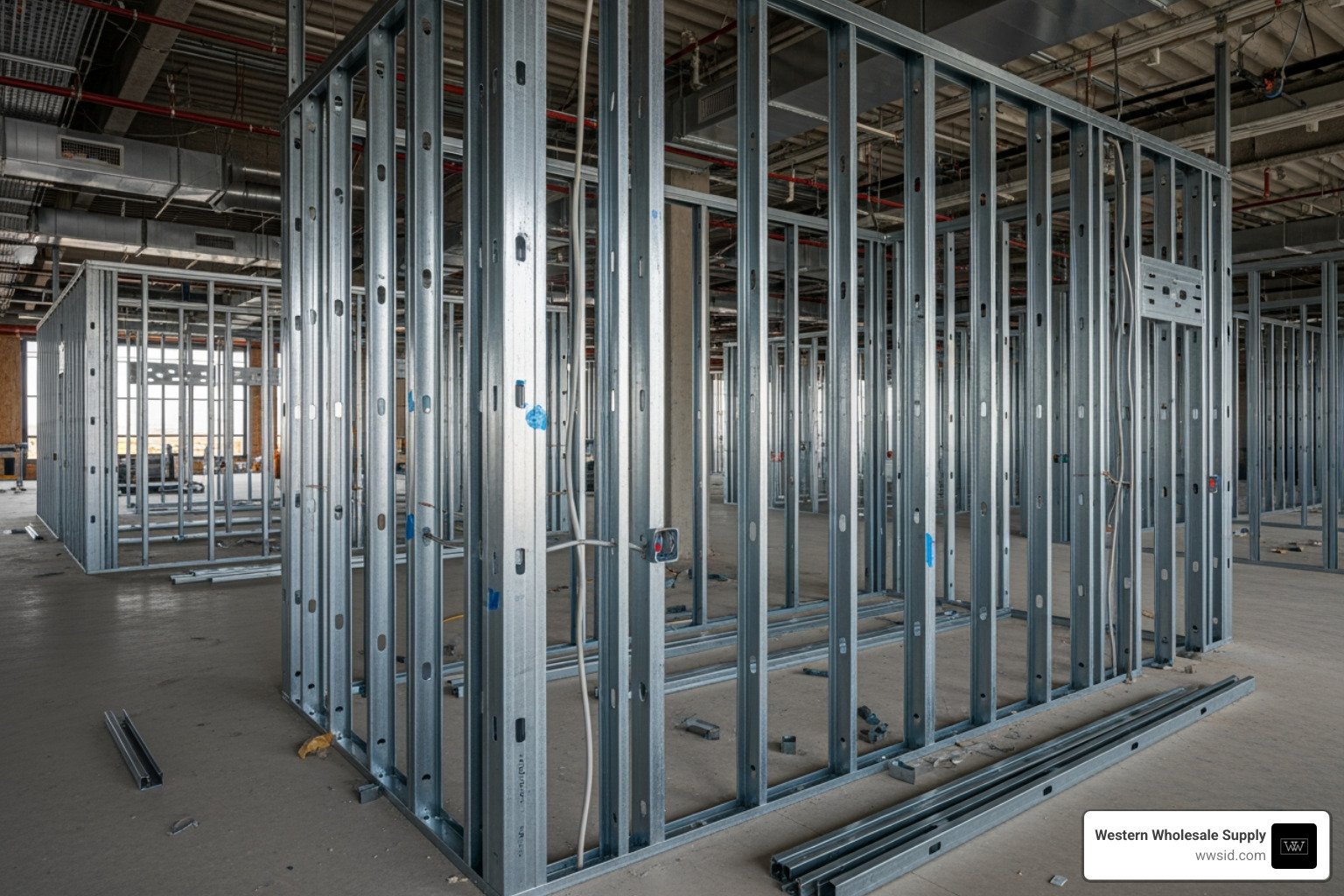
Gypsum metal stud framing has become the backbone of modern commercial and residential interior construction, offering superior fire resistance, dimensional stability, and faster installation compared to traditional wood framing.
Quick Answer: Installing Metal Framing
- Measure and mark your floor and ceiling for track placement
- Secure top and bottom tracks using appropriate fasteners
- Cut studs to length and insert them into tracks at 16″ or 24″ on-center
- Fasten studs into tracks using screws
- Verify plumb and alignment before attaching gypsum board
- Install drywall perpendicular to framing using proper screws
Metal stud framing systems consist of C-shaped studs that fit into U-shaped tracks, creating a framework that supports gypsum board (drywall). These cold-formed steel components are lighter than wood, won’t warp or shrink, and are naturally fire-resistant and pest-proof. The system uses friction-fit connections and self-tapping screws to create walls, partitions, and ceilings that meet strict building codes for fire and sound ratings.
At Western Wholesale Supply, we’ve spent over six decades helping contractors across Idaho and Wyoming build with gypsum metal stud systems. From picking the right gauge to dialing in fire-rated assemblies, we’ve seen how proper metal framing installation is the difference between a smooth, fast hang and a wall that turns into costly callbacks later.
The Anatomy of a Metal Framing System
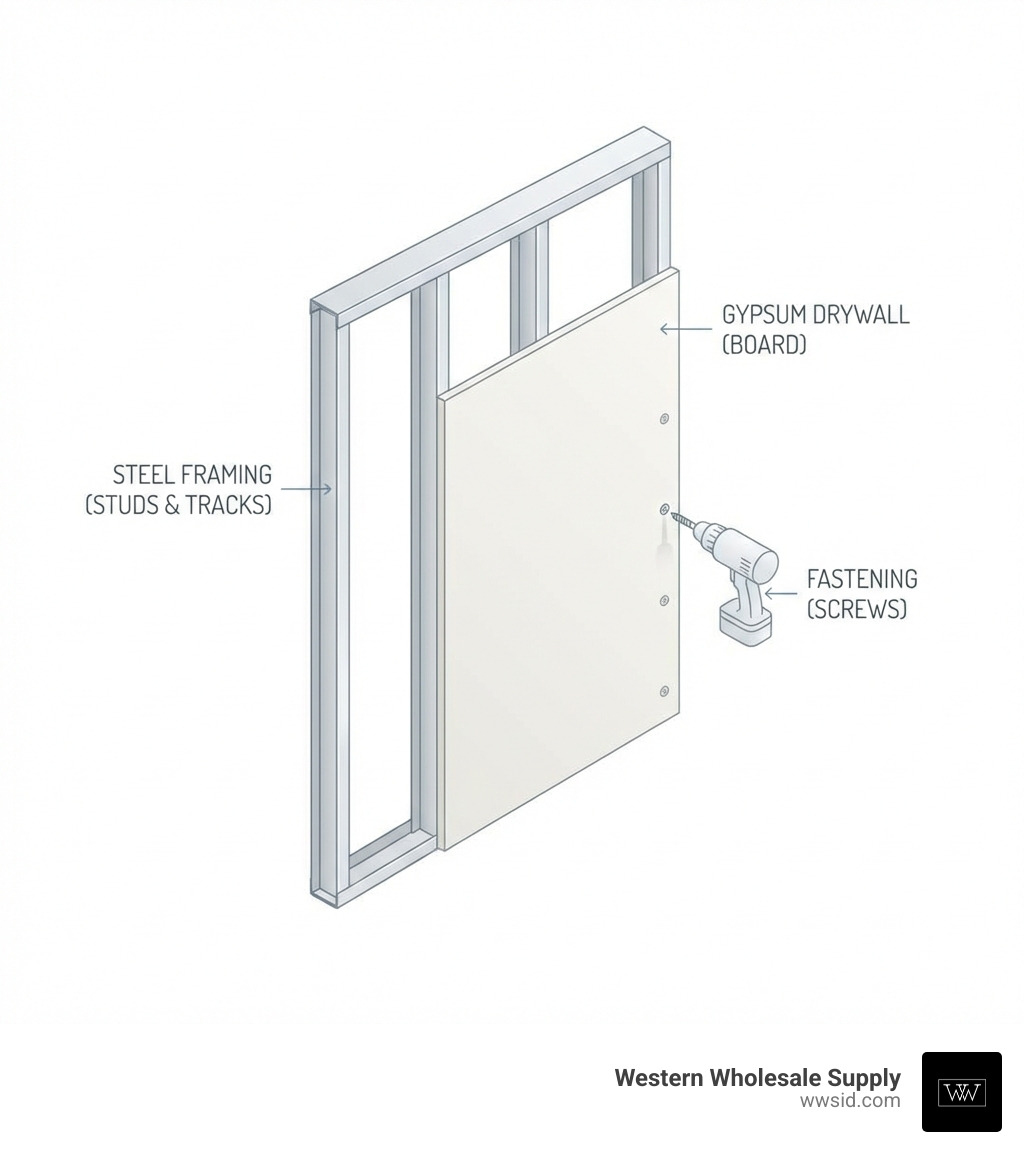
When we talk about a gypsum metal stud framing system, we’re referring to a collection of specialized components that work together to create sturdy, reliable walls and ceilings. At its core, it’s a cold-formed steel structure designed to support gypsum board, often referred to as drywall. This system is a departure from traditional wood framing, bringing a host of unique benefits and installation considerations.
The primary components of a metal stud framing system include:
- Steel Studs: These are the vertical members that form the skeleton of your wall. They are typically C-shaped, providing strength and a surface for attaching gypsum board.
- Steel Track: These are U-shaped channels that serve as the horizontal top and bottom plates of the wall. Studs fit into these tracks, holding them in place.
- Fasteners: Specialized screws (self-tapping, self-drilling) or crimping tools are used to connect studs to tracks and attach gypsum board to the studs.
- Accessories: This category includes a variety of clips, bracing, furring channels, and other specialized pieces designed to improve the frame’s performance, accommodate movement, or provide additional support.
For more in-depth information about the various components and applications of steel framing, be sure to check out our dedicated resource on Steel Framing.
Understanding Studs and Tracks
The stars of our show are the studs and tracks themselves. C-shaped studs are the most common type for vertical wall framing. Their C-shape provides excellent rigidity and allows for easy routing of electrical and plumbing lines through pre-punched holes in the stud web. These punchouts are typically 1-1/2″ x 4″ in members 3-1/2″ and wider, making installation of utilities a breeze. Smaller members might be unpunched unless specified. Some studs even feature knurled surfaces, which improve strength and reduce screw slippage, making your fastening job much easier.
U-shaped tracks, also known as runners, are installed horizontally on the floor and ceiling. The C-shaped studs then fit snugly into these U-channels. This connection is often a “friction fit,” meaning the stud is held in place by pressure, and then secured with screws or crimping. E Studs are a specific type of U-shaped profile often used as starter and end studs for specialized assemblies like shaftwalls, as well as for framing door openings and wall intersections. Standard wall studs are then connected to these top and bottom tracks.
The Role of Accessories and Connectors
Beyond the basic studs and tracks, a range of accessories play crucial roles in ensuring the structural integrity and performance of your gypsum metal stud system:
- Resilient Channel (RC): This is a thin, hat-shaped metal strip used to decouple gypsum board from the framing. By creating a gap, it significantly improves the sound dampening capabilities of a wall or ceiling assembly, making it a favorite for areas where acoustic performance is key.
- Furring Channels: These are used to create a level surface over uneven substrates or to create a space for insulation or utilities. Z-furring channels, for example, are often used with wall insulation, coordinated with the insulation thickness.
- Bracing and Blocking: Depending on the application, additional bracing might be required to stiffen walls, support heavy fixtures, or prevent rotation of studs. This can include horizontal straps or solid blocking.
- Deflection Clips: For walls that need to accommodate structural movement, such as in multi-story buildings, deflection clips or slip-type head joints are essential. These allow for vertical movement between the top track and the structural slab above, preventing cracking in the finished gypsum board.
These accessories aren’t just add-ons; they are integral to achieving the desired performance in terms of fire ratings, sound control, and overall durability.
Why Choose Steel? The Advantages Over Traditional Wood Framing
When it comes to framing, we often get asked why someone would choose steel over traditional wood. For us, the answer is clear: steel offers a compelling array of advantages that make it a superior choice for many construction projects in Eastern Idaho and Western Wyoming.
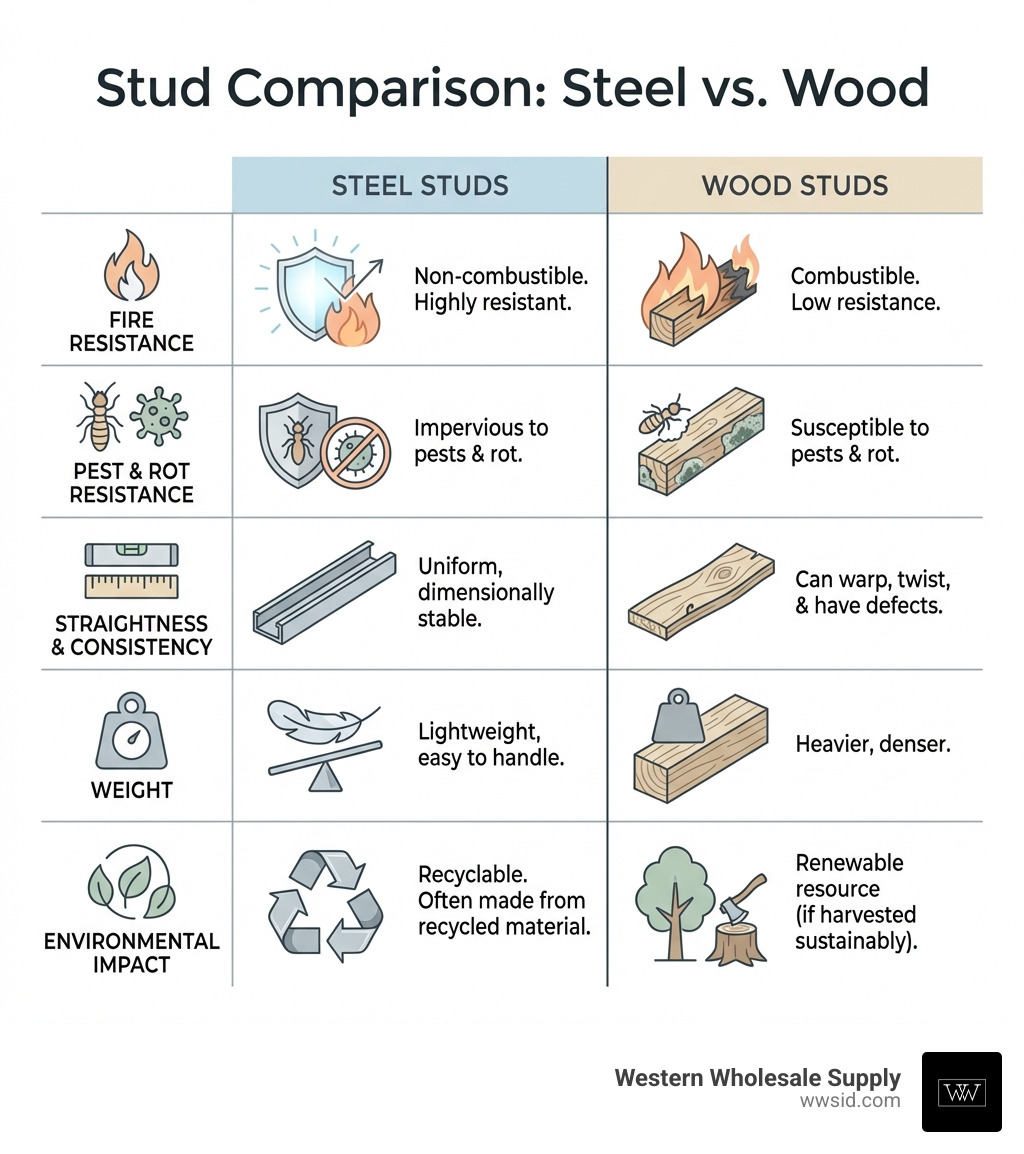
- Durability and Longevity: Steel studs are incredibly durable. Unlike wood, they are immune to rot, insects, and mold. This means a longer lifespan for your walls and less maintenance over time. In our often-dry climate, wood can still be susceptible to issues, but steel stands strong.
- Fire Resistance: This is a huge one. Steel is non-combustible. This inherent fire resistance is a significant safety advantage, contributing to higher fire ratings for wall assemblies and potentially lower insurance costs. Gypsum board itself is fire-resistant, and combined with steel, it creates a robust barrier against fire spread.
- Dimensional Stability: Wood can warp, shrink, twist, and split as it dries or reacts to humidity changes. Steel studs are cold-formed, meaning they maintain their shape and dimensions consistently. This leads to straighter, flatter walls, making drywall installation and finishing much easier and resulting in a superior finished product.
- Lighter Weight: While steel might seem heavy, light-gauge steel studs are actually lighter than comparable wood studs. This makes them easier to handle and install, potentially speeding up construction and reducing labor strain.
- Environmental Benefits: Our commitment to sustainable building practices is reflected in the use of steel. Steel studs are often made from a high percentage of recycled content and are 100% recyclable at the end of a building’s life. This reduces waste and conserves natural resources, aligning with our values for building in our beautiful region.
Choosing steel studs can significantly impact your project’s efficiency, longevity, and even its environmental footprint. It’s a smart choice that pays dividends. To learn more about how expanding into framing and insulation with materials like steel can benefit your bottom line, visit our resource: Beyond Drywall: Why Expanding Into Framing & Insulation Adds Big To Your Bottom Line.
A Step-by-Step Guide to Installing Your Gypsum Metal Stud Frame
Installing a gypsum metal stud frame might seem daunting at first, but with a systematic approach, it’s a straightforward process. We’re here to guide you through the key considerations for spacing, fastening, and handling, ensuring a solid foundation for your gypsum board.
Planning Your Gypsum Metal Stud Layout
Before any metal is cut or fastened, precise planning is essential.
- Measure and Mark: First, accurately measure and mark the proposed wall locations on both the floor and the ceiling. Use a chalk or laser line.
- Locate Tracks: Position your U-shaped tracks along these lines. The track width should match the stud width.
- Door and Window Openings: Plan for all door and window openings, as these will require specific framing details.
- On-Center Spacing: Determine your stud spacing. Common options are 16-inch on-center (16″ OC) or 24-inch on-center (24″ OC). The choice often depends on the gypsum board thickness, desired wall strength, and local building codes.
Assembling the Frame
With your layout marked, it’s time to bring the frame to life.
- Cut Tracks: Cut your bottom and top tracks to the required length using tin snips or a chop saw with a metal-cutting blade.
- Secure Tracks: Fasten the bottom track to the floor and the top track to the ceiling or overhead structure. Use appropriate fasteners for your substrate – concrete screws for concrete, wood screws for wood, or powder-actuated fasteners for speed and strength. If fastening to a concrete slab, a sealer gasket under the bottom track can prevent air infiltration.
- Cut Studs: Measure the distance from the inside of the bottom track to the inside of the top track, then subtract about 1/4 inch to 1/2 inch. This slight gap allows for easy insertion and accommodates minor structural deflection, preventing bulging in your finished wall. Cut your C-shaped studs to this length.
- Insert and Twist Studs: Insert each stud into the bottom track, aligning it with your layout marks. Then, twist the stud and lift it into the top track. This creates a friction fit.
- Fasten Studs: Secure the studs to the tracks. We typically use self-tapping screws (often 1/2-inch or 5/8-inch pan head screws) driven through the web of the stud into the track flange. A crimping tool can also be used to mechanically fasten the stud to the track without screws, which is sometimes faster. Ensure that the punchouts in the studs are generally aligned vertically to allow for easy passage of utilities later.
Common Challenges and How to Mitigate Them
Even with the best planning, challenges can arise. Here’s how we tackle them:
- Plumbness Issues: If a stud isn’t perfectly plumb, don’t just leave it. Use a level and adjust it before fastening. For minor adjustments, a few hammer taps or shims can help.
- Damaged Studs: Damaged studs, especially bent flanges, can compromise the integrity of your wall and make drywall installation difficult. Always handle materials carefully during delivery, storage, and installation to prevent damage. If a stud is significantly damaged, it’s often best to replace it.
- Misaligned Punchouts: While punchouts are designed for convenience, sometimes they don’t align perfectly, making it hard to run pipes or wires. While minor adjustments can be made, significant misalignment might require cutting new openings (with care not to compromise the stud’s strength) or adjusting the stud’s orientation before final fastening.
- Proper Fastening Techniques: Over-driving screws can strip the metal, reducing holding power. Under-driving leaves screw heads proud, creating bumps in your finished wall. Aim to set screw heads slightly below the surface, creating a dimple without breaking the face paper of the gypsum board.
- Working Around MEP (Mechanical, Electrical, Plumbing): The pre-punched holes in steel studs are a major advantage here. Plan your MEP runs carefully to use these openings. If additional holes are needed, ensure they are placed in the web of the stud and not too close to the flanges, and avoid creating large, unsupported openings that could weaken the stud.
Understanding the Technicals: Gauge, Ratings, and Codes
Building a gypsum metal stud frame isn’t just about putting pieces together; it’s about understanding the technical specifications that ensure safety, performance, and compliance. This includes everything from the thickness of the steel to the fire and sound ratings of the finished assembly.
How Gauge and Thickness Impact Performance
The performance of a steel stud is heavily influenced by its gauge and thickness. Gauge is an inverse measurement: a higher gauge number means a thinner piece of steel. Thickness is often measured in “mils” (thousandths of an inch).
- Light-Gauge Studs: These are typically 25-gauge (0.0179 inches or 18 mils) to 20-gauge (0.0329 inches or 33 mils). They are commonly used for interior non-load-bearing partitions where the primary function is to support gypsum board and light wall-hung items. For interior non-load-bearing studs without supporting attached loads, a minimum thickness of 25 gauge is generally acceptable.
- Structural Studs: These are heavier gauge studs, such as 18-gauge (0.043 inches or 43 mils), 16-gauge (0.054 inches or 54 mils), or even thicker. They are designed to carry significant axial loads (vertical weight) or withstand strong lateral loads (like wind pressure in exterior walls). Structural studs are crucial for applications like exterior curtain walls, load-bearing interior walls, tall partitions, and floor or roof truss assemblies. We always recommend a minimum thickness of 20 gauge for studs supporting significant wall-hung items like cabinetwork or equipment.
The choice between light-gauge and structural studs depends entirely on the application, the loads they need to bear, and deflection limits (how much the wall can bend under load). For complex projects, tools like the ClarkDietrich iTools – Structural Stud Lookup Tool can help architects and engineers select the appropriate stud size and gauge based on specific design criteria.
Key Considerations for a Gypsum Metal Stud Assembly
When we design and build with gypsum metal stud systems, fire and sound ratings are paramount, especially in multi-family residences or commercial buildings across Idaho and Wyoming.
- Fire-Resistance Ratings: These ratings indicate how long an assembly can resist fire penetration and maintain structural integrity. They are determined by rigorous laboratory tests, primarily following ASTM E119 standards. The rating depends on the core type and thickness of the gypsum board, the number of layers, the type and spacing of the studs, and how all components are assembled. For maximum fire resistance, double-layer gypsum board construction is generally recommended. The gypsum core itself contains water that turns to steam when heated, retarding heat transfer.
- Sound Ratings: We measure sound performance using the Sound Transmission Class (STC), which rates a wall’s ability to reduce airborne sound, and sometimes the Impact Insulation Class (IIC) for floor-ceiling systems. These are tested according to ASTM E90. Factors influencing STC include gypsum board thickness, the number of layers, stud spacing, the use of resilient channels, and the presence of insulation within the stud cavities. Adding mineral fiber, glass fiber, or cellulose fiber insulation (as long as it doesn’t exceed the stud depth) is permitted and can significantly improve sound attenuation. However, it’s crucial to remember that field conditions like air leaks and flanking paths can reduce acoustical performance, so meticulous installation is key.
Navigating Building Codes and Standards
Building codes and industry standards are our rulebook for safe and compliant construction. For gypsum metal stud systems, we primarily adhere to:
- International Building Code (IBC): The IBC is adopted across most of the United States, including Idaho and Wyoming. As of February 2026, the 2024 IBC is the current standard governing structural design, fire safety, and other aspects of construction.
- ASTM Standards: These standards define the properties and testing methods for materials. For gypsum board, ASTM C1396 is the key standard, covering everything from core types to dimensions. For more details on this, see our article What is Standard Gypsum Board? Decoding ASTM C1396.
- AISI Standards: The American Iron and Steel Institute (AISI) publishes standards like AISI S100 (North American Specification for the Design of Cold-Formed Steel Structural Members) and AISI S240 (North American Standard for Cold-Formed Steel Structural Framing). These are critical for the design and engineering of cold-formed steel components.
Our products are architecturally approved on all projects and will meet or exceed all current building codes, ensuring your project meets local requirements in Eastern Idaho and Western Wyoming.
Frequently Asked Questions about Gypsum Metal Studs
We often get questions from contractors and DIY enthusiasts alike about the practicalities of working with gypsum metal stud framing. Here are some of the most common ones we hear:
What are the main applications for gypsum metal stud framing?
The versatility of gypsum metal stud framing makes it suitable for a vast array of applications across residential, commercial, and industrial construction:
- Interior Partitions: This is the most common use, creating non-load-bearing walls for rooms, hallways, and offices.
- Load-Bearing Walls: With appropriately gauged structural studs, metal framing can support vertical loads, making it suitable for multi-story residential and commercial buildings.
- Exterior Curtain Walls: Structural steel studs are frequently used for exterior non-load-bearing walls that support cladding and resist lateral wind loads.
- Soffits and Ceilings: Metal framing is ideal for creating suspended ceilings, furred ceilings, and architectural soffits due to its light weight and dimensional stability.
- Special Assemblies: Metal studs are integral to specialized assemblies requiring high performance, such as:
- Shaftwalls: These fire-rated assemblies enclose elevator shafts, stairwells, and utility chases, providing critical fire protection. CH Studs and E Studs are specifically designed for these applications.
- Area Separation Walls: Used between adjacent dwelling units or buildings, these fire-rated walls prevent fire spread and often provide sound separation.
From a simple office partition to a complex curtain wall system on a commercial building in Boise, metal studs offer a robust and reliable solution.
How do you hang heavy items like TVs or cabinets on a metal stud wall?
Hanging heavy items on metal stud walls requires a bit more planning than with wood, but it’s certainly achievable:
- Locate Studs: Just like with wood, always try to fasten heavy items directly into the studs.
- Reinforcement/Blocking: For very heavy items like wall-mounted TVs, large shelving units, or cabinets, we recommend installing additional reinforcement or blocking before the gypsum board goes up. This can be done with plywood, lumber, or even additional steel members fastened horizontally between the studs. This spreads the load across multiple studs and provides a solid backing.
- Toggle Bolts and Hollow-Wall Anchors: For items that don’t align with a stud or aren’t excessively heavy, specialized toggle bolts or hollow-wall anchors designed for drywall can be used. These expand behind the gypsum board to create a secure attachment point. Always check the weight rating of these fasteners.
- Heavy-Duty Studs: If you know a wall will support significant weight, consider using a heavier gauge stud (e.g., 20-gauge or thicker) during initial framing, as these are better equipped to handle concentrated loads.
Build Straighter, Stronger, and Smarter with Steel
From the foundational tracks to the finishing touches of gypsum board, gypsum metal stud framing offers a modern, efficient, and robust solution for construction projects. We’ve explored its components, understood its significant advantages over traditional wood, walked through the installation process, and dug into the technical specifications that ensure a high-performance build. The benefits of durability, fire safety, dimensional stability, and environmental responsibility make steel a clear winner for many applications.
Whether you’re building a new commercial space in Idaho Falls, renovating a home in Pocatello, or tackling an industrial project in Eastern Idaho or Western Wyoming, embracing steel framing means choosing a straighter, stronger, and smarter way to build. For all your building material needs in Eastern Idaho and Western Wyoming, from steel framing to drywall and insulation, trust the reliable service and expertise of Western Wholesale Supply. We’ve been serving our communities since 1963, and we’re ready to help you build your next great project.
