

The Fast Answer: Setting-Type vs. Pre-Mixed Joint Compound
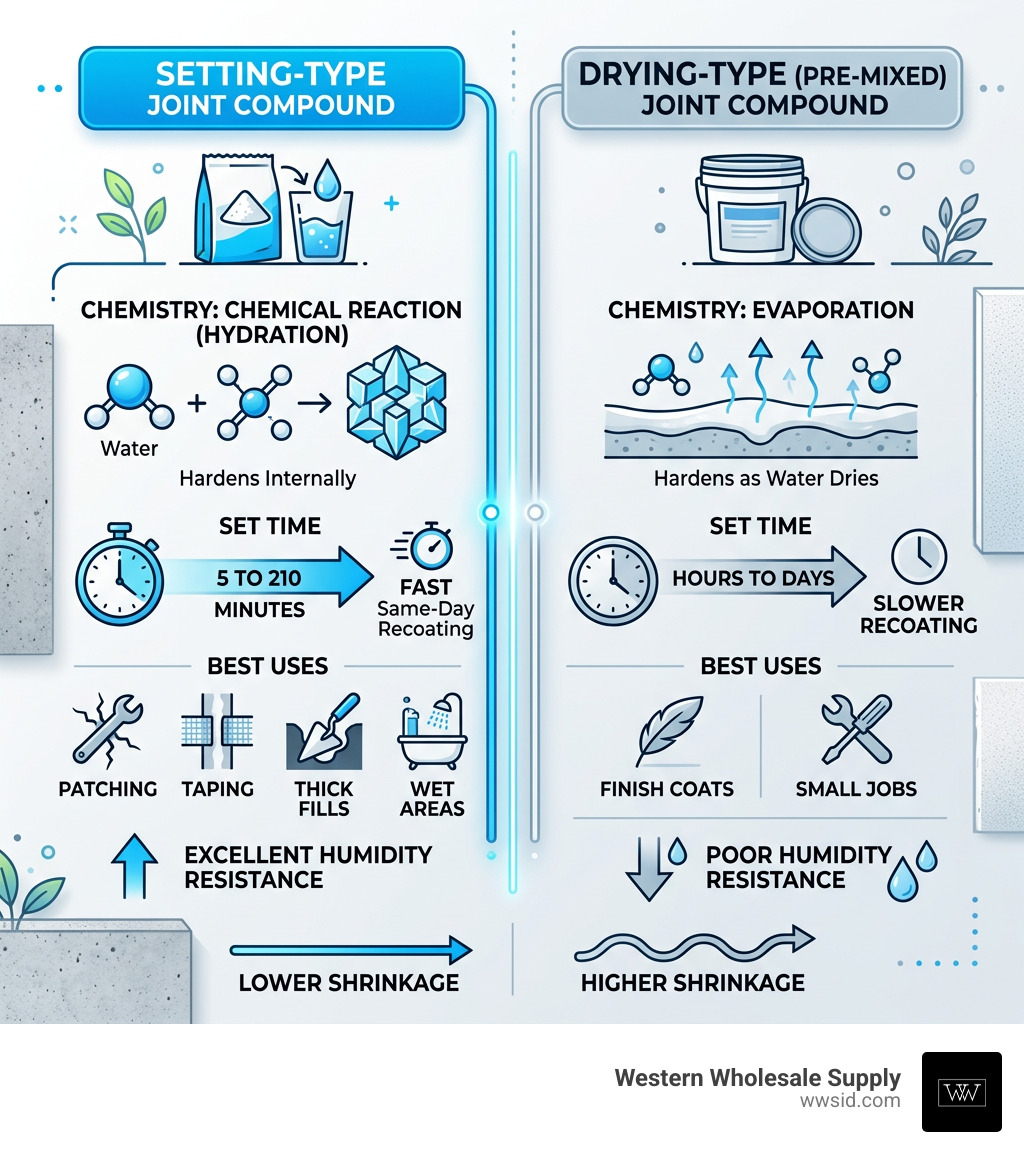
Setting type joint compound is a powder you mix with water that hardens through a chemical reaction — not by drying out. That makes it faster, stronger, and more reliable than pre-mixed compound in tough conditions.
Here’s a quick comparison to help you decide:
| Feature | Setting-Type Compound | Pre-Mixed Compound |
|---|---|---|
| Form | Powder (mix with water) | Ready to use |
| Hardens by | Chemical reaction | Water evaporation |
| Set time | 5 to 210 minutes | Hours to days |
| Shrinkage | Very low | Higher |
| Humidity resistance | Excellent | Poor |
| Same-day recoating | Yes | No |
| Sanding difficulty | Harder (use Easy Sand versions) | Easier |
| Best for | Patching, taping, thick fills, wet areas | Finish coats, small jobs |
If you’re on a tight schedule, working in a humid environment, or filling a deep void, setting-type compound is almost always the right call. If you just need a smooth final coat, pre-mixed works fine.
Walk into any drywall job without knowing which mud to grab, and you can easily lose hours — or worse, end up redoing work. As building materials professionals who have supplied contractors across Eastern Idaho and Western Wyoming with setting type joint compound and related products through Western Wholesale Supply, we’ve seen that mistake cost real money on real projects. Let’s make sure it doesn’t happen to yours.
Understanding Setting Type Joint Compound vs. Drying Compounds
When we talk about “mudding” a wall, we’re usually choosing between two very different chemical processes. Pre-mixed compound, often found in those heavy five-gallon buckets, is a drying-type compound. It consists of vinyl binders and fillers that stay soft as long as they are wet. Once you spread it on the wall, the water evaporates into the air, leaving the solid material behind.
Setting type joint compound, on the other hand, comes in bags of dry powder. When we add water, we trigger a chemical hydration reaction. This is very similar to how concrete or plaster hardens. It doesn’t need the air to “dry” it out; it creates a hard crystalline structure internally. This fundamental difference is why setting-type mud is often called “hot mud”—it actually generates a tiny bit of heat during the chemical reaction.
One of the biggest advantages of this chemical set is shrinkage resistance. Because drying-type mud relies on evaporation, it loses volume as it dries, which can lead to cracks or “dishing” in deep joints. Setting-type compound has very low shrinkage, making it the superior choice for areas where thick fills are necessary.
The Science of Setting Type Joint Compound
The magic of setting type joint compound lies in its hydration process. Unlike pre-mixed buckets that can take 24 hours to dry (especially in the humid summers of Western Wyoming or the damp winters of Eastern Idaho), setting compound hardens on a fixed schedule.
As the powder and water mix, crystals begin to grow and interlock. This creates a bond strength that is significantly higher than standard air-dry muds. This superior bond is why we recommend it for embedding tape, especially fiberglass mesh tape, which requires a stronger “grip” to prevent joint cracking later.
Advantages of Lightweight Formulas
Traditionally, “hot mud” was notoriously difficult to sand. It dried as hard as a rock, and if you left a ridge, you’d be grinding at it for hours. Modern technology has given us lightweight versions, such as Hamilton Fast Set joint compound.
These lightweight formulas, like Fast Set, are actually 30% lighter than conventional setting compounds. This makes them much easier to mix, apply, and—most importantly—sand. They provide the same chemical hardening benefits but use specialized fillers that allow you to achieve a smooth finish without the back-breaking labor. When you are selecting joint-treatments-trims, opting for a lightweight setting compound can save your shoulders and your schedule.
Choosing the Right Setting Time for Your Project
One of the most common questions we get at our Western Wholesale Supply locations in Idaho Falls or Pocatello is: “Which number do I need?” Setting compounds are labeled with numbers—5, 20, 45, or 90. These numbers represent the approximate minutes the product will remain workable.
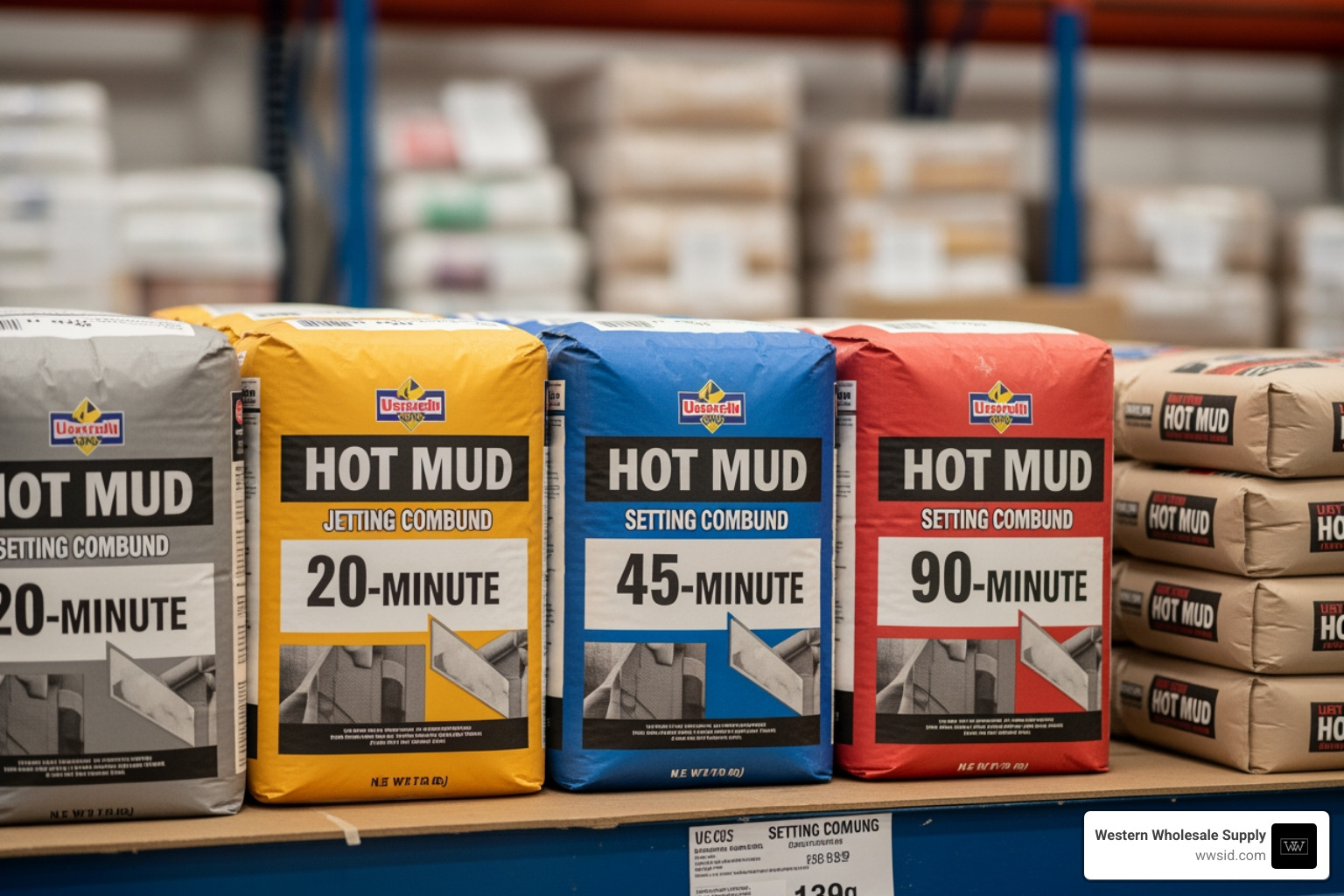
It is crucial to understand the difference between working time and setting time:
- Working Time: This is the window you have to actually spread the mud before it starts to get “chunky” or stiff in your pan.
- Setting Time: This is when the mud has hardened enough to apply another coat over it.
Selecting for Small Repairs
If you’re doing a quick patch job in a rental in Rexburg or fixing a hole in a shop in Blackfoot, you want speed.
- 5-Minute Mud: This is for the “surgical” strikes. It’s great for filling a single deep hole or a small crack. You have to work fast, or it will harden in your pan before you reach the wall.
- 20-Minute Mud: This is the sweet spot for one-day patching. By the time you finish applying it to a few spots and clean your tools, the first patch is usually ready for a second coat.
Selecting for Large Installations
For full-room projects or long runs of drywall, you need more “open time.”
- 45-Minute Mud: This is a favorite for professional tapers. It gives you enough time to run a few joints without rushing but still allows for a second coat before lunch.
- 90-Minute Mud: This is what we usually recommend for DIYers or larger taping jobs. It provides a comfortable pace for embedding tape and filling joints without the stress of the mud “going off” too quickly.
- 210-Minute Mud: Used mostly on massive commercial projects where a large batch needs to stay wet for several hours.
Best Practices for Mixing and Applying “Hot Mud”
Proper mixing is the difference between a professional finish and a lumpy mess. Unlike pre-mixed mud, which you can just fluff up with a drill, setting type joint compound requires a specific order of operations.
- Water First: Always put clean, drinkable water into your bucket or pan first, then add the powder. Adding water to powder almost always results in dry lumps at the bottom.
- The One-Minute Soak: After an initial stir, let the mix sit for about one minute. This allows the water to fully saturate the powder particles.
- Creamy Consistency: Mix until it looks like thick cake frosting or soft butter. If it’s too runny, it will sag; if it’s too thick, it won’t bond well.
When you’re sourcing materials for a project, drywall-done-right-choosing-the-best-supplier-for-your-project involves having the right advice on consistency and ratios.
Troubleshooting Your Setting Type Joint Compound Mix
If your mud is acting up, it’s usually due to one of these factors:
- Lumping: Usually caused by adding water to the powder or not letting it soak.
- Fast Setting: If your 90-minute mud hardens in 30 minutes, check your tools. Dirty water or leftover “set” mud in your bucket acts as a catalyst, speeding up the chemical reaction. Also, using hot water will make it set much faster.
- Weak Strength: This often happens if you add too much water or try to “re-temper” mud that has already started to stiffen.
Tools for a Professional Finish
You don’t need a warehouse full of tools, but a few basics are non-negotiable:
- Mixing Paddle and Low-Speed Drill: Aim for 450-650 RPM. High speeds whip too much air into the mix, causing bubbles.
- Mud Masher: For smaller batches in a bucket.
- Stainless Steel Trowel or Taping Knives: These are easier to clean, and cleanliness is vital with setting compounds.
Understanding your frame-your-future-understanding-gypsum-steel-components also helps in choosing the right knife width for the job.
Advanced Applications and Common Mistakes
Setting type joint compound isn’t just for joints; it’s a versatile tool for heavy-duty applications. For instance, it is excellent for laminating gypsum panels to concrete or sound-deadening boards like Quietrock EZ Snap. It’s also the go-to for filling gaps wider than recommended in what-is-standard-gypsum-board-decoding-astm-c1396 installations.
Using Setting Type Joint Compound in High-Moisture Areas
One of the standout features of “hot mud” is its performance in damp environments. Because it hardens chemically, it is virtually unaffected by high humidity once it has set. This makes it ideal for:
- Bathrooms and Kitchens: It provides a more stable base for tile backer or moisture-resistant drywall.
- Exterior Soffits: In protected outdoor areas, it resists the softening that can happen to standard mud in humid weather.
- Concrete Ceilings: It bonds exceptionally well to above-grade interior concrete.
For these specific areas, we always suggest checking our joint-treatments-trims inventory for the best moisture-resistant options.
Avoiding the “Re-tempering” Trap
This is the most common mistake we see. When the mud in your pan starts to get stiff, your instinct is to add a splash of water and stir it back to life. Don’t do it.
Adding water to mud that has already begun its chemical set breaks the crystalline bonds. You might get it spreadable again, but it will have no strength, it will likely crack, and it may even peel off the wall later. If it starts to harden, scrape it out, throw it away, and mix a fresh batch. For safety and handling details, always keep the PDF SDS for Fast-Setting Compounds handy.
Frequently Asked Questions about Setting Type Joint Compound
How much coverage does an 18 lb bag provide?
Coverage can vary based on how thick you apply it, but a standard 18-lb bag of setting type joint compound (like Easy Sand 45) will cover approximately 325 square feet of drywall.
In terms of raw weight, you can expect to use about 45-55 lbs of compound per 1,000 square feet of drywall panels. If you are planning a large project in Jackson or Twin Falls, dont-get-board-sourcing-sheetrock-in-bulk is the best way to ensure you have enough material on hand without making multiple trips.
Can you apply multiple coats in the same day?
Absolutely. This is the primary reason professionals use it. With a drying-type mud, you have to wait for the water to evaporate completely—which can take a day or more. With setting-type mud, you only have to wait for it to “set” (harden).
You can actually apply a second coat over a “damp” first coat as long as the first coat has reached its chemical set. This allows you to tape, bed, and finish a repair in a single afternoon. When you’re looking for dont-get-sheet-faced-finding-the-best-drywall-deals, the time saved by same-day recoating is a massive part of the value.
Is setting-type compound harder to sand than pre-mixed?
It used to be, but not anymore. If you choose the “Easy Sand” or “Lite” versions, the sanding effort is very similar to a standard all-purpose pre-mixed mud.
However, a pro tip for reducing dust: you can “water-sand” or sponge the edges of setting compound just as it starts to harden. By using a damp sponge to smooth out the edges before they are fully cured, you can often eliminate the need for heavy mechanical sanding altogether.
Conclusion
Choosing the right setting type joint compound doesn’t have to be a muddy mess. By matching the setting time to your project scale and following proper mixing techniques, you can achieve a professional, durable finish in a fraction of the time it takes with traditional drying muds.
At Western Wholesale Supply, we’ve been helping builders across Eastern Idaho and Western Wyoming—from the Tetons in Jackson to the Snake River Plain in Burley—since 1963. We are a third-generation, veteran-owned family business, and we pride ourselves on having the local expertise and reliable, on-time delivery you need to keep your project moving.
Whether you’re in Idaho Falls, Pocatello, or anywhere in the surrounding region, we have the inventory and the experience to help you choose the right materials for the job. Still have questions about your specific drywall project? Contact Western Wholesale Supply today, and let’s get to work!
