

What G60 Coating Actually Does (And Why It Matters for Your Project)
G60 metal studs are galvanized steel framing members coated with 0.60 ounces of zinc per square foot, making them the most widely used choice for interior non-load bearing wall framing in commercial and residential construction.
Here’s a quick breakdown of what you need to know:
| Feature | G60 Metal Studs |
|---|---|
| Zinc coating weight | 0.60 oz per sq ft |
| Best use | Interior, non-load bearing walls |
| Corrosion resistance | Moderate (controlled environments) |
| Common gauges | 20 GA EQ, 16 GA, 25 GA EQ |
| Key standards | ASTM A1003, AISI S220, IBC 2024 |
| Typical lengths | 8 ft, 10 ft, 12 ft, 19 ft |
The zinc coating acts as a protective barrier that prevents the steel underneath from rusting. In dry, controlled indoor environments — think office partitions, interior walls, and HVAC framing — G60 delivers solid protection without the added cost of heavier coatings like G90.
That balance of performance and value is exactly why G60 is the go-to standard for most interior framing jobs.
At Western Wholesale Supply, we are third-generation building materials professionals who have sourced and supplied G60 metal studs to contractors across Eastern Idaho and Western Wyoming for years. Our hands-on distribution experience gives us a practical, ground-level perspective on how these products perform in the field — and we’ll walk you through everything you need to know.
What are G60 Metal Studs?
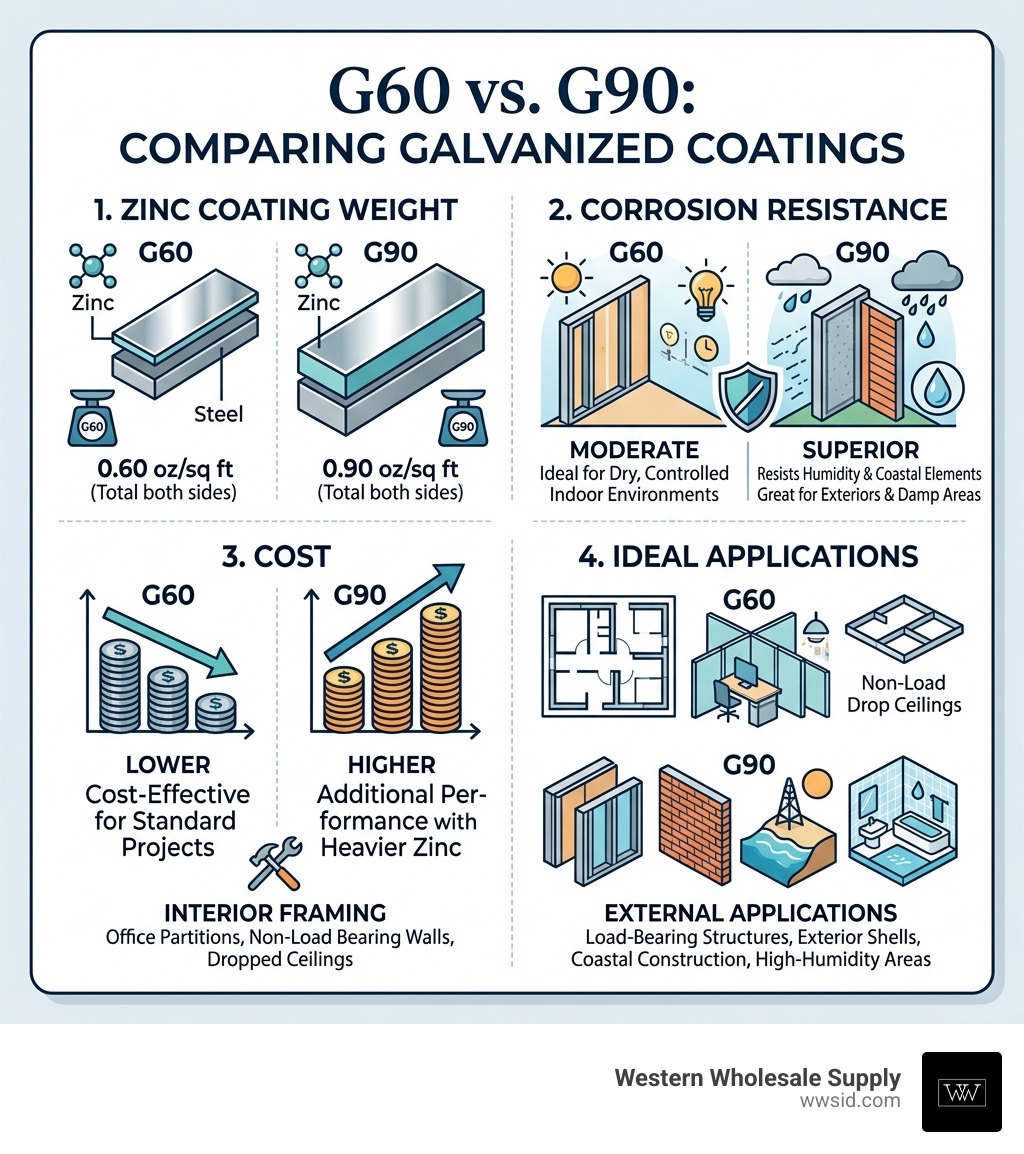
When we talk about g60 metal studs, we are referring to the specific weight of the zinc coating applied to the steel. In metallurgy, the “G” stands for galvanized, and the “60” represents the total weight of the zinc on both sides of the sheet: 0.60 ounces per square foot.
These studs are manufactured from mill-certified galvanized steel. This certification ensures that the material meets rigorous ASTM International standards, specifically ASTM A1003, which covers the metallic-coated steel used in cold-formed framing members. At Western Wholesale Supply, we’ve seen these studs become the backbone of commercial interiors from Idaho Falls to Jackson, WY, because they offer the structural integrity needed for modern partitions while remaining easy to handle.
| Feature | G60 Coating | G90 Coating |
|---|---|---|
| Zinc Weight | 0.60 oz/sq ft | 0.90 oz/sq ft |
| Corrosion Resistance | Moderate | High |
| Relative Cost | Economical | Higher |
| Typical Lifespan | Long (Interior) | Maximum (Exterior/Humid) |
| Primary Use | Interior Drywall Framing | Structural/Exterior/Coastal |
Understanding the G60 Designation
The G60 designation is more than just a number; it’s a promise of chemical protection. The galvanization process involves a metallurgical bond between the zinc and the underlying steel. If the surface is scratched, the surrounding zinc “sacrifices” itself to protect the exposed steel through a process called galvanic corrosion protection.
For a deeper dive into how these components fit into the larger picture of construction, check out Everything You Need To Know About Steel Framing. This protective layer is essential in our region, where indoor environments are climate-controlled but still require a baseline level of defense against ambient moisture.
G60 vs G90: Choosing the Right Protection
We often get asked if G90 is “better” than G60. While G90 has a thicker coating (0.90 oz/sq ft), it isn’t always the right choice for every budget. G60 is the most commonly used zinc coating thickness because it strikes an optimal balance between cost and protection.
If you are framing a standard office wall or a warehouse partition in a dry environment like Pocatello or Rexburg, G60 provides a moderate lifespan that will likely outlast the building itself. G90 is typically reserved for high-moisture areas, industrial sites, or exterior structural framing where the elements are much harsher.
Key Specifications and Performance of G60 Metal Studs
When you’re walking through a job site, you’ll likely see the standard “bread and butter” size: the 3 5/8 inch stud. A common specification we supply is the 3 5/8 in x 10 ft x 20 GA EQ G60 steel stud with a 1 1/4 in flange.
These studs typically range in thickness from 15 to 33 mils. The “mil” measurement is the actual decimal thickness of the steel (1 mil = 1/1000th of an inch). For example, a 30 mil stud is a sturdy 20-gauge member often used for taller interior partitions that need extra rigidity.
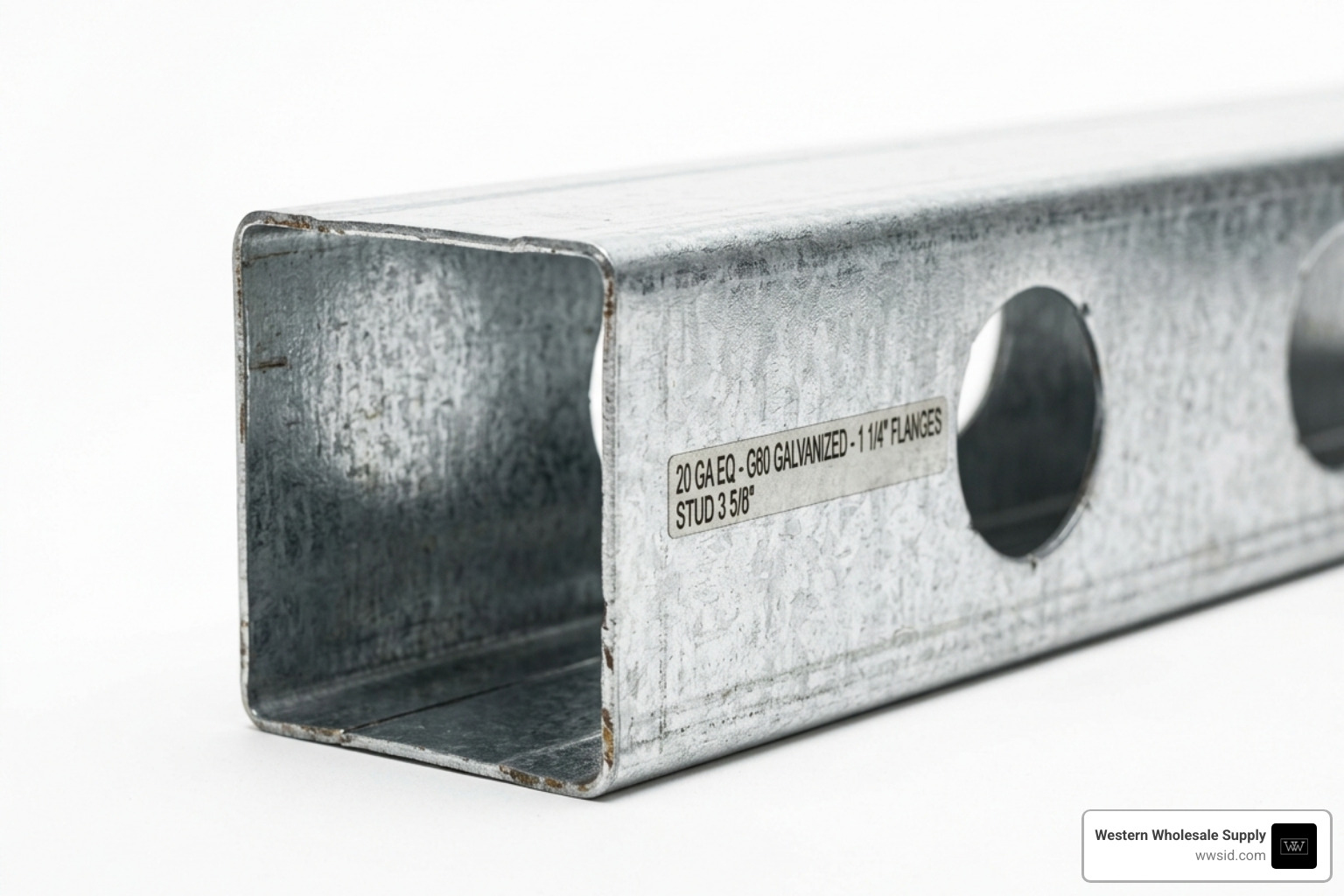
Understanding these specs is vital for ensuring your wall doesn’t bow or flex under the weight of the drywall. You can learn more about these specific components on our Steel Framing page.
The Role of EQ (Equivalent Gauge) in G60 Metal Studs
The term “EQ” stands for Equivalent Gauge. This is a bit of modern engineering magic. Manufacturers use high-strength steel (often 50ksi to 70ksi yield strength) that is thinner than traditional “heavy” gauges but performs just as well—or better—in terms of screw pull-out strength and moment capacity.
For instance, a 20 GA EQ stud might be thinner in actual mils than a traditional 20-gauge “structural” stud, but because the steel is harder, it meets the same performance standards for non-load bearing walls. This makes the studs lighter and easier to cut, which your framing crew will definitely appreciate. For more on how these high-tech components work, see Frame Your Future Understanding Gypsum Steel Components.
Compliance with Building Codes and Standards
Rest assured, g60 metal studs aren’t just a “good idea”—they are code-compliant. Quality G60 studs comply with:
- AISI S220: The standard for non-structural cold-formed steel framing.
- IBC 2024: The latest International Building Code requirements.
- ASTM A1003: Material specifications for coated steel.
- SFIA (Steel Framing Industry Association): Certification that ensures the stud actually meets the thickness and coating weight it claims on the label.
Applications and Benefits for Interior Projects
Why use g60 metal studs instead of wood or other materials? In our 60 years of experience serving Eastern Idaho and Western Wyoming, we’ve found a few key reasons:
- Fire Safety: Steel doesn’t burn. It’s a non-combustible material, which is often a requirement for commercial insurance and building codes.
- Consistency: Steel studs don’t warp, twist, or shrink. Your walls stay straight, which means no “nail pops” in your drywall later.
- Pest Resistance: Termites don’t eat steel.
- Efficiency: They are pre-punched for wiring and plumbing, saving hours of labor on-site.
For a look at how these benefits translate to large-scale projects, read Steel Yourself Unpacking The Benefits Of Prefabricated Framing.
Installation Best Practices for G60 Metal Studs
Installing g60 metal studs is straightforward, but there are a few “pro tips” to keep in mind:
- Alignment: Ensure all pre-punched knockouts (punchouts) are aligned horizontally. This makes it much easier to run electrical conduit or plumbing pipes later.
- Deflection Tracks: In commercial buildings, floors and ceilings can move. Using a deflection track at the top of the wall allows the building to “breathe” without cracking your drywall.
- Screw Connections: Use the right self-tapping screws. For 20 GA EQ studs, a standard fine-thread drywall screw works perfectly.
For more installation “hacks,” check out Studs Tracks And Drywall Hacks Building Your Metal Frame.
Maintenance and Longevity in Controlled Environments
One of the best things about g60 metal studs is that they are essentially maintenance-free. Once they are “closed in” behind drywall, the G60 coating protects them from the humidity levels typically found in offices, retail spaces, and homes.
In warehouse environments, steel framing offers excellent thermal stability. When paired with high-quality insulation, such as CertainTeed fiberglass batts, it provides superior thermal benefits that help maintain a consistent temperature and significantly reduce energy costs—a huge advantage for businesses in cold climates like Driggs or Victor, ID. Because steel is inorganic, it also doesn’t support the growth of mold or mildew, contributing to better indoor air quality.
Frequently Asked Questions about G60 Steel Framing
Can G60 studs be used for exterior walls?
Generally, no. For exterior curtain walls or load-bearing exterior structures, building codes usually require a G90 coating or a “CP60” (which is a structural version of G60). Exterior walls are exposed to much higher levels of moisture and potential salt (especially near roads in winter), so the thicker G90 protection is necessary to prevent long-term structural failure.
How does G60 compare to G40 or G90?
Think of it as a “Good, Better, Best” scenario for corrosion protection.
- G40: Often the minimum standard for very light-duty interior drywall. It has 0.40 oz of zinc.
- G60: The industry standard. Moderate protection, perfect for almost all interior commercial work.
- G90: High-level protection. Required for exterior work, high-humidity areas (like commercial kitchens or pool rooms), and structural applications.
What are the standard dimensions for G60 studs?
While custom lengths are available, the industry standards we keep in stock across our Idaho and Wyoming locations include:
- Web Widths: 1 5/8″, 2 1/2″, 3 5/8″, 4″, and 6″.
- Flange Sizes: Usually 1 1/4″ for drywall studs.
- Lengths: 8 ft, 10 ft, and 12 ft are the most common, though we often see 19 ft or 20 ft for tall warehouse partitions.
Conclusion
Choosing the right framing material is the foundation of any successful build. G60 metal studs offer the perfect mix of durability, code compliance, and cost-effectiveness for the interior projects we see every day in the Intermountain West.
At Western Wholesale Supply, we’ve been a part of this community since 1963. As a veteran-owned, third-generation family business, we take pride in knowing the technical details so you don’t have to. Whether you’re framing a small retail shop in Chubbuck or a massive warehouse in Idaho Falls, we have the expertise and the inventory to get you exactly what you need.
Ready to start your next project? Check out The Best Local Sources For Steel Framing And Studs or Contact Western Wholesale Supply today to speak with our team about your specific framing needs. We look forward to helping you build something that lasts!
