

What Are Metal Framing Clips and Which Ones Do You Need?
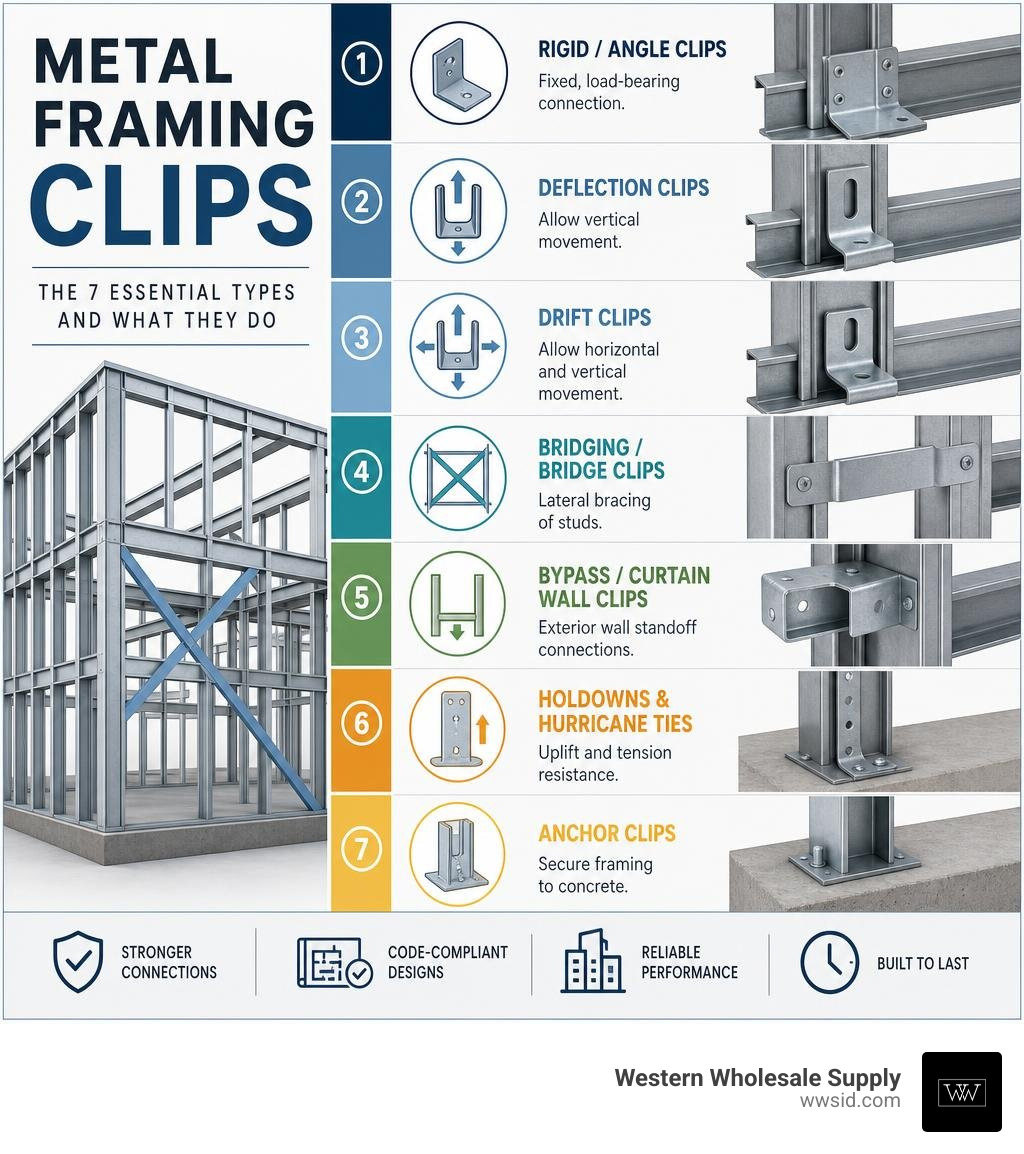
Metal framing clips are small but critical connectors that hold steel framing systems together — and choosing the wrong one can compromise your entire structure. Here’s a quick look at the most common types and what they do:
| Clip Type | Primary Function | Typical Use |
|---|---|---|
| Rigid / Angle Clips | Fixed, load-bearing connection | Headers, base connections, joist hangers |
| Deflection Clips | Allow vertical movement | Head-of-wall, curtain walls |
| Drift Clips | Allow horizontal and vertical movement | High-wind or seismic zones |
| Bridging / Bridge Clips | Lateral bracing of studs | Preventing stud buckling |
| Bypass / Curtain Wall Clips | Exterior wall standoff connections | Slab edge, exterior framing |
| Holdowns & Hurricane Ties | Uplift and tension resistance | Foundation and roof connections |
| Anchor Clips | Secure framing to concrete | Shear walls, load-bearing walls |
Whether you’re running curtain walls on a commercial project or securing load-bearing partitions in a multi-family build, the right clip keeps your structure safe, code-compliant, and on schedule.
Steel framing clips connect members to each other or to a primary frame — and as one industry resource puts it, they’re “a small but essential part of any framing package.” Get them right, and everything else lines up. Get them wrong, and you’re dealing with cracked finishes, failed inspections, or worse.
At Western Wholesale Supply, we have sourced and supplied metal framing clips across dozens of commercial and residential projects throughout the region. We’ll walk you through everything you need to know to make a confident purchase.
Core Types of Metal Framing Clips and Connectors
When building with cold-formed steel in our demanding mountain climate—where heavy snow loads in Jackson, Wyoming, and fierce winds across the Eastern Idaho plains are standard—understanding how load travels through a building is everything. To design a structure that stands the test of time, you must establish a continuous structural load path. This path ensures that gravity, wind, and seismic forces are safely transferred from the roof down to the foundation.
However, buildings are not static statues; they live, breathe, expand, contract, and settle. If you bolt everything together with completely rigid connectors, the natural movement of the building will find the weakest point and crack your drywall, warp your studs, or even cause structural failure. That is why we categorize metal framing clips into three primary families based on how they handle building movement: rigid, deflection, and drift.
To understand how these connectors integrate into the broader framing system, it helps to review the fundamentals of Everything You Need to Know About Steel Framing. Selecting the right class of connector depends entirely on whether you need a joint to hold fast, slide vertically, or sway dynamically in all directions.
Rigid Connections and Fixed Metal Framing Clips
Rigid connections are the workhorses of structural stability. They are designed to transfer loads directly between framing members without allowing any relative movement. If your engineering plans call for a fixed connection to handle shear, tension, or heavy gravity loads, you will be looking at fixed clips and angle clips.
For a massive variety of everyday framing tasks, builders rely on Steel Framing Connectors: Rigid Connections – ClarkDietrich . These fixed connectors are essential for building headers, door and window openings, and joist-to-stud connections.
A prime example of a heavy-duty, multi-application fixed connector is the Uni-Clip™ End Clip (UCEC) | ClarkDietrich Building Systems . This 14-gauge rigid connection clip is manufactured from high-strength Structural Grade 50 Type H steel with a robust G90 galvanized coating to prevent rust. Its engineered design features stiffened corners that provide superior design values compared to standard, field-bent angles.
With pre-embossed fastening patterns to guarantee accurate screw placement, the Uni-Clip is incredibly versatile. It is commonly used for:
- Base connections and stud-to-slab framing
- Bypass curtain wall connections where deflection is not required
- Joist-to-joist and rafter-to-plate connections
- Kicker connections to the bottom of concrete slabs or beams
- Suspended ceiling framing assemblies
Using these heavy-duty rigid clips correctly prevents structural failure at crucial junctions. For practical tips on executing these fixed connections in the field, check out our guide on Studs Tracks and Drywall Hacks Building Your Metal Frame.
Deflection and Drift Metal Framing Clips
While rigid clips keep things locked down, deflection and drift clips are engineered to let the building move safely. When a multi-story building experiences live loads—such as crowds of people, heavy office furniture, or snow piling up on the roof—the concrete floor slabs naturally deflect downward. If your interior partitions or exterior curtain walls are rigidly attached to the underside of these slabs, the downward pressure will crush the studs, causing bowing and severe drywall cracking.
Deflection clips solve this vertical movement problem. By utilizing specialized slide-clip designs with vertical slots, they allow the primary structure to deflect downward without transferring those vertical gravity loads to the non-structural wall studs below.
For high-performance bypass connections, the Fixed Universal Slip Clip (FUS) is a premier choice. This heavy-duty 10-gauge or 12-gauge clip is a universal, one-piece connector that works beautifully for medium to large standoff conditions. When used as a deflection connection, it utilizes proprietary heavy-duty deflection screws driven through engineered vertical slots to provide up to 1 inch of friction-free vertical movement.
But what happens when the building moves sideways? In regions prone to high winds or seismic activity, structures experience lateral drift. This is where drift clips—often called the “Kings of Deflection” in the trade—come into play. According to a detailed breakdown of the Most common Steel Framing Clips , drift clips are designed to handle both vertical deflection and horizontal drift up to an inch in all directions. They prevent the exterior curtain wall panels from twisting or shearing off when the building sways during a windstorm or earthquake.
Bridging, Bracing, and Bypass Applications
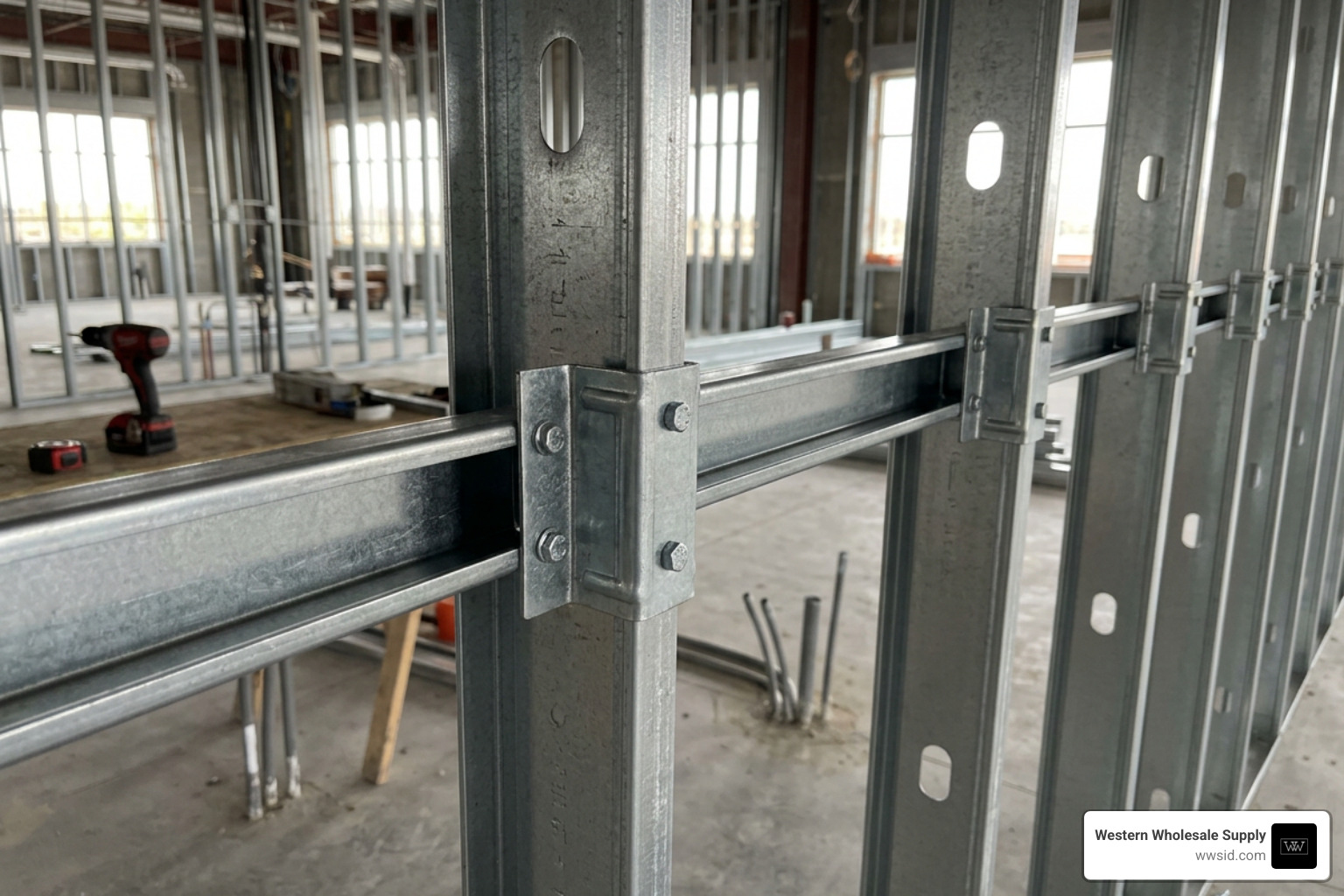
When you stand a tall, slender steel stud on end and apply an axial load from above, its natural tendency is to twist and buckle sideways. To prevent this lateral-torsional buckling, we must tie the studs together using lateral bridging and bracing.
Bridging typically involves running a cold-rolled channel (CRC) horizontally through the factory punchouts of the studs and locking it in place at regular intervals. Beyond interior walls, managing these connections in exterior assemblies is a major component of modern construction, as detailed in our analysis of Steel Yourself Unpacking the Benefits of Prefabricated Framing.
Lateral Bracing with FastBridge and EasyClip Support Clips
In the past, securing cold-rolled channel to studs required tedious field-cutting of angle iron and driving multiple screws into tight spaces. Modern bridging clips have completely revolutionized this process.
The ClarkDietrich FastBridge™ system (available in FB33, FB43, and FB68 models) features a brilliant friction-fit design. You simply insert the cold-rolled channel through the stud punchouts, twist the FastBridge clip into place over the channel, and secure it. Because of the tight friction-fit engineering, it requires as little as one self-drilling screw to complete the connection, saving massive amounts of labor on the job site. These clips are sold in convenient buckets of 200 pieces and are available in three different gauges:
- FB33 (20-gauge): For light-duty non-structural partitions.
- FB43 (18-gauge): For standard structural walls.
- FB68 (14-gauge): For heavy-duty load-bearing structural walls.
For miscellaneous rigid connections and lateral bridging, the EasyClip™ S-Series™ Support Clip | ClarkDietrich Building Systems is another indispensable job-site staple. Offered in lengths ranging from 3″ to 11″ and in thicknesses of 12, 14, and 16 gauge, these versatile utility clips feature prepunched holes for fast, highly accurate fastener placement.
When installing these support clips, we highly recommend using premium Grabber fasteners to ensure the threads bite cleanly and hold fast under structural loads.
Managing Exterior Movement with Bypass Clips
Bypass framing refers to exterior curtain wall studs that run past the outside edge of the building’s concrete floor slabs rather than sitting between them. This method maximizes interior floor space and creates a continuous exterior envelope, but it subjects the framing to intense wind loads and slab deflection.
Bypass clips bridge the gap between the exterior studs and the primary concrete slab or structural steel beam. By utilizing slide-clip mechanisms, these connectors securely anchor the curtain wall to the building to resist wind-induced suction and pushing forces, while simultaneously allowing the floor slabs to deflect vertically without crushing the exterior framing.
Key Selection Criteria for Metal Framing Connectors
Choosing the right metal framing clips is not a matter of guesswork; it is a precise science governed by local building codes and structural engineering. When preparing your submittals or ordering materials for a project in Eastern Idaho or Western Wyoming, pay close attention to the following physical and mechanical properties.
For a deeper dive into how steel coatings and grades protect your build, check out our G60 Metal Studs Complete Guide.
Understanding Steel Gauges and Material Thickness
The gauge of a steel clip tells you its thickness and, by extension, its load-bearing capacity. In structural steel framing, we measure thickness in mils (one-thousandth of an inch) and look for specific material grades.
- 20 Gauge (33 mils / 0.0346″ design thickness): Ideal for light-duty interior drywall partitions and non-load-bearing bridging.
- 18 Gauge (43 mils / 0.0451″ design thickness): The standard entry point for light structural applications and exterior curtain wall bridging.
- 16 Gauge (54 mils / 0.0566″ design thickness): Commonly used for structural support clips, knee-wall reinforcements, and minor joist connections.
- 14 Gauge (68 mils / 0.0713″ design thickness): Heavy-duty structural grade, typically manufactured from Structural Grade 50 Type H steel with a minimum yield strength of 50ksi. Used for high-load rigid connections.
- 12 Gauge (97 mils / 0.1017″ design thickness) & 10 Gauge (118 mils / 0.1242″ design thickness): Ultra-heavy-duty steel used for large standoff bypass conditions and high-stress structural connections.
To protect these steel connectors from the brutal moisture and temperature swings common to our mountain west winters, always verify that your clips feature a hot-dipped G90 galvanized coating. A G90 coating provides significantly better long-term corrosion resistance than standard G40 or G60 coatings, ensuring your structural connections will never rust or degrade over the lifespan of the building.
Structural Stability: Holdowns, Hurricane Ties, and Anchor Clips
To truly establish that continuous load path we discussed earlier, your building must be tied together from top to bottom:
- Hurricane Ties: These connectors translate uplift loads from the roofing assembly down to the wall studs, preventing high winds from ripping the roof off the structure.
- Anchor Clips: These heavy-duty connectors secure your load-bearing wall studs directly to the concrete foundation.
- Holdowns: Designed to transfer massive tension and uplift loads from structural shear walls directly to the concrete slab or foundation bolts, preventing the walls from lifting or sliding during high-wind events.
When anchoring these heavy-duty structural clips to concrete or structural steel, always use certified high-strength anchors and fasteners from trusted brands like Brighton Best to ensure code-compliant pull-out values.
Installation Best Practices and Code Compliance
Even the highest-quality engineered clip will fail if it is installed incorrectly. To keep your job site running smoothly and pass your inspections on the first try, follow these field-tested best practices:
- Fastener Symmetrical Patterns: When a clip has prepunched holes but the engineering details do not require all of them to be filled, always install your Grabber screws symmetrically starting from the outer edges and working toward the center. Symmetrical fastening prevents the clip from twisting or warping under load.
- Welding Specifications: If your structural plans call for welding clips to the primary steel frame instead of using screws, always provide a full weld from top to bottom along the outside edge of the clip. For a 3-inch leg, apply a minimum 3/4-inch weld on the outside edge to control warping caused by the extreme heat of welding.
- Sound Isolation & Fire-Rated Assemblies: In multi-family builds and commercial offices, clips play a massive role in safety and acoustic performance. For fire-rated columns, use specialized sheathing clips like the Steel Network’s GripClip® (which accommodates flange thicknesses from 1/4″ to 1″ and carries certified 1-hour and 1.5-hour fire ratings) to attach gypsum board directly to structural columns. For high-performance sound walls, pair your framing with Quietrock EZ Snap drywall and Durock cement board in wet areas to achieve maximum STC (Sound Transmission Class) ratings.
- Warehouse Insulation & Thermal Performance: In large commercial warehouses across our cold region, thermal performance is a major code priority. When installing roof and wall assemblies, ensure your framing permits thick insulation layers (aiming for Ceilings R-30+ and Walls R-13+ thermal benefits) to keep heating costs manageable during freezing winters.
For a comprehensive breakdown of how these components fit together in code-compliant assemblies, read through Frame Your Future Understanding Gypsum Steel Components.
Frequently Asked Questions about Metal Framing Clips
What is the difference between a deflection clip and a rigid clip?
A rigid clip creates a completely fixed connection designed to transfer structural loads directly between members without allowing any movement. A deflection clip features engineered vertical slots and uses specialized slide screws to allow vertical movement (such as slab deflection) while still resisting horizontal lateral loads.
Why is lateral bracing critical for metal studs?
Because cold-formed steel studs are thin and tall, they have very little resistance to twisting. Under axial (vertical) gravity loads, unbraced studs will suffer lateral-torsional buckling and fail long before reaching their theoretical load capacity. Running a cold-rolled channel through the punchouts and locking it with bridging clips keeps the studs perfectly aligned and structurally stable.
How do I choose the right gauge for framing clips?
The correct gauge depends entirely on the thickness of the studs you are connecting and the specific load requirements calculated by your project’s structural engineer. As a general rule of thumb, your connector clip should be equal to or greater than the thickness (gauge) of the studs being joined.
Conclusion
At Western Wholesale Supply, we’ve spent over 60 years helping contractors and builders across Eastern Idaho and Western Wyoming get the job done right. As an independent, veteran-owned, third-generation family business, we know that success is built on reliable service, deep expertise, and having the right materials on hand when you need them.
Whether your next project is in Idaho Falls, Pocatello, Jackson, Rexburg, or Twin Falls, we have the inventory and the logistical muscle to deliver your metal framing clips, steel studs, drywall, and CertainTeed acoustical ceilings directly to your job site on time.
To find the best local inventory for your next build, explore The Best Places to Grab Metal Framing Supplies in Your Neighborhood.
Ready to spec your next project or need a bulk quote on cold-formed steel connectors? Contact Western Wholesale Supply today, and let our experienced team help you build a structure that lasts.
