

What Are FRP Wall Panels and Why Do They Matter?
FRP wall panels — short for Fiberglass Reinforced Plastic — are one of the most practical wall surfacing solutions available for commercial and industrial construction. Here’s a quick breakdown of what they are and why contractors choose them:
- Material: A composite of fiberglass strands embedded in a polyester resin matrix, topped with a protective gel coat
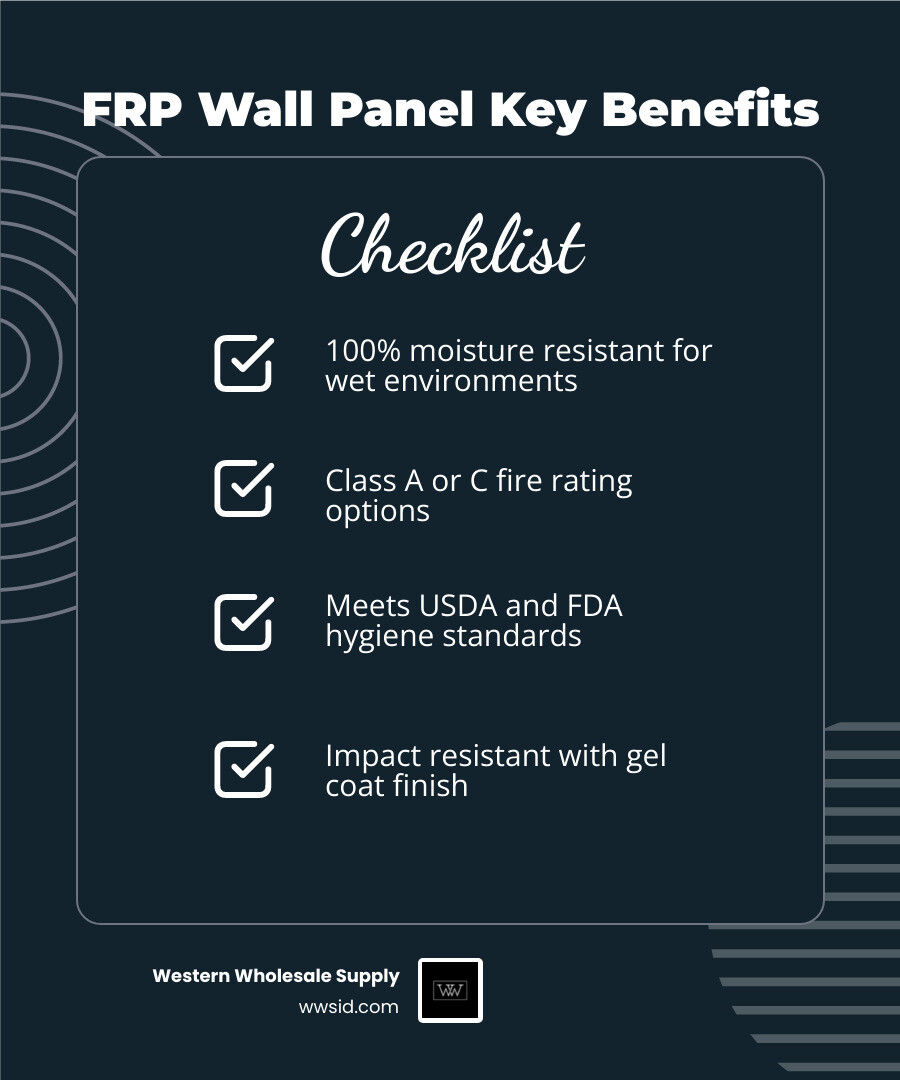
- Key strengths: 100% moisture resistant, impact resistant, easy to clean, and non-porous
- Fire ratings: Available in Class A or Class C depending on thickness and application
- Common uses: Commercial kitchens, food processing plants, healthcare facilities, restrooms, car washes, and refrigerated spaces
- Compliance: Meet USDA, FDA, and ASTM D-5319 standards for sanitary wall and ceiling surfaces
They’re built for environments where standard drywall or tile simply won’t hold up — places with heavy moisture, frequent cleaning, or hard physical use.
Commercial kitchens are a good example of where FRP panels prove their value. These are , high-moisture environments where sanitation is legally required, not optional. A wall surface that can’t be scrubbed down quickly or that harbors bacteria in grout lines isn’t just inconvenient — it’s a health code violation waiting to happen.
At Western Wholesale Supply, we are building materials professionals who have spent years supplying contractors with durable wall solutions — including FRP wall panels — across commercial and industrial projects in the region. In this guide, we’ll walk you through everything you need to know to spec, source, and install FRP panels with confidence.
Composition and Manufacturing of FRP Panels
To understand why FRP wall panels perform so well in tough conditions, we have to look at how they are made. At its core, FRP is a composite material. We take high-strength fiberglass strands and embed them into a specialized plastic resin matrix. This combination creates a “best of both worlds” scenario: the fiberglass provides the structural “backbone” and impact resistance, while the resin offers the chemical and moisture protection.
Most high-quality panels are finished with a protective gel coat. This isn’t just for looks; the gel coat creates a non-porous surface that repels dirt, stains, and bacteria. In the industry, we often refer to this as a Surfaseal finish, which makes the panels much easier to sanitize than raw plastics or painted surfaces.
Manufacturing these panels is a high-tech process. One of the most advanced methods used today is called Heat Accelerated Vacuum Assisted Infusion. This proprietary process ensures that the resin and fiberglass are fused perfectly under heat and pressure, eliminating air pockets that could lead to delamination later. It’s this level of engineering that allows manufacturers to produce panels in massive sizes — sometimes up to 10 feet high by 58 feet long for specialized industrial uses.
For most of our projects in Idaho Falls and Jackson, we stick to standard sheet sizes, but it’s good to know the technology can scale. If you want to dive deeper into the technical layers of these boards, check out our article on Everything You Need to Know About FRP Panel Boards and Liners.
Manufacturing Standards for FRP Wall Panels
When we talk about quality, we aren’t just guessing. FRP wall panels are governed by strict industry standards, specifically ASTM D-5319. This standard ensures that the glass-fiber reinforced polyester panels you buy meet specific criteria for thickness, strength, and safety.
When reviewing technical data sheets for your next project in Pocatello or Twin Falls, you’ll likely see several key metrics:
- Barcol Hardness: This measures the panel’s resistance to indentation. A standard FRP panel typically has a Barcol Hardness of 40, meaning it can take a beating from carts and equipment without denting.
- Izod Impact Resistance: Usually measured at around 7.0 ft-lbs/in, this tells us how much energy the panel can absorb during a sudden strike before cracking.
- Water Absorption: High-quality panels have a water absorption rate as low as 0.17%. For context, that’s virtually zero, which is why they don’t rot or support mold growth.
- Thermal Expansion: Since these are plastic-based, they will expand and contract slightly with temperature changes. This is why we always leave a small gap at the seams during installation.
For more technical specifications on regional availability, you can view the FRP – Fiberglass-Reinforced Plastics CO & WY resources.
Key Benefits of FRP Wall Panels for Commercial Use

In our 60 years at Western Wholesale Supply, we’ve seen plenty of wall materials come and go. But FRP wall panels remain a staple for a simple reason: they solve problems that other materials can’t.
The primary benefit is 100% moisture resistance. In a car wash in Rexburg or a dairy processing plant in Burley, the walls are constantly hit with water. Traditional drywall, even “green board,” would turn to mush in weeks. FRP doesn’t care about water. It doesn’t rust like metal, and it doesn’t pit or corrode when exposed to harsh cleaning chemicals.
Another major factor is the fire rating. We offer panels in both Class A and Class C fire ratings (per ASTM E-84 testing). Class A panels are often required in public hallways and commercial kitchens where fire safety codes are the most stringent. You can learn more about selecting the right grade for your building on our FRP Panels product page.
Hygiene and Regulatory Compliance of FRP Wall Panels
If you’re working in the food or medical industry, hygiene isn’t just a preference—it’s a legal requirement. FRP wall panels are designed to meet USDA and FDA requirements for food preparation areas. They are also compliant with LA County standards, which are some of the toughest in the nation.
Because the surface is non-porous, there is nowhere for bacteria, mold, or mildew to hide. Unlike tile, which has porous grout lines that can harbor pathogens, a properly sealed FRP system provides a continuous, easy-to-sanitize shield. Some modern panels even meet the CDPH Standard Method v1.2 for low VOC emissions, making them safe for use in schools and private offices.
Durability and Impact Resistance of FRP Wall Panels
Let’s be honest: commercial environments are rough. Between heavy equipment, rolling carts, and high foot traffic, walls take a lot of abuse. FRP wall panels are engineered to be shatter-resistant and scratch-resistant.
With a Barcol Hardness of 40 and a Notched Izod Impact of 7.0 ft-lbs/in, these panels are significantly tougher than standard vinyl wall coverings. In abrasion testing (NEMA LD3-2005), some panels can withstand over 9,000 cycles before showing wear. This means your walls in a busy Blackfoot warehouse or a Chubbuck hospital will look new for years, even with constant bumps and scrapes.
Common Applications and Installation Requirements
Where exactly should you use FRP wall panels? While they are famous for kitchens, their utility extends much further:
- Commercial Kitchens & Restaurants: Essential for health code compliance.
- Food Processing Plants: Resistant to the heavy-duty degreasers and high-pressure washing used in these facilities.
- Healthcare & Clean Rooms: Non-porous surfaces prevent the spread of germs.
- Car Washes & Laundromats: Constant humidity and water exposure won’t damage the panels.
- Restrooms & Locker Rooms: Durable, easy to clean, and resistant to graffiti.
- Transportation: Used in refrigerated truck bodies and trailers because they are lightweight yet strong.
For residential contractors, we’ve even seen a rise in use for home projects. To see if this fits your next residential job, read Why FRP Panels for Garage Walls Might Be Your Best Bet.
Substrate Compatibility and Fastening Systems
You can’t just slap FRP onto any surface and expect it to stay. Proper substrate preparation is the secret to a long-lasting installation. FRP panels can be installed over:
- Drywall: We recommend using a high-quality gypsum board or Quietrock EZ Snap for sound-dampening environments.
- Cement Board: For high-moisture areas like showers, Durock is our go-to choice for a solid, moisture-stable backing.
- Plywood or OSB: Common in back-of-house or industrial settings.
When it comes to holding everything together, we trust Grabber fasteners or Brighton Best hardware. Using the right screws and rivets ensures the panels don’t buckle or pull away from the wall over time. For more on the “sticky” side of things, check out The Ultimate Guide to FRP Adhesives for a Bond That Lasts.
Installation Methods for FRP Wall Panels
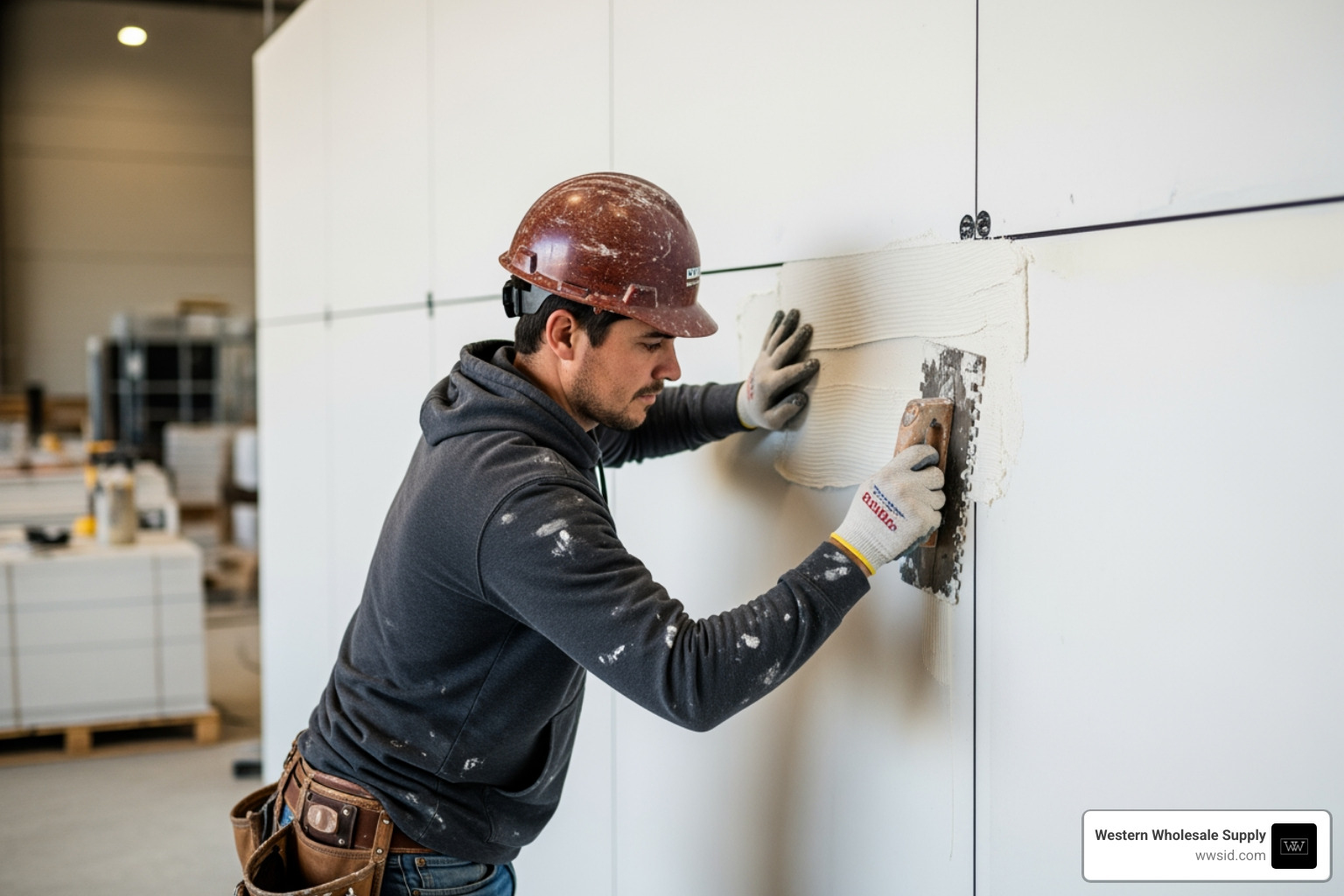
Installing FRP wall panels is a straightforward process, but it requires attention to detail. Here’s the typical workflow we see on jobsites from Rigby to Jackson:
- Acclimation: Let the panels sit in the room for 24-48 hours to adjust to the temperature and humidity.
- Cutting: You can use a standard utility knife for thin panels, though a circular saw with a fine-tooth blade is better for cleaner edges on thicker sheets.
- Adhesive Application: Use a trowel-on water-based or advanced polymer adhesive. Apply it to the entire back of the panel, not just in spots.
- Placement: Press the panel against the wall and use a laminate roller, starting from the center and moving outward, to remove air bubbles and ensure a 100% bond.
- Seams and Trims: Use matching PVC trim pieces (division bars, corner caps) to cover joints. Always leave about a 1/8″ gap in the trim for expansion.
- Sealing: In wet areas, apply a bead of food-safe silicone sealant inside the trim channels to create a watertight barrier.
In warehouse or industrial settings, we often see these panels paired with high-performance insulation. For optimal thermal benefits in our cold Eastern Idaho winters, we recommend aiming for R-30+ in ceilings and R-13+ in walls. This keeps the facility energy-efficient while the FRP keeps the interior surfaces protected. If you’re finishing the ceiling too, we often integrate these with CertainTeed ceiling systems for a professional, uniform look.
Comparing FRP to Alternative Wall Materials
Is FRP always the best choice? It depends on your priorities. Here is how it stacks up against the competition:
| Feature | FRP Wall Panels | PVC Panels | Ceramic Tile | Stainless Steel |
|---|---|---|---|---|
| Moisture Resistance | Excellent | Excellent | Good (Grout is weak) | Excellent |
| Impact Strength | High | Moderate | Low (Can crack) | Very High |
| Installation Speed | Fast | Very Fast | Slow | Moderate |
| Sanitation | Excellent | Excellent | Moderate | Excellent |
| Initial Cost | Moderate | Moderate | High | Very High |
While PVC panels are a newer innovation that eliminates the need for adhesives (using interlocking tongues and grooves), traditional FRP remains the king of impact resistance. Ceramic tile looks great but is expensive to install and the grout lines eventually fail in wet environments. Stainless steel is nearly indestructible but can be cost-prohibitive for large areas.
There are also fiberglass-free alternatives like NRP-FR panels, which offer Class A fire ratings without the use of glass fibers. You can explore those options in this Durable & Cost Effective sell sheet.
Maintenance and Lifecycle Considerations
One of the reasons we’ve been around since 1963 is that we believe in products that last. FRP wall panels have a service life that can span decades if maintained correctly.
Cleaning is simple. For everyday dirt, soap and water do the trick. For industrial kitchens, you can use steam cleaning or high-pressure sprayers without worrying about delamination. FRP is also resistant to bleach and strong bactericides, making it ideal for healthcare settings.
If a panel does get damaged—say, a forklift tines poke a hole in a warehouse wall—it can be repaired or replaced much more easily than a section of tile or a welded steel sheet. There are specific repair manuals available that walk you through patching the fiberglass and resin, though in most commercial settings, simply replacing the 4’x8′ sheet is the most cost-effective path.
Frequently Asked Questions about FRP Wall Panels
How do you clean and maintain FRP panels?
Cleaning is a breeze. Use a soft cloth or sponge with mild soap and water for regular maintenance. For tougher grease in kitchens, high-pressure washers or steam cleaners are perfectly safe. Avoid abrasive cleaners or metal scrapers that could scratch the gel coat finish.
Can FRP panels be installed directly over existing drywall?
Yes, as long as the drywall is structurally sound, clean, and flat. If the drywall is in a high-moisture area, we recommend ensuring it is a moisture-resistant grade or using a cement-based backer like Durock for better long-term performance. Always use the manufacturer-recommended adhesive for the specific substrate.
What are the standard sizes and custom color options available?
The most common sizes are 4′ x 8′, 4′ x 10′, and 4′ x 12′. Standard thicknesses range from .045″ to .120″, with .090″ being the industry standard for most commercial walls. While white and almond are the most popular, manufacturers like KAL-LITE offer up to 1,700 custom colors and various textures like pebbled, smooth, or linen to match any interior design.
Conclusion
Whether you are building a new medical clinic in Idaho Falls or retrofitting a restaurant kitchen in Jackson, FRP wall panels offer an unbeatable combination of durability, hygiene, and value. They are the “workhorse” of the wall world—designed to look good while taking a beating.
At Western Wholesale Supply, we take pride in being a veteran-owned, third-generation family business. For over 60 years, we’ve served Eastern Idaho, Western Wyoming, and South East Idaho with reliable, on-time delivery and the best building materials in the industry. We don’t just sell panels; we provide the expertise to ensure your project is built to last.
Ready to start your next project? Contact Western Wholesale Supply for a Quote today, and let our team help you find the perfect FRP solution for your needs.
