

Why a Fiberglass Wall Panel Is the Smart Choice for High-Traffic Walls
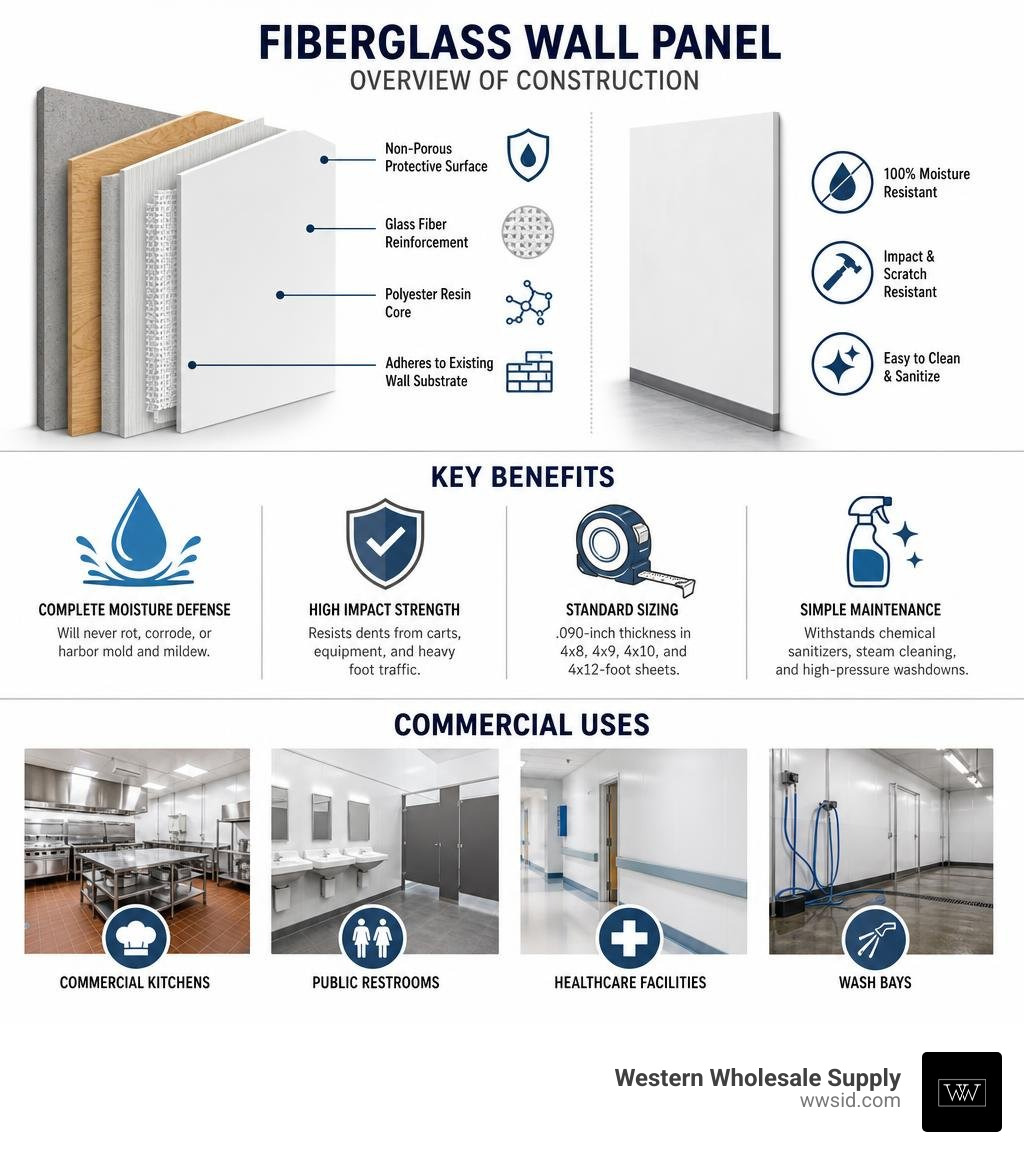
A fiberglass wall panel (commonly called FRP) is a rigid, impact-resistant wall covering made from polyester resin reinforced with glass fibers. It creates a 100% moisture-resistant, scratch-proof, and shatter-resistant barrier over existing drywall, plywood, or concrete. Builders use these panels in commercial kitchens, public restrooms, healthcare facilities, and wash bays because they meet strict sanitary standards and clean up easily.
Here is what makes a fiberglass wall panel essential for demanding interiors:
- Complete Moisture Defense: It will never rot, corrode, or harbor mold and mildew.
- High Impact Strength: The glass fiber reinforcement resists dents from carts, equipment, and heavy foot traffic.
- Standard Sizing: Panels are standardly sold in a .090-inch thickness in 4×8, 4×9, 4×10, and 4×12-foot sheets.
- Simple Maintenance: The non-porous finish withstands chemical sanitizers, steam cleaning, and high-pressure washdowns.
At Western Wholesale Supply, our team of third-generation building materials professionals helps commercial builders and contractors source the right fiberglass wall panel systems for heavy-duty projects. In this guide, we will walk you through panel types, fire safety ratings, and straightforward installation practices so you can get the job done right on schedule.
What Are Fiberglass Reinforced Panels and Where Are They Used?
Fiberglass reinforced panels—widely known across the trades as FRP—combine thermosetting polyester resin with strong glass fibers. When pressed and cured, this composite forms a non-porous, highly resilient cladding material engineered specifically for high-abuse and moisture-heavy spaces. Quality manufacturing adheres strictly to the ASTM D-5319 standard, which governs glass-fiber reinforced polyester wall and ceiling panels.
Because the composite matrix has zero porosity, these sheets deliver 100% moisture resistance. Water cannot penetrate the core, meaning the panel will never swell, delaminate, rot, or harbor bacterial growth. That level of sanitation and structural reliability makes them an industry standard for commercial wall protection. If you want a deep dive into engineering specs and material compositions, check out A Comprehensive Guide to FRP Wall Panels.
Common Commercial and Residential Applications
You will spot FRP wall protection in virtually any space that endures high humidity, daily sanitizing, or heavy foot traffic:
- Commercial Kitchens & Food Processing Plants: Walls behind cook lines, prep stations, dish pits, and slaughterhouses must withstand constant grease, acidic food splatters, and boiling washdowns.
- Healthcare Corridors & Cleanrooms: Hospitals, medical clinics, and clean utility rooms rely on seamless, non-porous cladding to maintain sterile conditions while brushing off frequent impacts from stretchers and mobile carts.
- Public Restrooms & Locker Rooms: Heavy humidity and constant public use demand wall surfaces that resist graffiti, standing water, and strong disinfectants.
- Agricultural & Industrial Buildings: Dairies, wash bays, and water treatment facilities need panels that will not corrode when exposed to harsh chemicals.
- Residential Garages & Workshops: Homeowners and mechanics frequently discover why FRP panels for garage walls might be your best bet when outfitting high-utility workspaces exposed to oil, moisture, and road salt.
Acoustic and Specialized Wall Cladding
Beyond utilitarian back-of-house areas, specialized fiberglass wall panels serve architectural and sound control purposes. Rigid fiberglass boards wrapped in acoustically transparent fabric provide exceptional sound dampening in commercial spaces, conference centers, and lecture halls.
For instance, a 1-inch thick acoustic panel achieves a Noise Reduction Coefficient (NRC) of 0.90, while a 2-inch panel reaches an NRC of 1.10. Products such as paintable acoustic fiberglass panels | Acoustical Surfaces let architects field-paint surfaces to match room aesthetics without degrading acoustic absorption. Additionally, these dense fiberglass cores deliver thermal benefits, providing an R-value of 4.1 for 1-inch panels and R-8.3 for 2-inch panels.
Key Benefits of Installing a Fiberglass Wall Panel System
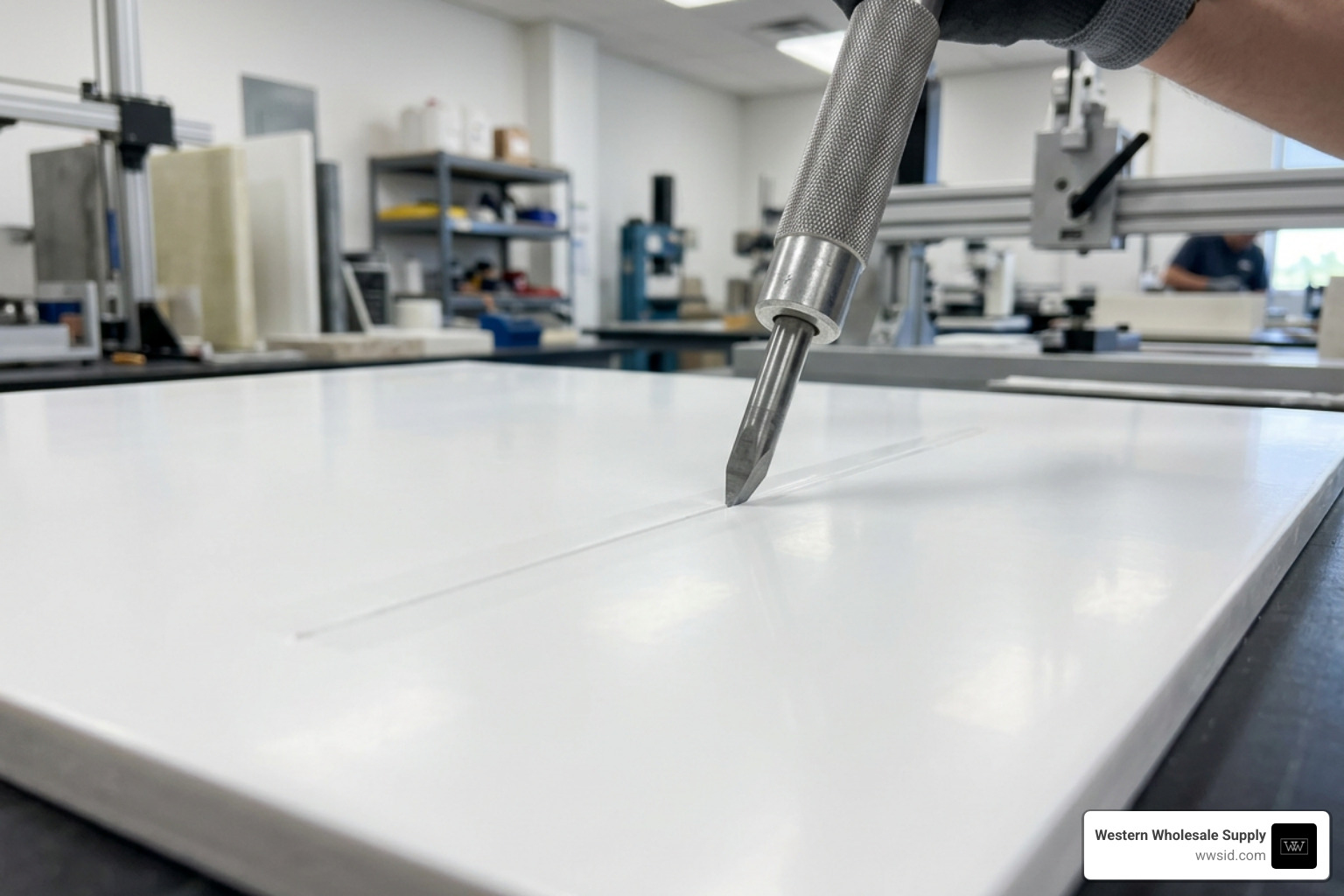
Standard wall assemblies struggle in tough commercial settings. Unprotected drywall easily dents and fosters mold when wet, while ceramic tile joints trap grease and require tedious scrubbing. FRP solves these headaches in one step.
Engineered for rugged environments, standard FRP panels feature an Izod Impact Resistance of 7.0 ft-lbs/in per ASTM D256 and a Barcol Hardness rating of 35B per ASTM D2583. They absorb direct hits from carts, tools, and heavy equipment without puncturing or cracking.
| Feature / Metric | Fiberglass Wall Panels (FRP) | Standard Drywall | Ceramic Tile | PVC Wall Liners |
|---|---|---|---|---|
| Moisture Resistance | 100% Impervious | Poor (Degrades quickly) | High (Grout is porous) | 100% Impervious |
| Impact Resistance | High (7.0 ft-lbs/in Izod) | Low (Easily gouged) | Moderate (Tiles can crack) | Moderate |
| Sanitation & Cleaning | High (Washdown ready) | Low (Cannot be washed) | Moderate (Requires scrub) | High |
| Installation Speed | Fast (Large 4×8 to 4×12 sheets) | Fast | Slow (Piece-by-piece) | Fast |
| Maintenance Needs | Extremely Low | High (Repairs & Paint) | High (Grout resealing) | Low |
Fire Safety Classifications and Building Codes
Commercial building codes regulate interior wall finishes based on flame spread and smoke development under ASTM E-84 testing:
- Class A Fire Rating: Flame Spread Index of 0–25 and Smoke Developed Index under 450 (with ultra-low smoke variants achieving Flame Spread 20 / Smoke Developed 100). Class A panels are mandatory in commercial exit corridors, public stairwells, healthcare facilities, and commercial kitchens near open flames.
- Class C Fire Rating: Flame Spread Index of 76–200 and Smoke Developed Index under 450. Class C panels are standard for general utility areas, storage closets, restrooms, and residential garages where local codes do not require Class A assemblies.
Regulatory Sanitation and Environmental Standards
For food handling and health facilities, sanitation compliance is non-negotiable. Quality fiberglass panels meet USDA and FDA requirements for direct food contact areas. Their smooth or lightly textured surfaces leave no gaps for bacteria, mold, or mildew to take root. Furthermore, panels tested under California CDPH Standard Method v1.2 emit low volatile organic compounds (VOCs), contributing toward green building credits under LEED and WELL rating systems.
Fiberglass Wall Panel Types, Dimensions, and Finishes
Understanding standard material formats ensures smooth ordering and minimizes scrap on the job site. If you are comparing product lines, reviewing everything you need to know about FRP panel boards and liners can help clarify your project specs.
- Thicknesses: The standard commercial contractor thickness is .090 inches. Lightweight economy panels are manufactured down to .045 inches, while heavy-duty industrial gauges reach .120, .135, and .170 inches.
- Sheet Dimensions: Widths are standard at 48 inches (4 feet) and 60 inches (5 feet). Commercial lengths come in 8, 9, 10, and 12-foot sheets to eliminate horizontal wall seams across standard ceiling heights.
- Continuous Coils: For expansive projects, continuous rolls can be supplied up to 500 feet long for .090-inch material and up to 1,200 feet for .045-inch material.
- Color Selection: While Bright White, Colonial White, Pearl Gray, and Black are standard stock items, custom manufacturers offer over 1,700 custom colors to match corporate branding or architectural interiors.
Choosing the Right Fiberglass Wall Panel Texture and Thickness
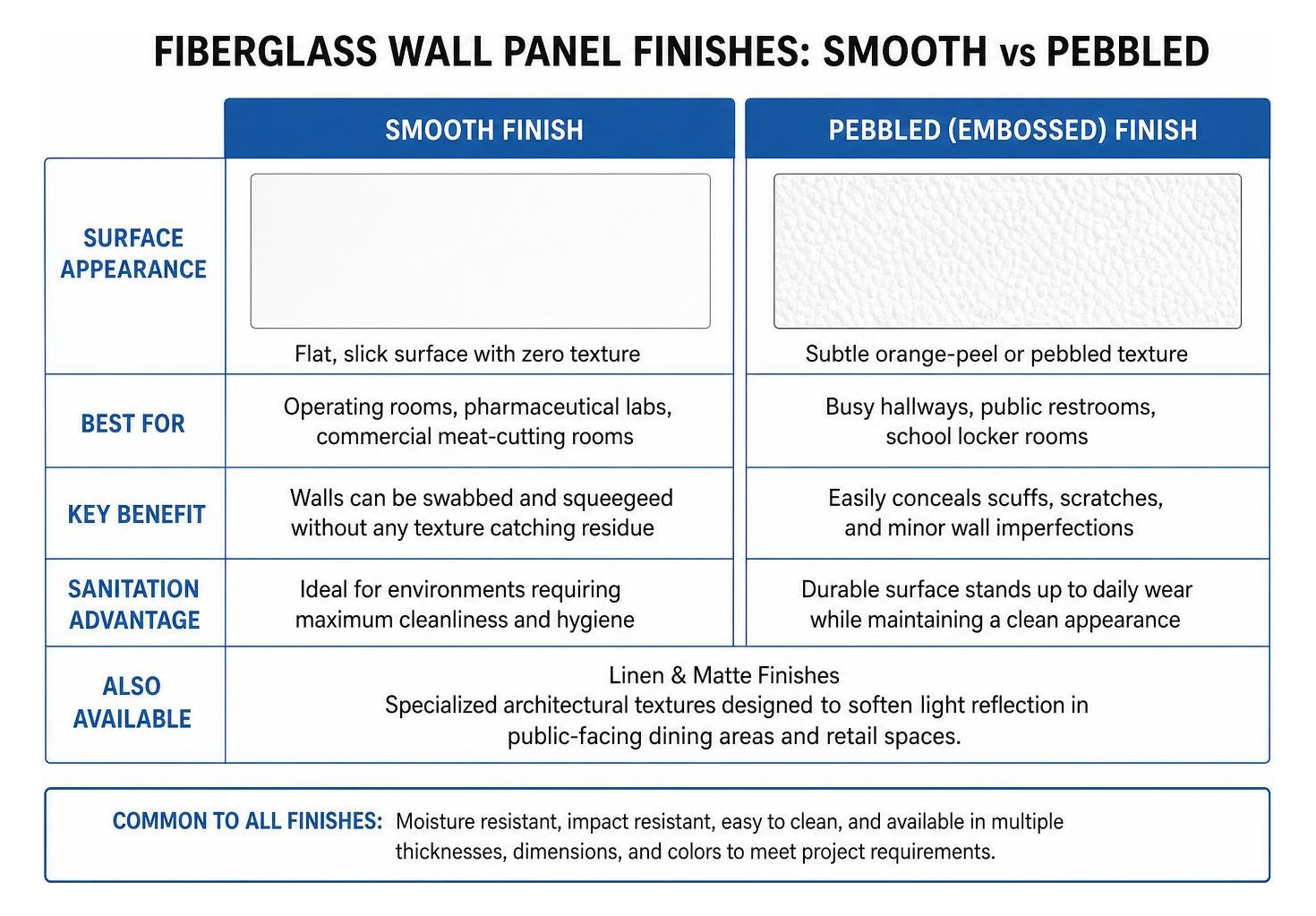
Choosing between surface textures comes down to balancing sanitation with scratch concealment:
- Pebbled (Embossed) Finish: Features a subtle orange-peel or pebbled texture. It easily conceals scuffs, scratches, and minor wall imperfections, making it the top choice for busy hallways, public restrooms, and school locker rooms.
- Smooth Finish: Provides a flat, slick surface with zero texture. It is preferred in operating rooms, pharmaceutical labs, and commercial meat-cutting rooms where walls must be swabbed and squeegeed without any texture catching residue.
- Linen & Matte Finishes: Specialized architectural textures designed to soften light reflection in public-facing dining areas and retail spaces.
For standard light-to-moderate traffic, .090-inch panels provide plenty of strength. In distribution hubs, brewery bottling lines, or livestock stalls facing daily direct impacts, stepping up to a .120-inch or .135-inch gauge prevents surface cracking.
Trim Moldings and Seam Profiles
To keep an FRP installation 100% moisture-tight, you must pair sheets with the correct moldings. Standard 8-foot and 10-foot trim profiles include:
- Division Bars (H-Molds): Join two adjacent flat sheets while leaving space for thermal expansion.
- Inside Corners: Provide a smooth, sealed 90-degree internal corner transition.
- Outside Corners: Wrap external corners to protect raw panel edges from cart impacts.
- End Caps (J-Molds): Finish top edges, wainscot lines, and base terminations.
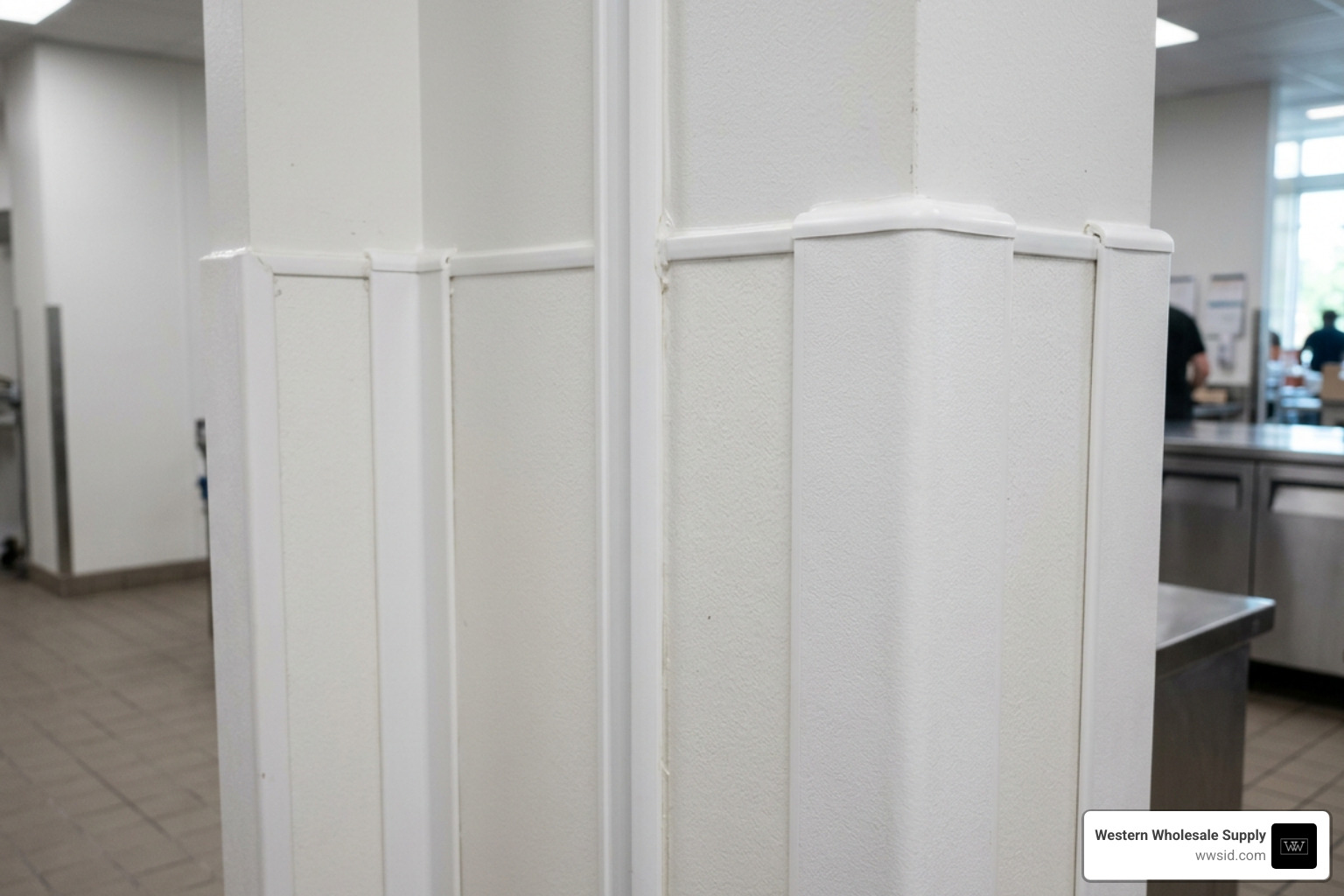
Trims come in color-matched extruded PVC for wet washdown zones, or rigid anodized aluminum for high-end architectural and industrial settings. Choosing durable options like Durable FRP Wall Panels for Commercial Spaces | Kal-Lite gives you complete systems with matching trim pieces ready to install.
Step-by-Step Installation and Substrate Preparation
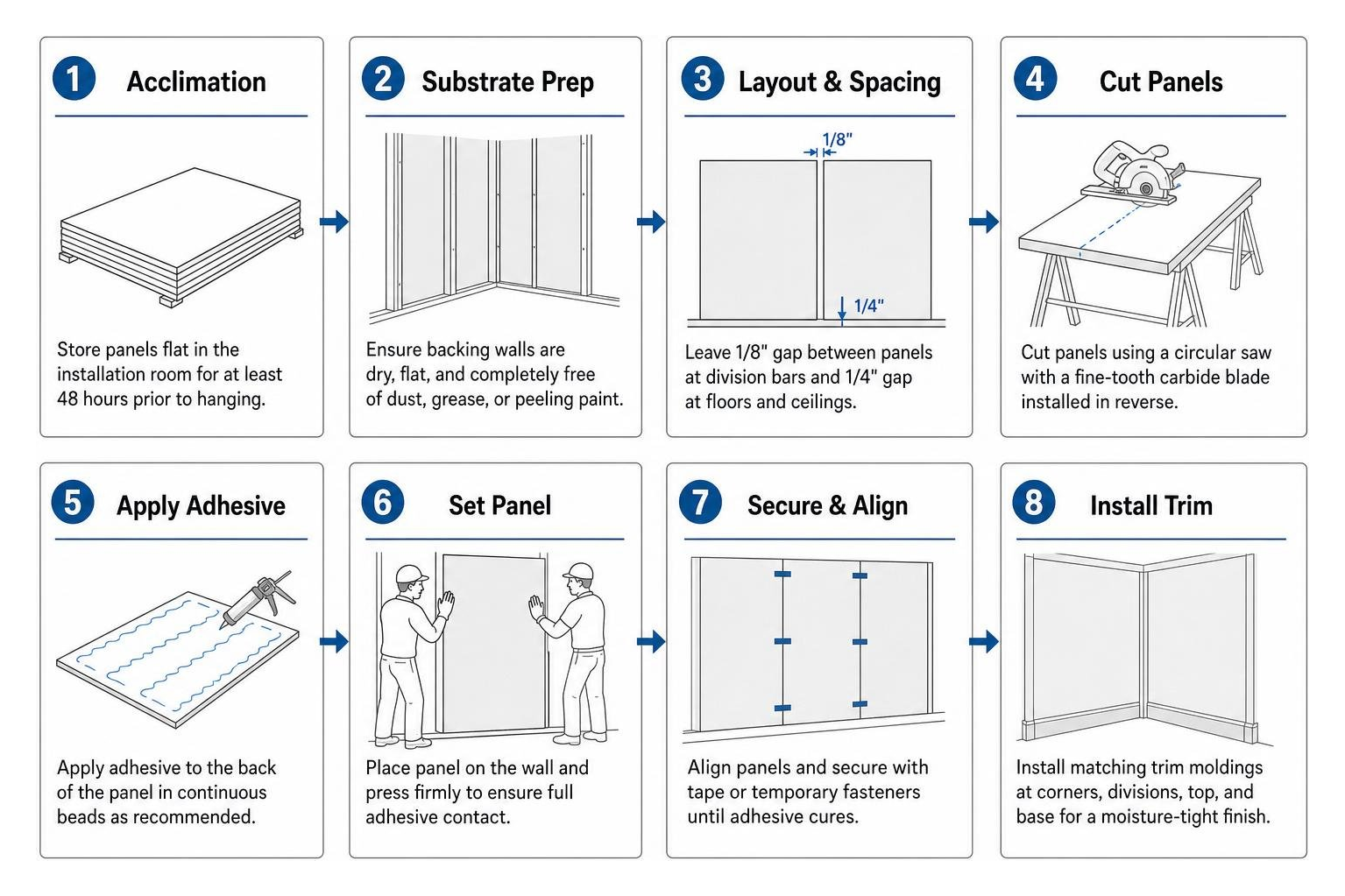
Installing fiberglass wall panels is straightforward, but clean substrate preparation makes all the difference. FRP sheets are flexible liners that must be adhered to a solid, flat backing. Compatible substrates include standard drywall, plywood, cement backer board like Durock, and sound masonry. In acoustic or sound-rated partition builds, contractors frequently back panels with Quietrock EZ Snap drywall.
- Acclimation: Store panels flat in the installation room for at least 48 hours prior to hanging so they adjust to operating temperature and humidity.
- Substrate Prep: Ensure backing walls are dry, flat, and completely free of dust, grease, or peeling paint.
- Thermal Expansion Spacing: Fiberglass panels expand and contract with temperature swings. Always leave a 1/8-inch gap between panels at division bars, and a 1/4-inch gap at floors and ceilings.
For a complete breakdown of adhesives, review the ultimate guide to FRP adhesives for a bond that lasts.
Panel Cutting and Adhesive Application Techniques
- Cutting: Cut panels using a circular saw equipped with a fine-tooth carbide blade installed in reverse, or a dedicated composite blade. For small cutouts around electrical boxes, use a jigsaw or oscillating multi-tool.
- Trowel Selection & Adhesive: Use a 100% cross-coverage application with a 3/16″ x 1/4″ x 5/16″ V-notch trowel. Fast-grab water-based FRP adhesive works well over porous drywall and plywood (averaging 50 sq. ft. of wall coverage per gallon), while non-porous backings like existing tile require advanced polyurethane or solvent-based adhesives.
- Bedding the Panel: Place the panel against the wall within the adhesive open time. Use a heavy 50-lb to 100-lb linoleum roller, working outward from the panel center to the edges to eliminate trapped air and achieve a uniform bond.
- Fasteners & Tools: When mechanical fasteners are specified along baseboards or top plates, contractors rely on corrosion-resistant fasteners from Grabber or Brighton Best. When finishing drywall seams behind moisture barriers, crews use professional drywall finishing tools from Hyde, USG Sheetrock Tools, Columbia Taping Tools, or Marshalltown to leave flat, unridged surfaces.
- Sealing Joints: Apply a continuous bead of color-matched, 100% silicone sealant inside all trim molding channels before seating the panel edges to guarantee a watertight barrier.
How to Maintain Your Fiberglass Wall Panel Installation
Maintaining FRP is remarkably easy compared to painted drywall or tiled walls:
- Daily Cleaning: Wipe down surfaces with warm water, mild soap, or standard commercial degreasers using a sponge or soft cloth.
- Heavy Washdowns: Panels readily handle commercial steam cleaning and high-pressure power washers. Keep spray nozzles at least 12 inches from panel joints to protect trim sealants.
- Avoid Abrasives: Do not use abrasive scouring powders, wire brushes, or harsh steel wool, which can dull smooth finishes over time.
- Periodic Sealant Check: Inspect joint seams and silicone lines every six to twelve months in wet areas to ensure joints remain water-tight.
Frequently Asked Questions About FRP Wall Panels
What is the standard thickness of a commercial FRP panel?
The commercial building standard is .090 inches (roughly 3/32″). This gauge provides the ideal balance of flexural strength, puncture resistance, and lightweight handling. Heavier gauges like .120″ to .170″ are reserved for severe industrial impact areas, while lighter .045″ sheets are common in continuous roll liners.
How does FRP compare to traditional ceramic tile?
FRP eliminates the single biggest failure point of commercial walls: grout. Tile grout absorbs grease, harbors mold, cracks over time, and requires hours of labor-intensive scrubbing. FRP installs in large 4×8 or 4×10-foot continuous sheets at a fraction of the labor time, delivering a 100% sanitary surface that wipes clean in seconds.
Can fiberglass panels be installed directly over existing drywall or tile?
Yes. As long as the existing drywall or tile substrate is structurally sound, clean, flat, and dry, you can mount FRP directly over top. For smooth, non-porous ceramic tile, scuff the surface and use an advanced solvent-based or reactive polyurethane adhesive to ensure a permanent bond.
Conclusion
When commercial spaces demand wall assemblies that can take a beating, resist standing water, and meet strict sanitation codes, fiberglass wall panels remain the gold standard. From bustling restaurant kitchens and healthcare corridors to high-humidity washrooms and industrial processing lines, FRP delivers clean aesthetics and long-term durability.
At Western Wholesale Supply, we are an independent, veteran-owned, third-generation family business supplying the construction industry with premium building materials since 1963. Whether you are outfitting a regional medical center, a commercial kitchen, or a municipal warehouse requiring high-performance wall cladding, acoustical ceilings from CertainTeed, or warehouse insulation (Walls R-13+, Ceilings R-30+), we have you covered.
With over 60 years of hands-on experience and fully stocked yards across Eastern Idaho and Western Wyoming—including Idaho Falls, Pocatello, Jackson, Rexburg, Twin Falls, and surrounding communities—our trademark is reliable, on-time job-site delivery and knowledgeable customer service. Explore our full lineup of FRP Panels today or contact our team to quote your next commercial build.
