

Why Lightweight Drywall Mud Easy Sand Changes How You Finish Drywall
If you’re comparing lightweight drywall mud Easy Sand options for your next project, here’s a quick breakdown of what matters most:
| Feature | Easy Sand (Lightweight Setting-Type) |
|---|---|
| Weight vs. conventional | 25% lighter |
| Sanding ease | Similar to ready-mix all-purpose mud |
| Setting mechanism | Chemical reaction (not evaporation) |
| Humidity resistance | Yes — works in damp conditions |
| Available working times | 5, 20, 45, 90, and 210 minutes |
| Shrinkage | Low — resists check-cracking |
| Exterior use | Yes — protected soffits and gypsum ceiling boards |
| Skim coating | Not recommended |
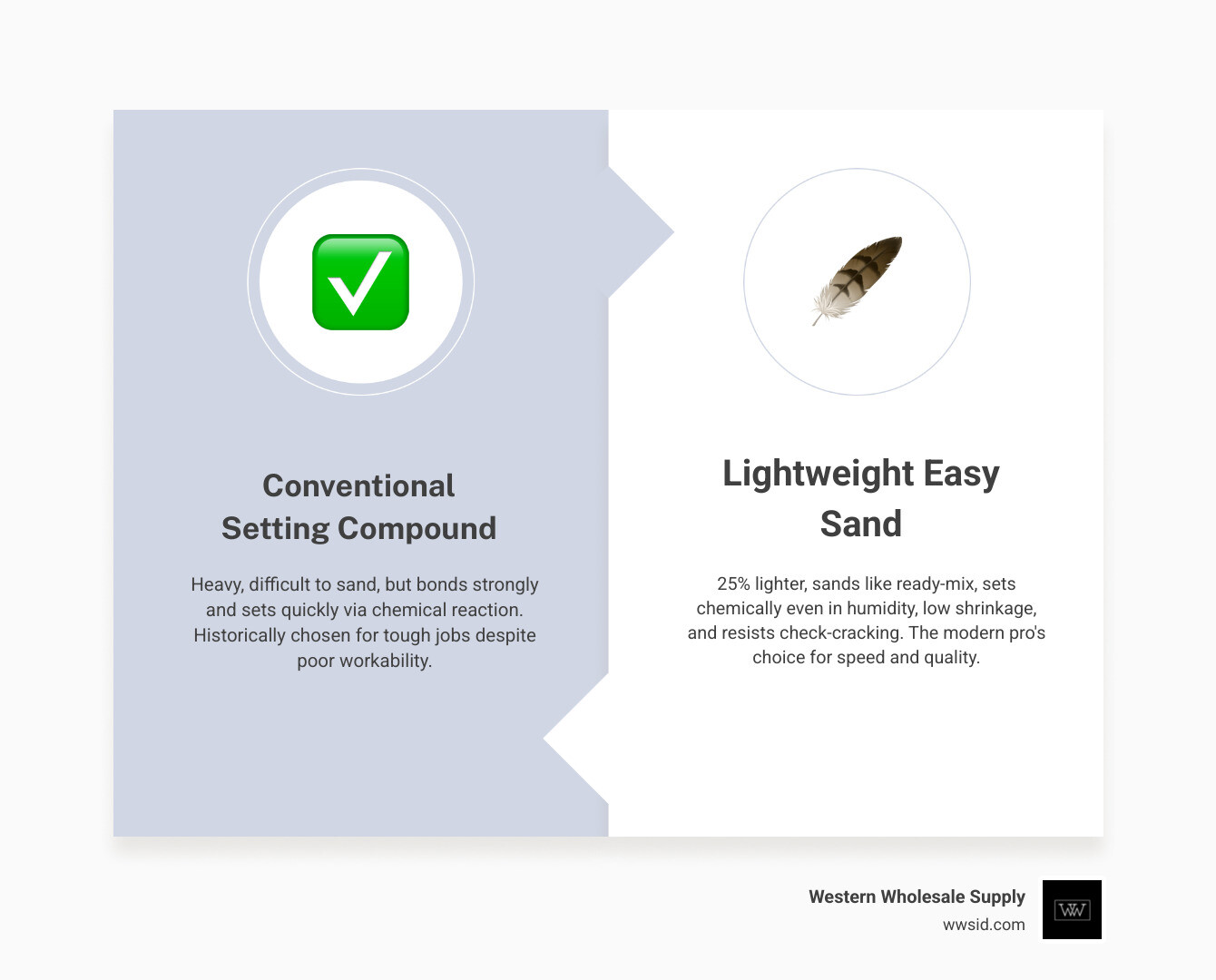
Most contractors know the tradeoff: setting-type compounds set fast and bond strong, but they’re heavy and a nightmare to sand. Ready-mix muds sand easily but take forever to dry and struggle in humidity. Lightweight Easy Sand closes that gap. It sets through a chemical reaction — not evaporation — so it hardens fast even in damp conditions, sands like a ready-mix, and weighs 25% less than conventional setting compounds. That combination is why it has become a go-to for professionals who need same-day joint finishing without sacrificing workability.
At Western Wholesale Supply, we are a third-generation building materials supplier. We have supplied lightweight drywall mud Easy Sand and related finishing products to contractors across Eastern Idaho, Western Wyoming, and beyond, and we’ve seen how choosing the right setting time and mixing technique can make or break a project schedule. In the sections below, we’ll walk through everything you need to know to pick the right product and use it correctly.
Understanding Lightweight Drywall Mud Easy Sand
When we talk about achieving a flawless level 5 finish or simply patching up a damaged wall, the materials we select dictate both our speed and the final appearance. Historically, finishers had to choose between the ultra-tough, fast-setting “hot muds” (which were incredibly difficult to sand) and the slow-drying, easy-to-sand ready-mixed compounds.

Choosing the correct compound is a core pillar of professional drywalling. For an in-depth look at how various materials interact on a job site, check out The Definitive Guide to Drywall Finishing Supplies.
What is Lightweight Drywall Mud Easy Sand?
At its core, lightweight drywall mud Easy Sand is a chemically setting joint compound in powder form. Unlike standard ready-mix bucket muds that dry purely through the evaporation of water, setting-type compounds undergo a chemical crystallization process when mixed with water. This chemical reaction allows the compound to harden uniformly from the inside out, regardless of how thick it is applied or how damp the surrounding air is.
This formulation meets the rigorous standards of ASTM C475 (Standard Specification for Joint Compound and Joint Tape for Finishing Gypsum Board). By utilizing a lightweight formulation, manufacturers have managed to lower the dry bulk density of the product to approximately 35–40 lb./ft³, making it significantly easier to haul, mix, and apply.
For complete technical specifications on these chemical and physical properties, you can review the Sheetrock® Brand Easy Sand™ Lightweight Setting-Type Joint Compounds Submittal Sheet (English) – J621 .
Key Benefits of Lightweight Drywall Mud Easy Sand
Why has this specific powder formula become such a staple in our regional showrooms from Pocatello and Twin Falls, Idaho, up to Jackson, Wyoming? The benefits are clear:
- 25% Lighter Weight: It weighs approximately 25% less than conventional setting-type joint compounds. This means less strain on your back when carrying bags onto the job site and less physical fatigue when holding a loaded hawk or mud pan above your head all day.
- Easy Sanding: Traditional hot muds dry to a plaster-like hardness that requires aggressive sanding and can easily damage the surrounding drywall paper. Easy Sand is formulated to sand with an ease comparable to a vinyl-based, ready-mixed all-purpose compound.
- Exceptional Humidity Resistance: Because it cures chemically, high humidity or damp weather won’t stall your project. It is virtually unaffected by moisture once applied, allowing for same-day joint finishing and next-day decoration.
- Low Shrinkage and Check-Crack Resistance: Air-drying muds shrink significantly as their water content evaporates, often requiring three or more coats to fill deep joints. Easy Sand exhibits minimal shrinkage and superior check-crack resistance, making it perfect for heavy fills, deep patches, and pre-filling drywall joints.
- Low VOC Emissions: These compounds are GREENGUARD Gold certified and qualify as low VOC emitting materials (meeting CA 01350), ensuring healthier indoor air quality during and after installation.
Choosing the Right Setting Time for Your Project
One of the most critical aspects of working with lightweight drywall mud Easy Sand is selecting the correct setting time. Because the chemical reaction begins the moment the powder hits the water, you are playing against a ticking clock.
Choosing the wrong formulation can leave you with a bucket of hardened stone before you’ve even finished taping your first wall. For a deeper look at managing project schedules with these materials, see our article on how to Speed Up Your Drywall Game with Quick Set Compounds.
Setting Time Options: From 5 to 210 Minutes
The number on the bag represents the approximate working time (in minutes) under standard conditions. However, the actual setting time—the point at which the mud chemically hardens—extends slightly past the working window. Here is how the family of products breaks down:
- Easy Sand 5: Offers a brief 8 to 12-minute set time. This is strictly for small, rapid patches and quick repairs where you want to apply mud, watch it harden, and paint it almost immediately.
- Easy Sand 20: Provides a 20 to 30-minute setting window. It is ideal for small rooms, quick patches, or experienced professionals who can run joints quickly. You can explore more about this version via the Sheetrock® Brand Easy Sand™ 20 Joint Compound.
- Easy Sand 45: Cures in roughly 30 to 80 minutes. This is the “sweet spot” for many residential remodelers, offering enough time to tape a medium-sized room without the mud hardening prematurely in the pan.
- Easy Sand 90: Cures in 85 to 130 minutes. This is our most popular choice for larger residential and commercial projects, providing a generous working window while still allowing same-day multi-coat application. Learn more through the Sheetrock® Brand Easy Sand™ 90 Joint Compound.
- Easy Sand 210: Cures in 180 to 240 minutes. Designed for massive commercial jobs or complex laminating projects where an extended open time is necessary.
| Product Name | Working Time | Chemical Setting Time | Best Use Case |
|---|---|---|---|
| Easy Sand 5 | 5 minutes | 8–12 minutes | Tiny patches, fast structural repairs |
| Easy Sand 20 | 20 minutes | 20–30 minutes | Small rooms, quick-turn patching |
| Easy Sand 45 | 45 minutes | 30–80 minutes | Medium rooms, residential remodels |
| Easy Sand 90 | 90 minutes | 85–130 minutes | Large areas, taping and filling |
| Easy Sand 210 | 210 minutes | 180–240 minutes | Large commercial projects, laminating |
Step-by-Step Application and Mixing Guide
To get the absolute best performance out of your lightweight drywall mud Easy Sand, your mixing technique must be precise. Because this is a chemical powder, you cannot simply “eyeball” it the way you might with pre-mixed bucket mud.
Having the right gear on hand is just as important as your mixing technique. For a complete breakdown of essential gear, read through our Drywall Tools 101 guide.
Mixing and Application Best Practices
To mix a standard 18 lb. bag of Easy Sand, we recommend using approximately 5 to 6 quarts (10 to 12 pints) of clean, drinkable water.
- Temperature Matters: Always ensure your water, air, and surface temperatures are at least 45°F (7°C) during application. For interior finishing, maintaining a minimum temperature of 55°F (13°C) is highly recommended. That water temperature directly affects setting times: cold water (below 55°F) slows down the chemical reaction, while hot water accelerates it dramatically.
- Add Water First: Always pour your clean water into a clean mixing bucket before adding the powder. This prevents dry pockets from forming at the bottom of the pail.
- Mix Thoroughly: Sift the powder into the water and mix thoroughly. If you are using a mechanical drill mixer, keep the speed low to avoid whipping excess air into the mud, which can cause pinholes on the wall. Let the mixture soak for a few minutes, then give it a final brief remix to achieve a smooth, lump-free consistency.
- Use Clean Tools: Any leftover dried mud in your bucket or on your tools from a previous batch will act as an “accelerator,” causing your new batch to set much faster than expected. Always clean your pans, buckets, and knives thoroughly between batches.
- Additives Warning: We strongly advise against using third-party additives or mixing different joint compounds together in the same wet batch. This disrupts the chemical balance of the compound. If you need to speed up a set, use a dedicated dry-form accelerator sprinkled directly into the mix—never dissolve it in the water first.
When applying the mud, make sure to use high-quality tools that give you ultimate control over your coats. In our local showrooms, we stock and recommend industry-trusted brands like Hyde, Columbia Taping Tools, and Marshalltown. Choosing the right knife width is crucial for a smooth feather; for a deeper look, check out our A-Z Guide to Taping Knives.
Safety and Dust Control Precautions
While lightweight drywall mud Easy Sand is easier to sand than traditional setting compounds, sanding any joint compound still produces fine airborne dust.
- Respiratory Protection: Always wear a properly fitted NIOSH/MSHA-approved respirator when mixing the dry powder and during the sanding phase to protect your lungs from dust inhalation.
- Dust Control and Wet Sanding: To minimize airborne dust, consider using wet-sanding techniques. A damp drywall sponge can easily smooth down the edges of Easy Sand without generating cloud-like dust. If dry sanding is required, use a sander equipped with a built-in vacuum dust-collection system.
- Exothermic Reaction Warning: Be aware that as setting-type compounds chemically cure, they generate a small amount of heat. Never attempt to use this product to make plaster casts of hands, feet, or other body parts. The heat generated during curing can cause severe burns, and the hardened material may require surgical removal if cast around skin.
Comparing Easy Sand to Conventional Joint Compounds
Understanding how lightweight setting mud compares to traditional options helps clarify why it has become the standard for modern drywalling.
For a detailed comparison of lightweight favorites and how professional crews leverage them to stay ahead of schedule, read 90-minute mud and other lightweight favorites for pros.
Performance, Shrinkage, and Bond Strength
Conventional setting compounds are incredibly dense and heavy, drying to a plaster-like hardness. While they offer excellent structural strength, they are notoriously difficult to sand, often requiring power sanders or heavy-grit paper that can easily scar the surrounding paper face of the drywall. Easy Sand provides a similar level of bond strength and crack resistance but with a dry density that is much easier to manage and sand using standard hand-sanding blocks.
With an average coverage rate of approximately 52 lb. per 1,000 sq. ft. of gypsum panels, Easy Sand is highly efficient. Its low shrinkage makes it the perfect choice for:
- Laminating Panels: Bonding gypsum panels directly to other panels, sound-deadening boards, or above-grade concrete surfaces.
- Acoustical Upgrades: When installing high-performance acoustic drywall like Quietrock EZ Snap, using a low-shrinkage, high-bond compound ensures the integrity of your sound-dampening barrier.
- Concrete Ceilings: Filling, smoothing, and finishing interior poured concrete ceilings. (Ensure new concrete has cured for at least 60 days before application).
Frequently Asked Questions
Can you use setting-type mud for thin skim coats?
No, setting-type joint compounds like Easy Sand are not recommended for thin skim coating.
Because these compounds rely on water to complete their internal chemical reaction, applying them in an extremely thin layer can cause the moisture to evaporate into the air or sink into the dry drywall paper before the chemical set can finish. If the compound dries out before it chemically sets, it will suffer from severe bond failure, chalking, and delamination. For thin skim coats, always use a high-quality ready-mixed conventional or lightweight air-drying joint compound.
Can Easy Sand be used on exterior surfaces?
Yes, but with limitations. Easy Sand can be used for finishing joints in protected exterior soffits and exterior gypsum ceiling boards where they are shielded from direct weather, rain, and standing water. It should never be used on fully exposed exterior walls or surfaces subject to direct moisture exposure.
For more technical details on exterior application guidelines, refer directly to the SHEETROCK® Brand Lightweight Setting-Type Joint Compounds Easy Sand™ Submittal (English) – J621 .
What is the shelf life and storage method for Easy Sand?
When stored under controlled, dry environmental conditions, an unopened bag of Easy Sand has a shelf life of up to 12 months (though we recommend using it within 6 months of purchase for optimum performance).
Once a bag is opened, it becomes highly susceptible to moisture in the air. To preserve the remaining powder, store open bags as tightly closed as possible in a dry, elevated location. Any exposure to moisture or high humidity will cause the powder to pre-hydrate, which severely degrades its shelf life and can cause unpredictable setting times when mixed.
Conclusion
Whether you are finishing a commercial space in Idaho Falls or patching up a residential remodel in Jackson, utilizing lightweight drywall mud Easy Sand is one of the smartest ways to speed up your workflow without sacrificing quality. Its unique combination of lightweight handling, chemical-setting speed, and ready-mix-like sanding ease makes it a game-changer on any job site.
At Western Wholesale Supply, we are proud to be an independent, veteran-owned, third-generation family business. Since 1963, we’ve supported contractors and homeowners across Eastern Idaho, Western Wyoming, and Western Montana with top-tier building materials, including drywall, steel framing, insulation, and CertainTeed acoustical ceilings. Backed by over 60 years of experience, our signature is reliable, on-time delivery and exceptional customer service.
Ready to stock up on Easy Sand, grab a new Columbia or Marshalltown taping knife, or discuss your next project? Contact Western Wholesale Supply today or stop by one of our local showrooms to experience the difference that local expertise makes.
