

What Are Drywall Finishing Supplies? (Quick Answer)
Drywall finishing supplies are the tools and materials used to conceal joints, fasteners, and corners after drywall panels are hung — creating a smooth, paint-ready surface.
Here are the essentials every contractor needs:
| Category | Key Items |
|---|---|
| Joint Compound | All-purpose ready-mix, setting-type, dust-control formula |
| Joint Tape | Paper tape, fiberglass mesh tape |
| Taping Tools | Taping knives, banjos, automatic tapers |
| Finishing Tools | Skimming blades, corner trowels, mud pans |
| Sanding Tools | Pole sanders, hand sanders |
| Corner & Trim | Paper-faced metal corner bead, flexible bead, J-trim |
| Primers | High-build primer-surfacers, Level 5 surfacer |
| Fasteners | Grabber drywall screws |
Hanging drywall is just the first step. The finishing work — taping, coating, and sanding — is what separates a rough installation from a truly professional result. Done right, it creates what the industry calls a “monolithic surface”: no visible joints, no fastener heads, just a clean wall ready for paint or wallpaper.
I’m Jake Bean, a third-generation building materials professional with hands-on experience sourcing and supplying drywall finishing supplies to contractors across residential and commercial projects. In this guide, I’ll walk you through everything you need to choose the right products and tools for the job.
Terms related to drywall finishing supplies:
Essential Drywall Finishing Supplies for Professionals
To achieve a professional finish, your toolkit needs to be more than just a bucket of mud and a single knife. High-quality drywall finishing supplies are designed to reduce physical strain and improve the “feathering” of joints so they disappear under a coat of paint.
For the pros working in Idaho Falls or Jackson, the basic hand tool set starts with a range of taping knives. You’ll typically want a 6-inch knife for embedding tape and 10-inch or 12-inch “broad knives” for the subsequent fill and finish coats. Stainless steel or blue steel blades are the industry standards; stainless offers better rust resistance, while blue steel provides a bit more flexibility for a smoother feel.
Mud pans are equally vital. A 12-inch or 14-inch stainless steel mud pan with “wipedown” edges allows you to clean your knife with every stroke, preventing dried bits of mud from creating streaks in your finish. For larger surfaces, skimming blades have become a game-changer. These wide, flexible blades allow you to apply a smooth, consistent layer of compound over large areas with minimal effort.
Of course, the foundation of any good finish is the board itself. Using High-Quality Drywall: More Than Just a Pretty Face ensures that the surface is flat and the tapered edges are consistent. When securing these panels, we always recommend Grabber fasteners. Using the right screw length and thread type is crucial—refer to our guide on Drywall Dimensions Demystified for 1/2-Inch and 5/8-Inch Panels to ensure your fasteners are seated at the correct depth without tearing the paper face.
Selecting the Right Drywall Finishing Supplies for Taping
Taping is the structural heart of the finishing process. Without proper joint reinforcement, even the most expensive mud will crack as the building settles. There are two primary options for joint tape: paper and fiberglass mesh.
- Paper Joint Tape: This is the traditional choice for a reason. It is incredibly strong in tension and provides excellent crack resistance. According to the CGC Synko® Brand Interior Finishing Products Catalog, paper tape is cross-fibered for strength and lightly creased in the middle for easy corner folding.
- Fiberglass Mesh Tape: This self-adhesive tape is easier for beginners to apply because it sticks directly to the wall. However, it is important to remember that mesh tape should only be used with setting-type compounds (hot mud). It does not provide the same structural reinforcement as paper when used with standard ready-mix.
Comparing Joint Compounds: Ready-Mix vs. Setting-Type
Choosing the right “mud” is perhaps the most important decision in the process. At Western Wholesale Supply, we see contractors use both types for different stages of the job.
Ready-Mix Joint Compound (Drying-Type)
Ready-mix is the most common of all drywall finishing supplies. It comes in a bucket or box and is ready to use after a quick stir. It hardens as the water evaporates.
- Pros: Easy to sand, long shelf life (up to nine months), and very smooth.
- Cons: High shrinkage and long drying times (usually 12–24 hours depending on humidity).
- Best For: Finish coats, skim coating, and DIY projects.
Setting-Type Joint Compound (Hot Mud)
Setting-type compounds, often referred to by their set times (e.g., 90-Minute Mud and Other Lightweight Favorites for Pros), harden through a chemical reaction rather than evaporation.
- Pros: Very low shrinkage, allows for multiple coats in a single day, and creates a much harder bond.
- Cons: Difficult to sand once fully cured and must be mixed in small batches.
- Best For: Embedding tape, first coats, and deep fills or repairs.
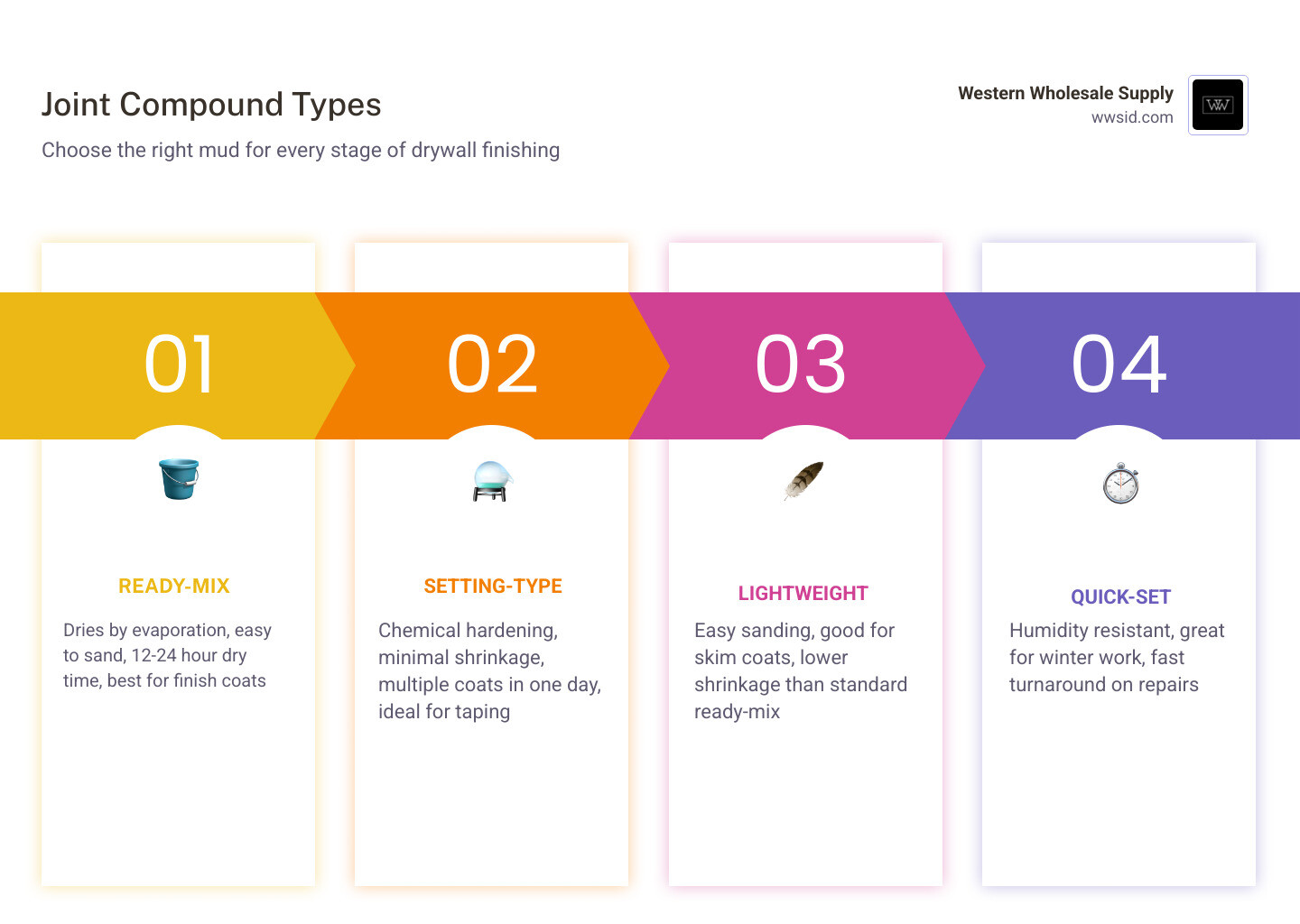
If you’re looking to Speed Up Your Drywall Game with Quick-Set Compounds, “hot mud” is less affected by humidity, making it a favorite for winter projects in Eastern Idaho. For more details on avoiding a mess, check out How to Choose the Right Drywall Compound Without Getting Stuck in the Mud.
Taping Efficiency: Manual vs. Automatic Tools
In professional drywall finishing supplies, time is money. While a skilled finisher can do amazing work with a hand knife and a mud pan, automatic tools can increase speed by 3x or 4x.
Manual Taping (The Banjo) A drywall banjo, like the Delko Zunder, is a middle ground between hand taping and full automation. It holds a roll of tape and a small reservoir of mud, applying both to the wall simultaneously. It’s a great choice for residential remodels in places like Rexburg or Rigby where space might be tight but speed is still required.
Automatic Taping (The Bazooka) For large-scale commercial jobs, automatic tapers (often called “bazookas”) are the gold standard. These tools apply the correct amount of compound and tape to flat joints and internal corners in one pass. When paired with flat boxes—which dispense a metered amount of mud over a joint—the finishing process becomes incredibly efficient.
To keep these tools running, we recommend using a power mixer. A heavy-duty mixer can turn a thick bucket of mud into a creamy, lump-free consistency in seconds. For those looking for the ultimate finish, using CertainTeed Level V surfacer through a sprayer can provide a monolithic surface that is virtually perfect under critical lighting.
Advanced Drywall Finishing Supplies for High-Volume Jobs
When you’re tackling high-volume projects, you need products that help you move faster without sacrificing quality. High-build primers and surfacers are essential here. A product like CertainTeed Level V Wall and Ceiling Primer/Surfacer can take a Level 4 finish to a Level 5 without the labor-intensive process of hand-applying a skim coat. This is particularly useful in modern homes with large windows and lots of natural light, where “photographing” of joints is a common concern.
For more technical specifications on these high-end finishes, the CGC Interior Finishing Products Catalog provides excellent data on coverage rates and application methods for professional-grade primers.
Achieving Professional Results: Sanding and Finishing Levels
The final step—and often the messiest—is sanding. Modern drywall finishing supplies have evolved to make this stage much cleaner. Dust-control joint compounds are a advancement; they contain specialized additives that cause the sanding dust to clump together and fall straight to the floor rather than floating in the air. This can reduce airborne dust by up to 60%, which is a huge benefit for occupied remodels in Jackson Hole or Idaho Falls.
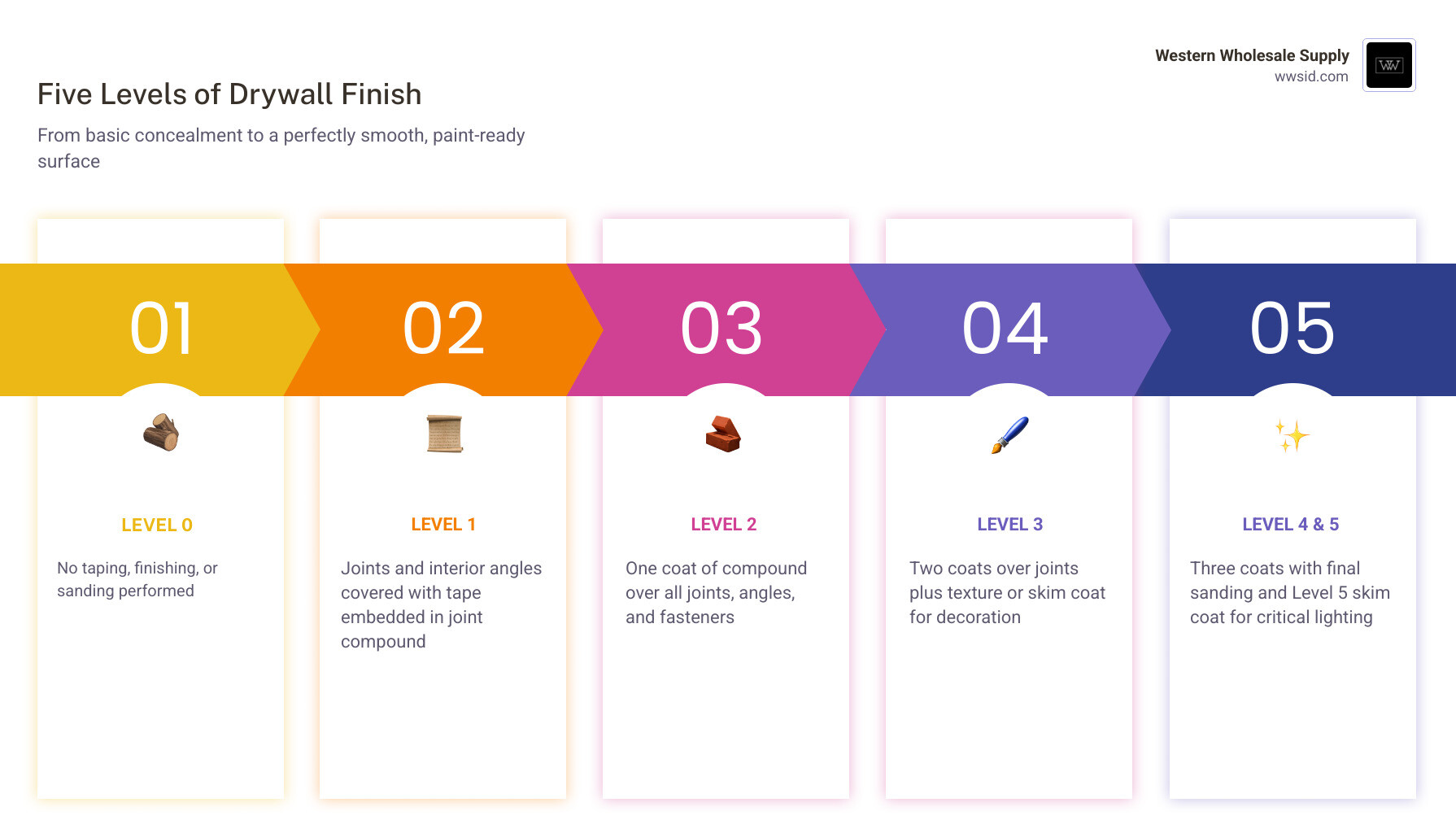
Pole sanders allow you to sand ceilings and high walls from the floor, saving your back and neck. However, the level of sanding required depends entirely on the “Level of Finish” specified for the job:
- Level 0: Just the boards—no taping or finishing.
- Level 1: Tape is embedded in compound (common in plenums or areas not open to view).
- Level 2: Tape is covered with a thin coat of mud; fasteners are covered.
- Level 3: An additional coat of mud over joints and fasteners (used for heavy textures).
- Level 4: Two coats over joints; three over fasteners (standard for most residential walls).
- Level 5: The highest level, involving a skim coat over the entire surface to ensure uniform porosity and texture.
If you are working on specialized projects, such as home theaters or high-end offices, don’t forget the importance of acoustics. Combining your finishing techniques with Quietrock EZ Snap can provide superior sound dampening. You can learn more about these systems in our guide to Soundproofing for Drywall: Everything You Need to Know.
Frequently Asked Questions about Drywall Finishing
How much joint compound do I need per 1,000 square feet?
A good rule of thumb for professionals is to use approximately nine gallons of ready-mix joint compound for every 1,000 square feet of wallboard. This typically covers the taping, filling, and finishing coats. If you are skim-coating for a Level 5 finish, you will need significantly more.
What is the shelf life of ready-mix joint compound?
Under good storage conditions—meaning a cool, dry place above 50°F—most ready-mix compounds have a shelf life of about nine months. It is critical to protect these drywall finishing supplies from freezing. While some products can withstand up to three freeze-thaw cycles, you should always allow frozen mud to thaw at room temperature for 24 hours and remix it thoroughly before use.
When should I use fiberglass mesh tape instead of paper tape?
Fiberglass mesh tape should generally be reserved for small repairs or when using setting-type (hot) mud. Because mesh tape is not as strong as paper in compression or shear, it requires the chemical hardness of setting compound to prevent joints from cracking later. For all standard joints using drying-type ready-mix, paper tape remains the superior choice for long-term crack resistance.
Conclusion
Getting the right drywall finishing supplies is only half the battle; having a reliable partner to get them to your job site on time is the other half. At Western Wholesale Supply, we’ve been serving Eastern Idaho and Western Wyoming since 1963. As a third-generation, veteran-owned family business, we understand that our customers in cities like Pocatello, Burley, and Twin Falls rely on our 60+ years of experience to keep their projects moving.
Whether you need a single bucket of dust-control mud or a full set of automatic taping tools, we are here to provide exceptional customer service and reliable delivery. For more tips on making your next project a success, check out our article on Drywall Done Right: Choosing the Best Supplier for Your Project.
Ready to stock up? Visit us at https://wwsid.com/ or stop by one of our locations to see our full range of CertainTeed, Durock, and Grabber products. We look forward to helping you achieve that perfect, monolithic finish!
