

What Are 150mm Drywall Screws and When Do You Need Them?
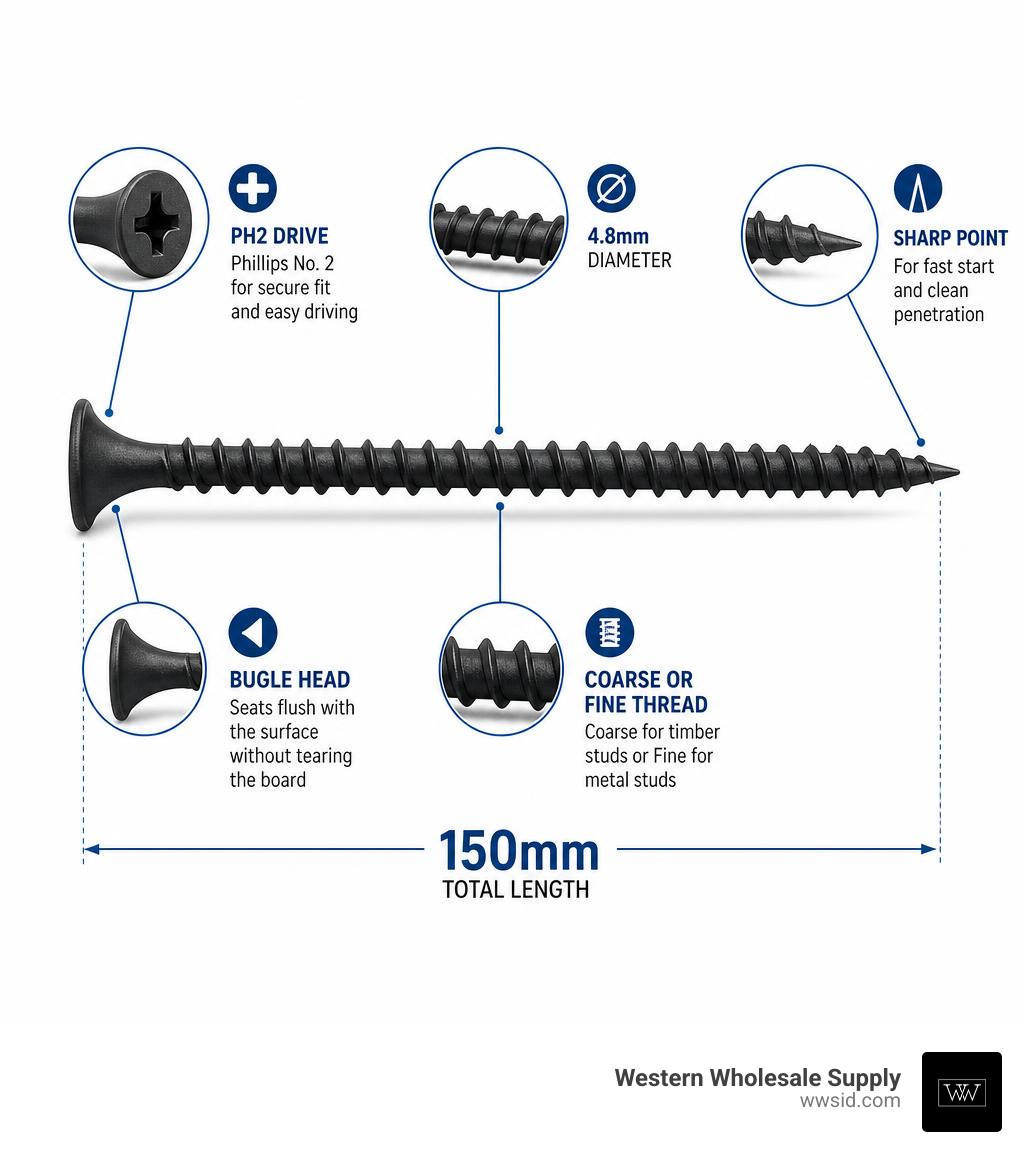
150mm drywall screws are extra-long fasteners designed for applications where standard-length screws simply won’t reach. Here’s a quick overview:
| Feature | Detail |
|---|---|
| Standard diameter | 4.8mm |
| Length | 150mm (approx. 6 inches) |
| Drive type | Phillips No. 2 (PH2) bugle head |
| Thread types | Coarse (timber) or Fine (metal) |
| Primary use | Plasterboard over thick insulation panels |
| Finish options | Zinc plated or black phosphate |
| Typical pack size | Box of 100 or 200 |
Most drywall jobs use shorter screws. But when you’re fixing plasterboard over deep insulation panels – common in warehouses, commercial builds, and energy-efficient residential projects – you need a screw long enough to pass through the board and insulation and still bite firmly into the stud behind it. That’s exactly what 150mm screws are built for.
They’re made from hardened carbon steel, feature a sharp point for clean penetration, and use a bugle head that seats flush without tearing the board surface. Fastener brands carried by professional suppliers, including Grabber and Brighton Best, offer reliable options trusted by contractors across the industry.
Authored by Western Wholesale Supply, this guide is written by building materials professionals with decades of distribution experience supplying contractors with fasteners including 150mm drywall screws for residential and commercial projects across Eastern Idaho and Western Wyoming. In this guide, we’ll walk you through everything you need to choose and use them correctly.
Learn more about 150mm drywall screws:
Understanding the Applications of 150mm Drywall Screws
In standard interior drywall construction, a typical 1-1/4 inch or 1-5/8 inch fastener is more than enough to secure sheetrock directly to wooden studs or light-gauge steel tracks. However, modern building practices – particularly in the cold climates of Eastern Idaho and Western Wyoming – demand robust thermal barriers. This is where extra-long fasteners become indispensable.
When installing high-performance acoustic systems or heavy-duty thermal insulation, standard fasteners fall short. For more background on how screw length impacts your installation, check out our guide on why size matters when you are screwing into sheetrock.

Structural Framing with 150mm Drywall Screws
When securing plasterboard over thick insulation, the fastener must pass through the board, traverse the entire depth of the insulation panel, and anchor deeply into the structural framing.
For timber stud framing, the coarse thread of a 4.8mm x 150mm screw provides rapid penetration and strong holding power. The deep, wide-spaced threads bite cleanly into softwood and hardwood studs alike, resisting tension and helping prevent the boards from sagging over time. Quality coarse-thread drywall screws typically use a sharp point and hardened carbon steel construction so they start quickly and drive consistently without pre-drilling in most timber framing applications.
For light-gauge steel framing, specialized fine-thread or twin-thread 150mm screws are engineered to pierce and grip thin metal channel, commonly up to 0.9mm depending on the fastener specification. Trusted fastener brands such as Grabber and Brighton Best design drywall screws with a hardened core to reduce the risk of torque shearing when driving through metal studs.
Installing Insulation Panels with 150mm Drywall Screws
In commercial warehouses and agricultural buildings throughout our service areas – from Twin Falls, Idaho, to Jackson, Wyoming – insulation is paramount to maintaining temperature control. To achieve thermal efficiency, regional building designs often call for:
- Ceilings: R-30+ insulation depth
- Walls: R-13+ insulation depth
Using 150mm drywall screws allows builders to mount drywall, such as Quietrock EZ Snap, directly over rigid foam boards or semi-rigid mineral wool batts. This direct-to-stud installation eliminates the need for complex secondary framing or furring strips, saving both material costs and labor time. The bugle head of the screw distributes holding pressure evenly across the face of the plasterboard, ensuring the heavy insulation layers remain tightly compressed against the structural studs.
Coarse Thread vs. Fine Thread Options
Choosing the correct thread pattern is the single most important decision when purchasing 150mm drywall screws. Using the wrong thread can lead to stripped wood, loose boards, or sheared screws.
| Feature | Coarse Thread | Fine Thread / Twin Thread |
|---|---|---|
| Primary Material | Timber studs (softwood/hardwood) | Metal studs (up to 0.9mm) |
| Thread Design | Deep, wide-spaced single thread | Double lead, closely spaced twin thread |
| Penetration Speed | Fast in wood; prone to stripping in metal | Steady; clean bite in steel channels |
| Holding Power | Superior in fibrous wood grain | Superior in sheet metal |
Coarse thread screws are designed specifically for timber. The deep threads grip the wood fibers, creating a high-strength anchor. If you attempt to drive a coarse-thread screw into a steel stud, the thread pitch is too wide to grip the thin metal, resulting in a spin-out.
Conversely, fine-thread screws feature double-lead threads that run parallel to each other. This design provides more contact points within thin steel channels, ensuring a tight, vibration-resistant hold. For a deeper dive into choosing fasteners for metal framing, refer to The Ultimate Guide to Drywall to Metal Screws.
Materials, Finishes, and Quality Standards
Because 150mm drywall screws carry substantial loads – holding both the weight of the plasterboard and the pressure of compressed insulation – they must meet strict manufacturing standards.
Material Composition and Hardness
Premium 150mm screws are manufactured from high-grade carbon steel and undergo a rigorous heat-treatment process. This creates a dual-hardness profile:
- Surface Hardness: Helps prevent the PH2 drive recess from stripping out or camming out under high torque and helps the sharp point penetrate framing cleanly.
- Core Hardness: Maintains ductility, allowing the screw to flex slightly under normal building movement rather than snapping.
Corrosion-Resistant Finishes
Since these fasteners are used in insulated wall cavities where temperature differentials can create condensation, corrosion resistance is vital.
- Black/Grey Phosphate: A traditional matte finish that provides temporary rust resistance during construction and offers a textured surface that bonds well with joint compound or wet plaster.
- Bright Zinc Plating (BZP) or Zinc & Yellow Passivation: Offers enhanced protection against moisture. Zinc-plated 150mm drywall screws are often preferred for humid interior environments or projects where framing may be exposed to damp conditions before the building envelope is sealed.
Quality Standards and Compliance
When sourcing fasteners for commercial projects in Eastern Idaho and Western Wyoming, compliance with building regulations is non-negotiable. Look for screws manufactured to recognized fastener and drywall screw standards, with consistent thread depth, head diameter, drive recess quality, and tensile strength. For drywall screw performance references, industry specifications such as ASTM C1002 are commonly used to define requirements for steel self-piercing tapping screws used with gypsum panel products.
Installation Best Practices and Tools
Driving a six-inch-long screw straight into a wall stud requires the right technique and equipment. At 150mm, any slight angle during installation will cause the screw to miss the stud entirely behind the insulation.
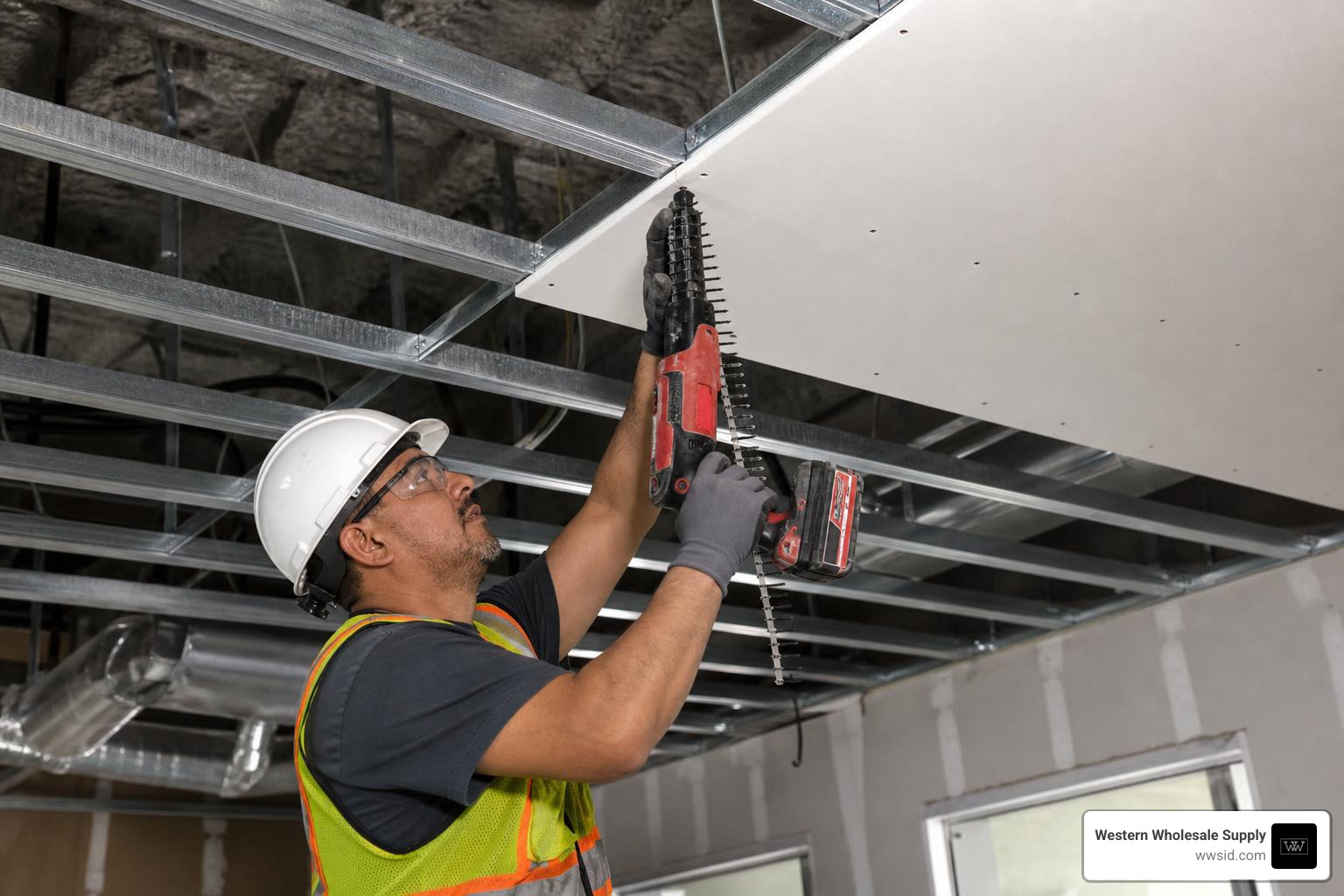
- Use the Right Tool: A dedicated drywall screw gun with a depth-sensitive nosecone is highly recommended. If you are using a standard cordless drill, equip it with a magnetic drywall dimbler bit. This prevents over-driving, which can rupture the paper face of the plasterboard. For a breakdown of essential gear, check out our guide on Drywall Tools 101.
- Maintain a Straight Drive Angle: Keep the tool perfectly perpendicular to the wall. Because of the 150mm length, even a minor tilt will cause the screw to exit the side of the timber stud, compromising the structural hold.
- Set the Correct Depth: The bugle head is designed to depress the paper surface of the plasterboard slightly, creating a shallow “dimple” without tearing the paper. The head should sit roughly 1mm below the board surface, leaving a clean pocket for joint compound.
- Isolate from Wet Plaster: If you are applying wet plaster or heavy joint compound, ensure the screw heads are completely sealed. Unprotected carbon steel can react with the moisture in plaster, leading to rust spots bleeding through your paint finish.
Purchasing Options: Collated vs. Loose Screws
When planning your project, you’ll need to decide between purchasing loose screws or collated screw strips.
Loose Screws
Loose screws are typically sold in boxes of 100 or 200. They are ideal for smaller projects, detail work, repairs, or tight corners where an auto-feed gun will not fit. Loose screws are also easier to hand-start in tricky framing situations, especially when you need precise placement through thick insulation and into the stud behind it.
Collated Screws
For large-scale commercial framing or extensive warehouse ceiling installations, collated screws are the industry standard. These screws come pre-assembled on plastic strips designed for auto-feed drywall guns.
- Speed: Auto-feed systems allow you to drive screws continuously without stopping to load each fastener by hand.
- Safety: Keeps one hand free to hold the plasterboard or insulation panels in place.
- Efficiency: Reduces dropped and wasted fasteners on the job site.
Buying in Bulk
Whether you choose loose or collated, purchasing in bulk is the most cost-effective approach for professional contractors. Bulk boxes help crews maintain consistent fastener supply across large runs of walls or ceilings and reduce downtime caused by mid-job material shortages. To understand how bulk purchasing can optimize your material overhead, read our article on why you should always buy drywall screws in bulk.
Frequently Asked Questions About Extra-Long Fasteners
What is the standard diameter for a 150mm drywall screw?
The industry standard diameter for a 150mm drywall screw is 4.8mm (often referred to as a #9 or #10 gauge equivalent). This thicker gauge is necessary to provide the shear strength required to support heavy drywall sheets over a six-inch span without bending or shearing under the weight.
Can I use these screws for exterior applications?
Standard black phosphate and zinc-plated 150mm drywall screws are designed strictly for interior applications. While they offer mild corrosion resistance, they will eventually rust if exposed to constant outdoor moisture or treated lumber. For exterior sheathing or decking, always use specialized exterior-grade wood screws or structural fasteners with a high-durability organic coating.
What driver bit is required for installation?
A standard Phillips No. 2 (PH2) driver bit is required. Ensure you use high-quality, hardened impact bits, as the depth of a 150mm screw requires sustained torque, which can quickly wear out cheap or soft driver bits.
Conclusion
When your project demands thick thermal barriers or deep acoustic insulation, standard drywall fasteners simply won’t cut it. 150mm drywall screws provide the length, strength, and precision needed to secure plasterboard through deep insulation layers directly to your structural framing. By choosing the correct thread type, verifying material standards, and following proper installation techniques, you can ensure a flat, stable, and durable finish.
At Western Wholesale Supply, we have been serving the builders, contractors, and drywall professionals of Eastern Idaho and Western Wyoming since 1963. With local branches in Idaho Falls, Pocatello, Jackson, Driggs, Victor, Rexburg, Rigby, Shelley, Blackfoot, Chubbuck, Burley, and Twin Falls, we provide reliable, on-time delivery of premium building materials directly to your job site.
Ready to stock up on high-quality fasteners from brands like Brighton Best and Grabber, CertainTeed ceiling systems, Quietrock EZ Snap drywall, or Durock cement board? Explore Drywall Supplies with us today, or stop by one of our local yards to get exactly what you need for your next build.
