

Why Choosing the Right Drywall to Metal Screws Matters
Using the correct drywall to metal screws is the single most important fastener decision you’ll make on any metal-framed wall or ceiling project. Use the wrong type and you’ll strip threads, crack drywall faces, or end up with panels that work loose over time.
Quick Answer: What screws do you use for drywall on metal studs?
| Drywall Thickness | Stud Gauge | Screw Type | Recommended Length |
|---|---|---|---|
| 1/2″ | 25–20 ga | Fine-thread, sharp point (#6) | 1-1/4″ |
| 5/8″ | 25–20 ga | Fine-thread, sharp point (#6) | 1-5/8″ |
| 1/2″ or 5/8″ | 20–18 ga | Self-drilling, fine-thread (#6–#8) | 1-1/4″ – 1-5/8″ |
| Double layer | 20–18 ga | Self-drilling, fine-thread (#8) | 2″ – 2-3/8″ |
The short version:
- Always use fine-thread screws on metal studs — never coarse-thread wood screws
- Use sharp-point screws for light-gauge steel (25–22 ga)
- Use self-drilling (drill-point) screws for 20-gauge and thicker
- Follow GA-216 spacing: 8″ on edges, 12″ in the field
- Expect 28–32 screws per 4×8 sheet
That covers the basics. The rest of this guide gets into the details — gauge-by-gauge selection, sizing charts, installation standards, and the mistakes that cause callbacks.
At Western Wholesale Supply, we are third-generation building materials professionals. We’ve sourced and supplied drywall to metal screws for residential and commercial framing projects across Eastern Idaho and Western Wyoming for years. If you want to get this right the first time, keep reading.
Understanding Drywall to Metal Screws: Types and Specifications
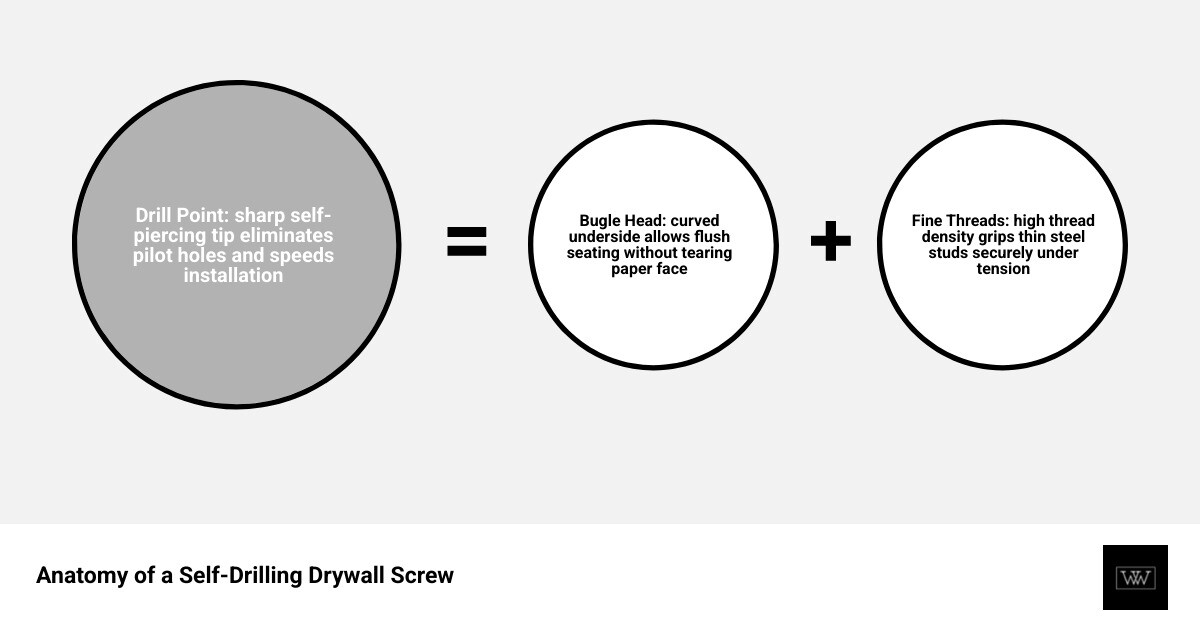
When we talk about drywall to metal screws, we aren’t just talking about a “standard” screw. These are specialized fasteners designed to pierce steel and hold gypsum board tight under tension. Unlike wood screws, which have deep, aggressive threads to bite into soft fibers, metal screws rely on friction and thread density.
At Western Wholesale Supply, we carry top-tier brands like Brighton Best and Grabber because they maintain the strict tolerances required for commercial and residential work. A quality screw should have a sharp, symmetrical point and a consistent bugle head. The bugle head is that curved shape under the screw top that allows the fastener to sit flush without tearing the drywall paper. If the paper tears, you lose nearly all the holding power of that fastener.
According to Drywall Screws for Metal Studs and Wood | Pro-Twist, these screws are typically made from heat-treated carbon steel (often C1022) to ensure they are hard enough to tap through steel without snapping.
Selecting Drywall to Metal Screws by Gauge
The most critical factor in your selection is the gauge of the metal stud. In steel framing, a lower gauge number means thicker metal.
- 25-Gauge (Light Gauge): Common in residential non-load-bearing partitions. These are thin and “flimsy,” requiring a sharp point that can pierce the metal instantly.
- 20-Gauge (Drywall or Structural): This is the “middle ground.” Depending on the manufacturer, 20-gauge can sometimes be pierced by a sharp point, but many pros prefer self-drilling points here to avoid “walking” (where the screw slides across the metal before biting).
- 18-Gauge and Thicker: These are structural studs. You cannot use a standard sharp point here. You need a self-drilling “Tek” screw that acts like a drill bit to create its own pilot hole.
As noted in How to Choose Drywall Screws for Metal Studs, using the wrong screw for the gauge can lead to stripped threads or “screws that won’t go in,” which kills your productivity on the job site.
Sharp Point vs. Self-Drilling Points
We often get asked when to switch from an S-type (sharp point) to a drill point.
Sharp Point (Type S): These are designed for 25-gauge to 20-gauge steel. They have a very fine thread and a needle-sharp tip. They work by piercing the metal and then drawing the threads through.
Self-Drilling (Drill Point/Tek): These feature a tip that looks like a tiny drill bit. They are essential for any metal 20-gauge or thicker (up to 12-gauge in some cases). They drill the hole, tap the threads, and fasten the board in one motion. Without these, you’d be stuck drilling pilot holes all day—and nobody has time for that.

Choosing the Right Size and Length for Metal Studs
“Size matters” isn’t just a catchy phrase; it’s a structural requirement. If your screw is too short, it won’t engage the metal stud fully. If it’s too long, you’re wasting money and potentially hitting utilities inside the wall cavity.
A good rule of thumb is that the screw should penetrate the metal stud by at least 3/8 of an inch (10mm).
| Application | Drywall Thickness | Recommended Screw Size |
|---|---|---|
| Single Layer Wall | 1/2″ | #6 x 1-1/4″ |
| Single Layer Ceiling/Wall | 5/8″ | #6 x 1-5/8″ |
| Double Layer | 5/8″ + 5/8″ | #8 x 2-1/4″ or 2-5/8″ |
| Heavy Gauge Framing | Any | #8 or #10 Self-Drilling |
For more on why these dimensions are non-negotiable, check out Size Matters When You Are Screwing Into Sheetrock. Most residential projects in Idaho Falls or Jackson will use a #6 gauge screw, while heavy commercial projects might bump up to a #8 for better shear strength.
Fastening Specialty Boards to Metal
Not all “drywall” is created equal. When you’re working with specialty boards, your fastener needs change:
- Durock: When installing Durock cement board over metal studs, you cannot use a standard bugle head screw. You need a wafer head or a specialized cement board screw with “nibs” under the head to help it countersink into the dense material.
- Quietrock EZ Snap: For sound-dampened rooms, Quietrock EZ Snap is a fantastic product we provide. Because it’s denser than standard gypsum, ensure you are using high-quality Brighton Best or Grabber fine-thread screws to maintain that tight seal.
- Double Layer Fire-Rating: In commercial corridors, you’ll often see two layers of 5/8″ Type X drywall. Your first layer uses standard 1-1/4″ screws, but that second layer needs 2-1/4″ or longer to reach the stud.
Installation Standards and Spacing Requirements
In our 60+ years serving the region, we’ve seen that the best-looking finishes start with the most boring part: the standards. The Gypsum Association (GA-216) and ASTM (C1002 for light gauge, C954 for heavy gauge) dictate how we should be installing these.
The withdrawal resistance—how hard it is to pull the screw out—is significantly higher for screws than nails. In fact, drywall screws provide 310–380 lb of withdrawal resistance in standard framing, which is about 30% more than ring-shank nails. This is why you rarely see “screw pops” compared to the “nail pops” of the old days.
For a deeper dive into the professional requirements, see The Pros Checklist for Commercial Construction Fasteners and Supplies.
Spacing Drywall to Metal Screws per GA-216
If you want to pass inspection in Twin Falls or Pocatello, you need to follow the GA-216 spacing rules. Proper spacing prevents sagging and ensures the wall can handle the weight of the mud, tape, and paint.
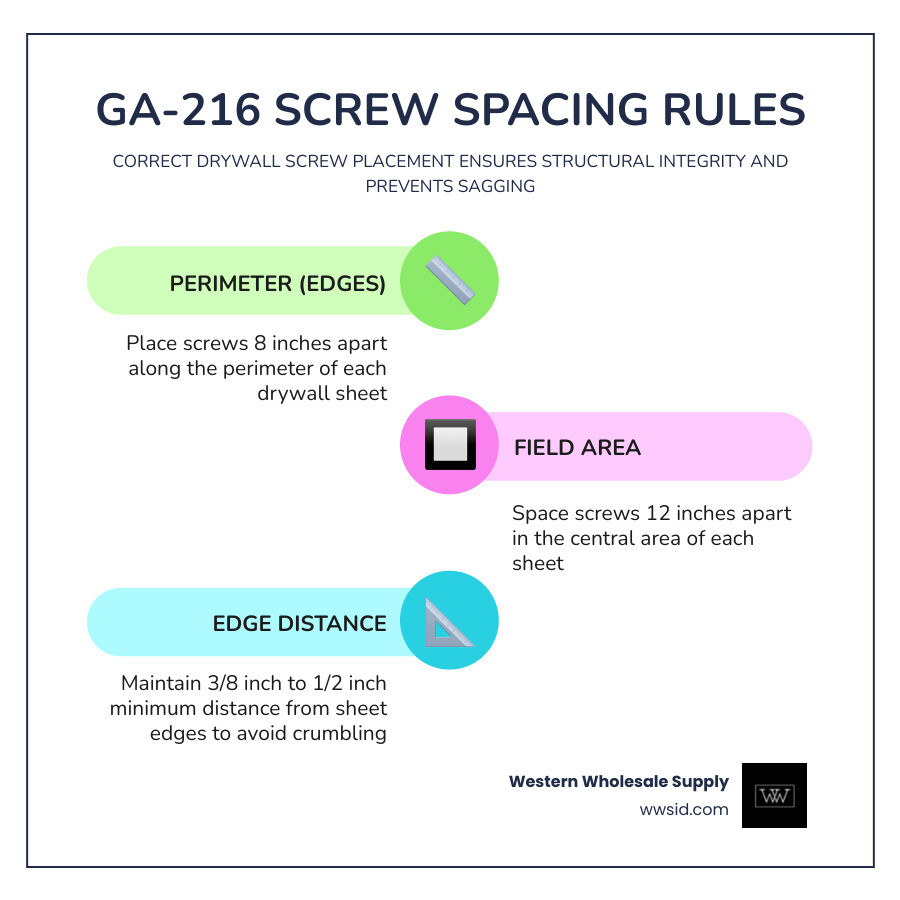
- Edges: Space screws 8 inches apart along the perimeter of the sheet.
- Field: Space screws 12 inches apart in the middle (the “field”) of the board.
- Edge Distance: Stay at least 3/8″ to 1/2″ away from the edge of the board to prevent the gypsum from crumbling.
According to the Drywall Screw Guide: How Many Screws Per Sheet?, a standard 4×8 sheet requires between 28 and 32 screws. If you’re doing a 1,000 sq ft project (roughly 31 sheets), you’ll want to have at least 1,100 screws on hand to account for waste and dropped fasteners.
Best Practices and Common Mistakes to Avoid
We’ve seen it all at the sales counter. The most common mistake? Over-driving the screw. If you drive the screw so deep that it punctures the paper face, the screw is doing absolutely nothing. You’ve basically just put a hole in your wall.
The goal is to create a “dimple.” The screw head should sit slightly below the surface of the paper, creating a small bowl that your mudder can fill, but the paper fibers must remain intact.
Another pro tip: Buy in bulk. Whether you’re a contractor in Rexburg or a DIYer in Driggs, running out of screws at 4:00 PM on a Tuesday is a nightmare. As we discuss in Why You Should Always Buy Drywall Screws in Bulk, it’s more cost-effective and ensures you have a consistent product throughout the room.
Preventing Corrosion and Structural Failure
Metal on metal can lead to problems if you aren’t careful about coatings.
- Black Phosphate: The most common coating. It’s great for dry, interior applications because it provides a good surface for joint compound to bond to.
- Zinc Plating (Clear or Yellow): Better for high-humidity areas. If you’re framing a commercial kitchen or a bathroom in a humid environment, zinc offers better protection against “bleeding” or rust spots showing through your paint.
Be aware of galvanic corrosion. This happens when two dissimilar metals touch in the presence of moisture. Using high-quality fasteners like Brighton Best ensures the coatings are up to snuff for our Western Wyoming and Eastern Idaho climates.
Frequently Asked Questions about Drywall to Metal Screws
Can I use wood screws on metal studs?
Short answer: No. Long answer: Wood screws have a coarse thread (fewer threads per inch). When you try to drive a coarse thread into a metal stud, it will usually “strip out” the hole. The screw will spin and spin but never get tight. Fine-thread drywall to metal screws are designed to grip the thin edges of the steel. Using wood screws on metal is a recipe for a wobbly wall and a failed inspection.
When should I use self-drilling vs. sharp point screws?
The “magic number” is 20-gauge.
- If your studs are 25-gauge or 22-gauge, use sharp point screws. They are faster and cheaper.
- If your studs are 20-gauge, 18-gauge, or thicker, use self-drilling screws. If you try to use a sharp point on 16-gauge structural steel, you’ll just burn out the tip of the screw and get a sore shoulder. For more technical specs, the Screw Fasteners Tech Guide is a great resource for understanding the physics of drill points.
How many screws are needed for a standard 4×8 sheet?
For a 4×8 sheet on 16-inch centers:
- 4 studs total (two edges, two in the field).
- At 12″ spacing in the field and 8″ on the edges, you land at roughly 32 screws per sheet. Always add a 10% waste factor. Between the screws you drop in the floor sweepings and the ones that hit a hard spot in the track and bend, you’ll be glad you have the extras.
Conclusion
Selecting the right drywall to metal screws isn’t just about grabbing a box off the shelf; it’s about matching the fastener to your gauge, your board type, and the local building codes of the Intermountain West. Whether you are framing a new warehouse in Burley or finishing a basement in Rigby, the details matter.
At Western Wholesale Supply, we’ve been the backbone of the local building community since 1963. As a veteran-owned, third-generation family business, we don’t just sell you a box of screws—we provide the expertise that comes from 60 years of being on the job site. We pride ourselves on reliable, on-time delivery to Idaho Falls, Jackson, Twin Falls, and everywhere in between.
Need to stock up for your next project? From CertainTeed ceilings to Brighton Best fasteners, we have you covered. More info about drywall products can be found on our main site, or stop by one of our yards today.

