

Why FRP Panels Work Well in Commercial Laundries
An FRP panel for laundries is a strong choice when walls face steam, detergent splash, frequent cleaning, and equipment traffic. For most commercial laundry areas, select smooth, moisture-resistant FRP with sealed seams and corners, install it over a clean, dry, flat substrate, and confirm the needed fire rating and ASTM documentation before ordering.
FRP is non-porous, impact resistant, and easy to wash down. Panels can meet USDA and FDA sanitation requirements, while Class A options can help meet applicable fire-code needs. For high-traffic walls near washers, carts, and dryers, 0.090-inch panels are commonly chosen for added durability.
A complete laundry wall system matters as much as the panel itself. Durock can provide a stable backing in wet areas, while Grabber or Brighton Best fasteners can support mechanical attachment where specified. For the surrounding buildout, Western Wholesale Supply also carries CertainTeed ceiling tiles and Quietrock EZ Snap products.
At Western Wholesale Supply, our building materials professionals have extensive experience helping contractors source dependable wall, ceiling, framing, and finishing materials. We bring an operations-focused view to selecting an FRP panel for laundries, with attention to durability, correct specifications, and keeping projects moving.
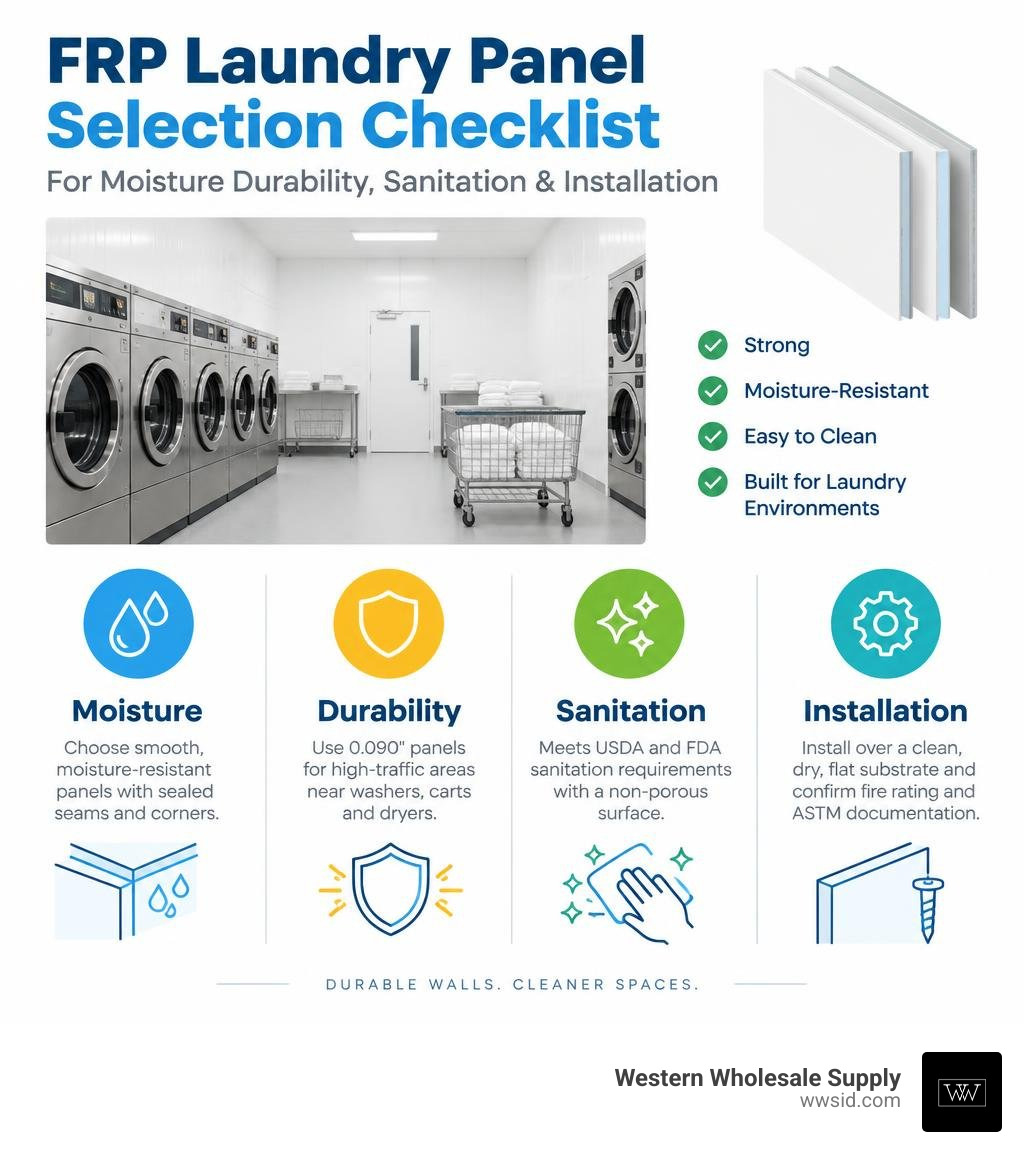
Know your frp panel for laundries terms:
Introduction
Commercial laundries, on-premises hotel wash facilities, and busy laundromats operate under punishing conditions. Between the constant presence of ambient steam, high-pressure washdown routines, chemical overspray from concentrated detergents, and physical impacts from heavy rolling linen carts, standard interior wall systems quickly fail. Drywall softens and sags, paint blisters, and organic substrates become breeding grounds for mold and mildew.
To prevent costly structural remediation and unscheduled downtime, facility designers and contractors rely on durable, moisture-impervious cladding. Fiber-reinforced polymer provides an impenetrable barrier against water absorption while offering robust impact protection. Understanding how composite wall cladding functions ensures you choose the proper wall system for long-term operational success.
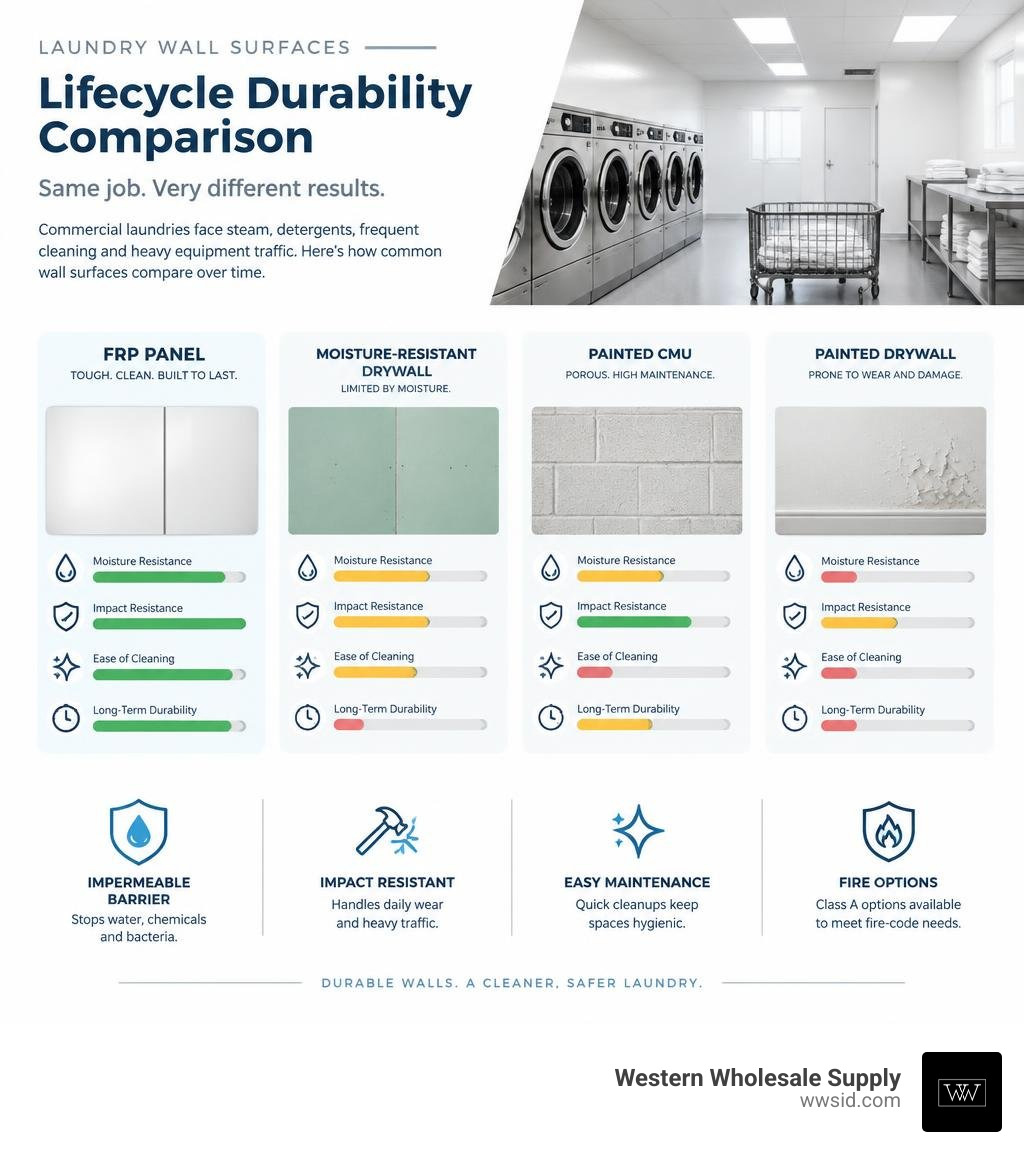
Why Specify an FRP Panel for Laundries Over Alternative Wall Systems
Selecting an appropriate interior finish requires balancing lifecycle cost, ease of maintenance, and physical resilience. Traditional drywall, even moisture-resistant green board, degrades when exposed to continuous relative humidity and daily thermal shifts. Painted concrete masonry units (CMU) offer structural mass but feature porous surfaces that trap lint, moisture, and bacteria, necessitating constant repainting.
FRP panels solve these persistent facility challenges by providing an impermeable, high-strength composite surface that does not corrode, rot, or harbor organic growth.
| Performance Attribute | Standard Drywall System | Painted Concrete Masonry (CMU) | Fiber-Reinforced Polymer (FRP) |
|---|---|---|---|
| Moisture Absorption | High (Prone to swelling) | Moderate to High (Porous) | 100% Waterproof (0.24% water absorption) |
| Impact Resistance | Low (Dents and punctures easily) | High (Prone to chipping paint) | Superior (Izod impact 7.0 ft-lbs/in) |
| Chemical Resistance | Very Low (Stains and degrades) | Moderate (Acids degrade mortar) | High (Impervious to alkalis, acids, bleaches) |
| Sanitation Maintenance | Difficult (Cannot power-wash) | Moderate (Requires scrubbing grout/pores) | Fast washdown, non-porous gelcoat |
| Service Life in Laundries | 2–5 Years | 5–10 Years (Frequent repainting) | 15–25 Years with near-zero degradation |
Core Performance Advantages of an FRP Panel for Laundries
The structural integrity of FRP stems from its composite makeup: high-tensile glass fibers embedded within a thermosetting resin matrix. This gives the material a lightweight profile—four to five times lighter than sheet steel—while maintaining a tensile strength of 90–130 MPa and a bending flexural strength of 140–300 MPa.
In environments where heavy metal carts collide with walls, FRP resists denting, cracking, and shattering. It achieves a Barcol hardness rating of 35B and an Izod impact resistance of 7.0 ft-lbs/in (tested per ASTM D256), easily absorbing everyday mechanical abuse.
Chemical resilience is equally critical. Commercial washing facilities rely on concentrated alkaline builders, acidic sours, chlorine bleaches, and quaternary ammonium sanitizers. While these chemicals rapidly corrode metals and peel standard coatings, FRP meets rigorous hygienic wall cladding standards, remaining unaffected by daily detergent splashes and rigorous sanitation cycles.
Sanitation, Mildew Resistance, and Code Compliance
High humidity and elevated temperatures create ideal conditions for microbial growth. Standard porous wall surfaces absorb moisture-laden steam, allowing mold spores to flourish behind finishes and inside wall cavities.
FRP provides a 100% moisture-resistant, non-porous face that deprives mold and mildew of an organic anchor. Advanced panels engineered with nano-silver antibacterial additives achieve greater than 99.9% reduction in bacterial colonies within 24 hours, ensuring hygiene compliance for linen processing plants that handle healthcare or food-service textiles.
Furthermore, commercial laundries must satisfy municipal health and life-safety codes. Quality composite panels meet ASTM D5319 standards for glass-fiber reinforced polyester wall claddings and comply with USDA and FDA requirements for cleanability. For fire safety, specify Class A rated panels tested under ASTM E84 (flame spread index under 25 and smoke developed index under 450) to fulfill building code mandates.
Key Material Specifications and Structural Performance
Understanding the technical composition of composite walling ensures the material matches the physical demands of your laundry buildout. The resin matrix—typically an isophthalic polyester or vinyl ester—encapsulates woven or chopped fiberglass strands, delivering dimensional stability.
A major technical advantage of FRP is its low linear thermal expansion coefficient of approximately 7.3 x 10^-6 /°C. This rate is lower than steel or aluminum and roughly 1/15th that of non-reinforced plastics, meaning FRP panels maintain dimensional stability across operating temperatures ranging from -60°C to +80°C without warping or buckling. For a deeper look at composite wall properties, consult A Comprehensive Guide to FRP Wall Panels.
Selecting the Right FRP Panel for Laundries: Thickness and Surface Finishes
Choosing the appropriate panel profile depends on traffic volume and sanitary requirements:
- Panel Thickness:
- .050 Inch (1.27 mm): A cost-effective, lightweight cladding suitable for low-impact utility rooms, linen storage closets, or mobile laundry trailers where weight savings are paramount.
- .090 Inch (2.29 mm): The commercial industry standard. It provides the rigidity and impact resistance necessary behind commercial washers, along cart transit pathways, and in washdown sorting bays.
- Surface Texture:
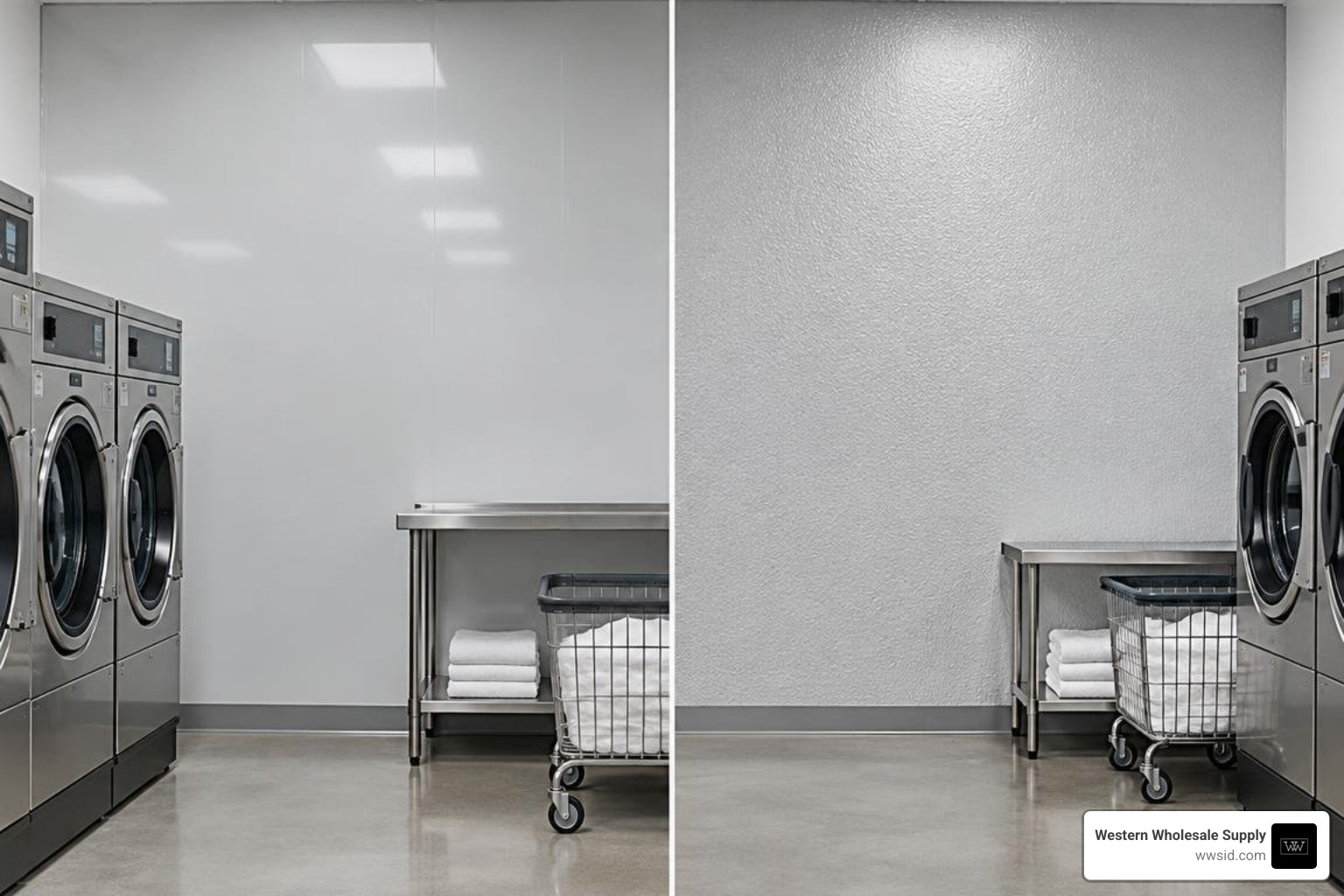
- Pebble-Embossed Texture: Features a textured profile that diffuses light, hides scuffs, and conceals minor abrasions caused by equipment contact.
- Smooth Finish: Provides a uniform, glossy or semi-gloss gelcoat finish. Smooth panels are ideal for sterile washdown zones because they eliminate microscopic valleys where airborne lint and moisture can accumulate, making wipe-downs significantly faster.
- Sheet Format and Seam Minimization:
- Standard sheet sizes include 4′ x 8′, 4′ x 9′, and 4′ x 10′ dimensions. For large industrial wash facilities, wide-format rolls and panels up to 3.1 meters (approx. 10 feet) wide can reduce vertical seams by up to 61%, significantly cutting installation labor and eliminating potential water migration points.
Substrate Compatibility and Moisture Barriers
FRP is a finish cladding, not a standalone structural wall; it requires a sound, flat substrate for permanent adhesive bonding. In dry commercial areas, panels can be bonded directly to drywall. However, in continuous high-moisture laundry wash bays, standard gypsum is inadequate.
For maximum longevity in wet settings, install panels over Durock cement board or primed water-resistant backer units. Durock provides an inorganic, rigid base that will not rot, swell, or delaminate if minor moisture gets behind the perimeter sealants.
Prior to panel installation, verify that the substrate is completely dry, flat within 1/8-inch over a 10-foot span, and free of dust, grease, or curing compounds. Where local codes require an additional continuous vapor barrier, ensure it is installed directly behind the backing board rather than between the board and the FRP sheet, allowing the adhesive to bond directly to the solid substrate.
Practical Installation Guidelines for Commercial Facilities
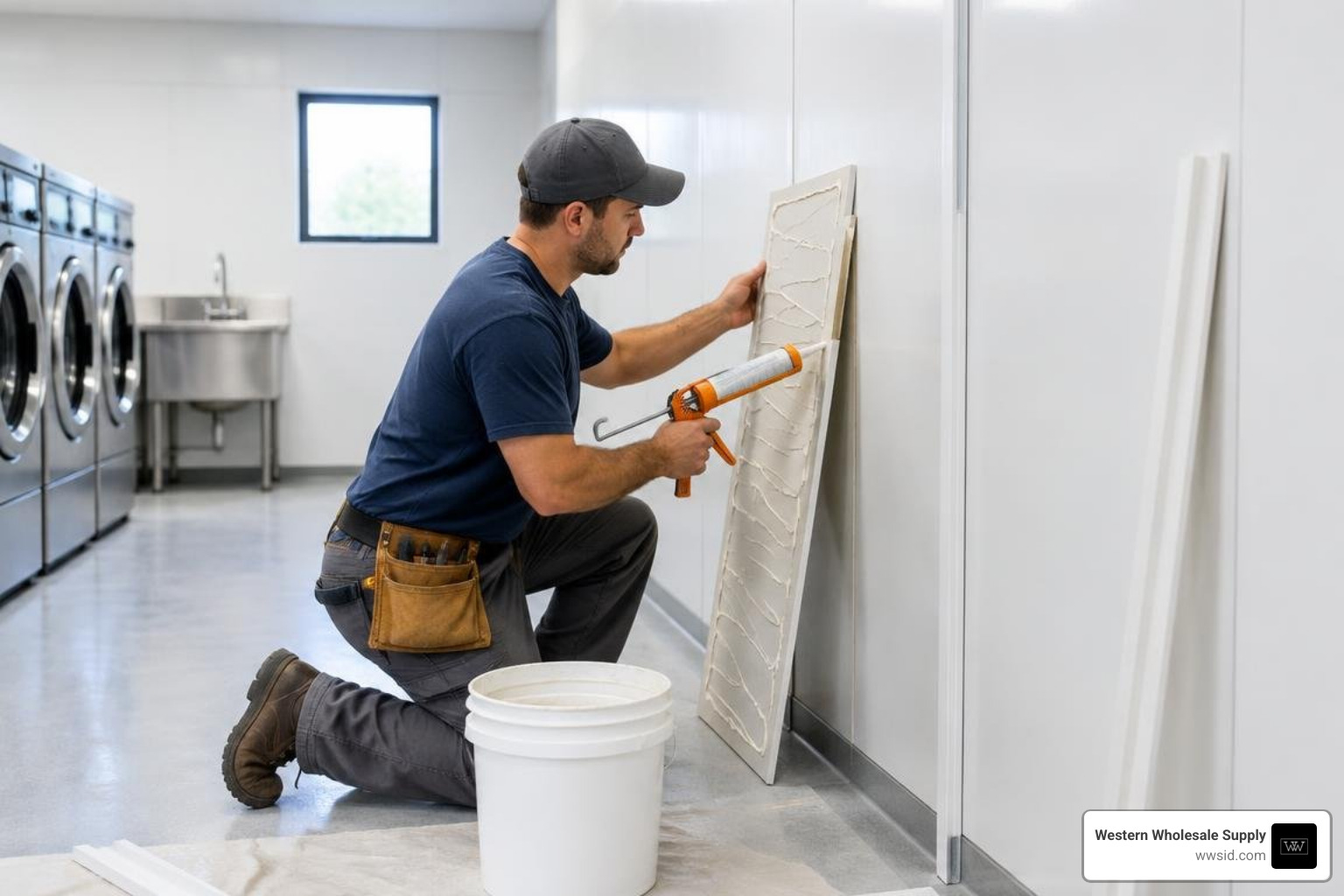
A long-lasting wall assembly depends on proper installation practices. Skipping expansion gaps or using improper adhesives can compromise even the highest-grade panels.
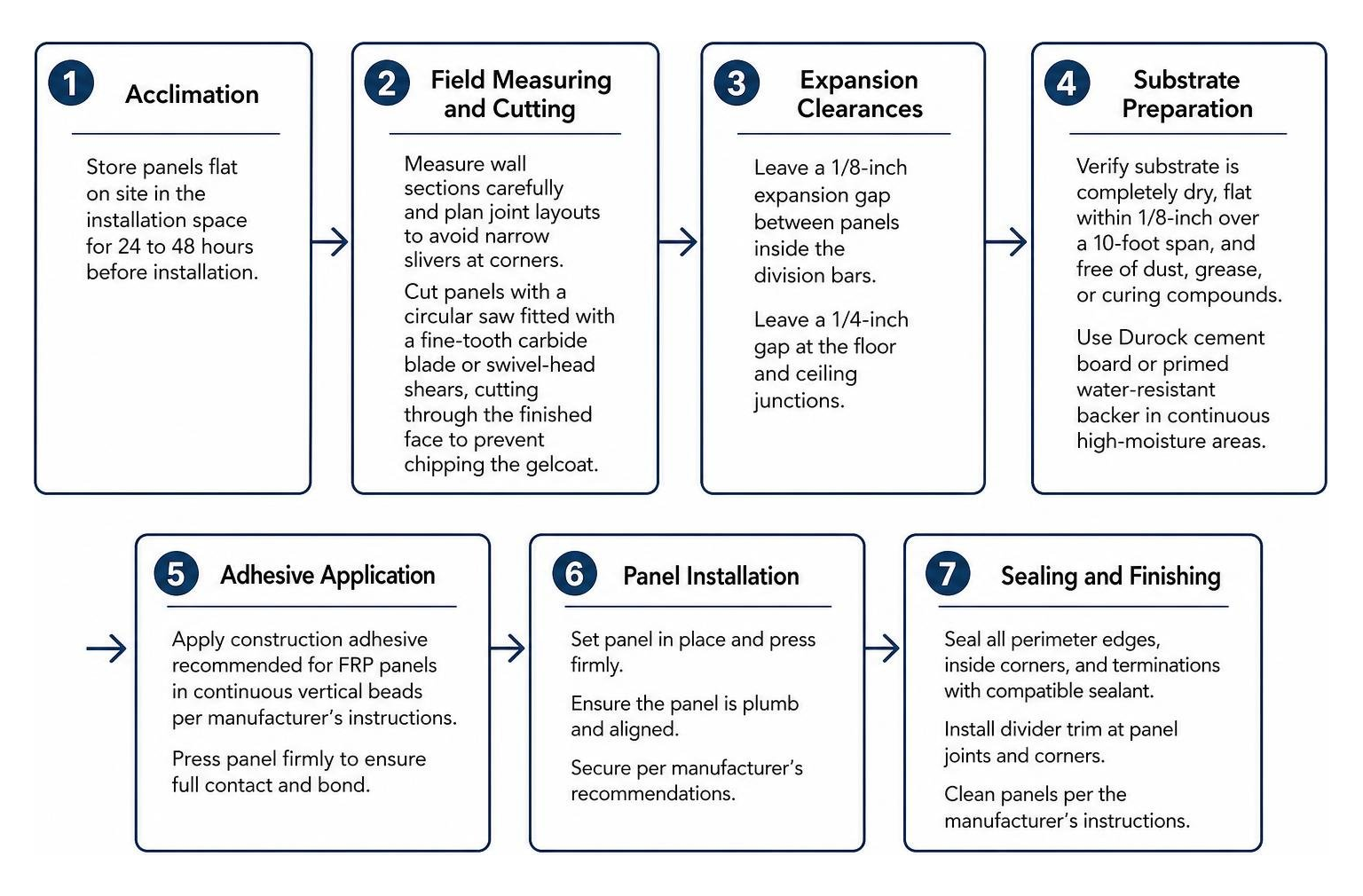
Refer to detailed step-by-step panel installation practices when planning your field layout.
- Acclimation: Store panels flat on site in the installation space for at least 24 to 48 hours prior to hanging to equalize material temperature and moisture levels.
- Field Measuring and Cutting: Measure wall sections carefully, planning joint layouts to avoid narrow slivers at corners. Cut panels with a circular saw fitted with a fine-tooth carbide blade or swivel-head shears, cutting through the finished face to prevent chipping the gelcoat.
- Expansion Clearances: Always leave a 1/8-inch expansion gap between panels inside the division bars, and a 1/4-inch gap at the floor and ceiling junctions. This clearance accommodates seasonal building movement without panel buckling.
- Adhesive Troweling: Apply a full-coverage layer of water-resistant, solvent-free FRP adhesive across 100% of the panel back using a 3/16″ x 5/32″ V-notch or cross-head trowel.
- Panel Setting and Rolling: Press the panel firmly against the substrate, seating it into the corner and division moldings. Use a heavy laminate floor roller, working systematically from the center outward to displace trapped air pockets and achieve full adhesive transfer.
- Sealing and Inspection: Fill all molding channels with a continuous bead of high-grade silicone sealant during panel insertion to ensure an airtight, watertight joint assembly.
Adhesive Selection, Fastening, and Seam Management
Selecting the correct adhesive is vital for preventing panel delamination over time. For porous backings like drywall or cement board, advanced water-based polymer or polyurethane adhesives provide exceptional grab and low-VOC compliance. For a thorough analysis of bonding chemistry, consult The Ultimate Guide to FRP Adhesives for a Bond That Lasts.
In demanding commercial laundry facilities where washdown sprayers and heavy equipment vibrations create dynamic loads, adhesive bonding is supplemented with mechanical fasteners. Use non-corrosive nylon drive rivets or premium Grabber or Brighton Best fasteners placed through pre-drilled, oversized pilot holes along panel perimeters and centers.
Manage seams using dedicated PVC or color-matched composite moldings, including:
- Division Bars (H-molds): Bridge vertical seams between adjoining panels.
- Inside and Outside Corners: Protect structural room angles while preventing water infiltration behind the wall envelope.
- End Caps (J-molds): Terminate panel edges neatly at ceiling lines, wainscot heights, and door jambs.
For drywall substrate finishing prior to installation, our showrooms stock professional finishing tools from Hyde, USG Sheetrock Tools, Columbia Taping Tools, and Marshalltown to ensure substrates are perfectly prepared.
High-Splash Zones
The areas immediately surrounding commercial washing extraction machines, water heaters, and bulk chemical dispensing pumps represent extreme splash zones. In these locations, standard snap-in trim strips should be reinforced with chemical-resistant, 100% silicone sealants embedded directly within the channel profile before panel insertion.
Panels treated with UV-stabilized acrylic gelcoats prevent surface yellowing and brittleness in facilities utilizing germicidal ultraviolet (UV-C) sanitation lighting. Furthermore, the inherent flexural resilience of glass-reinforced composites absorbs constant machine vibrations without cracking fasteners or fatiguing the panel matrix.
Frequently Asked Questions About Commercial Laundry Wall Cladding
What thickness of FRP panel is recommended for high-traffic commercial laundries?
For commercial and industrial laundries, the recommended thickness is 0.090 inch (2.29 mm). While .050-inch panels are suitable for residential closets, ceiling cladding, or mobile utility units, .090-inch panels offer the structural stiffness, tensile strength, and impact resistance needed to withstand strikes from loaded metal laundry hampers, mechanical maintenance equipment, and high-volume daily operations.
How do FRP panels withstand high heat and steam from commercial dryers?
FRP panels are engineered from thermosetting polymer resins that do not soften or deform under operating temperatures ranging from -60°C to +80°C (with short-term exposure up to 120°C). With an extremely low thermal expansion coefficient (7.3 x 10^-6 /°C), the panels expand and contract minimally during high-heat drying cycles. As long as standard 1/8-inch perimeter expansion gaps are maintained inside division moldings, steam exposure will not cause warping, bubbling, or delamination.
Can FRP panels be cleaned with industrial detergents and bleach solutions?
Yes. The cross-linked polymer matrix and protective gelcoat finish create an impermeable barrier against aggressive cleaning agents, including concentrated sodium hypochlorite (bleach), quaternary ammonium solutions, citric descalers, and heavy alkaline detergents. Surfaces can be sanitized daily using sponge mop routines, steam wands, or medium-pressure sprayers without dulling, softening, or degrading the surface finish.
Conclusion
Equipping a commercial laundry facility with dependable, moisture-impervious wall cladding prevents costly moisture damage, eliminates mold growth, and minimizes ongoing maintenance. Specifying heavy-duty, Class A fire-rated FRP panels over reliable Durock cement backing boards provides a clean, professional finish capable of withstanding decades of heat, steam, and mechanical wear.
At Western Wholesale Supply, we are an independent, veteran-owned, third-generation family business supplying premium commercial building materials across Eastern Idaho and Western Wyoming since 1963. Whether you are outfitting a facility in Idaho Falls, Pocatello, Jackson, Rexburg, Twin Falls, or surrounding communities, our team delivers the trusted products your jobsite requires—including CertainTeed ceiling systems, Durock substrates, Quietrock EZ Snap solutions, and Grabber or Brighton Best fasteners.
Explore our comprehensive resources and check out our in-depth guide to commercial FRP panels to choose the optimal wall cladding for your next commercial project. Contact our experienced team today for product specifications, material estimates, and reliable, on-time jobsite delivery.
