

What You Need to Know About FRP Panels for Commercial Use
FRP panels commercial applications are one of the most practical and cost-effective wall protection solutions available for contractors working in demanding environments like commercial kitchens, food processing plants, healthcare facilities, and restrooms.
Here is a quick look at where FRP panels fit best in commercial interiors:
| Feature | Why It Matters for Commercial FRP |
|---|---|
| Moisture resistance | Helps protect walls in kitchens, restrooms, dish rooms, and washdown areas |
| Impact resistance | Handles normal back-of-house traffic from carts, equipment, and daily use |
| Ease of cleaning | Supports routine sanitation and maintenance schedules |
| Installation efficiency | Installs quickly over properly prepared substrates with approved adhesive and trim |
| Food safety compliance | Many panels are available with USDA, FDA, and CFIA documentation |
| Repair planning | Damaged panels, trim, and sealant should be addressed before moisture reaches the substrate |
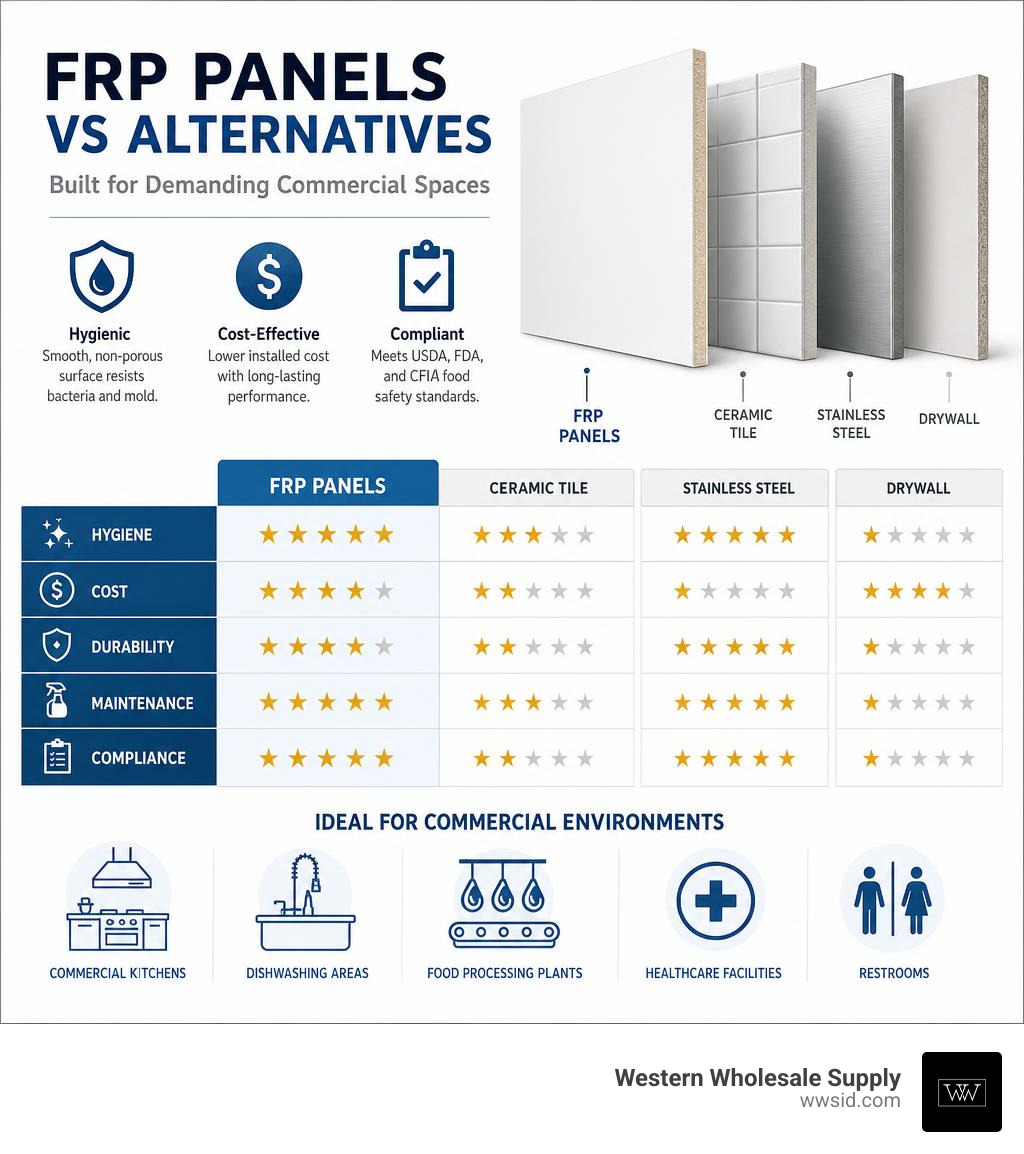
The short answer: FRP panels are a go-to wall system for commercial spaces that need hygienic, moisture-resistant, durable surfaces at a reasonable cost. Many commercial FRP panels meet USDA, FDA, and CFIA food safety expectations, install efficiently, and hold up well in high-humidity, high-traffic environments when the full system is detailed correctly.
Commercial kitchens, food prep areas, dishwashing stations, and processing plants all face the same challenge: walls take a beating from moisture, cleaning chemicals, and daily impact. Painted drywall is best reserved for dry, low-abuse spaces. FRP gives contractors a practical, proven wall covering for areas that need cleanability, durability, and code-conscious installation.
This guide is written by Western Wholesale Supply, a third-generation building materials supplier serving commercial projects across Eastern Idaho and Western Wyoming. In the sections below, we will walk through everything from how FRP panels are made to how they are selected, installed, cleaned, and maintained in commercial environments.
Introduction
At Western Wholesale Supply, we look at FRP panels the way most contractors look at a reliable pickup: not flashy, not fussy, but it shows up every day and does the job. For commercial walls, especially in kitchens, restrooms, food prep rooms, utility areas, and processing spaces, that matters.
FRP stands for fiberglass reinforced plastic. In plain English, it is a durable sheet panel made with plastic resin and fiberglass reinforcement. The result is a wall covering that resists moisture, cleans easily, and protects the wall behind it from impact, splashes, stains, and daily abuse.
For contractors in Eastern Idaho and Western Wyoming, FRP panels are often part of a practical interior package alongside drywall, steel framing, insulation, ceiling systems, cement board, and fasteners. We supply building materials for jobs where speed, durability, and code-conscious installation all matter. FRP fits right into that world.
This guide explains what FRP panels are, why they work so well in commercial environments, how to install and maintain them, and when you may want to compare them with newer wall systems.
What Are FRP Wall Panels and How Are They Made?
FRP wall panels are thin, rigid or semi-rigid sheets made by combining fiberglass reinforcement with a polymer resin matrix. The fiberglass gives the panel strength, while the resin helps create a water-resistant, cleanable surface.
Most commercial FRP wall panels are manufactured by embedding fiberglass strands or mat into polyester or similar resin. The material is cured into sheets, then finished with a surface layer that may be smooth, pebbled, embossed, or otherwise textured. Many panels also include a gel coat or protective surface treatment to improve cleanability, stain resistance, and long-term appearance.
For a deeper overview of panel types and liner uses, see our guide to FRP panel boards and liners. Manufacturer technical pages, such as Durable FRP Wall Panels for Commercial Spaces | Kal-Lite , also show how broad the category has become, with many thicknesses, colors, sizes, and fire-rating options available.
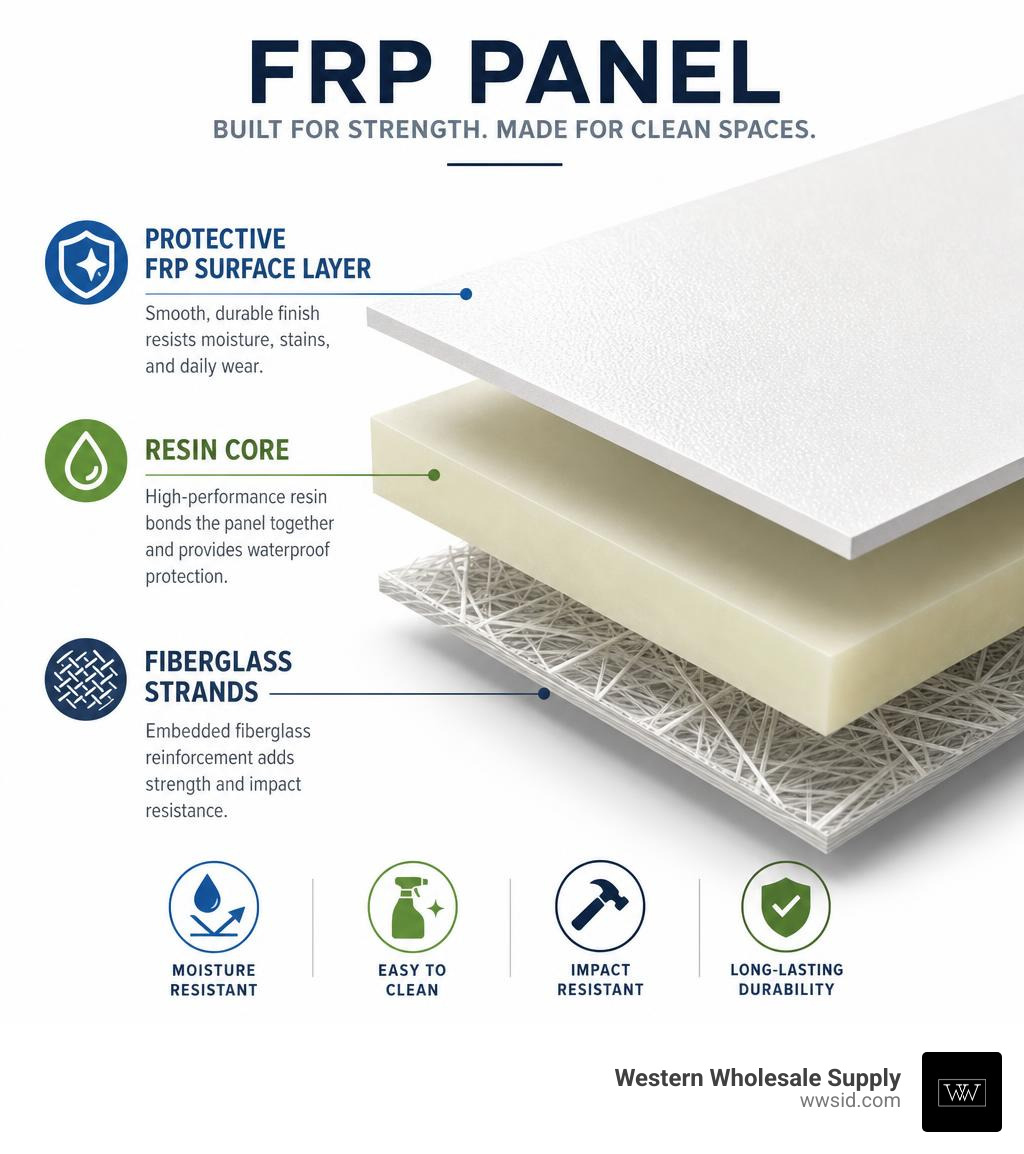
The basic FRP panel structure usually includes:
- A fiberglass reinforcement layer for strength.
- A resin system that binds the panel together.
- A finished face for hygiene and cleanability.
- Optional surface texture, color, or specialty coating.
- Matching trim or molding for edges, seams, and corners.
That combination is why FRP works well in commercial spaces. It is lighter than many heavy wall protection assemblies, installs efficiently over properly prepared substrates, and provides a much more moisture-resistant and washable surface than painted drywall in wet or high-use rooms.
Material Composition and Thickness
Commercial FRP panels are commonly available in thicknesses such as 0.045 inch, 0.060 inch, 0.075 inch, 0.090 inch, 0.120 inch, and heavier specialty options. A very common commercial wall panel thickness is 0.090 inch because it provides a strong balance of durability, impact resistance, flexibility, and ease of installation.
Panel sizes often include:
| Common Size | Typical Use |
|---|---|
| 4 ft x 8 ft | Standard commercial walls and smaller rooms |
| 4 ft x 9 ft | Taller wall coverage with fewer horizontal breaks |
| 4 ft x 10 ft | Commercial kitchens, prep rooms, and high-wall applications |
| 4 ft x 12 ft or rolls | Specialty or large-area installations where available |
Fire ratings are another key specification. FRP panels are commonly available in Class A and Class C fire-rated versions. The right choice depends on local code requirements, occupancy type, wall location, and project specifications.
In general:
- Class A FRP has a lower flame spread rating and is used where stricter fire performance is required.
- Class C FRP is common for many standard commercial wall protection applications where allowed by code.
- Always confirm the required rating with the project documents, building official, architect, or general contractor.
FRP panels may also be tested to standards such as ASTM D-5319 for glass-fiber reinforced polyester wall and ceiling panels. Food service and processing projects often require panels that meet USDA, FDA, FSIS, CFIA, or local health department expectations for cleanable, non-porous surfaces.
Surface Finishes and Customization

FRP panels are not all the same on the face. The finish affects cleanability, appearance, glare, and how well the panel hides scuffs.
Common FRP finishes include:
- Smooth finish: Easier to wipe down and often preferred where sanitation is the top concern.
- Pebbled texture: Helps hide scratches, dents, and everyday wear.
- Matte finish: Reduces glare and gives a softer visual appearance.
- Linen or patterned textures: Used where aesthetics matter more.
- Specialty colors: Used for branding, wayfinding, or design coordination.
White remains the most common color for commercial kitchens and food service because it looks clean, reflects light, and makes soil easier to spot. That said, FRP is available in many standard and custom colors depending on the manufacturer and project size.
Trim options also matter. Most commercial FRP systems use PVC or aluminum trim components such as:
- Inside corners
- Outside corners
- Division moldings
- End caps
- Base trims
- Corner guards
You can also visit our main FRP Panels page for more information on product options and commercial use cases.
Why FRP Panels Commercial Are the Industry Standard
The phrase FRP panels commercial may sound like something from a spec sheet, but the reason contractors keep using FRP is simple: it solves everyday wall problems without overcomplicating the job.
Commercial interiors are rough on walls. A kitchen wall may deal with steam, grease, washdown, carts, hand trucks, cleaning chemicals, and constant traffic. A restroom wall may see moisture, cleaners, splashes, and impact. A processing room may need daily sanitation. Painted drywall is not built for that kind of life.
FRP panels are widely used because they provide:
- Moisture resistance
- Impact resistance
- Easy cleaning
- Mold and mildew resistance when properly installed
- Faster installation than many labor-intensive wall protection assemblies
- Practical material and labor requirements for commercial interiors
- Good performance in high-humidity rooms
- Compatibility with many commercial substrates
Common commercial applications include:
- Restaurant kitchens
- Food prep rooms
- Dishwashing areas
- Walk-in cooler surroundings
- Food processing plants
- Restrooms
- Locker rooms
- Janitorial closets
- Healthcare support areas
- Clean rooms
- Utility corridors
- Schools and institutional buildings
- Water and wastewater treatment facilities
- Trailer, truck body, and transportation liner applications
FRP is not glamorous. It will probably never get invited to a design awards dinner. But if the goal is a clean, durable, code-friendly wall surface, it earns its keep.
Hygiene, Sanitation, and Regulatory Compliance
In commercial kitchens and food service spaces, walls must be smooth, non-absorbent, durable, and easy to clean. FRP panels are designed for exactly that kind of environment.
FRP helps support hygiene because it is:
- Non-porous on the finished face
- Resistant to moisture
- Easy to clean with routine detergents
- Compatible with frequent sanitation schedules
- Less prone to harboring soil when seams are properly sealed
- Resistant to mold and mildew growth on the panel surface
Many commercial FRP panels are manufactured to meet USDA, FDA, FSIS, CFIA, and local health department requirements for food-safe wall and ceiling surfaces. That does not mean every FRP panel automatically fits every project. It means you should select panels with the correct documentation and approvals for the application.
The installation is just as important as the panel. A food-safe panel installed with open seams, failed sealant, or trapped moisture behind it can still create sanitation problems. For kitchens and processing rooms, seams, corners, penetrations, and termination points need careful attention.
Best practices include:
- Use approved FRP adhesive.
- Install over a clean, dry, sound substrate.
- Maintain proper expansion gaps.
- Use compatible trim and moldings.
- Seal exposed edges and penetrations where required.
- Follow manufacturer instructions for food service environments.
- Confirm local health department and building code expectations.
Matching FRP to Commercial Wall Conditions
FRP is most effective when it is specified for the right rooms and installed as part of a complete wall assembly. The best approach depends on moisture exposure, impact exposure, sanitation requirements, fire rating needs, substrate condition, and project specifications.
| Wall Condition | Where FRP Fits | Notes for Contractors |
|---|---|---|
| High moisture or frequent cleaning | Commercial kitchens, restrooms, dish rooms, and janitorial areas | Use compatible adhesive, trim, and sealant details |
| Food service or processing | Prep rooms, processing rooms, bakeries, and institutional kitchens | Confirm USDA, FDA, FSIS, CFIA, and local health department requirements |
| High traffic back-of-house areas | Utility corridors, service rooms, and equipment support spaces | Consider panel thickness, corner protection, and impact exposure |
| Dry, low-abuse rooms | Offices, storage rooms, and other controlled areas | Standard drywall may be appropriate where cleanable wall protection is not required |
| Moisture-prone assemblies needing a durable substrate | Areas where a more moisture-tolerant backing is specified | Cement board such as Durock may be part of the wall assembly when required by the project |
Drywall is still the right product in dry commercial spaces. Durock is useful where a more moisture-tolerant substrate is needed. FRP wins when the owner needs a practical wall covering that can be cleaned often, installed efficiently, and maintained without a major production. It is the “keep the job moving” option.
Installation, Maintenance, and Modern Alternatives
Good FRP performance starts before the first panel goes on the wall. The subwall must be clean, dry, flat, and structurally sound. FRP does not magically fix a bad substrate. It covers the wall, but it will still reflect major humps, dips, and surface problems.
Typical substrates include:
- Drywall in dry or controlled interior areas
- Plywood where allowed and properly prepared
- Concrete or masonry with appropriate preparation
- Cement board such as Durock in moisture-prone wall assemblies
- Existing sound surfaces, depending on adhesive compatibility and project requirements
For adhesive guidance, see our resource on FRP adhesives for a bond that lasts. Adhesive selection matters because the wrong product can lead to bubbling, loose panels, or failure in humid spaces.
Mechanical fasteners may be used in some installations or at terminations depending on the system, substrate, and manufacturer instructions. When fasteners are part of the assembly, quality options from brands such as Grabber or Brighton Best can help keep the installation consistent.
Step-by-Step Installation of FRP Panels Commercial
Always follow the manufacturer’s written instructions for the specific FRP panel, adhesive, trim, and substrate. That said, most commercial FRP installations follow a similar process.
- Review the project requirements
Check plans, specifications, fire rating requirements, health department expectations, panel thickness, trim type, and adhesive compatibility before work begins.
- Acclimate the panels
Allow FRP panels, adhesives, and trims to acclimate to the installation environment. This helps reduce movement after installation. Temperature and humidity matter because FRP expands and contracts.
- Prepare the substrate
The wall surface should be:
- Clean
- Dry
- Flat
- Structurally sound
- Free of loose paint, dust, oil, and debris
- Compatible with the selected adhesive
Do not install over wet or damaged walls. If the wall has moisture issues, solve those first. FRP is moisture-resistant, not a magic spell.
- Plan panel layout
Measure carefully and plan seams before cutting. Try to avoid narrow slivers at corners or awkward seams in high-splash areas. Consider where equipment, sinks, counters, and trim will land.
- Cut panels to size
FRP can usually be cut with common jobsite tools using the correct blade. Support the panel properly while cutting to avoid chipping or cracking. Cutouts for outlets, pipes, and penetrations should be clean and properly sealed where needed.
- Apply adhesive
Use only manufacturer-approved adhesive. Apply it evenly with the recommended trowel pattern or method. Full, consistent adhesive coverage helps prevent bubbles and loose areas.
- Set the panel
Place the panel against the wall and press it firmly into the adhesive. Roll the surface with a laminate roller or recommended tool to ensure good contact.
- Allow for expansion gaps
FRP moves with temperature changes. Leave the recommended gaps at panel edges, corners, ceilings, floors, and trim components. Skipping expansion space is a classic way to create buckling later.
- Install division moldings and trim
Use compatible PVC or aluminum trim at seams, corners, edges, and terminations. Division moldings help protect seams and create a cleaner finished look.
- Seal where required
In food service, washdown, or wet areas, sealant may be required at seams, trim, penetrations, and transitions. Use a compatible, food-safe sealant where applicable.
- Clean the finished installation
Remove adhesive residue before it cures. Wipe panels clean and inspect seams, corners, and cutouts before turning the space over.
Long-Term Maintenance and Limitations
FRP is popular partly because maintenance is straightforward. Most routine cleaning can be done with mild detergents, water, soft cloths, sponges, or non-abrasive cleaning tools. Some FRP panels can tolerate stronger cleaning methods, but always check the manufacturer’s recommendations first.
Basic maintenance tips:
- Clean regularly so grease and soil do not build up.
- Avoid abrasive pads that can dull or scratch the surface.
- Rinse cleaners thoroughly where required.
- Inspect seams and trim periodically.
- Reapply sealant if it begins to peel, crack, or separate.
- Repair damaged panels before moisture reaches the substrate.
- Keep carts and equipment from repeatedly striking the same wall areas.
FRP holds up well over time, but it has limitations.
Common FRP challenges include:
- Seam vulnerability: Poorly sealed seams can allow moisture behind panels.
- Impact damage: Hard hits from carts or equipment can crack, gouge, or puncture panels.
- Edge damage: Exposed edges are more likely to chip or absorb abuse.
- Repair appearance: Patches may be visible, especially on smooth or colored panels.
- Adhesive failure: Bad substrate prep or wrong adhesive can cause bubbles or loose panels.
- UV exposure: Some panels may discolor if exposed to sunlight over time.
- Heat limitations: FRP should not be used too close to high-heat equipment unless approved for that condition.
For non-food applications and practical wall protection ideas, see our article on FRP panels for garage walls. Many of the same durability principles apply in commercial utility rooms, maintenance areas, and back-of-house spaces.
Specialty FRP Applications and System Selection
FRP is used in more than building interiors. Specialty liner panels, transportation panels, and mobile unit panels use the same basic idea: fiberglass reinforcement combined with a durable resin surface. For example, transportation liner panels such as FiberLite FRP Transportation Liner Panels | NUDO Products show how FRP’s moisture and impact resistance can be useful in trailers, truck bodies, concession units, and mobile commercial applications.
For building interiors, contractors should match the panel to the room conditions and required documentation. A commercial kitchen, restroom, processing room, or utility corridor may all use FRP, but the correct fire rating, thickness, adhesive, trim, sealant, and substrate can vary by project.
The right answer depends on the job. If a commercial kitchen needs proven food-safe wall protection installed over a prepared substrate, FRP is often the practical choice. If the project involves a specialty environment, confirm the product data, code requirements, and manufacturer installation instructions before ordering.
Frequently Asked Questions about Commercial FRP
Commercial FRP panels raise a lot of practical questions, especially when code compliance, sanitation, and installation quality are involved. Here are the questions we hear most often from contractors and owners.
Is FRP food safe?
Yes, many commercial FRP panels are suitable for food service and food processing environments when the correct product is selected and installed properly.
FRP panels are commonly used in:
- Restaurant kitchens
- Food preparation rooms
- Dishwashing areas
- Food processing plants
- Cold storage support areas
- Commercial bakeries
- Institutional kitchens
Many FRP wall panels are manufactured to meet USDA, FDA, FSIS, CFIA, and local health department requirements for smooth, cleanable, non-porous wall surfaces. However, food safety is not only about the panel. The full installation matters.
To maintain food-safe performance:
- Use approved FRP panels.
- Use compatible adhesive.
- Seal seams and penetrations where required.
- Use proper trim at joints and corners.
- Keep the surface clean and maintained.
- Repair cracks, holes, or failed sealant promptly.
In other words, FRP is food safe when the system is treated like a system. The panel, adhesive, trim, sealant, and workmanship all count.
What is the difference between Class A and Class C fire ratings for FRP?
Class A and Class C fire ratings refer to how a material performs in standardized fire testing, especially flame spread and smoke development. Class A generally indicates better fire performance, with a lower flame spread rating than Class C.
In practical terms:
- Class A FRP is used where stricter fire performance is required by code or specification.
- Class C FRP may be acceptable in many commercial wall protection applications, depending on occupancy and location.
- Fire rating requirements can vary by room type, building use, and local code interpretation.
Do not guess on fire ratings. Check the project specifications, product data sheets, and local building requirements. For commercial jobs in Eastern Idaho and Western Wyoming, it is always best to confirm the required classification before ordering panels.
Can FRP panels be installed over existing wall surfaces or drywall?
FRP can often be installed over existing drywall if the drywall is clean, dry, sound, flat, and properly prepared. That is one reason FRP is popular in remodels and tenant improvements.
Existing hard wall finishes require closer review. FRP may be installed over some existing surfaces only if the surface is firmly bonded, clean, flat enough, and compatible with the adhesive system. Glossy or uneven surfaces may require special preparation, and surface irregularities can telegraph through thin panels if the wall is not addressed first.
Before installing over existing surfaces, ask:
- Is the existing surface structurally sound?
- Is there trapped moisture?
- Are there loose materials, failing paint, or damaged drywall?
- Will the adhesive bond properly?
- Are there uneven areas that will show through the panel?
- Does the wall assembly meet code and health department expectations?
In wet or high-abuse spaces, cement board such as Durock may be used as part of a more durable wall assembly where appropriate. The key is matching the substrate to the room conditions and the manufacturer’s installation requirements.
Conclusion
FRP panels have earned their place in commercial construction because they are practical, durable, cleanable, and proven. They are especially useful in commercial kitchens, food service areas, restrooms, healthcare support spaces, processing rooms, and other interiors where moisture and daily abuse are part of the job.
The main takeaways:
- FRP panels are made from fiberglass reinforcement and resin.
- They provide strong moisture resistance and easy cleanability.
- Many commercial FRP products meet USDA, FDA, FSIS, and CFIA expectations.
- Class A and Class C fire-rated options are available.
- Standard sizes often include 4 ft x 8 ft, 4 ft x 9 ft, and 4 ft x 10 ft sheets.
- 0.090 inch is a common commercial thickness.
- Installation quality is critical, especially at seams and penetrations.
- FRP is a strong fit for many wet, washable, and high-use commercial wall applications.
- The right panel, adhesive, trim, sealant, and substrate should be selected for the specific room conditions.
At Western Wholesale Supply, we are an independent, veteran-owned, third-generation family business serving Eastern Idaho and Western Wyoming since 1963. We supply quality building materials including drywall, steel framing, insulation, acoustical ceilings, FRP-related materials, Durock, Quietrock EZ Snap, CertainTeed ceiling products, and fasteners from trusted lines such as Grabber and Brighton Best.
If you are planning a commercial kitchen, restroom, food service space, or back-of-house buildout, we can help you match the right materials to the job and get them delivered reliably.
Ready to talk through your project? Contact Western Wholesale Supply today.
