

The Best Way to Cut Sheet Rock (Quick Answer)
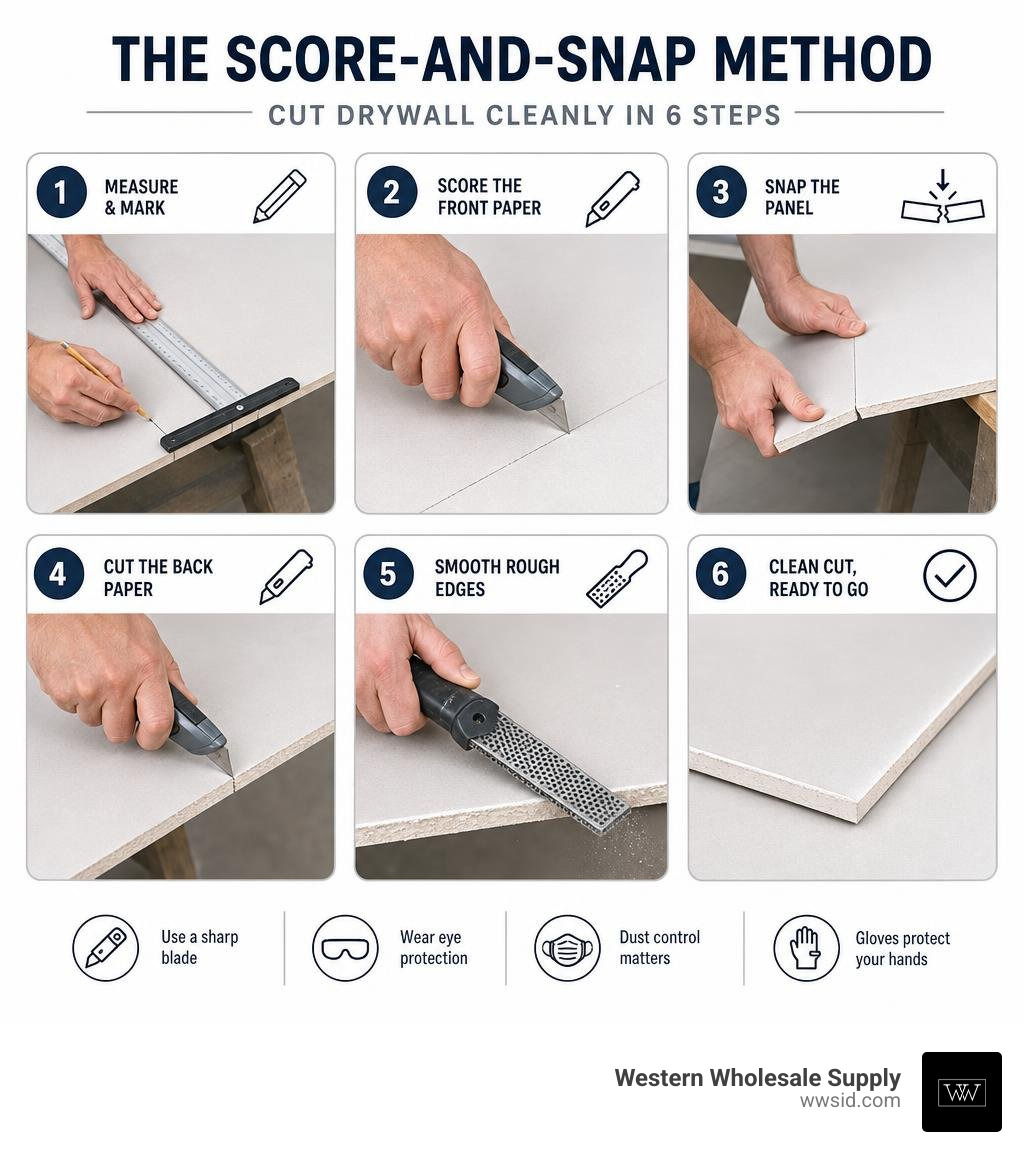
The best way to cut sheet rock for most straight cuts is the score-and-snap method. Here’s the fast version:
- Measure and mark your cut line with a pencil and T-square.
- Score the front paper with a sharp utility knife along the line.
- Snap the panel by bending it away from the scored face.
- Cut the back paper with your utility knife to separate the pieces.
- Smooth rough edges with a drywall rasp.
For openings like electrical boxes, use a jab saw or oscillating tool instead.
Cutting drywall looks straightforward — and it mostly is. But small mistakes add up fast. A dull blade tears paper instead of scoring it. An inaccurate measurement means a wasted sheet.
Nearly 90% of all drywall cuts on a job site use the same three-step sequence: score the face, snap the core, cut the back paper. Once you understand why each step works — and what to avoid — clean, precise cuts become repeatable and fast.
One real-world example makes the stakes clear: a professional finisher compared two houses where one contractor’s sloppy cuts added roughly eight extra hours of labor for the taper. Clean cuts at the start save time and money all the way to the end of the project.
At Western Wholesale Supply, we are third-generation building materials professionals, and we’ve spent years helping contractors and builders source and use drywall products the right way — including finding the best way to cut sheet rock for everything from quick repairs to full commercial installs. Let’s walk through exactly what you need to know.
Essential Tools: The Best Way to Cut Sheet Rock Safely
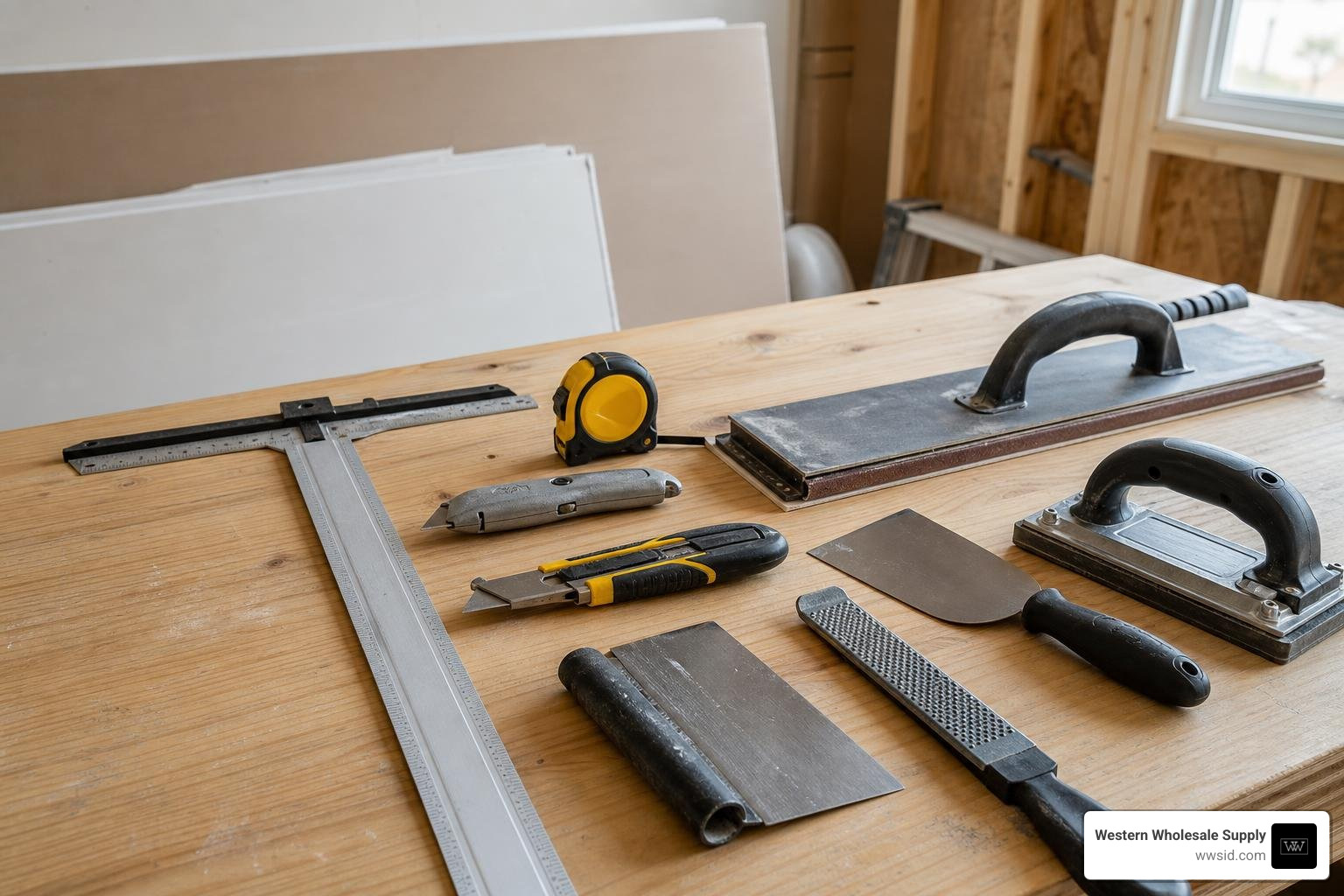
Before we make our first cut, we need to gather the right gear. Trying to cut drywall with a dull pocketknife or a standard wood-cutting hand saw is a recipe for ragged edges, torn paper, and a massive cloud of white dust.
To set yourself up for success, we recommend starting with a solid foundation. You can read our complete guide on Drywall Tools 101 to get a deeper sense of what professionals keep in their toolbags, but here is the essential list for clean, precise cuts.
Hand Tools vs. Specialized Saws
When selecting your cutting tools, the choice depends entirely on the type of cut you are making.
- The Utility Knife: This is the undisputed champion of the drywall world. For standard straight cuts, you do not need a power saw. A heavy-duty utility knife with a fixed or retractable blade is the safest and cleanest option. It slices the paper facing cleanly and allows you to snap the gypsum core without creating airborne dust. For high-performance soundproofing panels like Quietrock EZ Snap, a sharp utility knife is still your primary tool.
- The Jab Saw (Drywall Saw): This manual saw features aggressive, widely set teeth designed to cut both ways. A high-quality tool like a 6-inch carbon steel jab saw with 7 TPI (teeth per inch) is perfect for plunge cuts and short runs. It is specifically designed to cut out openings for electrical boxes or HVAC registers.
- Specialized Saws and Power Saws: For dense backer boards like Durock, specialized scoring tools or carbide-tipped cutters are preferred. If you are handling large-volume projects, some contractors utilize a circular saw or an oscillating multi-tool. According to The Jim BoSlice Workshop’s guide on cutting drywall with a circular saw, a circular saw should be equipped with a fine-tooth carbide blade (40 to 60 teeth) and set to a shallow blade depth—typically 3/4 inch for standard 1/2-inch drywall—to prevent damaging anything behind the board. However, power saws generate an immense amount of dust and require robust dust collection systems.
For most residential and commercial projects across Eastern Idaho and Western Wyoming, a high-quality utility knife combined with a sturdy T-square is the best way to cut sheet rock cleanly and quietly. Learn more about the basic scoring process in this guide on the Best Way to Cut Drywall with a Utility Knife.
Safety Gear and Dust Prevention
We cannot talk about cutting drywall without talking about safety. Drywall is made of a gypsum plaster core sandwiched between layers of heavy-duty recycled paper. When you cut, saw, or rasp drywall, it releases fine dust particles containing gypsum, talc, mica, and crystalline silica.
Inhaling these particles over time can cause severe respiratory irritation and long-term lung issues. To keep your lungs clean and your eyes safe, always wear the following personal protective equipment (PPE):
- N95 or P100 Respirator: A standard dust mask is a minimum requirement, but a tight-fitting N95 respirator is highly recommended to filter out fine silica particles.
- Safety Glasses: Gypsum dust is highly alkaline and can cause painful irritation if it gets into your eyes.
- Work Gloves: Heavy-duty utility blades are razor-sharp. Additionally, handling large sheets of drywall—a standard 1/2-inch sheet can weigh over 50 pounds—can easily lead to paper cuts or scrapes.
To minimize dust in your workspace, cut your drywall using the score-and-snap method rather than using power saws indoors. If you must use a circular saw or router, connect your tool directly to a shop vacuum equipped with a HEPA filter.
How to Cut Drywall in 6 Simple Steps
Now that we have our tools and safety gear ready, let’s look at the standard method for cutting drywall sheets to size. Whether you are installing standard panels or working with specialty materials, following these six steps will ensure clean, professional results every time.

Step 1: Measure and Mark Accurately
The old saying “measure twice, cut once” is a rule to live by in drywall installation. Start by taking measurements of the wall or ceiling area where the panel will go.
- Pro Tip: Always take measurements from both the top and bottom (or left and right) edges. Framing is rarely perfectly square, and using the smaller of the two measurements ensures the panel will actually fit.
- Allow for Gaps: To make installation easier and prevent the edges of the board from binding or crumbling during positioning, subtract 1/8 inch to 1/4 inch from your final measurement. Leaving a small gap at the bottom of the wall (about 1/2 inch from the floor) also protects the drywall from any moisture on the subfloor.
Use a pencil to mark your measurements clearly on the face (the smooth, light-colored side) of the drywall sheet. To understand panel sizing and weight considerations before you buy, check out our resource on Drywall Dimensions Demystified for 1/2 Inch and 5/8 Inch Panels.
Step 2: Align Your Straightedge
To get a perfectly straight cut, you need a reliable guide. A 48-inch drywall T-square is the ideal tool for this.
Lay your drywall sheet flat on a stable work surface, like a pair of sawhorses or a clean floor. Hook the head of the T-square over the top edge of the drywall sheet and align the straight metal blade with your pencil marks. Hold the T-square down firmly with one hand (or your foot if working on the floor) to prevent it from slipping while you cut.
Step 3: Score the Front Paper (The Best Way to Cut Sheet Rock Cleanly)
With your straightedge secured, hold your utility knife at a 45-degree angle against the metal guide.
Press the blade firmly into the paper face and pull it toward you in one continuous, smooth motion. You do not need to cut through the entire board—you only need to slice through the front paper layer and score slightly into the gypsum core.
According to the step-by-step tutorial on How to Cut Drywall Like a Pro, forcing the blade too deeply on the first pass can cause you to lose control of the knife or dull the blade prematurely. A single, clean score line is all it takes to guide a perfect break.
Step 4: Snap the Gypsum Core
Once the front paper is scored, it is time to snap the board.
Move the drywall sheet so the scored line aligns with the edge of your worktable or sawhorse. Alternatively, if the sheet is standing upright, place your knee against the back of the sheet directly behind the scored line.
Apply firm, even pressure to the waste side of the board, bending it backward away from the score line. The gypsum core will snap cleanly along your scored mark with a satisfying “pop.”
Step 5: Cut the Back Paper
With the core snapped, the two pieces of drywall will still be held together by the heavy-duty backing paper.
Fold the waste piece back at a 90-degree angle to expose the paper hinge on the backside. Run your utility knife down the crease of the folded paper from top to bottom. Be careful not to let the knife slip as it cuts through the paper, as the blade will be close to your fingers. Once the back paper is sliced, the waste piece will separate cleanly.
Step 6: Smooth the Rough Edges
Even the cleanest snap can leave a few small crumbs of gypsum or loose paper fibers along the edge.
Hold a drywall rasp at a slight angle and run it along the cut edge in one direction to shave down any high spots. This creates a neat, square edge that will butt up perfectly against the adjacent sheet. Removing loose paper fibers now prevents them from mixing into your joint compound later, saving you time during the taping phase.
Advanced Techniques: Cutting Openings and Curves
Standard straight cuts will get your walls covered, but you will inevitably run into obstacles like electrical outlets, light switches, and plumbing pipes. Cutting these openings accurately requires a different set of techniques.
Making Cutouts for Electrical Boxes
Cutting out openings for electrical boxes after the sheet is already hung is a common task, but it requires precision to avoid creating gaps that your outlet cover plates won’t hide.
- Measure and Locate: Measure the distance from the edge of the adjacent stud to the sides of the electrical box, and from the floor to the top and bottom of the box. Transfer these measurements to the front face of your drywall sheet.
- Use a Template: Keep a spare plastic electrical box on hand to use as a template. Place it over your marks and trace around it with a pencil. To ensure easy fitting, make your pencil marks about 1/4 inch larger than the box on all sides.
- The Plunge Cut: Push the sharp tip of your jab saw directly through the drywall at one of the corners of your traced outline. Using steady, controlled strokes, saw along your pencil lines. Keep the saw blade perpendicular to the board to ensure a straight cut.
- Screwing Around Openings: When securing the drywall around electrical boxes or framing, make sure you use the right length of fasteners. For 1/2-inch panels, standard 1-1/4 inch fasteners from trusted brands like Grabber are ideal. For more on fastener selection, see our guide on why Size Matters When You Are Screwing Into Sheetrock.
Score-and-Snap: The Best Way to Cut Sheet Rock for Straight Lines
For long, straight cuts across the entire width or length of a sheet, the score-and-snap method remains the absolute best way to cut sheet rock. It produces virtually zero airborne dust compared to power tools, keeps your workspace clean, and creates razor-sharp edges that make taping much easier.
Using high-quality utility blades, such as SK5 steel blades, provides superior chip resistance and a longer edge life when scoring abrasive gypsum. If you are cutting a long, narrow strip (less than 2 inches wide), snapping can sometimes be tricky. In these cases, score the line deeply, make a few relief cuts across the waste strip, and snap it off in smaller sections before cleaning up the edge with your rasp.
Avoiding Common Drywall Cutting Pitfalls
To achieve a professional-grade finish, keep these common mistakes in mind:
- Using Dull Blades: A dull utility knife blade will tear the face paper rather than slicing it, leading to ragged edges that are difficult to tape. Change your blade as soon as you notice the paper beginning to bunch up under the knife.
- Forcing the Cut: Do not try to cut all the way through the drywall sheet with your utility knife. Pushing too hard can cause the blade to slip, leading to severe hand injuries. Let the blade do the work of scoring the paper, and let the snap do the rest.
- Glove-Tight Joints: It is tempting to cut your drywall panels so they fit tightly against each other with zero gap. However, forcing tight panels into place often crushes the corners or causes stress cracks later. Leaving a tiny 1/8-inch gap between panels allows the framing to settle without cracking your finished joints.
- Ignoring the Right Mud: Once your cuts are made and your sheets are hung, choosing the right joint compound is the next critical step. To avoid common finishing mistakes, read our guide on How to Choose the Right Drywall Compound Without Getting Stuck in the Mud.
Frequently Asked Questions about Cutting Drywall
| Cutting Method | Best Used For | Dust Level | Precision |
|---|---|---|---|
| Score-and-Snap | Straight cuts, ripping sheets to size | Extremely Low | High |
| Jab Saw | Electrical boxes, small openings, curves | Medium | Medium |
| Oscillating Tool | Precise plunge cuts in installed drywall | Medium-High | High |
| Circular Saw | High-volume straight cuts, thick panels | Extremely High | High |
What is the cleanest way to cut drywall without making a mess?
The cleanest way to cut drywall is the manual score-and-snap method using a utility knife. Because you are only slicing the outer paper layers and snapping the inner gypsum core rather than sawing through it, almost no airborne dust is created.
For detailed tips on clean, dust-free DIY cutting, check out Bob Vila’s guide on how to cut drywall using simple methods.
Can you cut drywall that is already installed on the wall?
Yes, you can cut drywall that is already installed, but you must take extra precautions to avoid hitting wood studs, electrical wiring, or plumbing pipes behind the wall.
An oscillating multi-tool equipped with a drywall blade is excellent for this task. Set the blade depth to match the thickness of your drywall (usually 1/2 inch or 5/8 inch) so the tool does not penetrate deep into the wall cavity. Always use a stud finder before cutting to map out the framing.
How do you cut drywall lengthwise for long walls?
To cut a standard 8-foot or 12-foot sheet of drywall lengthwise when you do not have a giant worktable, stand the sheet upright against a wall.
Hold a tape measure in one hand, using your index finger as a guide against the factory edge of the sheet. Hold your utility knife in your other hand against the end of the tape measure. Slide both hands down the sheet simultaneously to score a straight line along the entire length of the board. Once scored, bend the sheet to snap the core, and slice the backing paper.
Conclusion
Mastering the best way to cut sheet rock is all about patience, accurate measurement, and using the right tools for the job. By sticking to the classic score-and-snap method for straight runs and using a sharp jab saw or oscillating tool for cutouts, you will save material, minimize dust, and make the taping process infinitely easier.
For over 60 years, we at Western Wholesale Supply have been supporting building projects across Eastern Idaho and Western Wyoming. As an independent, veteran-owned, third-generation family business, we pride ourselves on providing high-quality building materials—from standard drywall panels and soundproofing boards to commercial insulation and acoustical ceilings.
If you are working on a commercial warehouse or shop project, we can help you maximize your thermal benefits with R-30+ ceiling insulation and R-13+ wall insulation systems designed to keep your space comfortable in our harsh mountain winters.
Ready to get started on your next project? Explore our range of Western Wholesale Supply Products, or connect with local professionals in our network by checking out Drywall Done Right: Discover Local Experts for Installation & Repair. Come visit us at our locations in Idaho Falls and Pocatello, or contact us today for reliable, on-time delivery right to your job site!
