

Stop Guessing on Materials: How a Ceiling Tile Calculator Works
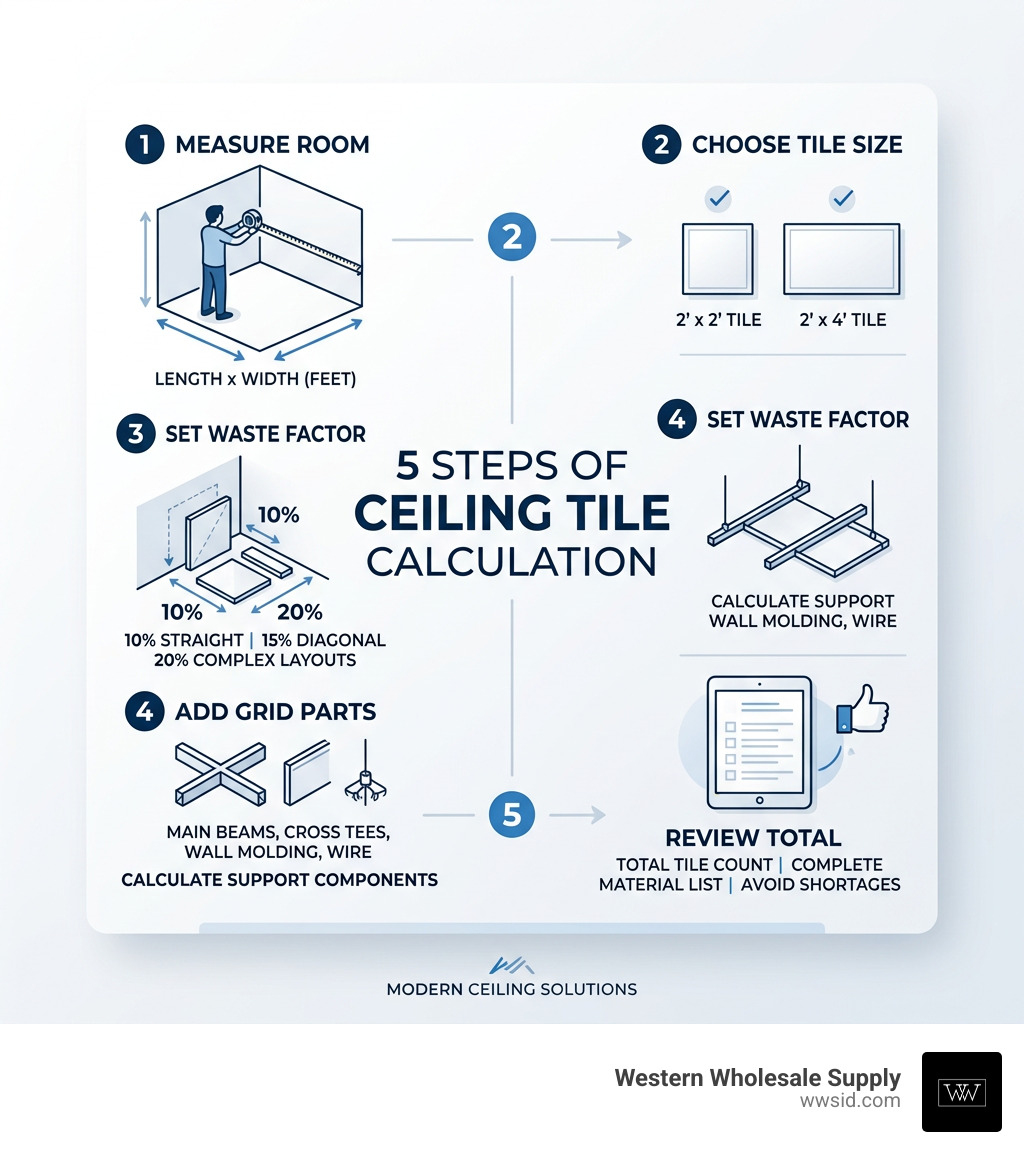
A ceiling tile calculator is the fastest way to estimate exactly how many tiles, grid components, and accessories you need before you order a single piece of material. According to Wikipedia, these systems are common in both residential and commercial buildings to hide utilities while providing acoustic benefits. Here’s how it works in five steps:
- Measure your room length and width (in feet)
- Choose your tile size (2×2 or 2×4 feet)
- Enter your waste factor (10% for straight layouts, 15% for diagonal, 20% for complex)
- Add grid components if installing a new suspended ceiling
- Review your total tile count and material list
For a quick example: a 12×10 ft room (120 sq ft) with 2×2 tiles needs 30 base tiles, plus 10% waste, for a total of 33 tiles.
Running short on materials mid-project is one of the most avoidable delays in a ceiling installation. Yet it happens constantly when contractors skip the math or rely on rough guesses. A ceiling tile calculator removes that risk by turning your room dimensions into a precise material list – saving you time, money, and a second trip to the supply house.
Western Wholesale Supply is a third-generation building materials professional team. We’ve helped countless contractors across Eastern Idaho and Western Wyoming get their ceiling tile orders right the first time, and we’ll walk you through exactly how to use a ceiling tile calculator to do the same.
Essential Measurements for Your Ceiling Tile Calculator
Before you sit down with a ceiling tile calculator, you need to gather the “raw data” from your job site. If your measurements are off by even a few inches, your final material count will be wrong, leading to either a pile of expensive leftovers or—even worse—a crew standing around waiting for a single box of tiles to arrive in Idaho Falls or Jackson.

Length and Width
Start by measuring the longest points of the room. For a standard rectangular room, this is straightforward. Always measure at the ceiling level if possible, as walls can sometimes lean or bow, changing the dimensions slightly at the top compared to the floor.
Square Footage and Perimeter
The square footage tells the ceiling tile calculator how many panels you need to cover the “field” of the ceiling and informs how many main runners and cross tees you will need. The perimeter (the total length of all walls added together) is equally important. This number determines how much wall angle you need to support the edges of your grid.
Joist Direction
For suspended ceilings, knowing which way your joists run is a pro tip that many DIYers overlook. Your main beams (the heavy-duty 12-foot runners) should ideally run perpendicular to the joists so you can securely fasten your hanger wires.
Choosing Between 2×2 and 2×4 Tiles in a Ceiling Tile Calculator
When you input your data into a ceiling tile calculator, one of the first questions will be about tile size. In Eastern Idaho and Wester Wyoming, the most common sizes are 2×2 and 2×4 feet.
- 2×2 Tiles: These are the gold standard for modern aesthetics. They create a balanced, symmetrical look and offer superior sag resistance. If you are using high-quality CertainTeed tiles, a 2×2 grid provides a premium finish that works well in offices and basements alike.
- 2×4 Tiles: These are often chosen for larger commercial spaces or warehouses because they require fewer cross tees, which can lower the initial material cost. However, be careful in humid environments (like a basement in Rexburg or a commercial kitchen in Victor); 2×4 tiles have a larger surface area and are more prone to sagging over time if they aren’t moisture-resistant.
Handling Irregular Room Shapes and L-Layouts
If your room looks more like an “L” or a “T” than a box, don’t panic. The best way to use a ceiling tile calculator for these spaces is “sectional math.” Break the room down into smaller rectangular blocks. Calculate the area and perimeter for each block separately, then add them together.
For custom borders, professional calculators allow you to adjust the “offset.” This ensures that the tiles at the edges of the room are of equal size on opposite sides, preventing a “sliver” of tile on one wall and a full tile on the other. This isn’t just about math; it’s about making sure your ceiling looks centered and professional.
Calculating Grid Components and Hardware
The tiles are the stars of the show, but the grid is the skeleton that holds everything up. A comprehensive ceiling tile calculator doesn’t just stop at panels; it estimates your main beams and cross tees.
In a standard suspended system, you’ll use:
- Main Beams: Usually 12-foot lengths that carry the weight of the ceiling.
- Cross Tees: Available in 4-foot and 2-foot lengths to snap into the main beams and create the grid.
To understand how these pieces fit together to create a high-performance ceiling, check out our resource on Grid Ceiling Tiles: Your Blueprint For Better Acoustics.
Estimating Hanger Wire and Fasteners with a Ceiling Tile Calculator
Hanger wire is the unsung hero of the drop ceiling. Industry standards generally require one hanger wire every 4 feet along each main beam.
When calculating wire:
- Count your anchor points: Based on a 4-foot spacing rule.
- Determine wire length: Measure the distance from the structural ceiling to your new drop ceiling, then add 2 feet. That extra 2 feet is crucial for wrapping and tying the wire securely.
- Total Footage: Multiply the number of wires by the length per wire.
For a deeper dive into the “how-to” of these components, our guide on Acoustic Ceiling Installation: A DIYer’s Dream Come True covers the physical steps of hanging the grid.
Accounting for Lights, Vents, and Fire Sprinklers
Your ceiling tile calculator result is a “gross” estimate, but your ceiling isn’t a solid plane. You’ll have 2×4 light fixtures, circular HVAC vents, and fire sprinklers.
- Lights: A standard 2×4 LED trotter replaces one 2×4 tile (or two 2×2 tiles). While this reduces the number of tiles you need, we always recommend ordering the full amount of tiles anyway. Why? Because you’ll almost certainly break a few tiles making the “cut-outs” for vents and sprinklers.
- Safety First: If you are working on a commercial project in South East Idaho, ensure your calculations account for fire-rated components. You can learn more about this in our article on Building Safety From The Top Down: Fire-Rated Ceiling Solutions.
Maximizing Savings with Accurate Waste Factors
This is where the real money is saved. If you order too little, you pay for extra shipping and lose time. If you order too much, you’ve tied up cash in material that will just sit in your garage in Rigby.
The “Waste Factor” is a percentage added to your net square footage to account for the tiles you have to cut at the edges.
| Layout Type | Recommended Waste Factor | Reason |
|---|---|---|
| Straight (Standard) | 10% | Minimal cutting; mostly perimeter trim. |
| Diagonal | 15% | Every single perimeter tile requires a diagonal cut. |
| Complex/Irregular | 20% | L-shapes, pillars, and multiple alcoves increase scrap. |
By adhering to these industry guidelines, you ensure you have enough CertainTeed tiles to finish the job without overspending. The goal of a ceiling tile calculator is precision, not just a “best guess.”
Professional vs. DIY Estimation Methods
While a manual formula (Area / Tile Size) works for a basic estimate, modern technology has made things much easier.
- Manual Formulas: Good for a “back of the napkin” estimate while you’re standing in a vacant building in Twin Falls.
- Automated Algorithms: Tools like the ones provided by major manufacturers allow you to “draw” your room. They calculate the most efficient layout to minimize waste.
- Printable Summaries: Professional tools generate a PDF that you can bring directly to us at Western Wholesale Supply. This ensures our team in Idaho Falls or Pocatello knows exactly what you need, from the main runners down to the last box of fasteners.
For those looking to optimize the environment of their room beyond just the tile count, consider the acoustic properties of your selection. Our guide, Quiet Comfort: A Comprehensive Guide To Acoustic Ceiling Solutions, explains how different materials affect sound.
Frequently Asked Questions about Ceiling Estimation
How many extra tiles should I order for future repairs?
We recommend keeping at least one full box of tiles on hand. In a commercial setting, roof leaks or HVAC repairs often result in stained or broken tiles. Since dye lots can change slightly over the years, having a box from your original order ensures a perfect match five years down the road.
What is the difference between drop ceiling and glue-up tile calculations?
A drop ceiling (suspended) calculation must include the grid (beams, tees, wire). A glue-up calculation is much simpler, focusing almost entirely on the surface area and the amount of adhesive required. However, glue-up tiles offer no access to the utilities above, which is why suspended ceilings remain the favorite for East Idaho businesses.
Conclusion
Using a ceiling tile calculator is the smartest first step for any renovation or new construction project. It bridges the gap between a vision and a finished, professional-looking ceiling while keeping your budget firmly in check. By accurately measuring your space, choosing the right CertainTeed products, and accounting for the necessary waste factors, you can avoid the headaches of material shortages and wasted money.
At Western Wholesale Supply, we’ve been the trusted partner for builders and homeowners in Eastern Idaho and Western Wyoming since 1963. As a veteran-owned, third-generation family business, we know that our reputation is built on your success. Whether you are in Shelley, Chubbuck, or Kimberly, we are here to provide the expert advice and reliable delivery you need to get the job done right.
Ready to start your next project? Elevate Your Projects: Discover Western Wholesale Supply’s Acoustical Ceiling Solutions and let us help you turn those calculator results into a reality.
