

What is an Allen Wrench Bolt?
Allen wrench bolts — also called socket head cap screws — are fasteners with a cylindrical head and a six-sided recessed socket that you drive with a hex key (Allen key). They are used everywhere from furniture assembly to automotive engines to industrial machinery.
Quick answer: What are Allen wrench bolts?
| Feature | Detail |
|---|---|
| Also known as | Socket head cap screws, hex socket bolts, Allen bolts |
| Drive type | Internal hexagonal (Allen key / hex key) |
| Common standards | ISO 4762, DIN 912 |
| Common grades | 8.8, 10.9, 12.9 (steel); A2, A4 (stainless) |
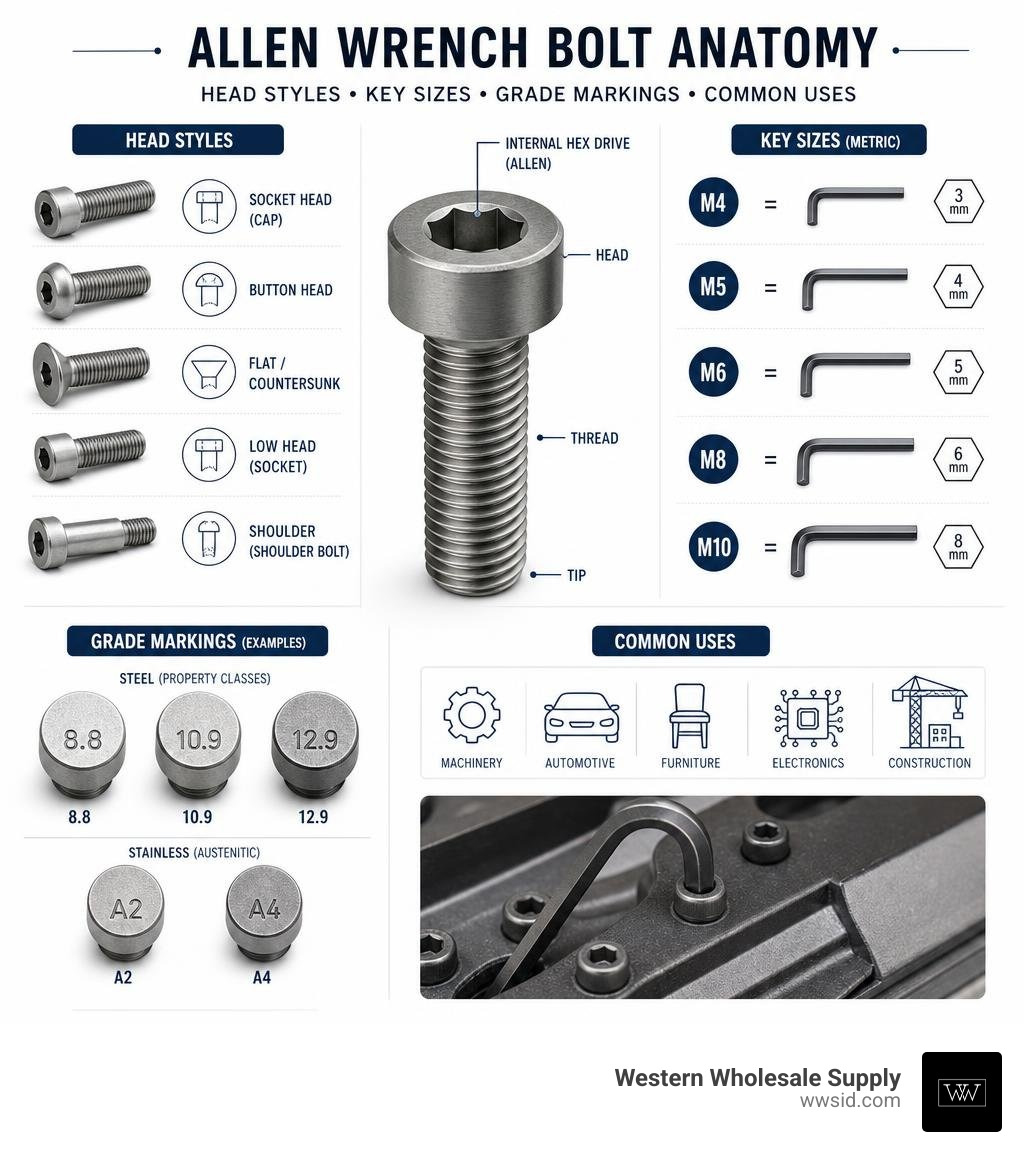
| Common head styles | Cap, button, flat/countersunk, low head, shoulder |
| Typical uses | Machinery, automotive, furniture, electronics, construction |
| Key sizes (metric) | M4 = 3 mm key, M5 = 4 mm, M6 = 5 mm, M8 = 6 mm, M10 = 8 mm |
If you’ve ever assembled flat-pack furniture or worked on a bicycle, you’ve already used one. That small L-shaped hex key that came in the box? It was made specifically for these bolts. And in industrial settings, socket head cap screws account for roughly 15–20% of all fasteners used in automotive and machinery manufacturing — so getting them right matters.
This guide covers everything: head styles, materials, grades, sizing, installation, torque, stripping prevention, and how to remove a damaged bolt.
At Western Wholesale Supply, we are a regional supply business serving contractors across Idaho and beyond — and allen wrench bolts are among the fasteners we help customers spec and source every day. Whether you’re building out a commercial space or maintaining heavy equipment, understanding these fasteners will save you time, money, and frustration on the job.
Glossary for allen wrench bolts:
Technically known as a socket head cap screw, an Allen wrench bolt is a precision fastener characterized by its cylindrical head and recessed hexagonal drive. Unlike traditional screws that rely on an external head grip or a slotted drive, these bolts are turned from the inside out using a mating hexagonal tool.
This internal hex drive design is engineered for superior torque transmission. When you insert a hex key into the socket, the tool makes direct contact with six distinct load-bearing walls. This distribution of force allows you to apply significantly more torque without the tool slipping or “camming out,” which is a frequent headache with Phillips or flathead screws.
At Western Wholesale Supply, we supply high-quality fasteners from industry-trusted brands like Grabber and Brighton Best. These manufacturers produce bolts with deep, precisely cold-forged sockets that maximize key engagement and prevent premature wear. For a deep dive into the engineering behind these fasteners, check out the Allen Key Bolt: Complete Selection Guide – YHengGroup.
How Allen Wrench Bolts Differ from Standard Hex Bolts
While both fasteners feature a six-sided geometry, they serve entirely different design needs. The most obvious difference lies in the drive style: standard hex bolts have an external hexagonal head that must be gripped by a wrench or socket from the outside. Allen wrench bolts feature an internal hex drive recessed directly into the bolt head.
This structural difference changes how they are used in spatial design:
- Clearance Requirements: Standard hex bolts require external space around the head so a wrench or socket can slip over them. Allen bolts, driven from the inside, need no side clearance. This makes them ideal for tight spaces, deep recesses, and compact machinery housings.
- Head Profile: Allen bolts can be installed flush with or even below the surrounding surface inside counterbored holes. Standard hex bolts always protrude above the material surface.
- Strength Defaults: Socket head cap screws are manufactured to higher strength specifications as a default. While standard hex bolts are commonly found in lower-strength utility grades, Allen bolts are typically produced in high-tensile alloy steels.
| Feature | Allen Wrench Bolt (Socket Head) | Standard Hex Bolt |
|---|---|---|
| Drive Type | Internal Hexagonal | External Hexagonal |
| Tool Required | Hex Key (Allen Wrench) or Hex Bit | Spanner, Socket, or Adjustable Wrench |
| Clearance Needed | Minimal (top-only access) | Generous (side-access for tool) |
| Installation Profile | Can be fully recessed (flush) | Always protrudes above surface |
| Standard Grades | High-tensile (Grade 10.9, 12.9) | Standard-to-high (Grade 8.8, 10.9) |
The History and Evolution of Hex Socket Drives
The story of the hex socket drive is rooted in industrial safety and progressive engineering. In the late 19th and early 20th centuries, factories were filled with overhead line shafts and spinning pulleys. Traditional safety set screws of the era had square heads that protruded from spinning shafts, frequently catching workers’ clothing and causing catastrophic injuries.
Between 1909 and 1910, William G. Allen of the Allen Manufacturing Company in Hartford, Connecticut, patented a safety screw featuring a recessed hexagonal socket. This design allowed the screw head to sit flush with or below the surface of the machinery, eliminating safety hazards while providing incredible driving power. The term “Allen” quickly became a proprietary eponym for both the hex key and the bolt.
During World War II, the demand for rapid, high-strength assembly of military hardware solidified the hex drive’s place in heavy manufacturing. Decades later, in the late 1950s, flat-pack furniture manufacturers popularized the inclusion of cheap, disposable L-shaped hex keys in consumer assembly kits. Today, the hex socket remains one of the most mechanically efficient and widely used drive designs in the world. You can read more about this fascinating evolution in The Incredible, Underrated Allen Wrench | The Art of Manliness
Types and Head Styles of Socket Screws
Just as we stock diverse building materials like Quietrock EZ Snap drywall and Durock cement boards to suit specific construction needs, allen wrench bolts come in various head styles tailored to distinct mechanical requirements. Selecting the correct style ensures your joint holds up under stress while meeting your visual and spatial goals. For a thorough comparison of these styles, explore the Comprehensive Guide To Allen Bolts: Types, Uses, And Selection | Artizono.
- Standard Socket Cap Head: The workhorse of the family. It features a tall, cylindrical head with vertical sides. Cap heads offer the deepest socket depth and the highest tensile strength, making them the default choice for heavy machinery, structural framing, and high-torque applications.
- Button Head: This style features a low-profile, dome-shaped head. It is designed for applications where clearance is tight or where a smooth, snag-free aesthetic finish is desired, such as consumer electronics, automotive interiors, and furniture. However, because the head is shallower, button heads have lower torque capacities than standard cap heads.
- Flat Head (Countersunk): Engineered with a conical 90-degree head, flat head Allen bolts sit completely flush with the material surface when installed in a countersunk hole. This is essential for moving parts that must pass over one another, or for clean architectural fixtures.
- Low Head: Similar to the standard cap head but with a significantly reduced head height. It is used in restricted clearance areas where a button head’s rounded shape is not suitable, though it has reduced torque limits due to a shallower socket recess.
- Shoulder Bolts: Also known as stripper bolts, these feature an unthreaded cylindrical shaft (the shoulder) between the head and the threaded portion. The shoulder acts as a precision axle or guide pin for rotating components, linkages, and sliding assemblies.
Choosing the Right Head Style for Your Project
Selecting the ideal head style involves balancing structural load, clearance, and appearance.
If your project involves high mechanical stress, vibration, or heavy load-bearing joints, always default to the Standard Socket Cap Head. Its deep socket allows you to apply full torque without stripping, ensuring maximum clamping force.
When working in tight enclosures where components must slide past each other, choose Flat Head (Countersunk) bolts. If you are fastening thin-gauge sheet metal or plastic panels where a flush countersink isn’t possible, a Button Head provides a low-profile, rounded safety edge that won’t catch on clothing or wiring. For rotating mechanical joints, a Shoulder Bolt is mandatory to provide a smooth, unthreaded bearing surface.
Materials, Strength Grades, and Sizing
Choosing the right material and strength grade is critical to preventing joint failure. Sourcing your fasteners from reputable brands like Grabber and Brighton Best ensures that the physical properties of the bolts match their structural ratings. To understand how these grades perform under load, refer to the Socket Head Cap Screw Guide: Allen Bolt Sizes, Grades & Torque.
- Carbon and Alloy Steel: Carbon steel bolts are categorized by property classes. Grade 8.8 is suitable for general medium-duty structural work. Grade 10.9 and 12.9 are high-tensile alloy steels designed for extreme stress, high-vibration machinery, and automotive engine internals. Grade 12.9 is the standard engineering default for heavy industrial socket head cap screws, offering a tensile strength of approximately 1220 MPa.
- Stainless Steel (A2 and A4): Stainless steel is preferred for corrosive environments. Grade A2 (304 stainless) offers excellent corrosion resistance for general outdoor use. Grade A4 (316 marine-grade stainless) is highly resistant to chlorides and salt water, making it the standard for coastal infrastructure and chemical processing. Standard stainless steel bolts generally have a lower tensile strength (roughly equivalent to Grade 8.8) and should not be used as direct substitutes for Grade 12.9 alloy steel in high-stress structural joints.
Matching Allen Wrench Bolts to the Correct Key Size
Using the wrong size hex key is the single most common cause of stripped bolt heads. Worn tools or mixing metric and imperial sizes will quickly round out the internal hex socket. Always ensure your hex key fits snugly with zero play before applying torque.
Here is a quick-reference guide for matching metric thread diameters to their standard Allen key sizes:
- M3 Thread: Requires a 2.5 mm Allen key
- M4 Thread: Requires a 3 mm Allen key
- M5 Thread: Requires a 4 mm Allen key
- M6 Thread: Requires a 5 mm Allen key
- M8 Thread: Requires a 6 mm Allen key
- M10 Thread: Requires a 8 mm Allen key
- M12 Thread: Requires a 10 mm Allen key
If you are working on commercial building structures—such as installing warehouse ceiling joists or framing support systems—matching the correct fastener to your design load is critical. For more information on sourcing professional-grade tools and structural fasteners for your next regional project, visit our guide on tools and fasteners.
Installation, Torque, and Prevention of Common Issues
Proper installation is what separates a reliable, long-lasting joint from an expensive maintenance failure. When tightening allen wrench bolts, follow these industry best practices:
- Inspect and Clean: Before driving the bolt, verify that both the internal hex socket and the receiving threads are clean and free of debris.
- Fully Engage the Tool: Insert the hex key or driver bit completely into the bottom of the socket. If the tool is only partially inserted, the concentrated force at the top of the socket will strip the hex corners instantly.
- Keep the Tool Square: Always turn the hex key at a perfect 90-degree angle to the bolt head. Tilting the tool reduces contact area and increases the risk of slipping.
- Use a Torque Wrench: For critical assemblies, always use a calibrated torque wrench with a hex bit socket. Tightening to exact manufacturer specifications ensures the bolt achieves its optimal tension (preload) without stretching the metal or damaging the threads.
- Prevent Galling on Stainless Steel: Stainless steel threads are prone to “galling”—a process where friction causes the threads to cold-weld together during installation. Always apply a high-quality anti-seize compound to stainless steel threads before assembly to prevent permanent seizing.
- Secure Against Vibration: In high-vibration environments, apply a thread-locking compound (such as Grabber thread locker) to prevent the bolt from backing out over time.
How to Remove Damaged or Stripped Allen Bolts
Despite your best efforts, you will eventually encounter a stripped or seized Allen bolt. When the internal hex socket is rounded out, standard keys can no longer grip. Fortunately, several proven extraction techniques can save your project:
- The Torx Bit Method: If the socket is only mildly stripped, find a Torx (star) bit that is slightly larger than the rounded hex socket. Tap the Torx bit firmly into the socket with a hammer to carve new grooves into the metal, then gently back the bolt out.
- Penetrating Oil and Heat: For bolts seized by rust or galvanic corrosion, apply a generous amount of penetrating oil and let it sit for 20 to 30 minutes. If appropriate for the surrounding materials, apply localized heat to the bolt head with a torch to break the corrosive bond.
- Screw Extractors: For completely rounded heads, drill a small pilot hole directly into the center of the bolt shank using a left-hand drill bit. Insert a tapered screw extractor (easy-out) into the hole and turn it counterclockwise. As you turn, the extractor grips the inside of the pilot hole and backs the bolt out.
- Welding a Nut: In heavy industrial or automotive settings, you can place a standard hex nut over the damaged Allen head and weld the inside of the nut to the bolt head. Once cooled, use a standard wrench on the welded nut to easily spin the assembly out.
For a detailed walkthrough on dealing with stubborn industrial fasteners and selecting specialized extraction tools, consult Allen Key Bolt: The Best Guide to Socket Head Cap Screws for Industrial Applications – DK Tooling.
Frequently Asked Questions about Allen Bolts
What is the difference between an Allen bolt and a socket head cap screw?
There is no physical difference; they are different names for the exact same fastener. “Allen bolt” or “hex socket bolt” are common commercial terms, while “socket head cap screw” is the formal engineering name defined by international standards like ISO 4762 and DIN 912.
Can Allen bolts be used for structural applications?
Yes, provided they are rated in appropriate high-strength classes. Grade 10.9 and Grade 12.9 alloy steel Allen bolts are highly suited for structural and high-stress applications due to their exceptional tensile and yield strength. However, always consult engineered structural specifications and avoid substituting lower-grade stainless steel fasteners in critical load-bearing joints.
Why do Allen bolts strip so easily and how can I prevent it?
Allen bolts typically strip because of human error: using worn-out hex keys, using imperial keys in metric sockets (or vice versa), failing to seat the key fully to the bottom of the socket, or over-torquing. You can prevent stripping by using high-quality hex keys, ensuring a clean and complete tool engagement, and using a torque wrench for final tightening.
Conclusion
Whether you are assembling machinery, working on automotive components, or securing structural fixtures, allen wrench bolts provide unmatched torque transmission, space-saving efficiency, and clean aesthetics. By choosing the right head style, selecting the correct material grade from trusted manufacturers like Grabber and Brighton Best, and following proper installation techniques, you can ensure your projects remain structurally sound.
At Western Wholesale Supply, we are a veteran-owned, third-generation family business that has proudly served contractors, builders, and industrial professionals across Eastern Idaho and Western Wyoming since 1963. From our convenient regional locations—including Idaho Falls, Pocatello, Rexburg, and Jackson, WY—we deliver high-quality building materials, drywall, CertainTeed acoustical ceilings, and reliable commercial fasteners directly to your job site.
Need to source high-quality fasteners, specialty tools, or building materials for your next project? Contact Western Wholesale Supply for your fastener needs and experience our exceptional customer service and over 60 years of regional expertise.
