

Why Structural Fiberglass Sheets Matter in Commercial Construction
Structural fiberglass sheets are composite panels made from glass fibers and resin. They are used where a wall, ceiling, or exterior panel must handle moisture, impact, chemicals, or frequent cleaning better than paper-faced gypsum, plywood, or OSB. For commercial projects, choose the sheet type by matching its reinforcement, resin, fire rating, thickness, and installation method to the job.
Solid FRP wall panels are often about 0.090 inches thick and work well in kitchens, restrooms, healthcare spaces, and food-processing areas. Heavier structural FRP and glass-mat sheathing serve different roles, such as corrosion-resistant industrial cladding, exterior wall assemblies, or structural strengthening.
The main advantage is practical: fiberglass does not rot, and the right resin system can stand up to wet, corrosive conditions found in wastewater plants and chemical facilities. But it is not a one-size-fits-all material. Fire classification, expansion gaps, UV exposure, and a sound substrate all affect long-term results.
At Western Wholesale Supply, our building materials specialists have decades of hands-on experience helping contractors source dependable wall, ceiling, framing, and fastening materials. In this guide, we break down structural fiberglass sheets in clear terms so you can compare the options and specify the right one for the project.
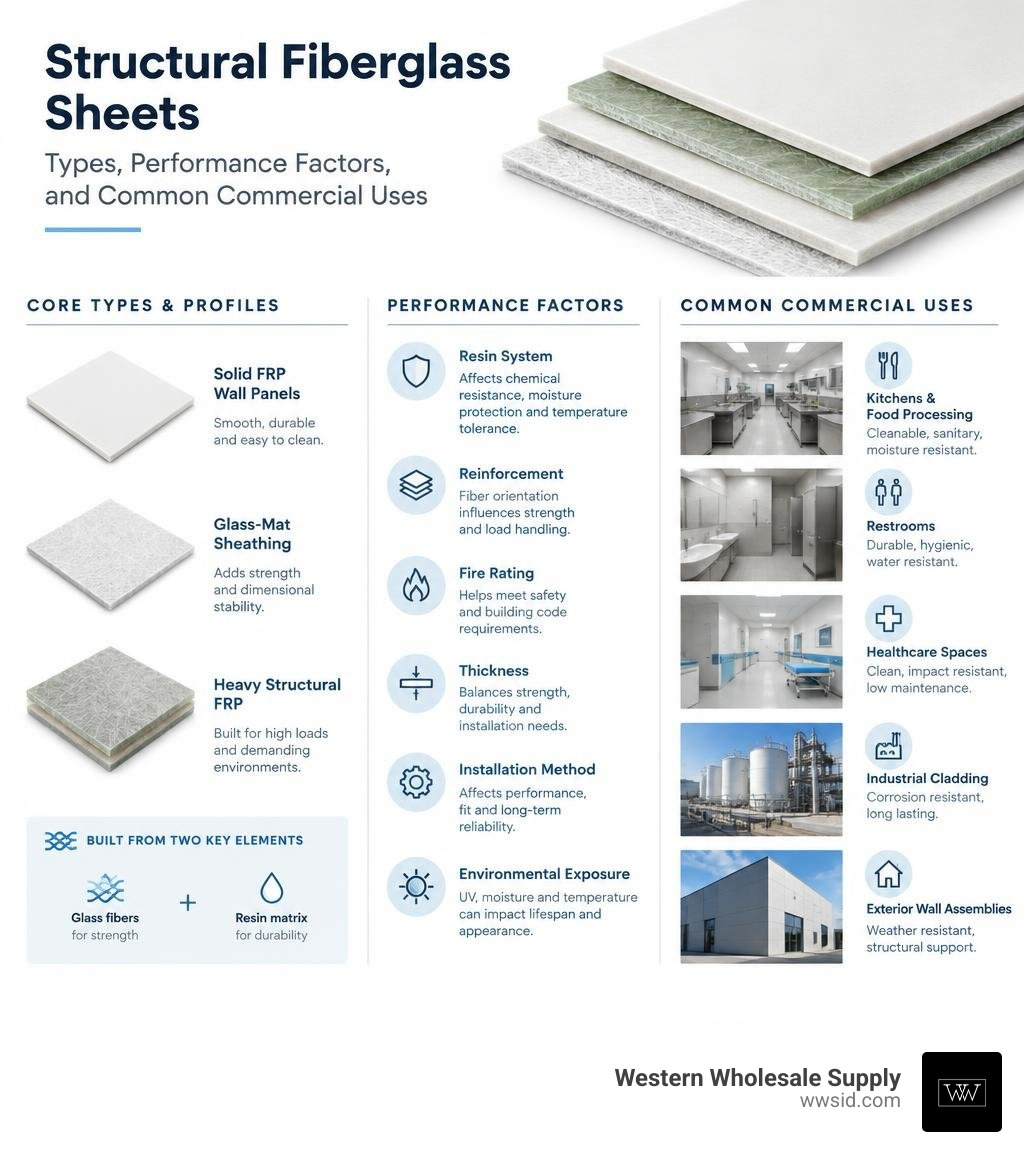
Core Types and Profiles of Structural Fiberglass Sheets
Commercial construction demands materials tailored to specific environmental stresses. Structural fiberglass panels combine high-tensile glass fibers embedded within a cured thermoset resin matrix. The choice of resin dictates chemical stability, moisture impermeability, and temperature resistance, while the fiber orientation dictates mechanical load handling.
Standard commercial applications utilize either polyester or vinyl ester thermoset resins:
- Thermoset Polyester Resins: Widely used for standard interior and exterior claddings, general industrial washdown rooms, and impact-resistant wall linings. They offer balanced structural performance, chemical resistance, and cost efficiency.
- Vinyl Ester Resins: Specified for highly aggressive chemical plants, pickling lines, and wastewater treatment processing areas where continuous acid, alkali, or solvent exposure occurs.
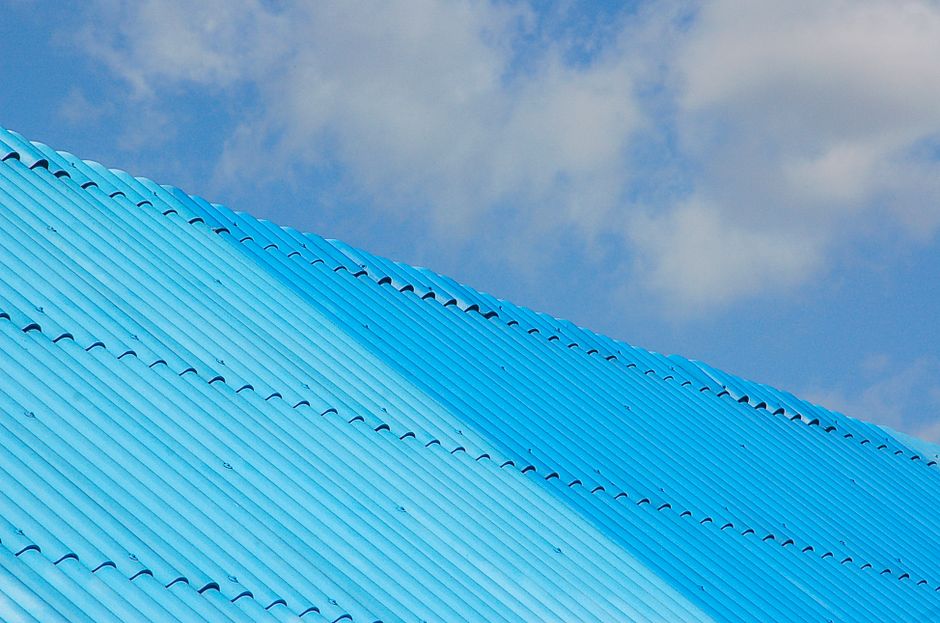
Selecting between flat wall skins, corrugated profiles, and continuous heavy-duty sheets depends on the structural span and architectural finish needed. Standard FRP panels provide a seamless, easy-to-sanitize surface, while ribbed and corrugated profiles dramatically boost stiffness across open framing spans without adding excessive dead load.
Reinforcement Fiber Architecture in Structural Fiberglass Sheets
The physical capability of any structural fiberglass sheet depends on its internal fiber architecture. Fiber orientations dictate whether a panel bears heavy directional loads or provides resilient, uniform resistance to multi-directional abuse.
- Unidirectional Fiber Fabric: Structural laminates like StructureWrap V2 280 UG align continuous E-glass fibers in a single direction. This creates high tensile capacity along the primary axis, making it suitable for seismic retrofits, beam reinforcement, and structural member strengthening under ICC-ES and ACI 440.2R criteria.
- Biaxial and Woven Fabrics: High-performance laminates, such as LAMILUX High Strength X-treme, utilize aligned woven layers with glass contents reaching up to 79%. This layout delivers balanced flexural and tensile strength along both longitudinal and transverse axes, ideal for vehicle bodies, high-wind exterior enclosures, and dynamic industrial diaphragms.
- Chopped Strand Matting (CSM): Seen in heavy-duty industrial cladding like Resolite FS25A/CRFS25A ’30’ Series, CSM randomly disperses cut glass fibers throughout the resin. This multidirectional orientation delivers uniform resiliency, resisting point impacts, punctures, and mechanical stress equally from all angles.
Solid FRP vs. Glass-Mat Sheathing Substrates
Engineers and contractors often distinguish between thin protective interior surfacing sheets and full structural glass-mat substrates:
- Solid FRP Panels (0.090-Inch Standard): These are dense, non-porous sheets applied directly over framing or existing backer boards. Meeting standards like ASTM D5319 with an impact strength rating of 7.0 ft-lbs/in, these fiberglass wall panels act as an impermeable, shatter-resistant shield against direct washdowns, mechanical carts, and surface abrasion.
- Glass-Mat Gypsum and Cementitious Sheathing: Products designed under ASTM C1177 and ASTM C1185 integrate non-woven fiberglass facings embedded directly into engineered cores. These structural wall boards replace standard paper-faced gypsum, providing shear strength, wind-load capacity, and mold resistance on commercial exterior walls, high-traffic corridors, and fire-rated assemblies.
Material Performance and Engineering Properties
Commercial facilities subject walls and ceilings to abusive physical and chemical demands. Structural fiberglass sheets withstand severe mechanical stress, frequent thermal cycling, and aggressive cleaning chemicals without delaminating or supporting microbial growth. Understanding these properties ensures proper material specification for cleanrooms, processing facilities, and practical FRP panel options for labs.
Mechanical and Physical Properties of Structural Fiberglass Sheets
The structural behavior of composite sheets is defined by resin density, glass-to-resin ratios, and fiber tensile modulus:
- Tensile Strength & Modulus: Unidirectional E-glass structural fabrics achieve an ultimate tensile strength of 109,710 psi (756 MPa), a design tensile strength of 97,140 psi (670 MPa), and a tensile modulus of 7,304,000 psi (50,360 MPa) with 1.48% elongation at break. High-density woven panels deliver longitudinal tensile strengths up to 1,100 N/mm².
- Flexural Strength & Modulus: Industrial chopped strand sheets with a nominal 30% glass content yield flexural strengths of 27,000 psi and tensile ratings of 16,000 psi. In heavy-duty composite constructions, flexural strength can reach 1,200 N/mm² with a flexural modulus of 42,200 N/mm².
- Structural Board Density & Acoustics: Heavy composite cementitious wall panels provide a density of 74.6 lbs/ft³, delivering superior rigidity, up to four times the wind load capacity of traditional gypsum board, and Sound Transmission Class (STC) ratings between 50 and 70.
Fire Resistance and Code Compliance Ratings
Building codes strictly regulate the flame spread and smoke generation of wall and ceiling assemblies under ASTM E84 (UL 723) testing protocols:
- Class A Fire Rating: Panels engineered with specialized fire-retardant halogenated or mineral additives achieve a Flame Spread Index of 25 or less and a low Smoke Developed Index. They are mandatory in exit corridors, vertical stairwells, commercial kitchens, and assembly occupancies.
- Class C Interior Finishes: Standard-grade FRP panels offer flame spread ratings between 76 and 200, suitable for localized utility closets, storage rooms, or agricultural buildings where strict Class A fire compliance is not mandated.
- High-Temperature Stability: Premium industrial fiberglass panels feature ignition points exceeding 850°F to 900°F (454°C to 482°C), maintaining structural matrix cohesion far longer than standard thermoplastics under elevated thermal exposure.
Structural Fiberglass vs. Traditional Wall and Ceiling Substrates
Selecting structural fiberglass over legacy building substrates involves evaluating life-cycle durability, environmental exposure, and structural integrity. While paper-faced drywall, standard plywood, and OSB perform well in climate-controlled spaces, they degrade when exposed to moisture, steam, mold, and chemical cleaning agents.
| Substrate Material | Moisture Absorption | Mold Resistance (ASTM D3273) | Impact Durability | Flame Spread / Fire Resistance | Primary Use Case |
|---|---|---|---|---|---|
| Solid Structural Fiberglass (FRP) | 0% (Impermeable) | 10 (No Mold Growth) | Very High (Shatter-Resistant) | Class A (FSI ≤ 25) or Class C | High-traffic, washdown, and corrosive areas |
| Glass-Mat Gypsum Sheathing | Very Low Core Permeance | 10 (Perfect Score) | Moderate to High | Non-Combustible (UL Listed) | Exterior sheathing, EIFS, fire-rated assemblies |
| Durock® Cement Board | Low (Water Durable) | 10 (Inorganic Mat) | High (Rigid / Dense) | Non-Combustible | Tile backer, high-moisture wet rooms |
| Quietrock® EZ Snap Soundproof Drywall | Standard Gypsum Face | Requires Treated Paper | Moderate (Standard Core) | Type X Fire-Rated (1-2 Hour) | High-STC acoustic partitions |
| Plywood / OSB | High (Swelling / Rot) | Poor (Organic Nutrient) | High Structural Shear | Class C (Combustible) | Framing shear walls, structural roof decks |
In cold-storage warehouses, commercial kitchens, and processing rooms, structural fiberglass eliminates panel rot, delamination, and face-paper degradation. For warehouses and storage centers, pairing solid structural wall assemblies with properly insulated exterior thermal envelopes (maintaining Ceilings R-30+ and Walls R-13+) stabilizes internal climate control, eliminating the temperature swings that accelerate condensation behind wall claddings. Reviewing commercial FRP panel performance shows that fiberglass panels significantly reduce lifetime facility maintenance compared to wood and gypsum backings.
Commercial Installation Best Practices and Substrate Fastening
Proper installation ensures long-term performance and prevents warping, buckling, or delamination. Because structural fiberglass sheets possess a distinct coefficient of thermal expansion, mechanical and adhesive fastenings must accommodate environmental movement.
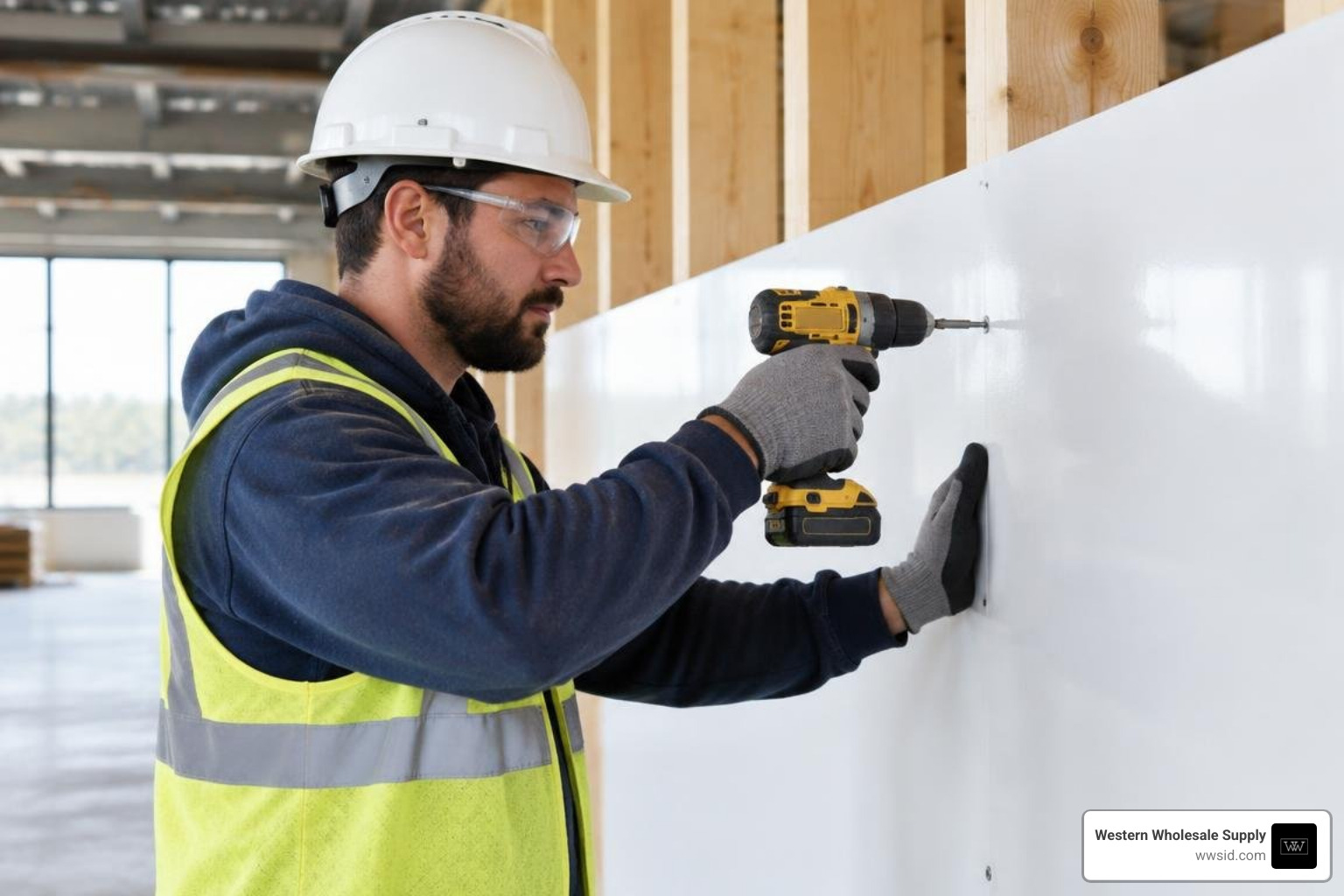
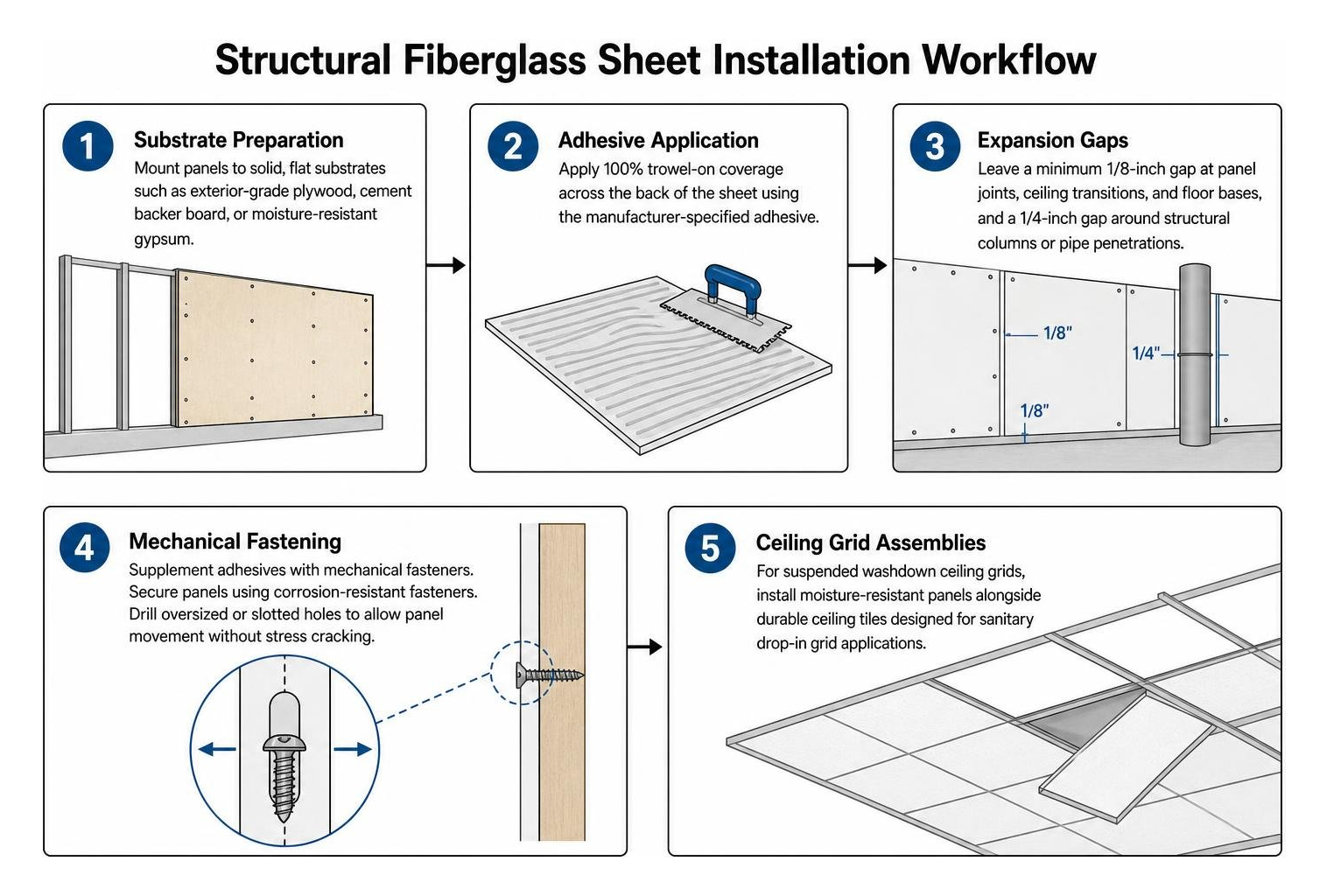
- Substrate Preparation: Mount panels to solid, flat substrates such as exterior-grade plywood, cement backer board, or moisture-resistant gypsum. When finishing drywall joint assemblies before applying FRP liners, use professional taping knives from reliable manufacturers like Hyde, USG Sheetrock Tools, Columbia Taping Tools, or Marshalltown to ensure a flat, ridge-free backing plane.
- Adhesive Application: Apply 100% trowel-on coverage across the back of the sheet using the manufacturer-specified adhesive. Match the adhesive chemistry (solvent-based, water-based, or reactive polyurethane) to your substrate porosity. Consult our guide on FRP adhesives for long-term bonding to select the right adhesive.
- Expansion Gaps: Structural fiberglass expands and contracts with ambient temperature shifts. Leave a minimum 1/8-inch gap at panel joints, ceiling transitions, and floor bases, and a 1/4-inch gap around structural columns or pipe penetrations.
- Mechanical Fastening: In heavy-duty washdown bays or structural cladding runs, supplement adhesives with mechanical fasteners. Secure panels using heavy-duty, corrosion-resistant Grabber or Brighton Best fasteners. Drill oversized or slotted pilot holes through the fiberglass to allow panel movement without stress cracking.
- Ceiling Grid Assemblies: For suspended washdown ceiling grids, install moisture-resistant panels alongside durable CertainTeed ceiling tiles designed for sanitary drop-in grid applications. Learn more about matching ceiling systems in our overview of fiberglass ceiling panels.
Frequently Asked Questions About Structural Fiberglass Panels
How do structural fiberglass sheets perform in corrosive industrial environments?
Structural fiberglass panels provide chemical resistance against acids, alkalis, salts, and industrial solvents that degrade steel, aluminum, and concrete. In wastewater treatment facilities and chemical processing plants, thermoset vinyl ester and isophthalic polyester resins create a non-reactive barrier that prevents rust, chemical pitting, and rot, ensuring decades of structural performance without protective re-coating.
What adhesives and fasteners ensure proper panel attachment?
Achieving a permanent bond requires full trowel-applied adhesive coverage over a dry, stable substrate. Complement adhesives in high-vibration or exterior zones with mechanical anchors. Pre-drill oversized clearance holes and secure the panels using corrosion-resistant Brighton Best or Grabber fasteners fitted with sealing washers to prevent water penetration and accommodate thermal expansion.
How does thermal expansion affect exterior structural fiberglass installations?
Fiberglass laminates expand and contract as ambient temperatures change. If panels are fastened too tightly without adequate perimeter allowances, thermal cycling can cause localized buckling, surface waviness, or fastener tear-out. To avoid this, use slotted fastening holes, maintain 1/8-inch expansion margins in all perimeter trims, and specify gel-coated UV-resistant finishes to minimize solar heat buildup on dark-colored exterior panels.
Conclusion
Structural fiberglass sheets deliver high-strength durability, moisture impermeability, impact toughness, and chemical resistance for demanding commercial spaces. Whether your design requires lightweight Class A interior panels for sanitation or high-tensile structural profiles for industrial cladding, selecting the proper resin, fiber architecture, and fastening layout ensures a durable installation.
Western Wholesale Supply is an independent, veteran-owned, third-generation family business supplying quality building materials like drywall, steel framing, insulation, and acoustical ceilings. Serving Eastern Idaho and Western Wyoming since 1963, our mission is reliable, on-time delivery and exceptional customer service, backed by over 60 years of experience. Visit any of our locations across Idaho Falls, Pocatello, Jackson, WY, Driggs, Victor, Rexburg, Rigby, Shelley, Blackfoot, Chubbuck, Burley, Kimberly, and Twin Falls to review our inventory of commercial fiberglass panel solutions and structural supplies for your upcoming project.
