

Why Comparing Lumber Takeoff Software Tools Matters Before You Buy
Lumber takeoff software helps contractors and builders calculate exactly how much wood framing material a project needs — directly from digital blueprints — before a single board is ordered.
Here is a quick comparison of the top lumber takeoff software tools to help you decide fast:
| Software | Best For | Key Strength | AI-Powered |
|---|---|---|---|
| PlanSwift | Small framing businesses | Joist & rafter tools, printable layouts | No |
| STACK | Teams & commercial contractors | Cloud collaboration, plan overlay | No |
| Exayard | Framing contractors | Auto stud count, board feet calculator | Yes |
| Takeoff.Systems | Estimators & suppliers | 99.2% accuracy, audit trail | Yes |
| Uncle Jerry AI | Solo contractors | 60-second analysis, 95% accuracy | Yes |
| Houzz Pro | Residential contractors | CRM integration, fast bid turnaround | Partial |
| TakeCost | Budget-conscious contractors | Free tier, cloud-based proposals | Partial |
| Estima | Lumberyard sales reps | 50M+ product database, 3D rendering | No |
If you are still spending hours counting studs by hand, you are not alone. Manual lumber takeoffs are one of the most time-consuming parts of the estimating process — and one of the most error-prone. Estimators routinely build in a 10 to 15% over-ordering buffer just to stay safe, which ties up real money in unused material sitting on a job site.
The good news is that digital tools have come a long way. Today’s lumber takeoff software can process a full set of residential plans in minutes, not days.
At Western Wholesale Supply, we’ve seen how the right estimation tools — combined with accurate lumber takeoff software — can change the pace of a project and protect contractor margins. Below, we break down the top options so you can find the right fit for your business.
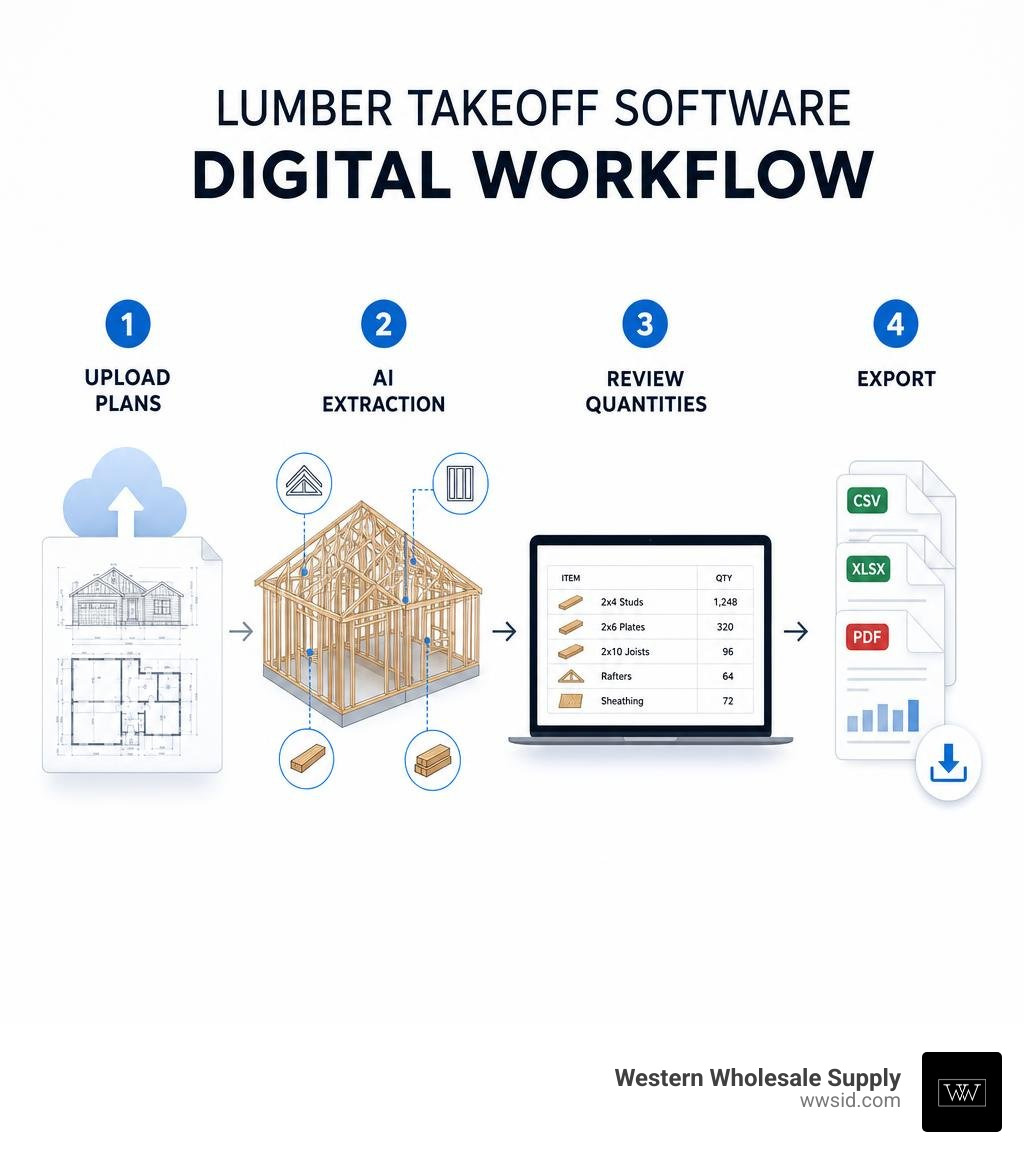
Lumber takeoff software basics:
What is Lumber Takeoff Software and How Does It Work?
At its core, lumber takeoff software is a specialized digital solution designed to extract quantities, lengths, and volumes of wood framing materials from a set of construction drawings. Instead of using a physical scale ruler, highlighters, and a legal pad, estimators upload digital plan sets directly into the program.
The software works by establishing a digital scale on the blueprint. Once scaled, you can use point-and-click tools to trace walls, joists, rafters, and sheathing areas. The software automatically translates these linear and area measurements into standard lumber industry metrics, such as board feet, linear feet, and sheet counts.
By utilizing digital plans, we can completely eliminate the need to print massive physical plan sets. This transition from physical paper to digital blueprints not only saves money on printing costs but also prevents the classic “coffee-stained blueprint” dilemma on the job site. For more foundational information on how estimation works across various trades, check out our guide on material estimation for construction.
Core Functions of Modern Lumber Takeoff Software
Modern platforms do much more than just measure lines. They utilize complex logic engines to build comprehensive bills of materials.
- Auto Stud Counts: Instead of manually counting every single 2×4 or 2×6 on a wall layout, you can draw a line along a wall, specify the stud spacing (e.g., 16 inches or 24 inches on center), and the software will instantly calculate the total studs required, including top and bottom plates.
- Joist and Rafter Tools: These specialized tools allow you to define a floor or roof span. The software automatically calculates the required number of joists or rafters, accounts for member spacing, and even identifies where structural hangers are needed.
- Sheathing Takeoffs: Calculating plywood or OSB for subfloors, wall sheathing, and roof decks is simplified. By tracing the perimeter of a floor or roof area, the software provides an exact sheet count while factoring in standard sheet dimensions.
To learn more about how digital tools handle these complex 2D plans, explore the features of 2D Takeoff Software for US Contractors.
Who Benefits Most from Digital Lumber Estimation?
Whether you are a custom builder in Jackson, WY, or a commercial framing contractor in Idaho Falls, ID, digital estimation tools offer significant advantages:
- Framing Contractors: Speed up bid times dramatically, allowing you to submit more bids and win more jobs without working late into the evening.
- General Contractors: Keep your projects on budget and verify subcontractor bids with your own quick, accurate internal takeoffs.
- Lumberyards and Suppliers: Provide faster, more accurate quotes to builders, establishing trust and securing larger material orders.
To understand how these tools can scale your operations, read about why contractors need calculators in modern workflows.
Key Features to Look For in Lumber Takeoff Software
When comparing lumber takeoff software options in 2026, it is easy to get overwhelmed by flashy user interfaces. However, the best tool is the one that fits your daily workflow and integrates seamlessly with your material procurement process.
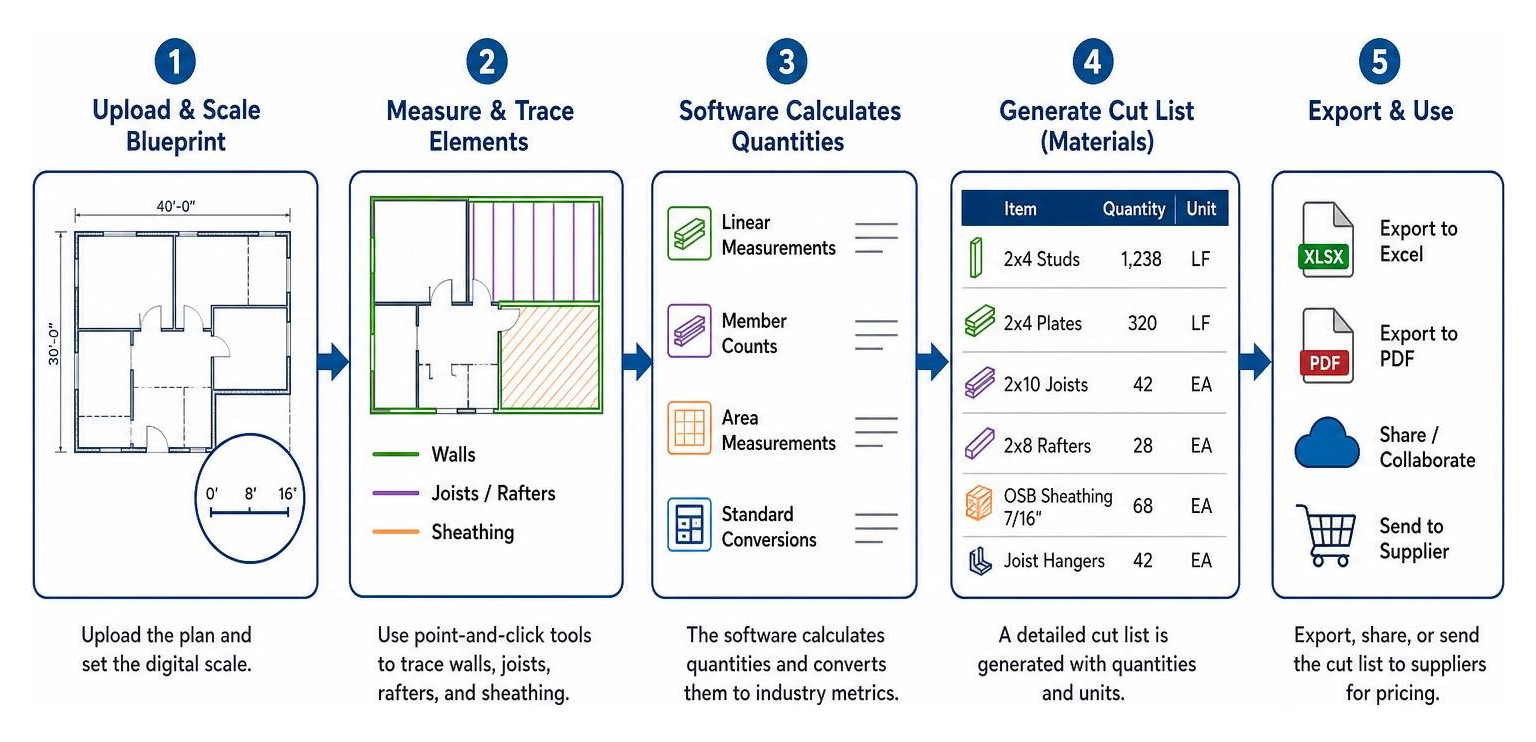
Essential Tools for Small Businesses vs. Large Enterprises
Small businesses and solo contractors in regional hubs like Driggs, Victor, or Rexburg often need simple, cloud-based tools that require zero installation and offer flexible pricing structures. Features like single-project calculators or monthly subscription tiers are ideal for keeping overhead low while still benefiting from digital speed.
For larger enterprises operating across Eastern Idaho, South East Idaho, and Western Wyoming, the requirements change. Enterprise-level organizations need robust collaboration tools, multi-user licenses, API integrations to connect with internal ERP systems, and highly customizable templates that can standardize estimating across multiple project managers. To compare the top-performing platforms available today, view our breakdown of the top material takeoff software.
Material Assemblies and Customization Options
The true power of high-end takeoff software lies in its “material assemblies.” An assembly is a pre-configured package of materials linked to a single measurement. For example, when you trace a 10-foot-tall exterior wall, a “smart assembly” will automatically calculate:
- The correct number of vertical studs based on your chosen spacing.
- Double top plates and single bottom plates.
- Exterior sheathing (OSB or plywood) and housewrap.
- The correct quantity of fasteners, such as high-quality Grabber or Brighton Best framing screws.
If you are transitioning to advanced wall systems, such as soundproof assemblies utilizing Quietrock EZ Snap drywall or moisture-resistant backer boards like Durock, your software should allow you to build these specific layers directly into your wall templates. This level of customization ensures that you never forget to price critical accessories.
For projects requiring specialized ceiling systems, integrating high-performance CertainTeed acoustical ceilings into your assemblies can save hours of manual calculation. If you want to dive deeper into calculating specific framing layouts, read our guide on how to calculate lumber for walls. For commercial projects utilizing metal studs instead of traditional wood, you can also check out our resources on steel framing.
AI-Powered vs. Traditional Lumber Takeoff Software
The biggest technological shift we’ve seen leading up to 2026 is the rise of artificial intelligence in construction estimating.
| Feature | Traditional Takeoff Software | AI-Powered Takeoff Software |
|---|---|---|
| Measurement Method | Manual point-and-click tracing | Automated computer vision detection |
| Processing Speed | Hours per plan set | Minutes or seconds |
| Setup & Scaling | Requires manual scaling verification | Auto-detects scales & alerts on discrepancies |
| Material Calculations | Based on user-defined math formulas | Combines computer vision with deterministic code |
| Verification | Fully reliant on the estimator’s eye | Visual audit trails with bounding box citations |
Traditional takeoff software requires you to manually click every corner, trace every wall, and hand-key your material formulas. AI-powered tools, on the other hand, use computer vision and machine learning to “read” blueprints much like an experienced human estimator would. To see how these advanced systems are built specifically for carpentry, check out AI-Powered Carpentry & Framing Software.
The Role of Artificial Intelligence in Lumber Takeoff Software
AI tools do not simply guess quantities. Instead, they analyze the lines, text, and symbols on a PDF blueprint to identify walls, doors, windows, and structural members.
By using natural language processing, some AI engines even allow you to “talk” to your blueprints. You can type a prompt like, “Count all 2×6 studs spaced at 16 inches on center on the first floor,” and the AI will highlight and count them in seconds. To see this technology in action, look at the Uncle Jerry AI Blueprint Analyzer, which can analyze complex structural drawings in under a minute.
Accuracy, Time Savings, and Common Pitfalls
AI-powered takeoff systems boast impressive statistics, with many delivering up to 90% to 95% accuracy compared to manual hand-counting. By generating incredibly precise board feet calculations, contractors have reported reducing their standard lumber over-ordering waste by up to 15%. This means fewer extra studs lying in the dirt at your job sites in Pocatello or Burley, saving you real money on material returns and clean-up.
However, pure automation can be a liability if left completely unchecked. AI tools do not make assumptions beyond what is explicitly drawn on the plans. If a blueprint has a scaling error or lacks clear structural details, the AI may produce inaccurate counts.
This is why the “human-in-the-loop” approach is critical. The most successful contractors use AI to perform the heavy lifting of counting and measuring, but always perform a manual human review to verify the scale, check complex roof intersections, and adjust waste factors before sending the final list to their supplier.
Frequently Asked Questions About Lumber Estimation Tools
What file formats do lumber takeoff tools support?
Almost all modern lumber takeoff software platforms support high-resolution vector PDF plans. This is the industry standard for digital blueprints. Many advanced tools also support CAD formats such as DWG and DXF, as well as scanned image files (like PNG or JPG). If you upload a scanned image, you will simply need to input one known measurement to help the software calibrate its digital scale.
How accurate is digital takeoff software compared to manual counting?
Digital takeoff software is significantly more accurate than manual counting because it eliminates human transcription errors and missed sections on physical paper. While manual estimators often rely on rough square-footage approximations, software calculates exact linear runs and areas. When combined with human verification to catch blueprint scale discrepancies, digital takeoffs routinely achieve over 99% accuracy.
Can takeoff software integrate with supplier ordering systems?
Yes. Most takeoff platforms allow you to export your finalized material list as a CSV or XML file. These files can be imported directly into vendor quoting systems and distributor ERPs. This eliminates the tedious process of manually re-typing your material lists into a purchase order, bridging the gap between your estimating office and your local building materials supplier.
Conclusion
Choosing the right lumber takeoff software is one of the smartest investments a contractor can make to protect their time, reduce material waste, and scale their bidding capacity. Whether you prefer the hands-on control of traditional tools like PlanSwift and STACK, or the lightning-fast automated workflows of AI-powered systems, transitioning away from manual legal-pad estimates is the key to staying competitive.
At Western Wholesale Supply, we’ve spent over 60 years supporting the builders, framers, and contractors who shape Eastern Idaho and Western Wyoming. From our locations in Idaho Falls and Pocatello, all the way to Jackson, WY, and across South East Idaho, we deliver the high-quality building materials your projects demand.
Once your digital takeoff is complete, our team is ready to supply you with the exact drywall, steel framing, fasteners, and high-performance warehouse insulation materials (including Ceilings R-30+ and Walls R-13+ thermal systems) needed to get the job done right. We carry top-tier brands like CertainTeed for acoustical ceilings, Quietrock EZ Snap soundproof drywall, and Durock cement boards, alongside dependable Grabber and Brighton Best fastening systems.
Ready to streamline your next project’s material supply chain with reliable, on-time delivery? Contact Western Wholesale Supply today, and let’s build something lasting together.
