

The Fast Answer: What Are 1-Inch Drywall Screws Used For?
1-inch drywall screws are short drywall fasteners designed primarily to fasten gypsum board to light-gauge metal studs and, in some applications, thin wood framing. Here is a quick reference to help you choose the right screw:
| Use Case | Recommended Screw | Thread Type |
|---|---|---|
| Drywall to light-gauge metal studs (under 20 gauge) | 1-inch fine thread | Fine |
| Drywall to wood framing | 1-1/4 inch or longer | Coarse |
| Thin or curved 1/4-inch drywall to wood | 1-inch coarse thread | Coarse |
Quick rule of thumb: For standard 1/2-inch drywall on wood studs, 1-1/4-inch coarse-thread drywall screws are the standard choice. A 1-inch screw only leaves about 1/2 inch of bite into the framing, which is why it is generally too short for standard drywall over wood.
Choosing the wrong screw length or thread type is one of the most common mistakes on drywall jobs. It leads to screws that spin out, boards that sag, or surface damage that costs time to fix. Getting it right from the start keeps your project on schedule.
At Western Wholesale Supply, we have supplied contractors and builders with high-quality fasteners — including 1-inch drywall screws from trusted brands like Grabber and Brighton Best — across residential and commercial projects in Idaho and Wyoming. In this guide, we’ll walk you through everything you need to know to pick the right screw for the job.
What Are 1-Inch Drywall Screws and When Do You Use Them?
At Western Wholesale Supply, we have spent decades helping builders across Eastern Idaho and Western Wyoming select the right materials. Whether you are running a commercial crew in Idaho Falls or remodeling a custom home in Jackson, Wyoming, understanding the mechanics of your fasteners is key to a lasting installation.
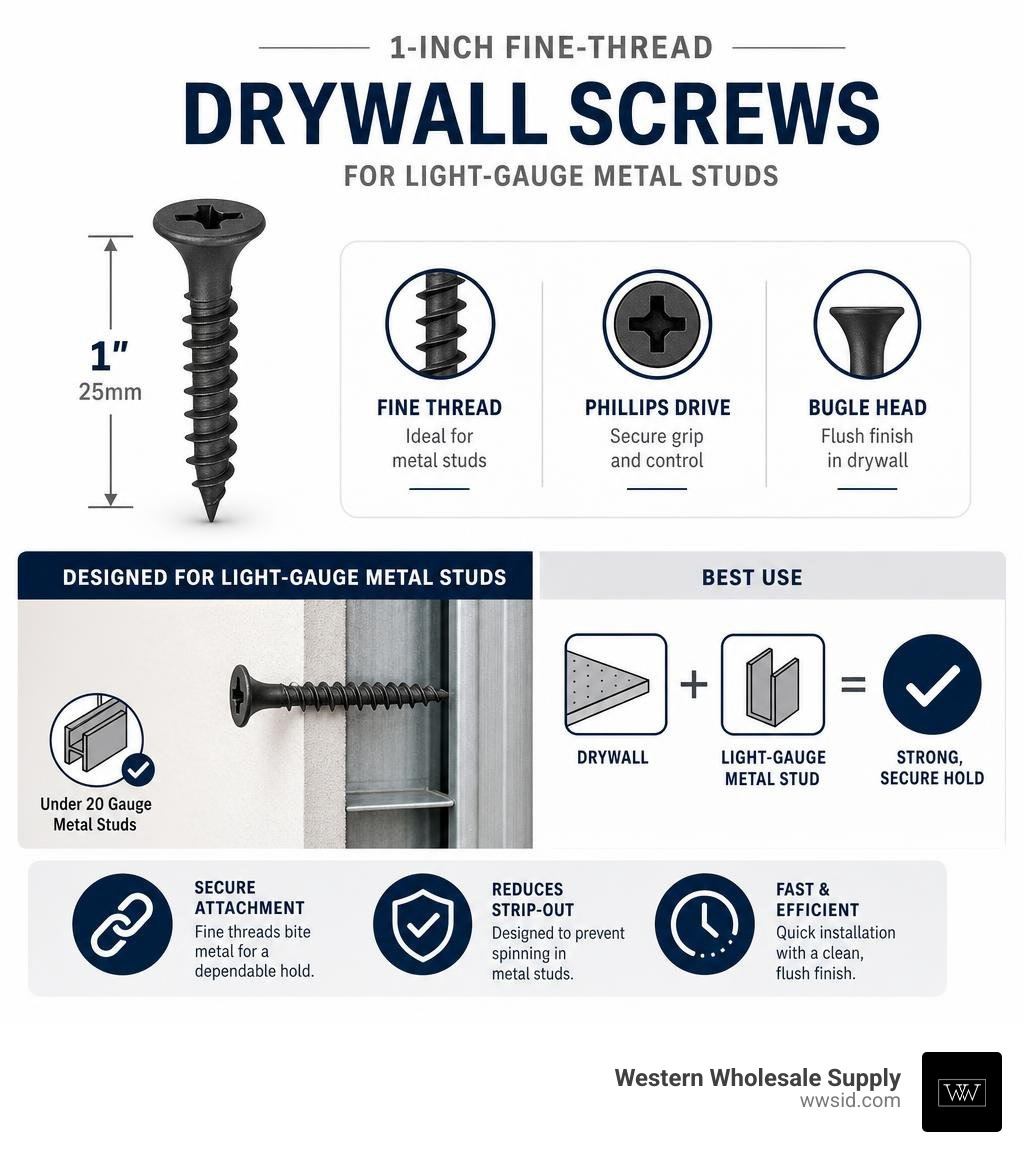
1-inch drywall screws are specialized fasteners designed for drywall and gypsum board applications. They feature a sharp piercing point (or self-drilling tip), a bugle head designed to sit flush without tearing the face paper, and a specialized thread pattern.
In modern construction, these screws are primarily used to attach gypsum panels to light-gauge steel studs, typically 20 to 25 gauge. Because metal studs do not require the deep penetration depth that wood framing does, a shorter fastener is highly efficient.
To understand why a 1-inch screw is appropriate for these specific assemblies, we must look at panel thickness. Standard drywall panels typically range from 1/4 inch to 5/8 inch thick. For a comprehensive breakdown of how panel thickness affects your project layout, take a look at our guide on Drywall Dimensions Demystified for 12-Inch and 5/8-Inch Panels.
When you are installing standard 1/2-inch drywall onto a light-gauge steel partition, a 1-inch screw provides enough length to pass through the board and bite securely into the metal stud. This is why 1-inch fine-thread drywall screws are a common choice for metal framing work.
However, if you are mounting standard boards to wood studs, using a 1-inch screw is a recipe for a callback. Let’s look at why screw length selection is so critical.
Choosing 1-Inch Drywall Screws vs. Longer Alternatives
The golden rule of drywall fastening is that your screw must penetrate deep enough into the structural substrate to resist the weight of the board and any added tension from joint compound, paint, or structural movement.
In many everyday residential drywall applications, 1-1/4 inch coarse-thread drywall screws are used for 1/2-inch drywall over wood framing, while longer screws may be needed depending on the board thickness, assembly, or local specification. If you attempt to use 1-inch drywall screws on standard wood studs, you will only achieve about 1/2 inch of penetration. While this might feel tight initially, wood naturally expands and contracts with the seasonal climate changes we experience here in places like Rexburg, Rigby, and Twin Falls. Over time, this shallow bite leads to “screw pops” and sagging boards.
So, when do you use a 1-inch screw on wood? They are best reserved for thin, specialized panels, such as 1/4-inch flexible drywall used to build arched pathways or curved partition walls.
For projects requiring heavy-duty framing, double-layering, or specialized shaft walls, you will need to step up to much larger fasteners. To see how extreme fastener lengths are applied in specialized commercial systems, check out our Essential Guide to 150mm Drywall Screws.
If you are stocking up on standard sizes for commercial metal stud partitions, choose 1-inch fine-thread drywall screws for light-gauge steel and self-drilling options when the metal gauge requires a drill point.
Fine Thread vs. Coarse Thread Drywall Fasteners
The thread pattern of your drywall screw is not a decorative choice; it dictates how the screw grips the framing material. Choosing the wrong thread can strip out your metal studs or fail to grip your wood studs entirely.
| Feature | Fine Thread Screws | Coarse Thread Screws |
|---|---|---|
| Primary Substrate | Light-gauge steel studs | Wood studs and wood framing |
| Thread Design | Closely spaced threads | Deep, widely spaced threads |
| Installation Action | Slices cleanly through thin steel | Bites deep into wood fibers to resist pull-out |
| Common Lengths | 1 inch to 1-5/8 inches | 1 inch to 3 inches+ |
| Key Brand Options | Grabber, Brighton Best | Grabber, Brighton Best |
Using a fine-thread screw in wood is highly inefficient because the shallow threads cannot grab the wood fibers, resulting in low pull-out resistance. Conversely, using a coarse-thread screw in metal studs can tear the thin steel sheet rather than threading through it, leaving you with a screw that spins endlessly without tightening. For a deep dive into matching fasteners to metal framing systems, consult The Ultimate Guide to Drywall to Metal Screws.
Fine Thread Screws for Metal Studs
Fine-thread drywall screws are engineered to drive cleanly and quickly into light-gauge steel framing.

When working with light-gauge steel track systems, these screws act as self-tapping fasteners. The sharp piercing point punches through the steel sheet, and the fine threads immediately engage, drawing the bugle head tightly against the paper face of the drywall.
For heavier-gauge metal studs, a standard sharp-pointed screw may not pierce the steel efficiently. In these commercial scenarios, you must use self-drilling screws, often called tek or drill-point screws. These feature a miniature drill bit tip that cuts a pilot hole through the steel before the threads engage.
If you are sourcing self-drilling options for commercial metal framing, look for bugle-head drywall screws specifically labeled for metal studs and matched to the gauge of steel on your project.
Coarse Thread Screws for Wood Framing
Coarse-thread screws feature a deep thread with a wide pitch. This aggressive design is optimized to slice into softwoods and engineered wood framing. As the screw drives home, the wide threads pull the wood fibers tightly together, creating exceptional holding power and high resistance to pull-out forces.
While 1-inch coarse-thread screws are less common than their 1-1/4 inch and 1-5/8 inch counterparts, they can be useful for installing thin backing boards, plywood underlayments, or 1/4-inch flexible drywall sheets.
If you are looking for fasteners for standard residential drywall over wood framing, choose coarse-thread drywall screws in the length required by the board thickness and project specification.
Key Specifications: Head Types, Coatings, and Collated Options
To achieve a flawless finish that requires minimal joint compound or mud, you must pay close attention to the head design and protective coating of your drywall screws.
Head Types: Bugle, Countersunk, and Wafer
The shape of the screw head determines how it interacts with the drywall’s paper face:
- Bugle Head: This is the industry standard for drywall installation. The curved, trumpet-like profile of a bugle head distributes the clamping pressure over a wider surface area. Instead of tearing the delicate paper face, the bugle head gently compresses the gypsum core, creating a neat dimple that sits just below the surface. This dimple is easily filled with joint compound.
- Countersunk Head: Unlike bugle heads, countersunk screws have flat, angled heads. If used on drywall, they will slice straight through the paper face, destroying the structural integrity of the hold and causing the board to pull away from the wall.
- Wafer Head: These feature a wide, flat, low-profile head that sits on top of the material. Wafer heads are not meant for hanging drywall because they cannot be recessed and mudded over. Instead, they are used to connect metal tracks to metal studs during the framing phase, where a flush finish is not required.
Coatings: Black Phosphate vs. Zinc Plating
Drywall screws are constantly exposed to moisture, both from the wet joint compound applied during installation and from atmospheric humidity. Untreated steel screws will rust rapidly, leading to unsightly orange spots bleeding through your painted walls.
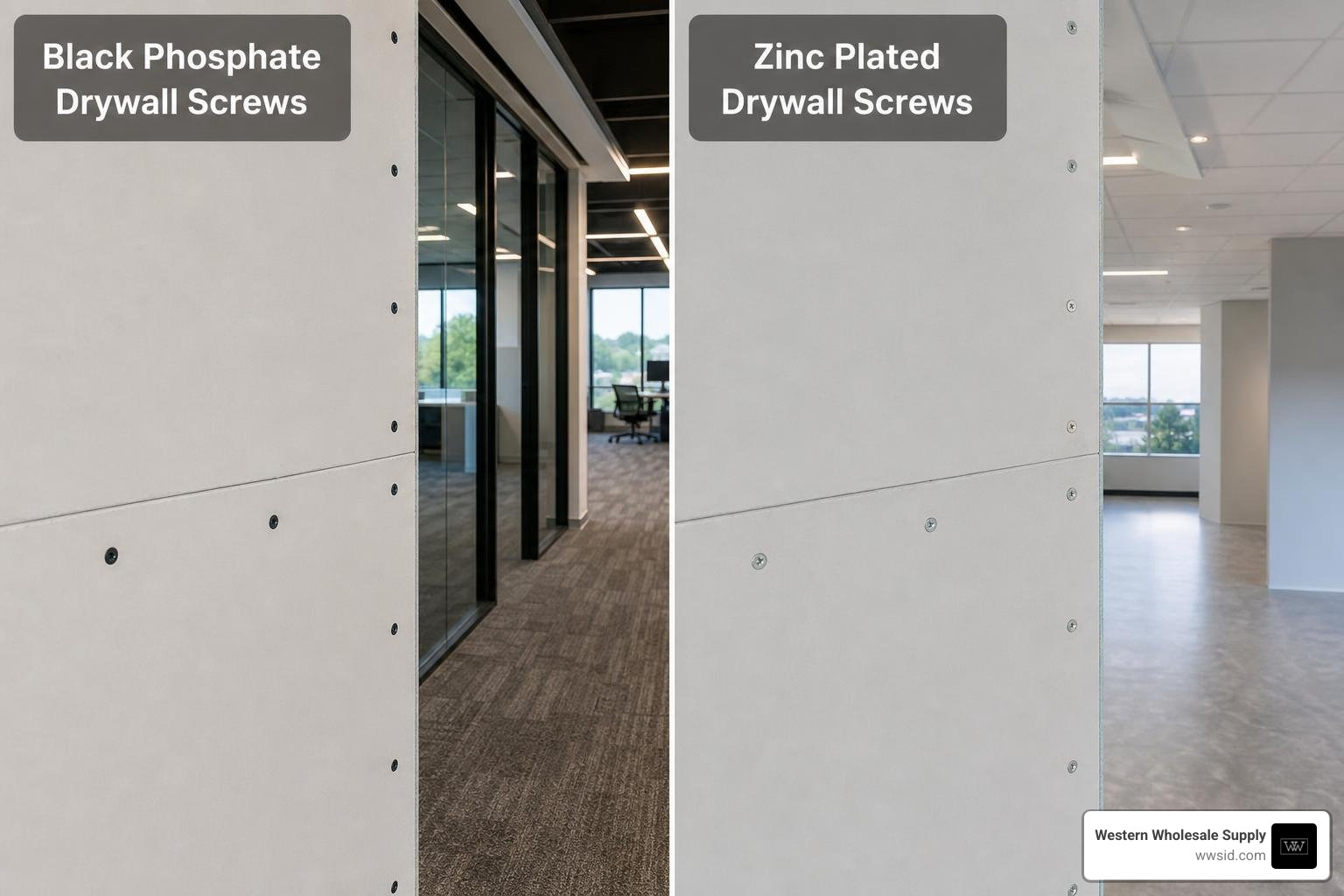
To prevent this, manufacturers apply protective coatings:
- Black Phosphate: This is the traditional drywall favorite. The chemical phosphate treatment gives the screw a matte black appearance and corrosion resistance. More importantly, the rough, porous surface of a black phosphate coating provides an excellent key for joint compound, ensuring your mud sticks to the screw head without flaking.
- Zinc Plating: Zinc-plated screws offer a shiny silver finish and robust rust protection. While highly durable, their smooth surface does not bond quite as well with joint compound as phosphate-coated screws. However, they are often used where added corrosion resistance is desired.
To keep your job site running smoothly and avoid running out of fasteners mid-room, buying in bulk is always the smartest route. Read our article on Why You Should Always Buy Drywall Screws in Bulk to learn how bulk purchasing saves money and reduces downtime.
Best Practices for Installing 1-Inch Drywall Screws
Hanging drywall is a physical, detail-oriented job. To ensure your walls are flat, solid, and ready for paint, follow these professional installation guidelines:
- Use a Dedicated Drywall Screwdriver or Nosepiece: Standard drills make it incredibly difficult to control depth. Use a drywall screw gun or a depth-sensitive nose cone attachment on your drill. This ensures that every screw is driven to the perfect depth — about 1/32 inch below the paper surface — without breaking the paper face.
- Drive Perpendicularly: Always drive the screw at a strict 90-degree angle to the wall. Angled screws will leave one side of the bugle head protruding, which will catch your trowel during the taping and mudding phase.
- Maintain Proper Spacing: For standard residential and commercial walls, space your screws about 12 inches apart along the studs. For ceilings, reduce the spacing to about 8 inches to combat gravity. Keep screws at least 5/8 inch away from the edge of the drywall sheet to prevent the gypsum core from crumbling.
- Consider Collated Screw Systems: If you are tackling a large commercial space or a multi-family housing development in Pocatello or Idaho Falls, loose screws will slow you down. Collated screw strips feed automatically into a specialized auto-feed gun, allowing you to hang boards faster with one hand free to hold the panel.
For high-speed commercial operations, choosing quality collated strips is essential. Low-quality plastic tape can jam your auto-feed gun, causing frustrating delays.
Frequently Asked Questions About Drywall Fasteners
What is the recommended penetration depth for drywall screws?
For a secure hold, drywall screws must bite properly into the framing material. A 1-inch drywall screw is a strong fit for standard 1/2-inch drywall over many light-gauge metal studs, but it is typically too short for standard drywall over wood studs. For wood framing, choose a longer coarse-thread screw based on board thickness and project requirements.
Why are black phosphate coatings preferred over zinc plating?
While both coatings protect against rust, black phosphate coatings feature a porous, matte texture. This rough surface allows joint compound, mud, and primers to adhere tightly to the screw head. Smooth zinc-plated screws can occasionally cause paint or mud to peel or flake off over time.
Are collated screws worth the extra cost?
Yes, for any project larger than a single room. Collated screws save a massive amount of labor time by eliminating the need to manually load individual screws onto a magnetic bit. The increased installation speed easily offsets the slightly higher cost of the collated strips.
Conclusion
Selecting the right fastener is the foundation of any professional drywall job. By matching your 1-inch drywall screws to the correct light-gauge metal studs and ensuring your installation depth is properly calibrated, you guarantee a flat, secure surface that will stand the test of time.
At Western Wholesale Supply, we have spent over 60 years delivering top-tier building materials, expert advice, and unmatched customer service to contractors across Eastern Idaho and Western Wyoming. Whether you need Grabber fasteners, CertainTeed ceiling systems, QuietRock EZ-SNAP drywall, or Durock cement boards, we are here to support your next project with reliable, on-time job site delivery.
Ready to stock up for your next build? Explore our high-quality drywall products or stop by one of our local yards to get exactly what you need to get the job done right.
