

What Are Steel Studs? A Quick-Start Guide for Builders
Steel studs are C-shaped, galvanized metal framing members used to build walls, partitions, and ceilings in both residential and commercial construction. Here’s a fast overview of what you need to know:
| Feature | Steel Studs |
|---|---|
| Material | Galvanized steel (G60 or G90 coating) |
| Common gauges | 25-gauge (lightest) to 12-gauge (heaviest) |
| Typical widths | 1-5/8″, 2-1/2″, 3-5/8″, 4″, 6″, 8″ |
| Common lengths | 8 ft, 10 ft, 12 ft, 16 ft, 20 ft |
| Best for | Interior partitions, curtain walls, load-bearing walls |
| Key advantages | Fire resistant, termite-proof, dimensionally consistent |
| Key limitation | Not ideal for heavy point loads without proper gauge selection |
Steel studs come in two main categories: non-structural (light gauge, for interior partitions) and structural (heavy gauge, for load-bearing and curtain wall applications). Choosing the right gauge for your project is the most important decision you’ll make.
As of May 2026, steel framing continues to grow in commercial construction — and more residential builders are making the switch too. Whether you’re framing a commercial tenant improvement or a basement partition wall, understanding your options saves time, money, and headaches on the job site.
I’m Jake Bean, co-owner of Western Wholesale Supply and a third-generation building materials professional who has helped contractors across Eastern Idaho and Western Wyoming select and source the right steel studs for everything from small remodels to large commercial builds. In the sections ahead, we’ll walk through everything you need — sizes, gauges, comparisons to wood, installation tips, and more.
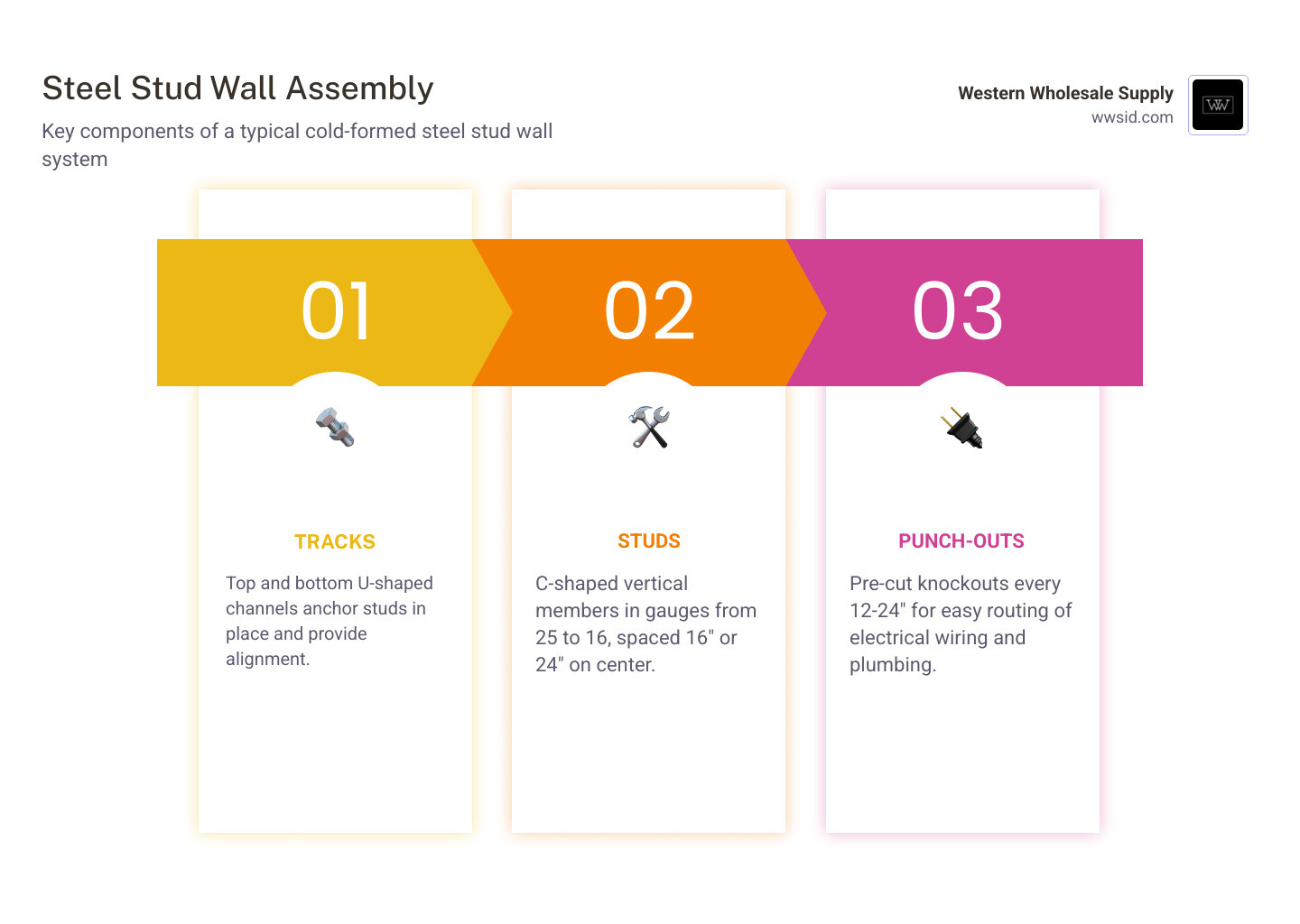
Understanding Steel Studs: Sizes, Gauges, and Standards
When we talk about steel studs in the modern construction landscape of May 2026, we are usually referring to cold-formed steel “C-sections” or “S-members.” Unlike wood, which can warp, twist, or shrink depending on the moisture content in our often-dry Idaho climate, steel provides a perfectly straight, dimensionally stable alternative.
The manufacturing process involves feeding rolls of galvanized steel through a series of rollers that shape the metal into the familiar C-shape. This shape is engineered for maximum strength-to-weight ratio. To ensure safety and consistency, we always recommend looking for products that meet the C955 Standard Specification for Load-Bearing Steel Studs. This standard ensures the metal has the right yield strength and coating to last the life of the building.
For a deeper dive into why this material has become a staple in our region, check out our guide on everything you need to know about steel framing.
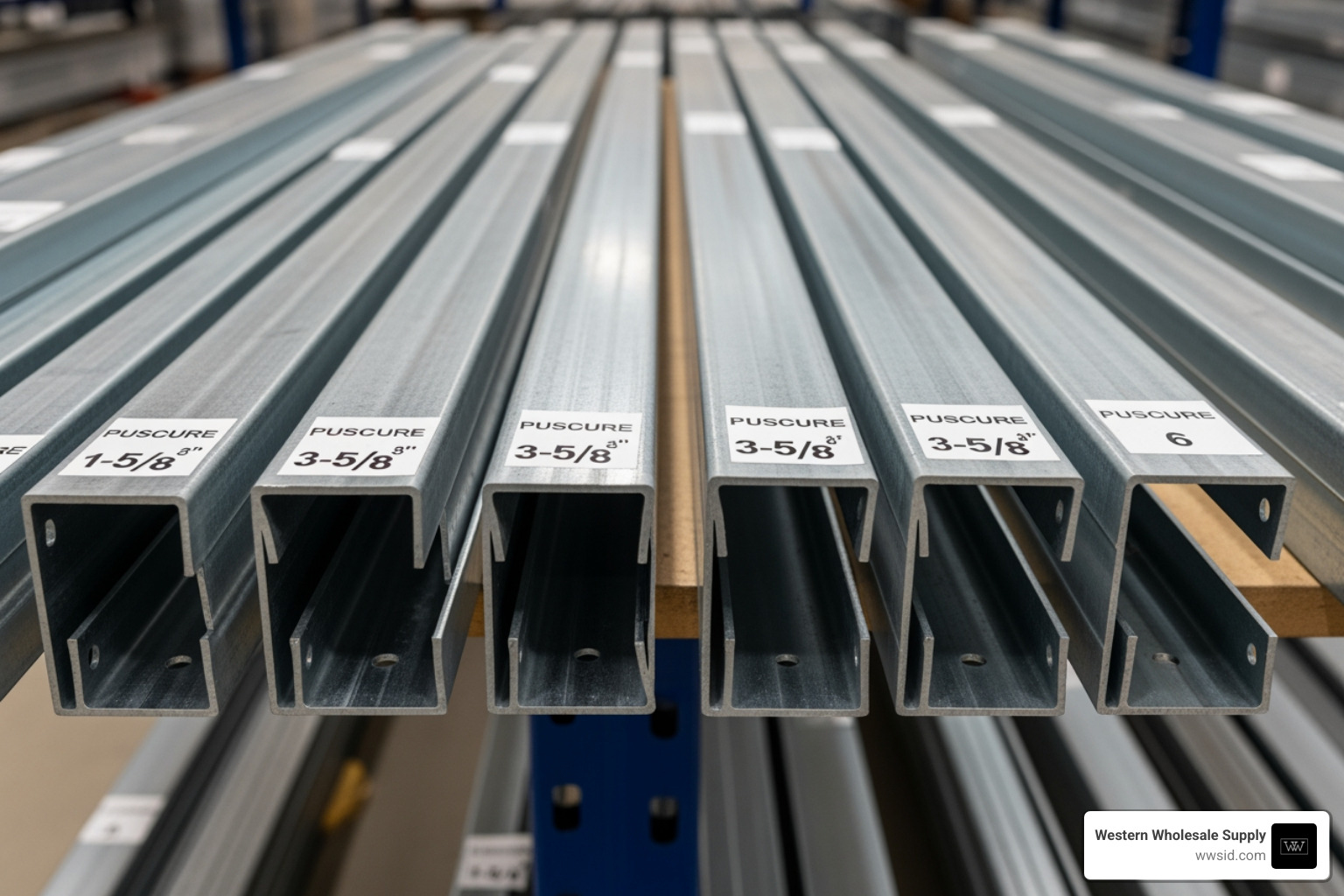
Standard Dimensions of Steel Studs
Navigating steel measurements can feel like learning a new language. We typically look at three main numbers: the web size (the width of the stud), the flange size (the “legs” of the C), and the mil thickness (the gauge).
- Web Sizes: Common widths include 1-5/8”, 2-1/2”, 3-1/2”, 3-5/8”, 4”, 5-1/2”, 6”, 8”, 10”, 12”, and even 14”. In most interior residential or light commercial office partitions, the 3-5/8″ stud is the industry standard.
- Flange Sizes: These typically range from 1-3/8” to 3”. The flange is where you’ll be driving your screws to hang drywall.
- Gauges (Mil Thickness): This is where things get technical. The lower the gauge number, the thicker the steel.
- 25-gauge (18 mil): Often called “drywall studs,” these are the most frequently used for non-load-bearing interior walls.
- 20-gauge (33 mil): A versatile “heavy” drywall stud or light structural member.
- 16-gauge (54 mil) to 12-gauge (97 mil): These are heavy-duty structural studs used for load-bearing walls and exterior curtain walls.
Understanding these components is the first step to a successful build. You can learn more about how these pieces fit together in our resource on understanding gypsum steel components.
Structural vs. Non-Structural Steel Studs
It is vital to distinguish between structural and non-structural applications. If you use a 25-gauge non-structural stud where a load-bearing member is required, the wall will fail.
Non-structural studs are designed to support the weight of the drywall and perhaps some light fixtures. They are perfect for basement finishing in places like Rexburg or office partitions in Idaho Falls.
Structural studs, on the other hand, are engineered to handle axial loads (vertical weight from floors or roofs above) and lateral loads (wind pressure against an exterior wall). These must be installed according to the C1007 Standard Specification for Installation of Load Bearing Steel Studs. These studs are often made of 50ksi steel and feature a heavier G60 or G90 galvanized coating to prevent rust in exterior applications.
Steel Studs vs. Wood Studs: The Ultimate Comparison
In the Pacific Northwest and Intermountain West, wood has been king for a long time. However, steel studs are rapidly gaining ground. Let’s look at how they stack up:
| Factor | Steel Studs | Wood Studs |
|---|---|---|
| Fire Resistance | Non-combustible; excellent for fire-rated assemblies. | Combustible; requires chemical treatment for fire rating. |
| Termite/Pest Resistance | 100% immune to termites and carpenter ants. | Vulnerable; requires treatment or specific species selection. |
| Moisture Resistance | Galvanized coating resists rust and rot. | Prone to rot, mold, and warping if moisture is present. |
| Consistency | Perfectly straight; no crowns, twists, or knots. | Natural variations; requires “culling” the pile for straight pieces. |
| Weight | Lightweight and easy to carry in bundles. | Heavy; weight varies by moisture content. |
| Sound Transmission | Lower mass can transmit noise; needs insulation. | Higher mass absorbs sound better naturally. |
One of the biggest “wins” for steel is durability. In the long run, steel doesn’t shrink. This means you won’t see those annoying “nail pops” in your drywall two years after the house is built because the wood dried out and twisted. For more on this, read our article on steel framing benefits.
Performance and Strength of Steel Studs
While wood is naturally strong under heavy vertical loads, steel is engineered for precision. A structural steel stud wall can be designed to withstand significant seismic activity—a relevant concern for those of us building near the Teton fault lines.
Steel’s strength is also beneficial in “curtain wall” applications, where the steel frames the exterior skin of a building (like stone or metal panels) against high Idaho wind pressures. We’ve seen a massive shift toward prefabricated framing because steel can be cut to exact tolerances in a factory setting, ensuring every piece performs exactly as the engineers intended.
Best Practices for Installation and Maintenance
Installing steel studs requires a slightly different toolkit than wood. Instead of a hammer and nails, you’ll be using a miter saw with a metal-cutting blade (or aviation snips for light gauge) and a screw gun.
One of the best features of metal studs is the “punch-out.” These are pre-cut holes in the web of the stud, usually spaced 12” or 24” on center. When you align these punch-outs during installation, it creates a perfect “chase” for electrical and plumbing lines to run through the wall without any drilling required.
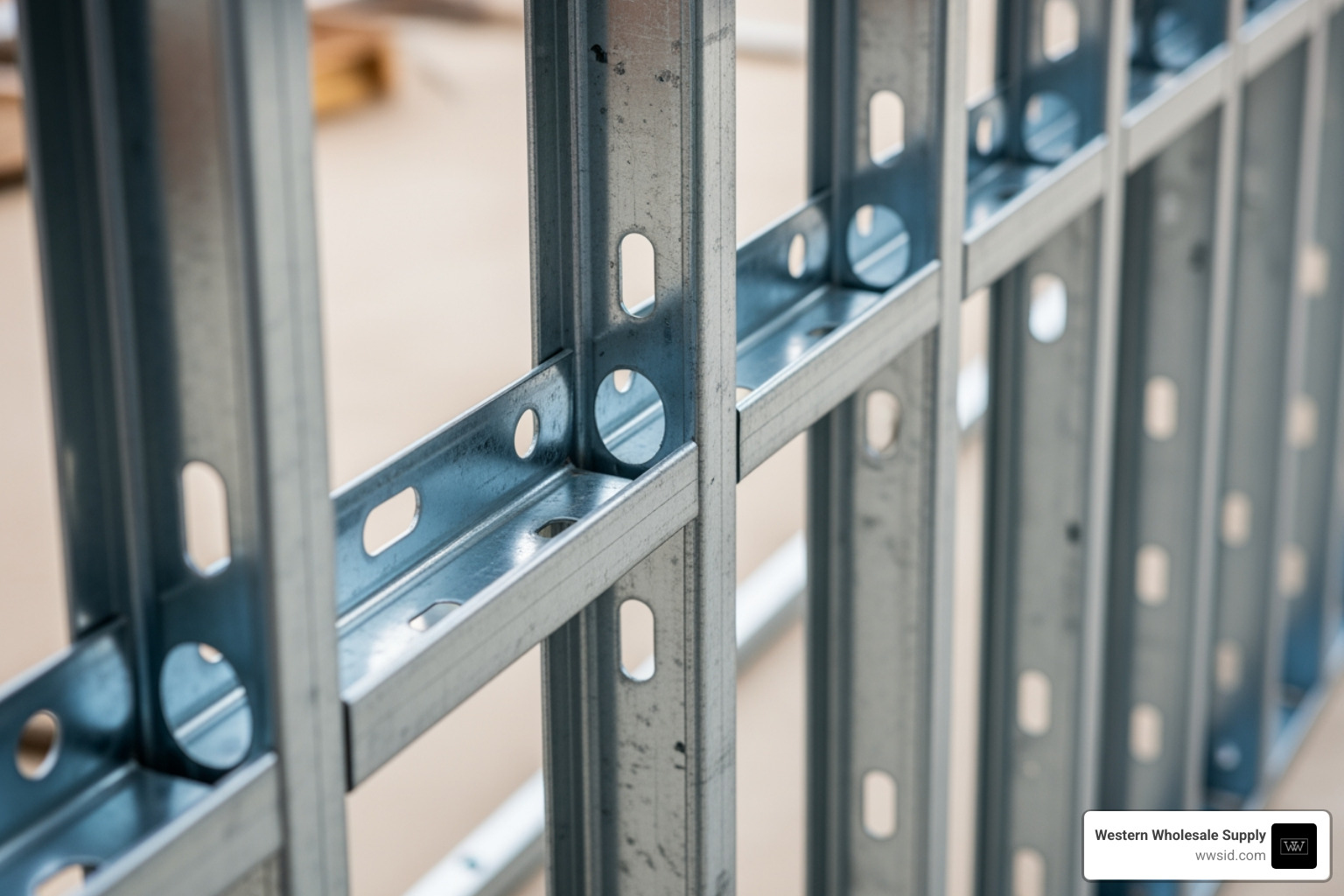
To prevent rust, especially in high-moisture areas like bathrooms or commercial kitchens, ensure you are using galvanized steel with at least a G60 coating. If you have to cut the studs, it’s a good practice to hit the cut edges with a zinc-rich spray paint to maintain that protection. For more hacks, check out our guide on studs, tracks, and drywall hacks.
Essential Fasteners and Accessories
You can’t just use standard wood screws for metal framing. We highly recommend using Grabber or Brighton Best fasteners.
- For light gauge (25-20ga): Use sharp-point “wafer head” screws that can pierce the metal without a pilot hole.
- For heavy gauge (18-12ga): You’ll need “self-drilling” or “Tek” screws that have a small drill bit built into the tip.
Additionally, if you are framing a wet area, consider using Durock cement board over your steel studs. It provides a rock-solid, moisture-resistant base for tile that pairs perfectly with the rot-proof nature of steel. Learn more about these pairings in the ironclad truth about steel framing.
Insulation and Sound Control
One common myth is that metal buildings are cold or noisy. While steel is a conductor of heat (thermal bridging), this is easily solved with proper insulation.
In warehouse applications across Eastern Idaho and Western Wyoming, we recommend aiming for R-30+ in ceilings and R-13 in walls. This ensures your energy bills stay manageable during our sub-zero winters.
For sound control, steel studs actually perform very well when paired with the right materials. Because steel studs are more flexible than wood, they don’t transmit vibration as easily if installed correctly. We suggest using Quietrock EZ Snap drywall for interior walls where privacy is key. This, combined with mineral wool insulation, can make a steel-framed room quieter than a traditional wood-framed one. Explore these options in our article on building with cold-formed steel.
Frequently Asked Questions about Metal Framing
Are steel studs load-bearing?
Yes, but only if you use the correct gauge. Non-structural 25-gauge studs are for partitions only. For load-bearing applications, you must use structural gauges (typically 18-gauge, 16-gauge, or thicker). These are often used in shear reinforcement for concrete and axial load-bearing wall assemblies. Always consult an engineer for load-bearing requirements.
How do you handle wiring and plumbing in metal walls?
As mentioned, the pre-cut punch-outs make this easy. However, because the edges of the metal can be sharp, you must use plastic grommets or “bushings” that snap into the holes. This protects the plastic coating on electrical wires from being chafed or cut. For plumbing, using plastic piping (like PEX) is common, but you must ensure the pipe is shielded from the metal edges.
Do metal studs interfere with Wi-Fi or cellular signals?
In a standard residential setting, no. The spacing of the studs (16″ or 24″ on center) is wide enough that signals pass through easily. You would only see signal degradation in “high-density” framing or if you were using solid steel plating, which isn’t the case in standard wall construction.
Conclusion
At Western Wholesale Supply, we’ve seen the construction industry evolve over the last 60 years. From our roots as a veteran-owned, family business starting in 1963, we’ve always prioritized providing the best materials for the unique challenges of building in the Intermountain West.
Whether you are in Idaho Falls, Jackson, or Twin Falls, we understand that your project needs to be durable, fire-safe, and delivered on time. Steel studs offer a level of precision and longevity that is hard to beat, especially when backed by the expertise of a team that’s been doing this for three generations.
Ready to start your next project? Contact Western Wholesale Supply today. We serve Eastern Idaho, Western Wyoming, and beyond with reliable delivery and the local knowledge you need to get the job done right.
