

Understanding Acoustic Performance in a Felt Baffle Ceiling
When sound waves hit hard, flat surfaces like concrete floors or bare drywall, they bounce back into the room as unwanted reverberation and echo. Suspended vertically, a felt baffle ceiling interrupts those sound waves before they can bounce around an open space. Because both sides of each baffle are exposed to airborne sound waves, the system captures acoustic energy more effectively than many flat surfaces.
Sound absorption is primarily measured using the Noise Reduction Coefficient (NRC). This rating scale ranges from 0.00 (perfect reflection) to 1.00 and above (high absorption). Depending on panel thickness, material density, core composition, and spatial spacing, acoustic felt baffle products typically yield NRC ratings between 0.30 and 1.20. For high-noise open plenums, choosing high-performing solutions creates a quieter, more comfortable environment. To explore how sound-absorbing ceilings transform commercial spaces, check out our guide on sound absorbing ceilings the secret to a quieter environment. High-end options like the Akustika 25 Baffle demonstrate how premium acoustic engineered panels deliver maximum sound attenuation.
Material Variations in a Felt Baffle Ceiling
Felt baffle systems are primarily constructed from two distinct acoustic materials: synthetic PET felt and natural wool felt.
- PET (Polyethylene Terephthalate) Felt: Manufactured from recycled plastic (such as water bottles), PET felt is lightweight, durable, and highly moisture-resistant. Standard PET felt formulations contain 60% to 100% recycled content (including both pre-consumer and post-consumer recycled plastic). PET felt is naturally free of formaldehyde, phenols, and phthalates, making it a safe choice for indoor air quality.
- 100% Wool Design Felt: Made from pure natural wool fibers, wool felt offers rich visual texture and deep coloration. Wool felt is 100% biodegradable and compostable, contains zero chemical irritants, and naturally manages humidity. High-performance wool felt baffles often combine a wool felt exterior face with an acoustic substrate containing 60% pre-consumer recycled content to maximize structural integrity and sound dampening.
Acoustic Ratings and Metrics Explained
A baffle ceiling’s sound-dampening capabilities depend heavily on panel thickness, density, and physical profile:
- Thickness and Weight: PET felt panels typically range from 9mm (weighing around 1100–2000 g/m²) up to 24mm (weighing roughly 3500 g/m²). Thicker, denser felt captures broader sound frequencies. For instance, standard 9mm PET felt achieves an NRC around 0.30, 12mm felt reaches NRC ratings of 0.45 to 0.85, 18mm felt reaches 0.85 NRC, and heavy 24mm panels reach up to 0.90 NRC. Premium composite panels reaching 1 1/4 inches (31 mm) in total thickness can reach Sound Absorption Average (SAA) ratings of 1.18 and NRC ratings of 1.20.
- Dual-Sided Absorption: Hanging vertically in an open plenum allows sound waves to strike both front and back surfaces. Certain ceiling cloud baffles can absorb up to 80% of direct airborne sound waves.
Primary Design Styles and Customization Options
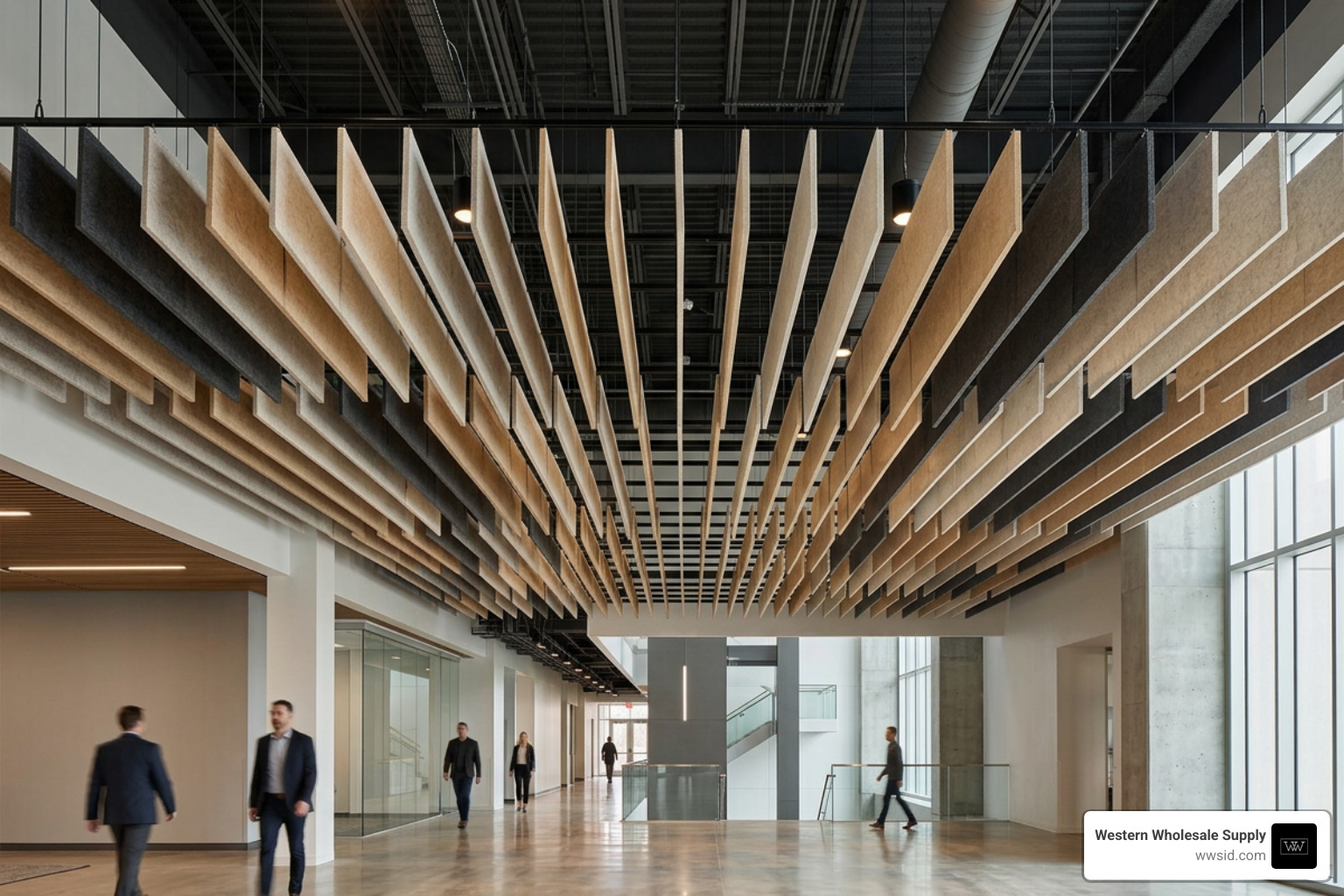
Modern interior architecture demands functional acoustic control that complements aesthetic goals. Felt baffle ceilings offer extensive customization options, including over 42 standard solid colors, natural heathered tones, and digital print overlays that mimic real wood grain or marble patterns. For a deeper dive into overhead acoustic structures, read our article detailing all about acoustic ceiling clouds.
Customizing Your Felt Baffle Ceiling Layout
Customization extends beyond simple color selection. Baffles can be tailored in length, height, depth, and spatial frequency to fit specific project footprints. Standard suspended panel dimensions range from compact 1-square-foot units up to massive 4-foot by 8-foot acoustic blades or continuous linear runs reaching nearly 10 feet in length.
For large commercial interiors—such as corporate headquarters, educational facilities, or hospitality spaces—modular felt baffle systems can be specified in complex geometric layouts to visually zone open floor plans while maintaining uniform acoustic comfort.
Structural Profiles: Linear, Cloud, Mesh, and Asymmetric Shapes
Selecting the right profile shape affects both room aesthetics and sound wave diffusion.
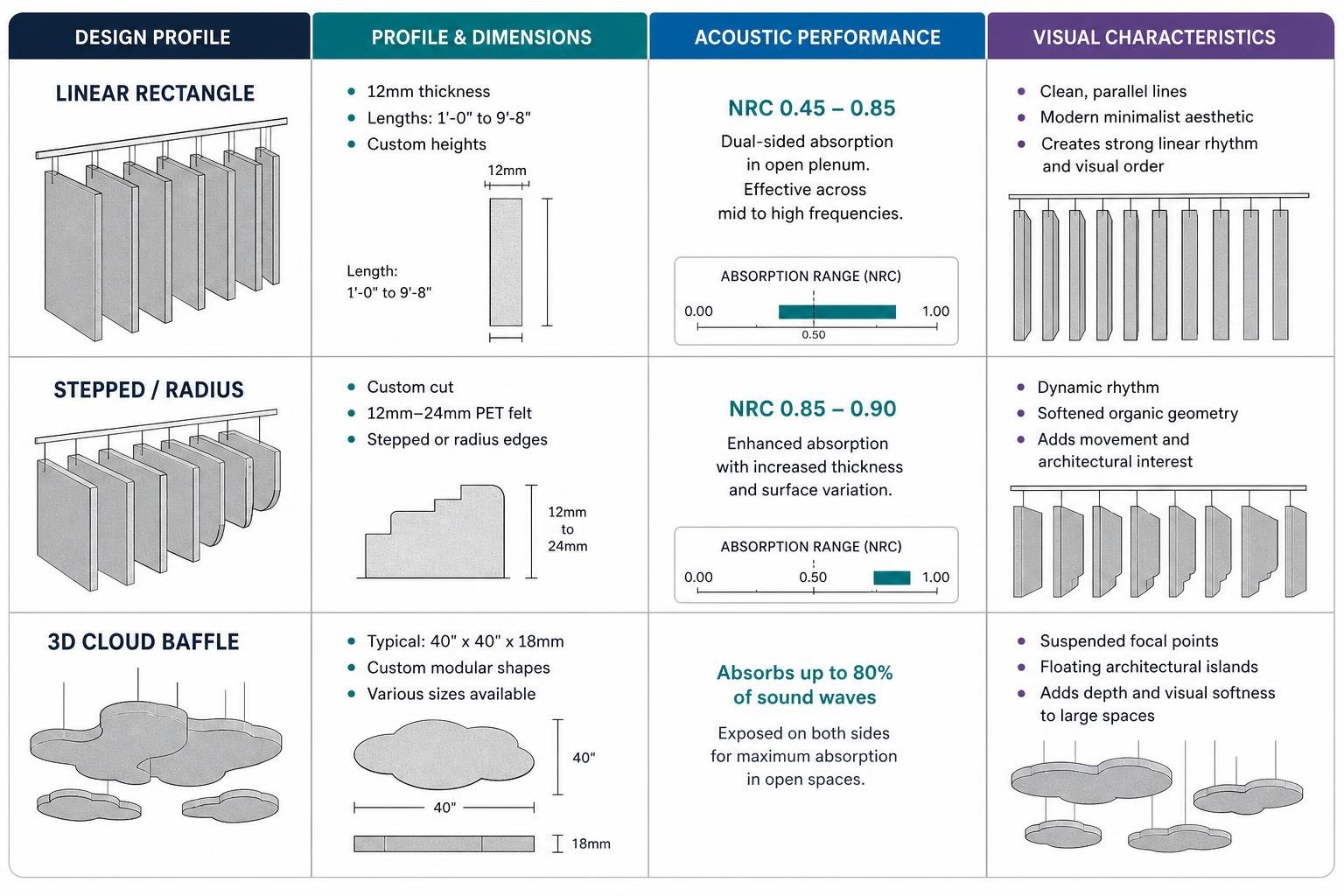
| Profile Geometry | Common Dimensions & Thickness | Acoustic Performance (NRC) | Primary Visual Impact |
|---|---|---|---|
| Linear Rectangle | 12mm thickness; 1′-0″ to 9′-8″ lengths; custom heights | NRC 0.45 – 0.85 | Clean, parallel lines; modern minimalist aesthetic |
| Stepped / Radius | Custom cut 12mm–24mm PET felt | NRC 0.85 – 0.90 | Dynamic rhythm; softened organic geometry |
| 3D Cloud Baffle | 40″ x 40″ x 18mm or custom modular shapes | Absorbs up to 80% of sound waves | Suspended focal points; floating architectural islands |
| Asymmetric (Folded) | 5 1/2″ to 5 3/4″ height; 30° & 60° folded angles | NRC 0.50 | Sculptural depth; multi-angled light and shadow effects |
| Parametric Mesh | Interlocking 9mm–24mm grid structures | NRC 0.30 – 0.90 | Complex 3D ceiling lattice; structural visual texture |
Hardware, Mounting, and Suspension Options
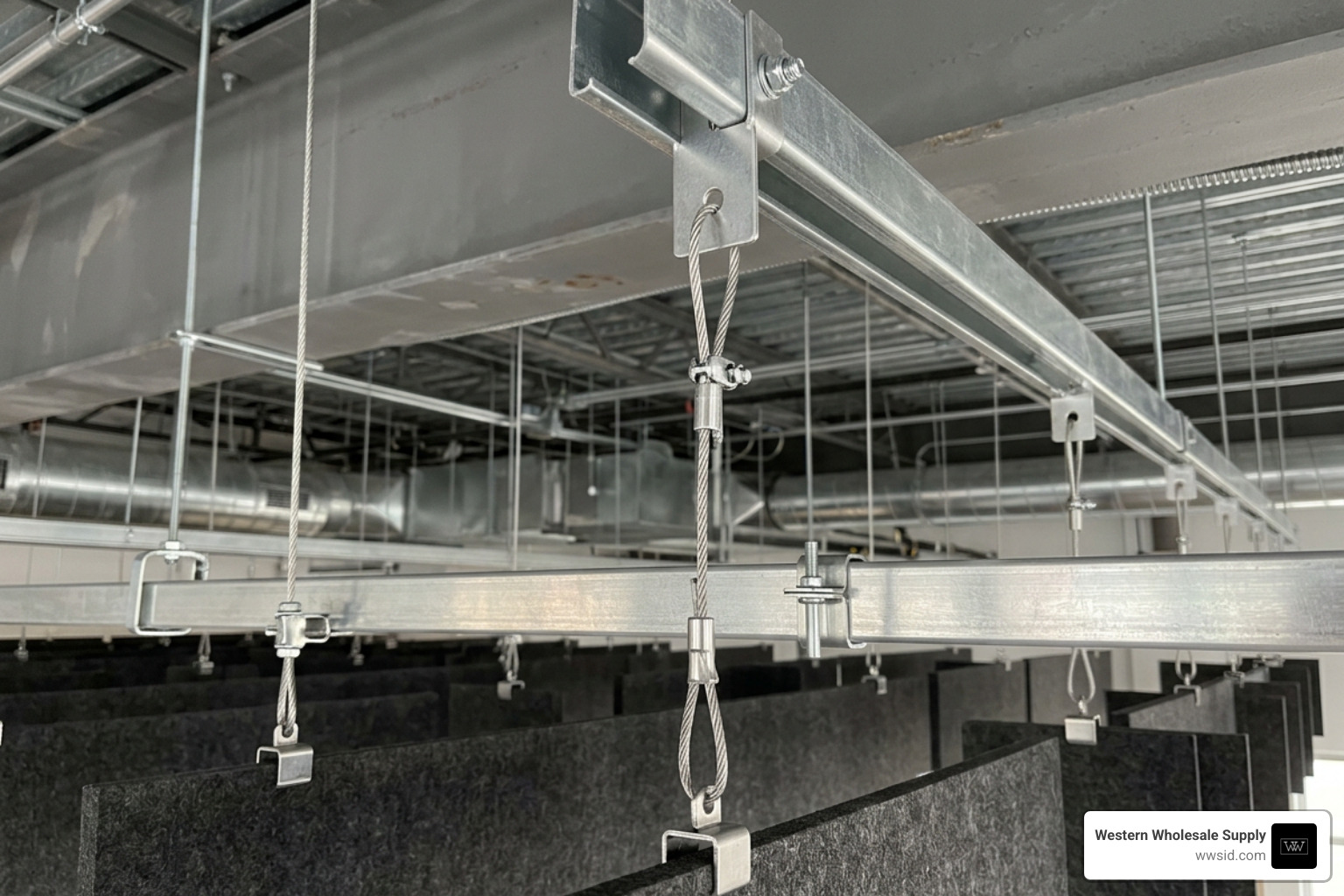
The performance and safety of a suspended ceiling rely on secure, precise installation hardware. Depending on structural overhead conditions—whether exposed steel joists, concrete decks, or existing drop ceiling grids—contractors can select from several standard mounting systems.
For detailed product cut sheets and hardware layout options, review the ARO Baffle 1 Cut Sheet or explore linear acoustic systems detailed in the BRC Baffle Ray Ceiling documentation. If you are retrofitting or planning an installation, learn more by reading acoustic ceiling installation a diyers dream come true.
Suspension Cables, Grid Clips, and Track Systems
Felt baffle systems rely on flexible, engineered connection hardware tailored to site conditions:
- Suspension Cables and Grippers: Aircraft-grade stainless steel cables (typically available in standard 6-foot or 12-foot lengths) use adjustable automatic cable grippers. These grippers make quick work of fine-leveling panels during installation.
- Sliding Track Channels: Integrated top channels allow attachment hardware to slide laterally along the length of the baffle. This features makes it easy to bypass overhead mechanical ducts, pipes, lighting, and conduit without custom jobsite fabrication.
- ACT Grid Clips: When mounting directly beneath an existing Acoustical Ceiling Tile (ACT) ceiling, heavy-duty grid clips twist directly onto standard 9/16-inch or 15/16-inch ceiling T-grids. This eliminates the need to drill into the deck above.
- Unistrut and Direct Mounts: For industrial open-plenum jobs, baffles adapt easily to metal Unistrut channel framing. Where vertical clearance is minimal, direct ceiling mounting plates secure panels tight against drywall or wood substrates.
How to Calculate Baffles Needed for a Room
To determine the correct quantity of felt baffles for an open-plenum layout, follow this standard step-by-step formula:

- Determine Room Square Footage: Multiply room length by room width (e.g., $40text{ ft} times 50text{ ft} = 2,000text{ sq ft}$).
- Establish Target Coverage Ratio: Effective acoustic dampening typically requires covering 30% to 50% of the ceiling surface area. For high-echo spaces, aim for 40% coverage ($2,000text{ sq ft} times 0.40 = 800text{ sq ft}$ of baffle face area).
- Calculate Baffle Surface Area: Calculate the face area of your selected baffle size. A baffle measuring 4 feet long by 1 foot tall presents 4 sq ft per side (8 sq ft total exposed acoustic surface).
- Divide Required Area by Panel Size: Divide total target surface area by single panel face area to find total panel count ($800text{ sq ft} div 4text{ sq ft per side} = 200text{ baffles}$).
- Round Up: Always round up to the nearest full box or set count when placing material orders to ensure consistent dyelots and jobsite coverage.
Maintenance and Long-Term Care Best Practices
Felt baffle ceilings require minimal upkeep to maintain their appearance and acoustic properties over years of service. For comprehensive recommendations on maintaining interior ceiling systems, reference our guide on quiet comfort a comprehensive guide to acoustic ceiling solutions.
- Routine Dusting: Remove dry airborne dust and loose debris using a standard soft-brush vacuum hose attachment or a hand-held lint roller.
- Spot Cleaning: Address localized soil or smudges using a clean cloth dampened with lukewarm water and a mild household dish soap. Crucial: Gently blot the surface; never scrub aggressively, as friction can alter the felt texture or cause localized surface fuzzing.
- Professional Care: For large commercial installations or stubborn stains, PET felt panels can be professionally wiped clean or dry cleaned.
- Color Fastness: High-quality PET and wool felt panels achieve high lightfastness ratings (Class 4–5 per ISO standards), resisting fading under commercial interior lighting.
Frequently Asked Questions About Felt Baffle Ceilings
How do felt baffles improve room acoustics compared to standard tiles?
Standard lay-in acoustical ceiling tiles, such as CertainTeed ceiling tiles, absorb sound on only one exposed horizontal surface. Vertical felt baffles expose both sides of the panel directly to airborne noise within the open plenum. This vertical orientation breaks up horizontal sound reflections, catching reverberation early and providing superior Noise Reduction Coefficient (NRC) performance in open-plan spaces.
Can felt baffles be mounted directly onto existing drop ceiling grids?
Yes. Utilizing specialized Acoustical Ceiling Tile (ACT) grid clips, felt baffles clamp directly onto existing 9/16-inch or 15/16-inch ceiling T-grids. Sliding top track grippers allow installers to align suspension cables precisely with grid intersection points without disturbing surrounding lay-in ceiling tiles. For asymmetric layout specs, refer to the ARO Baffle V2 Cut Sheet.
What fire ratings and eco-certifications do felt baffles have?
Quality acoustic felt ceiling products meet stringent commercial interior building codes. PET felt baffles commonly carry EN 13501-1 Class B-s1,d0 fire safety classifications and ASTM E84 Class A flame spread certifications. Environmentally, leading felt baffle systems hold OEKO-TEX Standard 100 certifications, maintain Declare Labels for material transparency, contribute directly to LEED credit categories, and contain 60% to 100% recycled content.
Conclusion
A felt baffle ceiling delivers a proven balance of acoustic control, architectural style, and sustainable material performance. By capturing sound waves across both vertical surfaces, these systems manage reverberation in challenging open-plenum spaces while providing flexible design options across shapes, colors, and installation layouts.
When planning your next commercial or residential project, partnering with an experienced material supplier ensures you select the exact acoustic density, suspension hardware, and fire-rated products your job site requires. Explore options and request project guidance by connecting with our team through our main portal at Western Wholesale Supply or visiting our dedicated guide to elevate your projects discover western wholesale supplys acoustical ceiling solutions. We provide reliable delivery, extensive material expertise, and personal service for job sites across Eastern Idaho, South East Idaho, Western Wyoming, and Western Montana.
