

Find the Best Drywall Utility Knife for Clean, Reliable Cuts
The best drywall utility knife for most pros is a fixed-blade model with a rigid metal body, a comfortable non-slip grip, and easy blade changes. Pair it with sharp, heavy-duty trapezoid blades made for drywall, and you will get straighter score lines, cleaner snaps, and less blade flex.
| Quick answer | What to choose |
|---|---|
| Best type for drywall scoring | Fixed-blade utility knife |
| Best blade shape | Standard trapezoid utility blade |
| Best blade thickness | At least 0.024 inch; heavier blades add rigidity |
| Best for drywall and roofing felt | A knife that accepts both trapezoid and hook blades |
| Key safety features | Secure blade retention, non-slip grip, safe blade storage, and a cover or retraction system |
A utility knife may look like a basic tool, but it has a big effect on cut quality and crew speed. Drywall is abrasive, and a dull or loose blade can tear the paper face, wander off the line, or force the user to push harder than necessary. The right knife holds a blade firmly, feels balanced during repeated scoring, and makes blade changes fast without leaving loose blades in a tool bag.
This guide compares the leading knife styles and the blade features that matter most for drywall work. It also covers when a fixed blade makes more sense than a retractable or folding knife, how to handle roofing felt, and how to avoid common cutting mistakes.
At Western Wholesale Supply, our team of third-generation building materials professionals in Idaho has hands-on experience supporting contractors who install drywall, steel framing, insulation, and related products. Our work with builders and supply operations informs this guide to selecting the best drywall utility knife for dependable jobsite use.
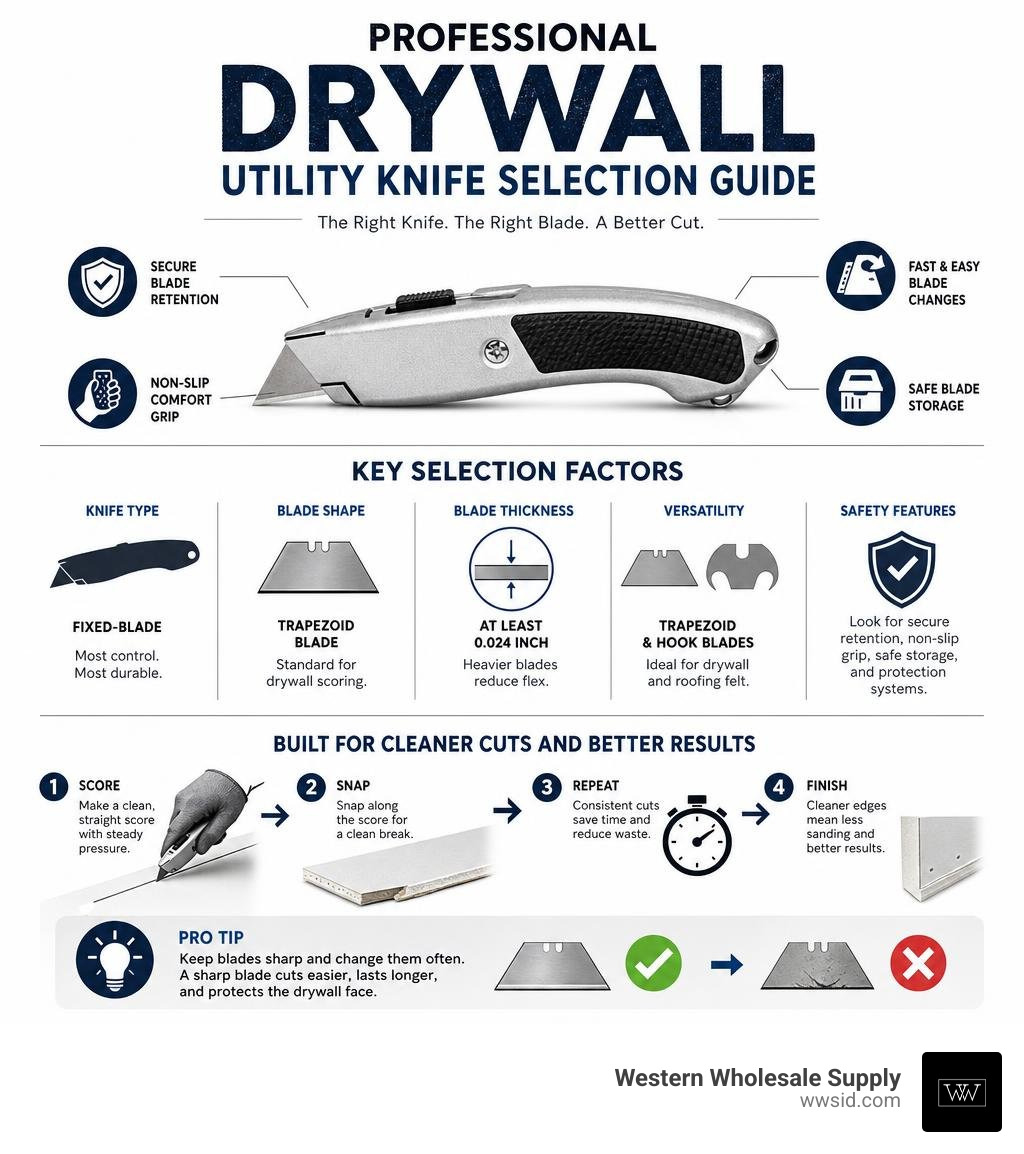
Best drywall utility knife terms explained:
Key Features of the Best Drywall Utility Knife
When you are out on a commercial job site in Eastern Idaho or Western Wyoming, your utility knife is your most frequently handled hand tool. Scoring wallboard panel after panel requires precision, safety, and physical comfort. To pick the best drywall utility knife, you must look beyond standard box cutters and examine features built specifically for dense gypsum cores and tough paper facing. Learn more about essential jobsite gear in our guide to Drywall Tools 101.
Key structural features to look for in a professional-grade drywall utility knife include:
- Blade Rigidity and Clamping Stability: Gypsum wallboard causes severe friction and lateral drag during scoring. The knife body must clamp the blade with zero movement to ensure straight score lines.
- Ergonomic, Non-Slip Handle Design: Slicing through heavy paper and gypsum for hours places strain on the palm, thumb, and wrist. An angled, contoured handle with textured rubber overmolding or zinc alloy ridges transfers leverage efficiently while reducing hand fatigue.
- Tool-Free Blade Access: Jobsite efficiency drops when you need a screwdriver just to swap out a dull blade. Look for captive thumb-screws, quick-release buttons, or flip-open latches.
- Internal Blade Storage: Integrated handle compartments that securely store 5 to 10 replacement blades keep your work flowing without trips back to the tool box.
- Nose Contour for Scribing: A narrow, tapered nose lets you rest a tape measure housing flush against the knife body, making it easy to rip consistent strips down an entire 12-foot sheet of drywall.
Blade Thickness and Metallurgy Specifications
The blade itself dictates cutting performance just as much as the handle mechanism. Standard utility blades measure approximately 0.024 inches thick. While suitable for light cardboard or tape, standard blades can flex, bend, or wander when pulled through 5/8-inch Type X fire-rated drywall or specialty panels like Quietrock EZ Snap.
For heavy-duty board scoring, heavy-duty blades ranging from 0.025 to 0.035 inches in thickness offer maximum lateral rigidity. Thick high-carbon steel blades resist buckling under extreme downward force. Additionally, options like the Stanley® 11-937 Drywall Utility Knife Blade, 2-7/16 in, 0.024 in THK, High Carbon Steel feature double-hardened cutting edges designed specifically to handle abrasive gypsum and CertainTeed ceiling tiles without dulling prematurely.
Advanced blade metallurgy includes bi-metal construction—where a high-speed steel cutting edge is electron-beam welded to a flexible spring steel back. This design yields up to three times the cutting life of conventional carbon steel without shattering under bending stress. For long-term production cutting, tungsten carbide coated or laser-deposited edges maintain sharpness up to ten times longer, lowering your overall blade cost per sheet.
Selecting the Best Drywall Utility Knife for Cutting Drywall and Roofing Felt
Jobsite versatility is crucial for general contractors, framers, and roofers alike. Modern building envelopes frequently require cutting dense gypsum, cement boards like Durock, acoustic panels, and bituminous underlayments or roofing felts. Choosing a multi-purpose knife frame capable of accepting various blade geometries speeds up transition time between tasks.
Reviewing a specialized Utility knife to Cut Drywall & Roofing Felt shows how tool design handles diverse construction materials:
- Trapezoid Blades for Board Scoring: Double-bevel, standard-length trapezoid blades deliver clean, deep scores through paper facings into gypsum cores. They allow controlled cutting depth when slicing around junction boxes or corners.
- Hook Blades for Flexible & Bituminous Sheeting: Slicing heavy bitumen roofing felt, asphalt saturated underlayment, or flexible synthetic membranes with a flat trapezoid blade causes material bunching and rapid blade friction. Swapping to a heavy-duty hook blade pierces the sheet and cuts from underneath using a pulling stroke, keeping the edge sharp and avoiding substrate drag.
- Heat-Resistant Metallic Construction: Metal knife bodies with high melting thresholds are essential for roofer safety when working around open flame torches on torch-down bitumen roofs.
Essential Safety Features on Job Sites
Safety on commercial construction sites is non-negotiable. According to trade safety audits, hand injuries from slipping utility knives rank among the top reported jobsite incidents. Choosing a utility knife engineered with active and passive safety features protects workers and maintains OSHA compliance.
Look for these critical safety components:
- Positive Blade Locking Mechanisms: Whether fixed or retractable, the blade holder must lock firmly into position so the blade cannot shift or collapse during high-force pulls.
- Magnetic Edge Alignment: Internal magnets inside the handle housing hold replacement blades steady during changes, preventing accidental drops and cuts when loading fresh edges with gloved hands.
- Deep Ergonomic Finger Guard: A prominent forward finger stop prevents your indexing finger from slipping over the blade edge if the knife hits a hard obstruction inside a sheet.
- Dedicated Disposal Systems: Pair your crew’s knives with puncture-proof blade disposal containers. Never throw loose, dull utility blades directly into garbage bags or tear-off bins.
Fixed vs. Retractable: Choosing the Best Drywall Utility Knife for Professionals
Selecting the proper blade housing mechanism is one of the biggest decisions trade professionals face. The primary debate centers on fixed-blade utility knives versus retractable or folding models. Exploring trade gear options in our collection of Tools & Fasteners helps align knife styles with daily contractor tasks.
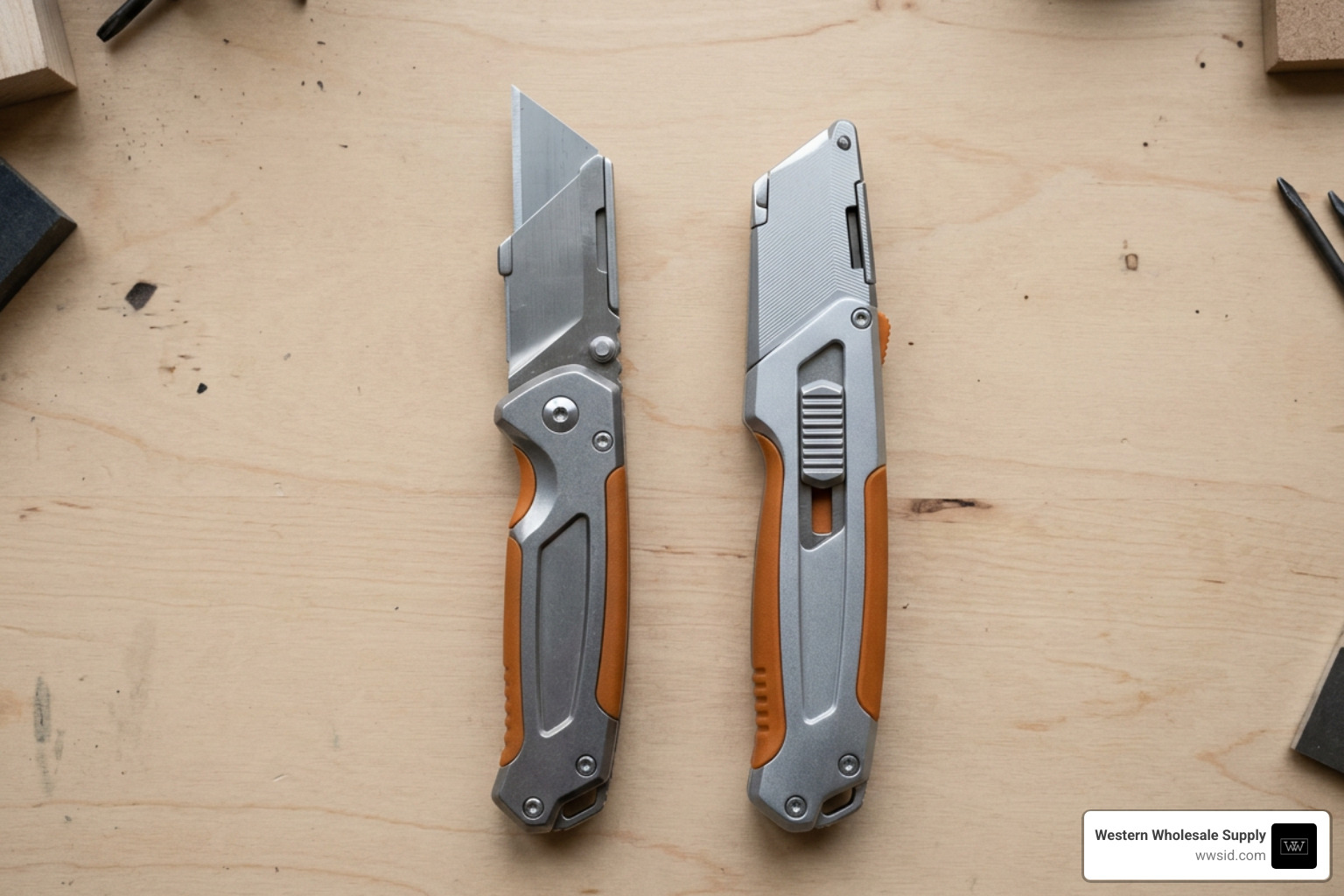
| Feature | Fixed-Blade Utility Knife | Retractable Utility Knife | Folding Utility Knife |
|---|---|---|---|
| Blade Wobble / Slop | Absolute zero | Minor to moderate | Minimal to minor |
| Mechanical Complexity | Very low (few moving parts) | Moderate (internal slider) | High (pivot joint & lock) |
| Jobsite Portability | Requires sheath / holster | Pocket safe when retracted | Pocket safe with belt clip |
| Blade Change Speed | Fast (thumb-screw / latch) | Varies (slider or side button) | Quick-release lever |
| Best Primary Use | Continuous heavy drywall scoring | General material cutting | Pocket carry / punch-out work |
Why Fixed Blades are the Best Drywall Utility Knife Option for Heavy Use
For professional drywall hangers who score dozens of sheetrock panels daily, fixed-blade knives remain the gold standard. In a fixed-blade knife, the two halves of the cast aluminum or zinc alloy handle bolt or lock tightly together, clamping the blade in a rigid steel channel.
Products like the Drywall Fixed Utility Knife | IRWIN demonstrate why pros rely on fixed mechanisms. Fixed handles eliminate “blade slop”—the side-to-side wobble and vertical deflection inherent in retractable slider tracks. When pulling a deep score through tough board facings, zero blade slop keeps your cut running perfectly parallel along your T-square edge.
Furthermore, fixed-blade handles feature fewer internal moving parts to clog with fine gypsum dust. In high-dust drywall installation environments, mechanical sliders in retractable knives can bind up over time, whereas a heavy-duty fixed knife functions reliably day after day.
Folding and Retractable Knives for Daily Carry
While fixed-blade knives excel in heavy board production, retractable and folding utility knives provide unmatched convenience for superintendents, remodelers, and punch-out crews who move frequently around a site.
- Retractable Utility Knives: These feature a multi-position thumb slider that extends the blade to variable cutting depths and retracts it safely into the body when not in use. This eliminates the need for a belt holster. Modern pro models incorporate heavy-duty spring-loaded blade locks to minimize slop while maintaining pocket safety.
- Folding Utility Knives: Inspired by everyday carry (EDC) pocket knives, folding utility knives feature a liner-lock or lock-back mechanism that folds the blade head safely into the handle body. They include integrated pocket clips for effortless carry on work trousers or tool vests. Many folding models offer rapid push-button blade releases that allow instant, tool-free blade swaps in seconds.
Step-by-Step Guide: How to Cut Drywall and Avoid Common Mistakes
Achieving clean, crisp drywall cuts requires correct knife technique combined with basic trade practices. Improper scoring leads to jagged gypsum edges, torn face paper, and uneven snaps that require extensive raspers or extra taping compound during finishing. For a comprehensive walkthrough, check out our guide on How to Cut Drywall in 6 Simple Steps.
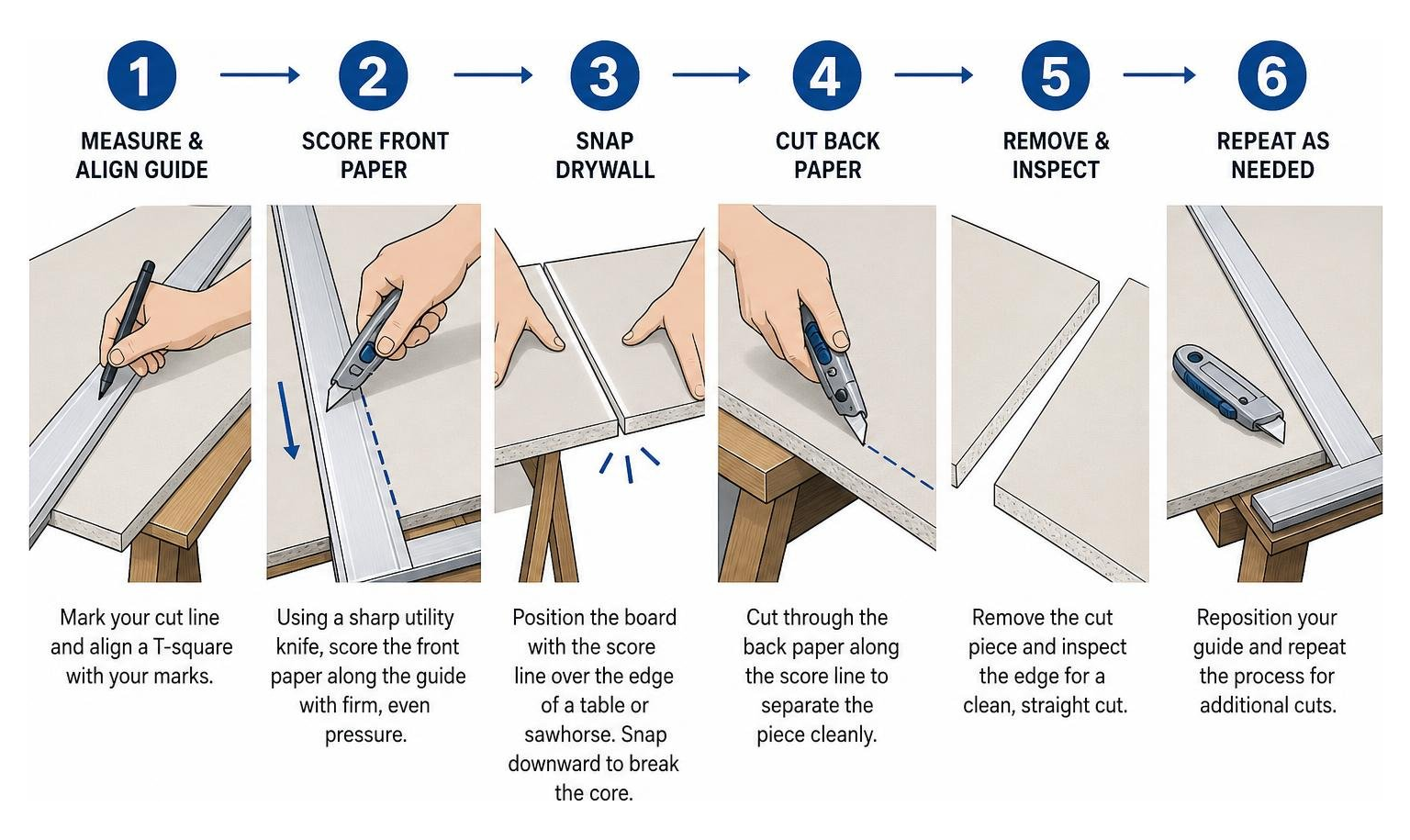
How to Score and Snap Sheetrock Properly
Cutting drywall efficiently relies on scoring the front paper facing, fracturing the internal gypsum core, and slicing the back paper backing cleanly. Follow these step-by-step instructions for professional results:
- Measure and Align Your Guide: Mark your desired cut width on the drywall sheet. Place a heavy-duty aluminum T-square along your marks. Review our guidelines in the Ultimate Checklist for Adjustable T-Squares to ensure your square stays true.
- Score the Front Paper in a Single Pass: Hold your utility knife firmly against the T-square edge, angling the blade slightly inward toward the straight edge. Apply firm, steady downward pressure and pull the knife across the panel in one continuous motion. You want to cut completely through the face paper and score 1/16 to 1/8 inch into the gypsum core. Avoid making multiple shallow scoring passes, as this creates ragged score lines.
- Snap the Gypsum Core: Place your hand behind the score line near the edge of the panel and apply firm pressure pushing backward away from the score. The gypsum core will snap cleanly along the scored line.
- Back-Cut the Rear Paper: Fold the snapped piece forward at a 90-degree angle to expose the back paper hinge. Run your utility knife blade along the crease from top to bottom, keeping the flat side of the blade flush against the back board face to slice the paper cleanly without tearing.
Common Cutting Mistakes to Avoid
Even seasoned installers occasionally run into rough edges or ruined panels. Avoiding these common mistakes ensures higher productivity and better finished wall lines:
- Using Dull or Chipped Blades: Gypsum is highly abrasive. Once a blade edge dulls, it drags and tears the face paper rather than slicing it. Replace or reverse utility blades as soon as drag increases.
- Applying Excessive Lateral Force: Over-pushing sideways against your T-square causes thin blades to flex, driving the score line off course. Let a sharp blade do the work with steady downward pressure.
- Scoring Multiple Friction Lines: Dragging the knife back and forth over the same score line creates feathered paper edges that fray during installation and complicate joint taping.
- Ignoring the Rear Paper Crease: Attempting to break the back paper by snapping the board backward without slicing it tears large chunks of paper off the rear face, weakening the board’s edge structural integrity.
Frequently Asked Questions About Drywall Utility Knives
What blade thickness is recommended for cutting drywall?
For scoring standard 1/2-inch wallboard and 5/8-inch Type X fire-rated drywall panels, standard utility blade thickness is 0.024 inches. However, professional drywall contractors prefer heavy-duty blades measuring between 0.025 inches and 0.035 inches.
Thicker blades provide superior beam strength and lateral rigidity, preventing blade deflection when pulling high-force scoring passes along T-squares. Additionally, choosing blades engineered with high-carbon bi-metal steel or double-hardened cutting edges significantly increases edge life against abrasive gypsum board.
Can the same utility knife cut drywall and bitumen roofing felt?
Yes, a single heavy-duty utility knife handle can be used for both drywall and bitumen roofing felt, provided the knife handle supports standard notch-mounted trapezoid and hook blades.
For drywall scoring, equip the knife with a double-bevel trapezoid utility blade to score gypsum surfaces cleanly. When cutting heavy bitumen roofing felt or synthetic roofing underlayments, swap out the trapezoid blade for a heavy-duty hook blade. The hook shape pierces and pulls through tough felts from underneath, eliminating substrate friction and keeping the cutting edge from clogging with asphalt residue.
Why do drywall professionals prefer fixed blade knives over snap-off blades?
Professional drywall hangers consistently choose fixed-blade utility knives over snap-off blade knives due to structural stability and jobsite safety.
Scoring dense gypsum board places high lateral pressure on the knife blade. Snap-off blades feature pre-scored break lines that can snap unexpectedly under heavy side pressure or twisting forces, posing a serious safety hazard to the installer.
Furthermore, snap-off blade tracks permit noticeable side-to-side movement (“blade slop”), which can cause the blade to wander away from straight T-square guides. Fixed-blade utility knives clamp the blade securely in a solid metal housing, eliminating wobble and ensuring razor-straight score lines on every panel.
Conclusion
Finding the best drywall utility knife comes down to matching robust blade clamping with ergonomic comfort and jobsite durability. For daily drywall production hanging, a fixed-blade metal utility knife paired with heavy-duty high-carbon or bi-metal trapezoid blades provides the wobble-free rigidity needed for straight scores and clean snaps. If your work requires mobility across diverse punch-out tasks, heavy-duty folding or retractable knives with tool-free quick-change mechanisms deliver safety and convenience.
At Western Wholesale Supply, we understand that reliable trade tools and quality materials make all the difference on the jobsite. As an independent, veteran-owned, third-generation family business serving Eastern Idaho and Western Wyoming since 1963, we provide contractors across Idaho Falls, Pocatello, Jackson, and surrounding communities with dependable building supplies—from premium drywall and steel framing to insulation and acoustical ceiling systems.
Stop by our local showrooms or contact our experienced team today to Explore commercial grade drywall tools and jobsite supplies and discover how our dependable delivery service keeps your job sites running smoothly.
