

Why Specify an FRP Panel for Labs Over Alternative Wall Claddings?
Designing a resilient research or diagnostic facility requires wall claddings that handle chemical splashes, physical impacts from mobile carts, and daily washdowns without degrading. While traditional materials like ceramic tile, painted drywall, stainless steel, and standard PVC have historically appeared in commercial builds, an engineered composite panel consistently outperforms them across critical lab metrics.
Evaluating materials for research spaces requires looking at physical durability, surface hygiene, and total lifecycle costs:
| Performance Metric | Laboratory FRP Panels | Stainless Steel Cladding | Ceramic Tile | PVC Wall Cladding |
|---|---|---|---|---|
| Surface Hardness | Barcol Hardness 89 | High (Prone to denting) | High (Prone to cracking) | Low (Easily scratched) |
| Impact Resistance | Flexural Strength 9,080 psi | Moderate (Permanent dents) | Brittle (Chips/shatters) | Moderate |
| Seam Integrity | Minimal seams (Up to 3.1m wide) | Welded or batten joints | Extensive porous grout lines | Welded or trim joints |
| Chemical Resistance | Excellent (Acids, bases, VHP) | High (Susceptible to chlorides) | Good tile / Poor grout | Moderate (Weak to solvents) |
| Lifecycle Cost | Low (15–25 yr lifespan) | Very High initial cost | High (Ongoing regrouting) | Moderate |
| Biological Resistance | ISO 846 Rating 0 (Excellence) | Non-porous | Fungal growth in grout | Non-porous |
Ceramic tile introduces thousands of linear feet of cementitious grout. Grout is porous, absorbs moisture, harbors biological growth, and degrades when exposed to acidic wash protocols. Stainless steel provides high hygiene but carries a prohibitive upfront cost, dents easily under impact from rolling equipment, and suffers from pitting corrosion when exposed to chlorine-based sanitizers. PVC wall sheets offer moisture protection but lack rigidity, scratching easily and expanding significantly under thermal shifts.
By contrast, solid composite panels provide a non-porous gelcoat over a dense structural matrix, delivering exceptional scratch and impact resilience. For an overview of how these commercial materials are specified across various facilities, read our commercial FRP wall panel guide.
Chemical Tolerance Against Harsh Lab Reagents and Disinfectants
Routine decontamination in chemistry, biology, and pharmaceutical suites involves aggressive reagents. Surface materials must endure repeated exposure to sterilants such as sodium hypochlorite (bleach), hydrogen peroxide vapors, quaternary ammonium compounds, hydrochloric acid, and isopropyl alcohol.
FRP panels engineered for laboratories utilize cross-linked polyester and vinylester resin matrices. When reagents splash onto the surface, the cross-linked polymers prevent chemical penetration, softening, and surface discoloration. Standard laboratory testing demonstrates zero staining or etching after prolonged contact with concentrated acids and alkalis, matching the rigorous benchmarks outlined in laboratory polymer wall specification guidelines.
Contamination Control and Microbial Resistance
Contamination control is non-negotiable in biocontainment and tissue-culture environments. Standard architectural finishes with micro-fissures allow pathogens, mold spores, and bacteria to colonize deep within the wall structure.
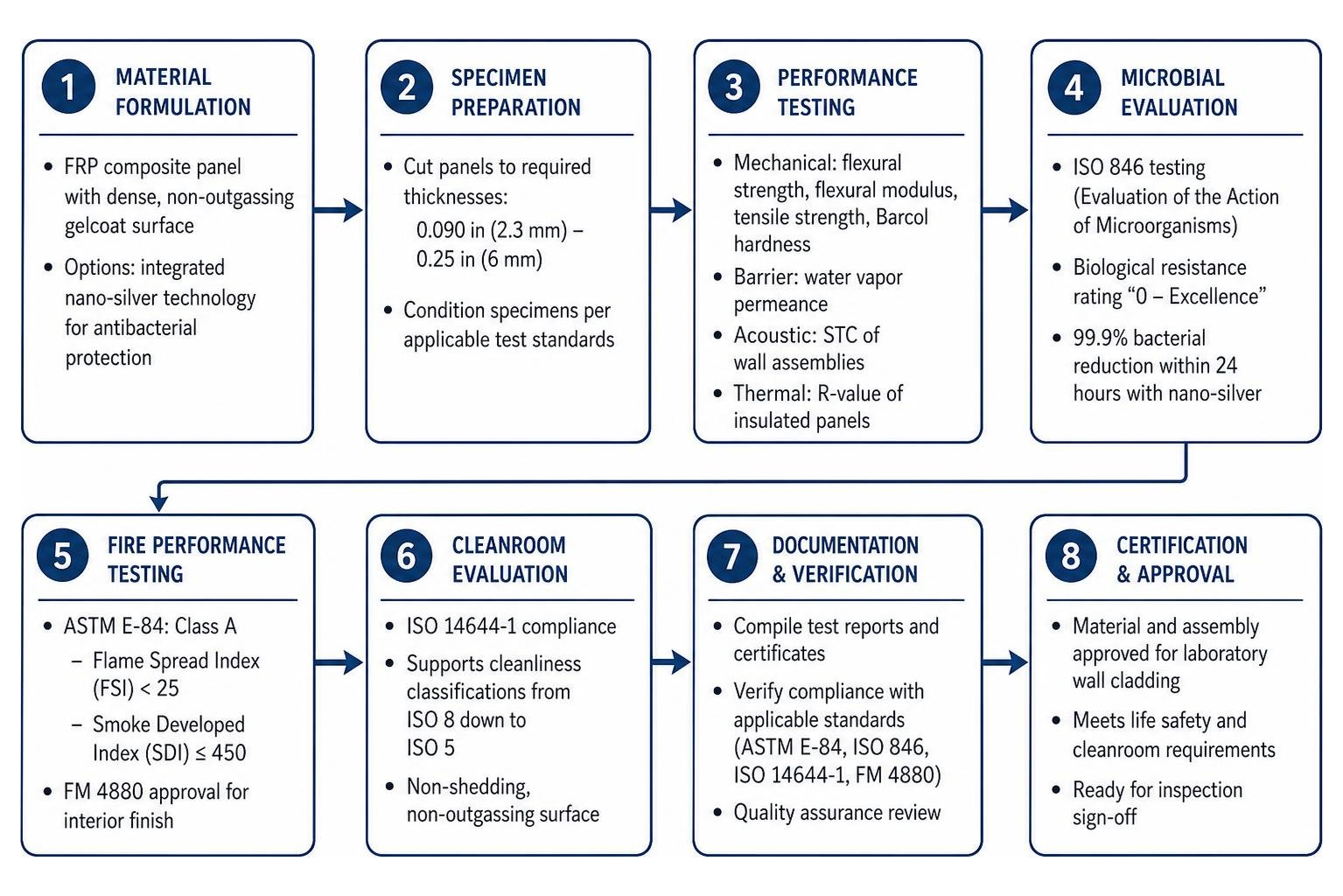
Hygienic laboratory panels incorporate a dense, non-outgassing gelcoat surface. When augmented with integrated nano-silver technology, the surface provides active antibacterial protection, achieving a 99.9% bacterial reduction within 24 hours—even against drug-resistant strains. Under ISO 846 testing (Evaluation of the Action of Microorganisms), high-grade panels achieve a biological resistance rating of “0 – Excellence,” demonstrating that the composite does not provide a nutrient source for fungi, bacteria, or mildew. To learn more about how composite materials deliver these properties, explore fiberglass reinforced panel fundamentals.
Core Engineering and Performance Standards for Laboratory Panels
Laboratory wall claddings must comply with strict municipal life safety codes and international cleanroom standards. Selecting materials that satisfy structural, thermal, acoustic, and fire performance ensures smooth inspection sign-offs and reliable daily operations. For a broad look at panel types and structural options, review our essential FRP wall panel guide.
Essential Technical Specifications of an FRP Panel for Labs
Understanding the mechanical metrics of structural wall claddings allows architects and contractors to select the right assembly:
- Thickness: Standard laboratory solid liners feature a nominal thickness of 0.090 inches (approx. 2.3 mm) to 0.25 inches (6 mm) for direct-to-stud applications.
- Flexural & Tensile Strength: Panels achieve a flexural strength of 9,080 psi, a flexural modulus of 1,020,000 psi, and a tensile strength of 7,240 psi.
- Barcol Hardness: An 89 Barcol hardness rating prevents gouging and scuffing from mobile lab carts and stainless steel tables.
- Vapor Permeance: Water vapor permeance measures less than 0.023 perms, creating an airtight moisture barrier.
- Acoustic Attenuation: When laminated over 5/8″ gypsum boards on both sides of a 6-inch wall cavity packed with mineral wool insulation, assemblies achieve a Sound Transmission Class (STC) of 62, dampening loud equipment noise.
- Thermal Properties: For temperature-controlled suites, insulated composite sandwich panels with XPS foam cores provide R-values ranging from R-18 (3-inch core) to R-28 (4⅝-inch core), maintaining thermal efficiency.
When building specialized partition walls, selecting the right engineered FRP panels ensures that both acoustic isolation and structural strength meet project requirements.
Regulatory Fire Safety and Cleanroom Classifications
Life safety and cleanroom particle emissions dictate wall material selection in regulated research environments:
- Fire Performance (ASTM E-84): High-containment and vivarium spaces require Class A fire-rated materials. These panels deliver a Flame Spread Index (FSI) under 25 and a Smoke Developed Index (SDI) of 450 or less.
- FM 4880 Approval: Compliance with Factory Mutual (FM) 4880 certifies the composite wall assembly as an approved interior finish without requiring an additional thermal barrier.
- Cleanroom Standards (ISO 14644-1): The non-shedding, non-outgassing face of smooth laboratory panels supports cleanliness classifications from ISO 8 down to ultra-sterile ISO 5 suites, satisfying current Good Manufacturing Practice (cGMP) guidelines.
Practical Applications and Specialized Configurations in Laboratory Environments
Laboratories are not one-size-fits-all spaces. A diagnostic medical lab has different environmental demands than an agricultural testing facility, cold storage biological vault, or pharmaceutical compounding cleanroom.
When building heavy-duty wall assemblies, pairing high-performance claddings with the right substrates—such as standard drywall, impact-resistant boards, or moisture-tolerant Durock backer boards—ensures long-term structural integrity. For ceiling systems, specifying non-shedding CertainTeed architectural tiles in cleanroom grids complements the hygienic wall envelopes. In facilities requiring specialized acoustic control between analytical equipment rooms and offices, incorporating Quietrock EZ Snap panels behind the composite cladding delivers high sound isolation without adding wall thickness. To explore various core and backer configurations, read about structural FRP panel boards and liners.
Cleanrooms, Compounding Areas, and Bio-Containment Facilities
In pharmaceutical compounding and bio-containment areas (BSL-2, BSL-3), controlling particulate shed and maintaining airtight containment is vital:
- Wide-Format Sheets: Manufacturing panels up to 3.1 meters (over 10 feet) wide reduces vertical seams by 61% compared to traditional 4-foot panels, eliminating joint failure risks.
- Demountable Partition Assemblies: Modular framing systems allow entire wall sections to be relocated or reconfigured with a material reuse rate exceeding 95%.
- Flush Perimeter Detailing: Prefabricated corner pieces and coved wall-to-floor transitions eliminate 90-degree internal angles where particulates settle.
Cold Storage Rooms, Washdown Bays, and Hard-Lid Ceilings
Biological specimen vaults and walk-in cold rooms operate under continuous sub-ambient temperatures. Standard wall coverings fail in these conditions due to condensation and freeze-thaw cycles:
- Insulated Sandwich Panels: Panels engineered with XPS (extruded polystyrene) foam cores (densities of 30–40 kg/m³) provide continuous insulation, preventing thermal bridging and condensation behind walls.
- Hard-Lid Ceilings: Using structural composite panels for hard-lid ceilings creates a sealed envelope that withstands positive and negative air pressure differentials while accommodating flush-mounted diffusers and sealed lighting.
- Thermal Cycle Stability: Quality laboratory composites handle swings from -40°C to 120°C without warping, buckling, or delaminating.
Installation Methods and Best Practices for Laboratory Wall Systems
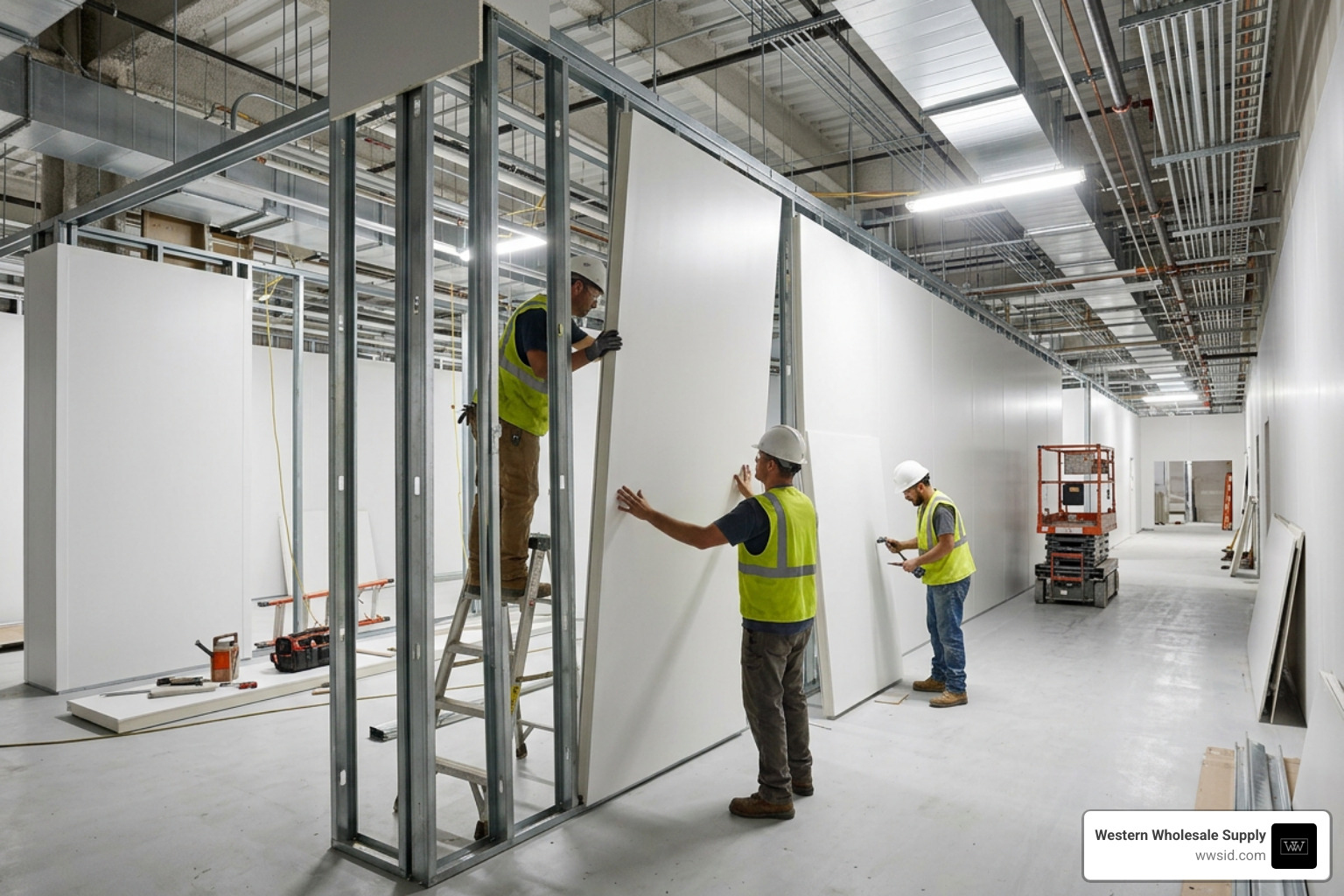
Even high-performance wall claddings will fail if installed with improper adhesives, insufficient expansion allowances, or low-grade sealants. Maintaining a true sterile boundary requires careful substrate prep and precise installation techniques. For a deeper look at bonding agents, check out our advanced FRP adhesives guide.
Installation Methods and Mounting for an FRP Panel for Labs
There are three primary installation methods for laboratory environments, each balancing installation speed, demountability, and structural rigidity:
Direct-Bond Polymer Adhesives:
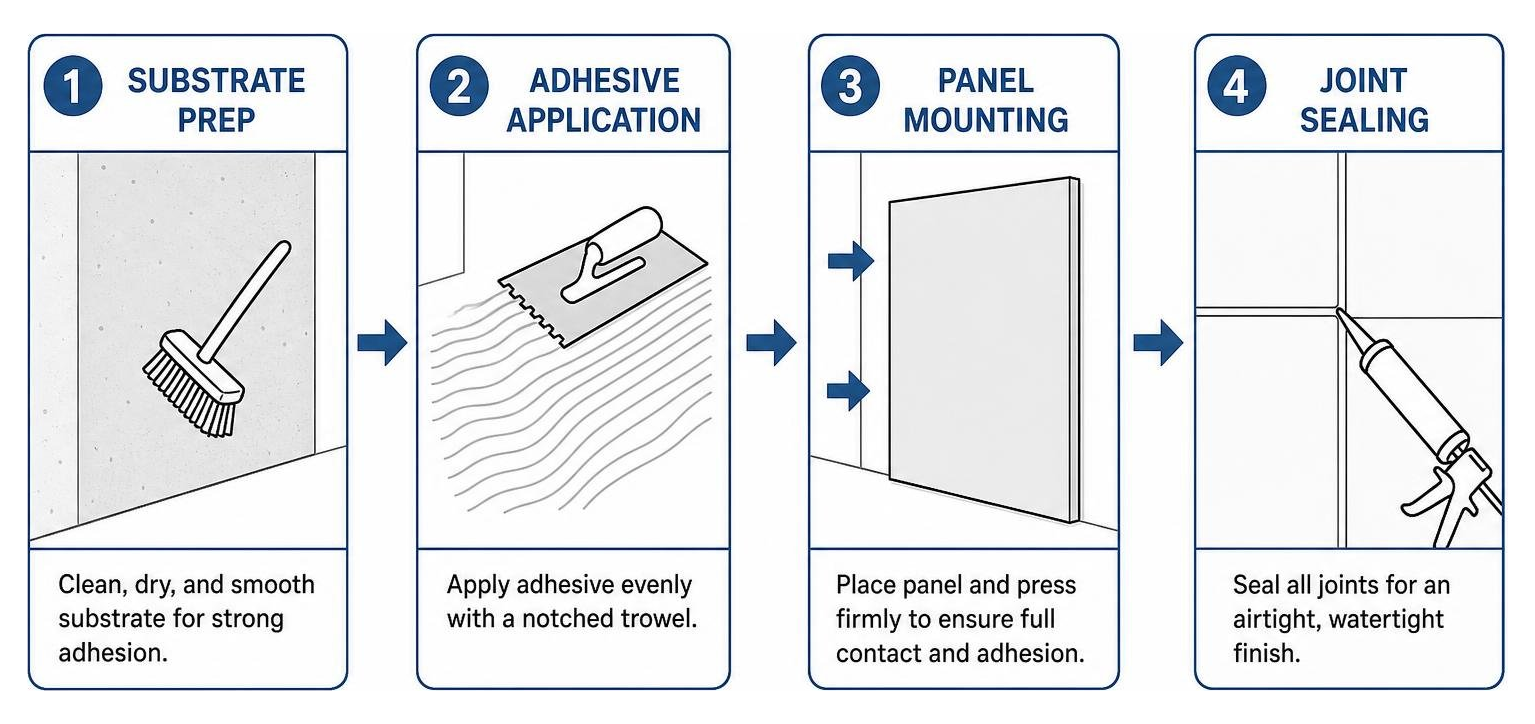
- Process: A structural advanced polymer or water-resistant acrylic adhesive is applied to the substrate using a notched trowel. Panels are rolled firmly to eliminate trapped air.
- Best For: Flush bonding over moisture-resistant drywall, cement board, or smooth masonry.
- Speed: An experienced 4-person crew can install 800 to 1,200 m² per day, with individual panels set in as little as 6 minutes.
Concealed Mechanical Clips:
- Process: Hidden male/female mounting clips are secured to the subwall and panel reverse, clicking into place without surface penetrations.
- Best For: Cleanroom suites requiring future access to in-wall utility chases, or spaces where panels must be demountable.
Face-Fastened Mechanical Anchors:
- Process: Using non-corrosive Grabber or Brighton Best fasteners driven through pre-drilled oversized holes, capped with color-matched polymer heads.
- Best For: Rough framing, high-vibration equipment bays, or direct-to-stud utility zones.
For clean substrate prep and cutting, professional installers rely on high-grade drywall finishing tools from trusted brands like Hyde, USG Sheetrock Tools, Columbia Taping Tools, and Marshalltown to ensure flat, even surfaces before bonding.
Joint Sealing, Expansion Accommodations, and Preventative Maintenance
Composites expand and contract with temperature shifts. Failing to accommodate this movement can cause buckling and seam failure:
- Thermal Expansion Spacing: Maintain a 1/8-inch (approx. 3 mm) gap at panel joints and a 1/4-inch gap at floors and ceilings to allow natural thermal expansion.
- Two-Component Urethane and Antimicrobial Sealants: Skip standard silicone caulks in sterile suites. Use specialized two-component, non-outgassing urethane or MS polymer sealants. Smooth the joint flush using a radiused caulking tool to prevent recessed ledges.
- Routine Maintenance Protocols: Clean the non-porous gelcoat using soft microfibers, neutral detergents, or standard sanitizing mists. Avoid abrasive scouring pads and wire brushes, which can dull the gloss finish and create micro-scratches over time.
Frequently Asked Questions About Laboratory FRP Wall Panels
What cleanroom classifications do FRP panels support in research facilities?
Smooth, high-performance composite panels support cleanroom cleanliness classifications from ISO 8 down to ISO 5 under ISO 14644-1. Their cross-linked, non-shedding surface prevents particle emissions, while non-outgassing properties ensure air purity in pharmaceutical manufacturing, semiconductor research, and sterile hospital compounding suites.
How do laboratory FRP panels resist aggressive cleaning chemicals and autoclaving vapors?
Laboratory-grade panels are formulated with high-density polyester or vinylester resin matrices and a factory-cured protective gelcoat. This non-porous finish resists chemical softening, bubbling, and etching from aggressive cleaners like 10% sodium hypochlorite, vaporized hydrogen peroxide (VHP), peracetic acid, and concentrated solvents.
What is the expected lifespan of FRP panels under daily laboratory washdown conditions?
Under continuous daily washdown and aggressive sanitization routines, high-quality composite panels deliver a typical service life of 15 to 25 years. Because the material does not rot, corrode, rust, or support fungal growth, it requires minimal structural maintenance compared to painted drywall or tiled surfaces.
Conclusion
Selecting the right wall cladding is a critical decision in laboratory design. The ideal material must deliver verified chemical resistance, impact toughness, fire safety, and antimicrobial performance while keeping long-term maintenance low. By choosing an engineered composite system, facility managers and contractors create durable, compliant research spaces built to perform for decades.
At Western Wholesale Supply, we are an independent, veteran-owned, third-generation family business supplying commercial builders across Eastern Idaho, Western Wyoming, and neighboring regions since 1963. Whether your project is in Idaho Falls, Pocatello, Jackson, Rexburg, or Twin Falls, we support commercial builders with dependable, on-time jobsite delivery and technical product expertise. To choose the right materials for your next controlled environment, explore comprehensive commercial FRP panel solutions with our team today.
