

Understanding Drywall Anchors and Weight Capacities
Choosing the right fastener requires understanding how weight acts on hollow wall assemblies. When you hang an item on standard 1/2-inch or 5/8-inch sheetrock, two main forces are applied to the mounting point: shear load and pullout force. Shear load is the downward gravitational pull hanging parallel to the wall surface, like a flat picture frame. Pullout force is the outward tension pulling the anchor directly forward out of the wallboard core, which increases when an object extends outward, like a plant hanger or heavy shelf bracket.
Manufacturers test fasteners to determine their ultimate holding strength, but safe working limits are significantly lower. Industry standard safety guidelines recommend calculating working weight limits at 25% (one-fourth) of an anchor’s maximum ultimate load capacity to prevent wall shear failures over time.
Weight limits also change depending on panel thickness. For example, standard heavy-duty self-drilling nylon fasteners hold approximately 65 lbs in 3/8-inch drywall, 75 lbs in 1/2-inch drywall, and 80 lbs in 5/8-inch drywall.
| Anchor Type | Duty Rating | General Drywall Weight Capacity | Common Project Applications |
|---|---|---|---|
| Plastic Expansion Anchors | Light-Duty | 5 to 25 lbs | Small picture frames, lightweight clocks |
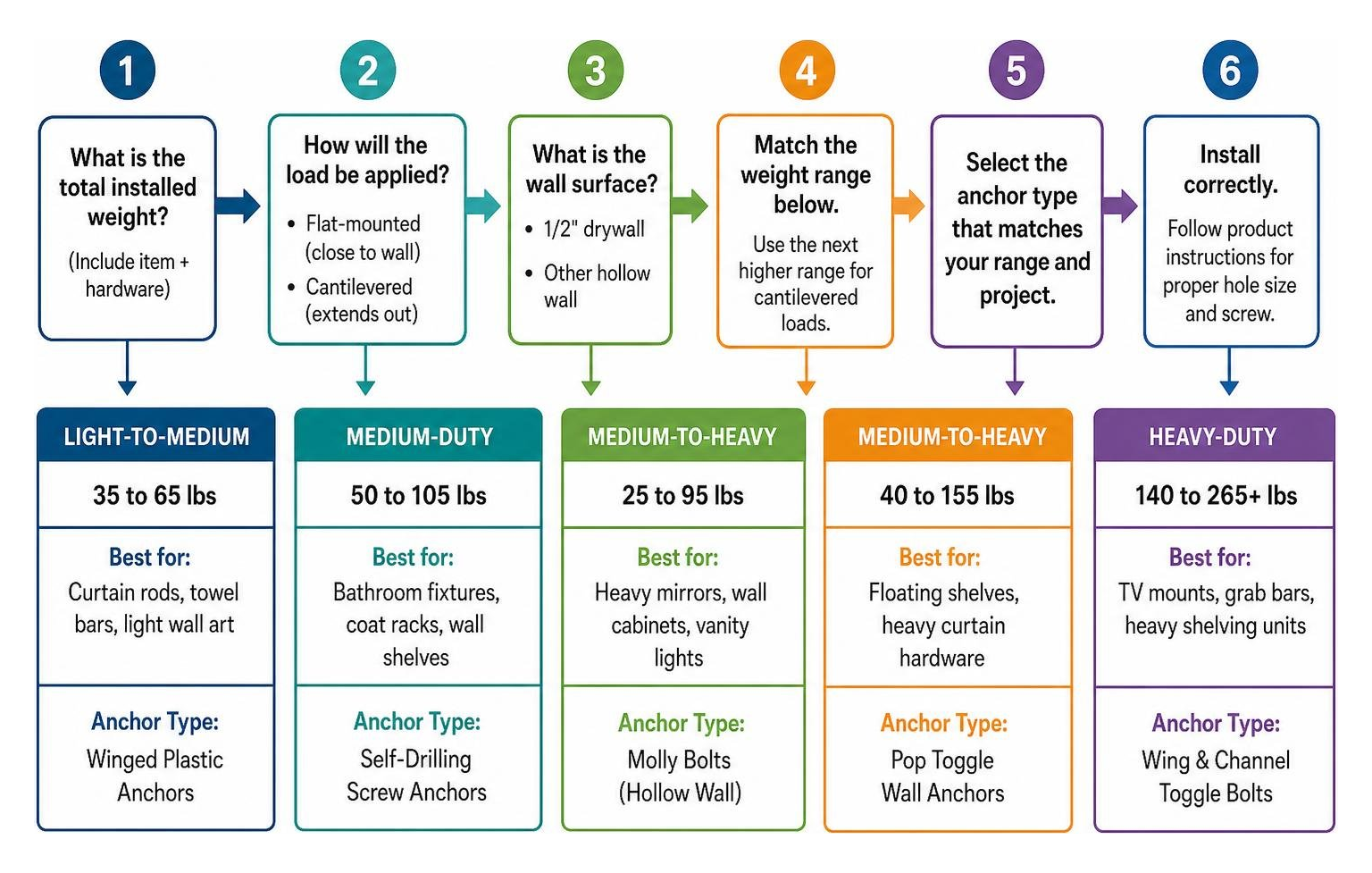
| Winged Plastic Anchors | Light-to-Medium | 35 to 65 lbs | Curtain rods, towel bars, light wall art |
| Self-Drilling Screw Anchors | Medium-Duty | 50 to 105 lbs | Bathroom fixtures, coat racks, wall shelves |
| Molly Bolts (Hollow Wall) | Medium-to-Heavy | 25 to 95 lbs | Heavy mirrors, wall cabinets, vanity lights |
| Pop Toggle Wall Anchors | Medium-to-Heavy | 40 to 155 lbs | Floating shelves, heavy curtain hardware |
| Wing & Channel Toggle Bolts | Heavy-Duty | 140 to 265+ lbs | TV mounts, grab bars, heavy shelving units |
Plastic Expansion and Winged Drywall Anchors
Plastic expansion plugs are the most common light-duty fasteners. They work by expanding outward against the sides of a pre-drilled hole as a screw is driven into their center core. While popular for lightweight hardware, standard smooth plastic plugs are primarily engineered for solid masonry or concrete rather than hollow sheetrock. In hollow drywall, they lack solid backing to expand against, which frequently causes them to spin, loosen, or pull through under loads over 10 to 25 pounds.
Winged plastic anchors improve on basic plugs by using flexible plastic legs that compress during installation, then pop open behind the sheetrock layer as the screw is tightened. This creates a mechanical flange behind the wallboard, raising the safe weight capacity up to 35 to 65 pounds. To learn more about selecting hardware for decorative items, explore our comprehensive guide to drywall anchors for hanging pictures.
Self-Drilling Screw Drywall Anchors
Self-drilling screw anchors—often called threaded anchors or wall augers—are designed with deep, aggressive outer threads and a drill-bit tip. Made from zinc alloy or tough glass-filled nylon, these fasteners slice directly into hollow gypsum wallboard without requiring a separate pilot hole.
Products like E-Z Ancor Twist-N-Lock 75 lbs. Drywall Anchors (50-Pack) 25310 or the high-capacity Walldriller Plus #8 x 1-1/2 in. Nylon Self-Drilling with Screws Phillips Head 105lbs. Hallow Wall Anchor (50-pack) thread into the material, creating a firm friction fit across a wide surface area. They install quickly using standard screwdrivers or power drivers equipped with Phillips or square drive bits. For a complete breakdown of easy-to-install varieties, read the definitive guide to drywall anchor types for easy installation.
Heavy-Duty Molly Bolts and Toggle Bolts
When mounting heavy fixtures, mechanical toggle devices provide the highest holding power in hollow construction. Molly bolts (expandable hollow wall anchors) feature a slotted metal sleeve that collapses outward into five rigid legs behind the wallboard as the central machine screw is tightened, trapping the drywall between the front head collar and the expanded metal wings.
Toggle bolts take holding power even further. Traditional wing toggle bolts use a spring-loaded metal butterfly nut that opens flat against the back of the wall. Modern channel toggles (like snap toggles) use a solid metal channel sliding on plastic straps. A single 1/4-inch channel toggle bolt can support up to 265 lbs in 1/2-inch drywall by spreading the weight across a thick steel bar. For a deeper look into expandable metal fasteners, review the definitive guide to molly fasteners.
How to Choose the Right Anchor for Your Project
Selecting the proper fastener requires matching your object’s total weight and shape to the correct anchor mechanics. Always factor in the item’s center of gravity; flat-mounted items apply pure shear weight, while cantilevered items (like deep floating shelves, towel bars, or extended light fixtures) exert leverage that pulls the top fastener outward.
When selecting fasteners for commercial or residential builds, using reliable brands like Brighton Best or Grabber fasteners ensures consistent thread engagement and strength.
Plastic vs Metal Fastener Options
Drywall anchor materials generally fall into two categories: plastic/nylon and metal (zinc alloy or steel).
- Nylon Plastic Fasteners: Non-corrosive, lightweight, and budget-friendly. Modern glass-filled nylon self-drilling anchors offer impressive holding strength (up to 75–105 lbs) while resisting stripping during installation.
- Zinc Alloy & Steel Fasteners: Superior shear strength and higher heat resistance. Metal self-drilling options like an 8 x 1.18 in. Zinc Self Drilling Drywall Anchors Kit (25-Pack) bite into tough wall finishes without snapping, and zinc molly bolts handle heavy structural fixtures.
For more details on matching fastener sizes to sheetrock thickness, read our guide on how size matters when you are screwing into sheetrock.
Ceiling Mounting and Flat-Screen TV Applications
Mounting fixtures overhead or hanging flat-screen televisions requires extra caution. Gravity pulls ceiling anchors down in continuous tension (pure pullout force), drastically reducing standard weight capacity ratings. Self-drilling nylon anchors should never be used in ceiling applications or for hanging wall-mounted televisions.
For ceiling installations, select vibration-resistant fasteners like specialized self-drilling metal anchors or solid steel toggle bolts that lock securely behind the gypsum board. When mounting flat-screen TVs or heavy articulating arms, securing the bracket directly to wood or steel wall studs is always the safest method. If stud placement prevents this, heavy-duty snap toggles anchored into sound wallboard provide strong mechanical anchorage.
Step-by-Step Installation and Reusability Guide

Installing drywall anchors cleanly requires the right sequence and proper tools. Keeping basic drywall tool kits on hand ensures professional results.
Tools Required for Installation:
- Cordless drill or screwdriver
- Drill bit set (matched to anchor packaging specs)
- Hammer or rubber mallet
- Tape measure and level
- Eye protection
- Drywall finishing tools (like Hyde, USG Sheetrock Tools, Columbia Taping Tools, or Marshalltown taping knives for minor repairs)
Installation Sequence:
- Mark the Spot: Mark your mounting location using a level and pencil. Use a stud finder to verify whether a stud is present behind the sheetrock.
- Pre-Drill (If Required): For plastic expansion plugs, molly bolts, or toggle bolts, drill a straight pilot hole matching the anchor manufacturer’s exact diameter specification. Avoid wiggling the drill bit so the hole stays round. Self-drilling anchors skip this step.
- Seat the Anchor: Tap plastic plugs or molly bolts flush into the hole using a hammer. For self-drilling anchors, drive the anchor directly into the drywall using hand pressure on a screwdriver or low speed on a drill until the head sits flush with the paper surface.
- Tighten Screw: Insert the included screw through your mounting bracket and drive it into the anchor. For molly bolts, drive the screw tightly to collapse the metal legs behind the wall, then back it out slightly to hook your fixture.
Are drywall anchors reusable? As a rule, most hollow wall anchors are not reusable. Removing a plastic plug, self-drilling anchor, or toggle leaves an enlarged hole in the wallboard core, destroying the tight material fit required for safe re-installation. While you can unscrew the center fastener from an installed molly bolt or channel toggle without removing the anchor body, the anchor insert itself remains permanently seated in the wall.
To cleanly remove a damaged anchor, hammer the exposed head slightly below the paper surface and patch over it with spackle, or carefully slice off the raised rim with a utility knife before patching. For tool recommendations, explore Drywall Tools 101.
Frequently Asked Questions
Are drywall anchors reusable after removal?
No, standard drywall anchors are not reusable. Threaded self-drilling anchors and expansion plugs carve away internal gypsum core material during installation. Pulling them out leaves an enlarged hole that will not hold a new anchor of the same size. If you remove an anchor, you must patch the hole and install a fresh anchor in a new wall location.
What is the difference between molly bolts and toggle bolts?
The main difference lies in their mechanical design behind the wall. A molly bolt features a pre-attached expandable metal sleeve that collapses outward into rigid metal legs as you tighten its screw. A toggle bolt uses a separate threaded machine bolt paired with spring-loaded wings (or a solid steel channel) that pass through a drilled hole and open wide behind the wall panel. Toggle bolts generally support heavier ultimate loads than molly bolts.
Can you install heavy items without hitting a wall stud?
Yes, heavy items can be safely mounted without a wall stud if you use heavy-duty steel channel toggle bolts or snap toggles. High-capacity channel toggles spread loads across a wider area of sheetrock, supporting up to 265 lbs per anchor point in 1/2-inch drywall under static shear loads. However, for dynamic loads or extremely heavy items (like large floating cabinets or structural grab bars), fastening directly to structural studs is recommended.
Conclusion
Understanding how drywall anchors distribute weight allows you to complete every mounting project with confidence. Whether you are installing lightweight trim, setting up curtain rods with self-drilling nylon fasteners, or mounting heavy shelving with steel toggle bolts, matching the fastener to the load prevents wall damage and keeps fixtures secure.
At Western Wholesale Supply, we have served contractors, builders, and trade professionals across Eastern Idaho and Western Wyoming since 1963. As a third-generation, family-owned supplier, we stock commercial-grade building materials—from standard sheetrock, specialty soundproof panels like Quietrock EZ Snap, Durock cement board, CertainTeed ceiling tiles, steel framing, and warehouse insulation (R-30+ ceilings, R-13+ walls) to professional jobsite fasteners from top brands like Brighton Best and Grabber.
Visit our showrooms across Eastern Idaho and Western Wyoming or contact our experienced team today for reliable, on-time jobsite delivery and professional service backed by over 60 years of building experience. Learn More at Western Wholesale Supply.
