

Drywall Easy Anchors Make Hollow-Wall Mounting Faster
Drywall easy anchors are hollow-wall fasteners that let you mount light- to medium-duty items when there is no stud at the mounting point. Many are self-drilling: their sharp tip and coarse threads drive directly into gypsum board, then hold a matching screw securely enough for items such as picture frames, curtain hardware, towel bars, and small shelves.
| Quick answer | What to know |
|---|---|
| Easiest type to install | Self-drilling nylon or zinc anchors usually need no pilot hole. |
| Best use | Static wall-mounted fixtures in sound, dry wallboard. |
| Load limits | Ratings vary by anchor, drywall thickness, and load direction. Use the manufacturer rating and a conservative safety margin. |
| Avoid | Ceiling loads, television mounts, and safety-critical fixtures unless the hardware is fastened into suitable framing or backing. |
The right anchor is not simply the one with the highest number on the package. Wall thickness, the condition of the drywall, the fixture shape, and whether the load pulls outward or bears downward all affect real holding strength.
At Western Wholesale Supply, as third-generation building-materials professionals working with contractors and builders across residential and commercial projects, our experience supplying drywall and related hardware helps us focus this guide on selecting and installing drywall easy anchors with fewer callbacks and less wall damage.
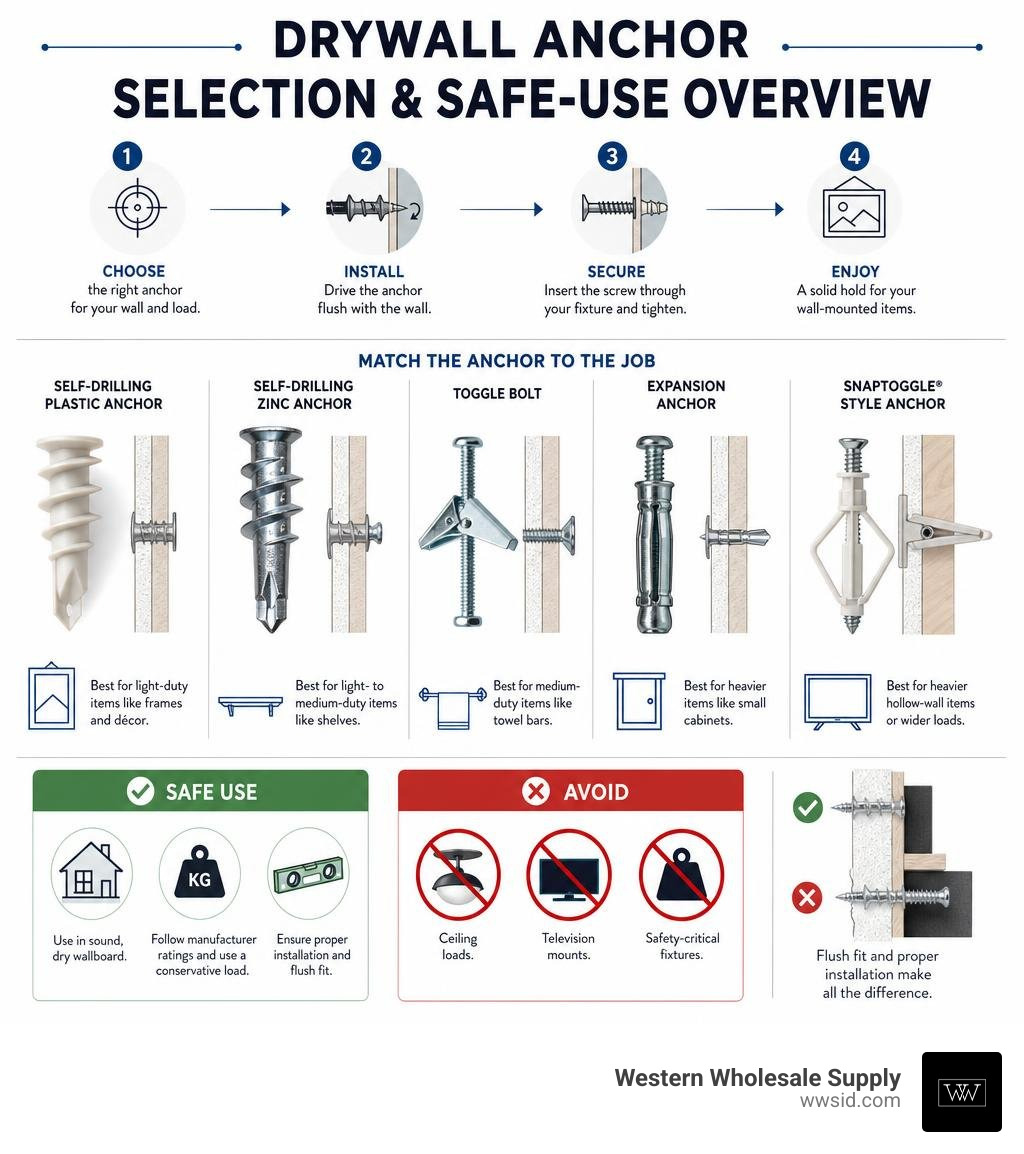
Understanding Drywall Easy Anchors and How They Work
At our supply centers across Eastern Idaho and Western Wyoming—from Idaho Falls and Pocatello to Jackson and Twin Falls—we frequently help builders and DIY homeowners solve a common challenge: securing fixtures cleanly into hollow gypsum board. While hitting a solid wall stud is always ideal, interior design layout often forces us to mount items directly into hollow drywall bays. That is where drywall easy anchors come into play.
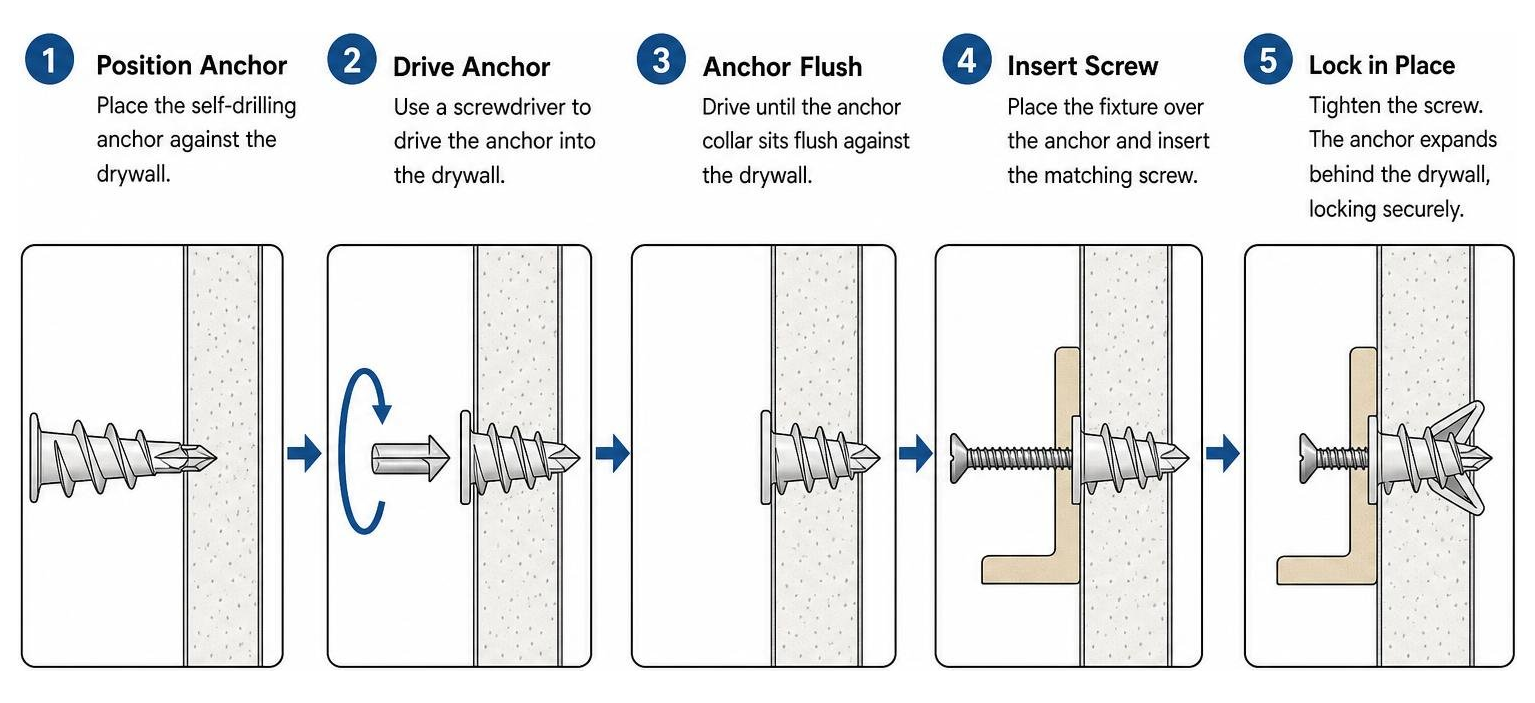
Unlike traditional plastic wall plugs that demand a pre-drilled pilot hole and often collapse under pressure, modern self-drilling fasteners feature integrated drill-bit tips and aggressive external threads. When you drive the anchor into drywall, the tip slices through the paper facing and gypsum core, while the wide outer threads bite deep into the panel. Once the anchor body sits flush against the wallboard, you insert a matching screw through your fixture. As the screw drives into the center core of the anchor, it forces the anchor mechanism to expand or break open behind the panel, creating a rock-solid mechanical wedge.
Mechanics of Self-Drilling Fasteners
The secret behind a self-drilling anchor is thread engagement and load distribution. Standard wallboard relies on a compacted gypsum core sandwiched between heavy paper facings. A simple nail or plain screw quickly pulls out under load because standard threads offer minimal contact area against brittle gypsum.
Self-drilling fasteners overcome this limitation by dramatically increasing the surface area of thread contact. The wide exterior pitch acts like an auger, transferring downward shear force across a broad section of the wallboard. Knowing how screw diameter and thread pitch engage the wallboard is vital for long-term holding strength, as explained in our guide on how Size Matters When You Are Screwing into Sheetrock. High-quality fasteners from trusted brands like Brighton Best or Grabber are engineered so that driving the sheet metal screw expands the anchor’s inner tail, locking the fastener permanently into position without stripping the drywall core.
Zinc vs Nylon Drywall Easy Anchors
When choosing self-drilling fasteners, you will primarily decide between heavy-duty zinc alloy and high-strength engineered nylon. Both materials eliminate pre-drilling in standard wallboard, but they serve different performance requirements:
- Zinc Alloy Anchors: Cast from durable zinc, these anchors feature exceptionally sharp drill points that slice through thick drywall and standard paint layers with ease. Zinc anchors offer superior shear strength and high heat resistance. In fact, heavy-duty zinc fasteners—like the options featured in the CRL Zinc 6-8 Screw Size EZ-Anchor for Drywall | CRL —can even bore directly into behind-the-wall wood studs without breaking if you happen to hit framing mid-drive.
- Engineered Nylon Anchors: Molded from reinforced non-conductive resins, nylon fasteners provide an excellent lightweight alternative. Heavy-duty nylon anchors resist corrosion, making them ideal for high-moisture commercial spaces like bathrooms, breakrooms, or damp basements. High-performance nylon options, such as the Twist-N-Lock 75 lbs. Drywall Anchors (4-Pack) , utilize specialized splitting tails that grip firmly behind 3/8-inch, 1/2-inch, or 5/8-inch sheetrock without tearing the paper backing.
Types of Drywall Fasteners and Load Capacities
Selecting the proper hollow-wall anchor requires matching the weight and usage of your item with the correct fastener geometry. Choosing an undersized anchor risks pulled-out wallboard, while an oversized toggle bolt might create an unnecessary hole for a lightweight picture frame.
Self-Drilling vs Expansion vs Toggle Fasteners
To understand where drywall easy anchors shine, it helps to compare them against traditional wall anchors:
- Plastic Expansion Plugs: These basic ribbed sleeves require a pre-drilled pilot hole. As you drive a screw inside, the plastic expands against the inner walls of the drywall hole. They are strictly designed for light loads (up to 10 to 25 pounds) and can fail easily if dynamic pulling force is applied.
- Self-Drilling Fasteners: Designed for effortless installation, these require no pre-drilling. Equipped with high-torque threads, self-drilling nylon or zinc anchors comfortably handle medium-duty items from 30 up to 75 pounds in standard 1/2-inch drywall.
- Hollow-Wall Sleeve Fasteners (Molly Bolts): Featuring expandable metal legs, molly bolts expand inside the cavity to clamp the back of the drywall. They support up to 95 pounds. For a deep dive into these metal anchors, read The Definitive Guide to Molly Fasteners.
- Spring-Loaded Toggle Bolts: Toggle bolts feature metal wings that spring open behind the wall board, distributing heavy loads across a broad area. They offer ultimate holding power (holding 150 to 265 pounds), but require drilling a large entry hole.
| Anchor Type | Pre-Drilling Required? | Relative Holding Strength | Maximum Rated Load Range* | Ideal Applications |
|---|---|---|---|---|
| Plastic Expansion Plug | Yes | Light | 10 – 25 lbs | Small picture frames, smoke detectors |
| Self-Drilling Nylon Anchor | No | Light to Medium | 30 – 75 lbs | Towel bars, clocks, curtain brackets |
| Self-Drilling Zinc Anchor | No | Medium to Heavy | 50 – 100 lbs | Coat racks, shelving, bathroom hardware |
| Molly Bolt | Yes | Heavy | 50 – 95 lbs | Kitchen cabinets, heavy mirrors |
| Toggle Bolt | Yes | Maximum | 150 – 265 lbs | Heavy shelving units, wall-mounted sinks |
*Note: Rated capacities reflect ultimate laboratory values in sound 1/2-inch drywall. Safe working load rules must be applied.
Safe Load Capacity Guidelines
A frequent mistake in hardware installation is taking the weight capacity printed on a box as an absolute promise for daily use. Laboratory strength ratings are calculated under ideal conditions in factory-fresh 1/2-inch wallboard under purely vertical static shear loads.
In real-world construction, safety factors are essential. Industry standard guidelines state that you should limit working loads to 25 percent of the anchor’s total rated weight capacity. For instance, an anchor rated for an ultimate holding limit of 75 pounds has a safe continuous working load of roughly 18.75 pounds. This 4:1 safety factor absorbs unexpected shock loads, minor vibrations, or slight imperfections in aging gypsum.
Furthermore, holding power scales directly with drywall thickness:
- 3/8-inch Drywall: Reduces holding power by roughly 15–20%.
- 1/2-inch Drywall: Standard baseline rating (e.g., 75 lbs ultimate rating).
- 5/8-inch Drywall: Increases holding power to roughly 80–100 lbs ultimate rating.
For detailed guidelines on hanging lighter artwork and wall decorations, check out A Comprehensive Guide to Drywall Anchors for Hanging Pictures.
Best Practices for Anchor Installation and Removal
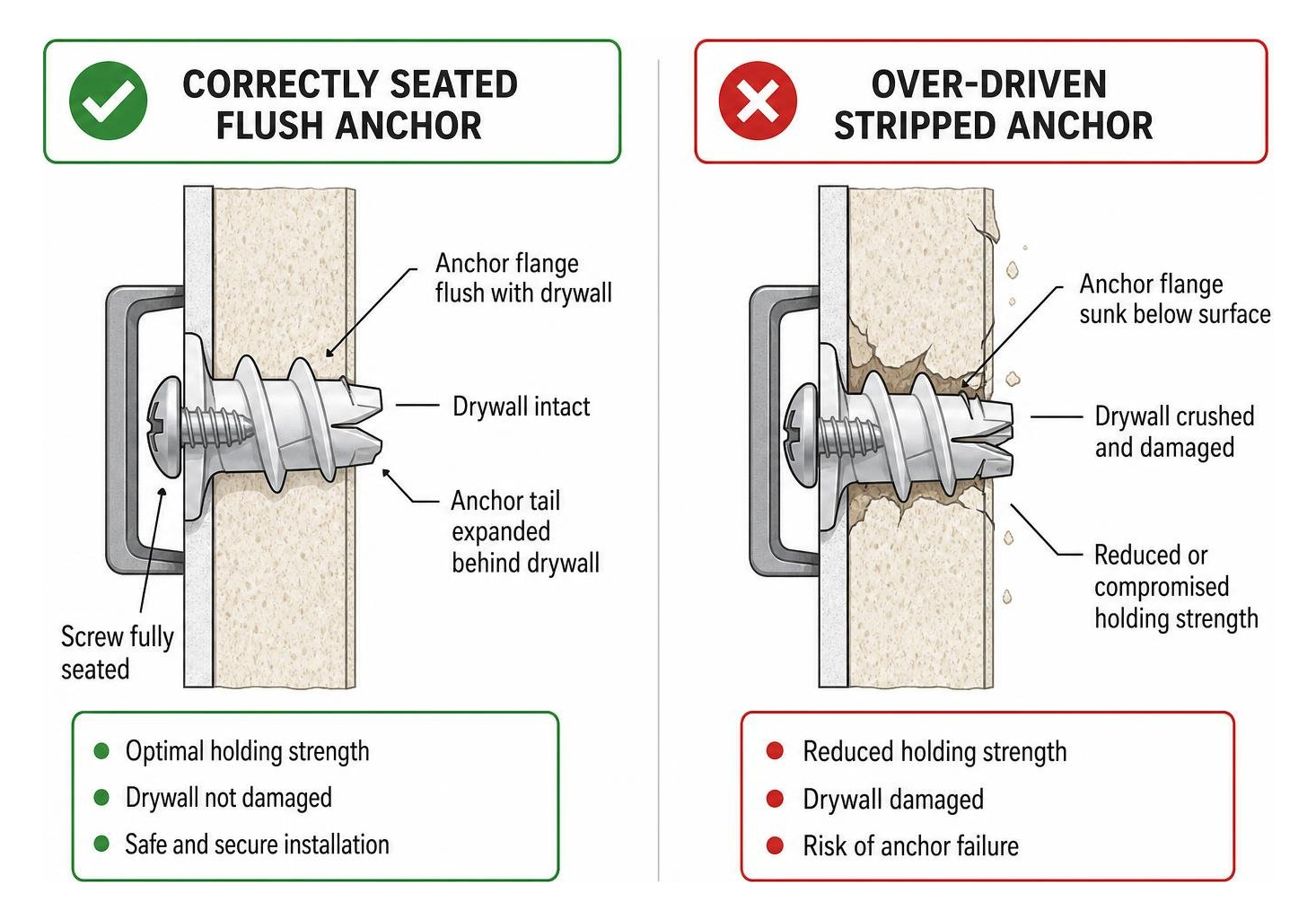
Proper installation technique ensures your anchors grip flush and hold tight without stripping out the soft gypsum core.
Installing Drywall Easy Anchors Step-by-Step
Installing self-drilling fasteners is straightforward when following these key steps:
- Mark the Target Location: Use a spirit level and pencil to mark the exact spot. Verify there are no live electrical wires or plumbing lines running directly behind the mark.
- Position the Anchor Tip: Set the tip of your self-drilling anchor directly onto your mark.
- Drive the Anchor Flush: Using a standard #2 Phillips hand screwdriver or a cordless driver set to low speed/low torque, apply steady forward pressure and turn clockwise. The auger tip will penetrate the wallboard facing and drive the wide threads into the drywall. Stop turning as soon as the outer flange sits flush with the surface. Do not overtighten, as spinning the anchor beyond flush will strip the surrounding gypsum core.
- Secure the Mounting Bracket: Place your item’s bracket over the anchor core. Insert the included sheet metal screw through the bracket into the center of the anchor.
- Listen for the Engagement Click: Drive the screw smoothly. As the screw reaches halfway in, high-quality self-drilling anchors often produce a distinct single “click” sound. This audible cue confirms that the anchor’s locking tail has expanded or split properly behind the wallboard. Continue driving until the screw head seats firmly against the bracket.
For additional practical advice on choosing the right drive bits and fasteners, refer to our helpful tips on Self-Drill Drywall Screws Tips 2026.
Anchor Removal and Wall Repair
One major advantage of drywall easy anchors compared to permanent toggle bolts or molly expansion sleeves is how cleanly they back out of wallboard when redecorating or moving fixtures.
To remove a self-drilling anchor:
- Remove the inner machine or sheet metal screw.
- Insert a #2 Phillips hand screwdriver firmly into the central drive head of the anchor body.
- Turn counter-clockwise while applying mild backward pressure. The wide external threads will unthread smoothly from the sheetrock, leaving a clean threaded hole.
To repair the hole, scrape away loose paper fibers using a joint knife from quality manufacturers like Hyde, Sheetrock Tools, Columbia Taping Tools, or Marshalltown (all stocked right in our local showrooms). Press lightweight spackling compound or joint compound into the opening, feather the edges flush with the wall, let it dry, sand smoothly, and prime. For specialized techniques when using wall setting tools, explore How to Use a Hollow Wall Anchor Tool in 7 Days.
Safety Considerations and Ideal Applications
Matching hardware to the surrounding building envelope prevents costly property damage or personal injury.

Approved Applications vs Prohibited Uses
Drywall easy anchors are engineered for static wall-mounting applications on vertical surfaces. They perform exceptionally well for:
- Bathroom accessories (towel bars, toilet paper holders, soap dishes)
- Coat hooks, key racks, and entryway organizer shelves
- Drape hardware, curtain rods, and window blind brackets
- Wall clocks, decorative mirrors, and framed artwork
- Thermostats, security keypads, and electrical control panels
Prohibited Applications:
- Ceiling Installations: Never use standard self-drilling anchors overhead in ceilings. Gravity exerts continuous downward pullout tension, which can pull the anchor straight out of brittle ceiling drywall over time.
- Television Wall Mounts: Flat-screen TVs project outward on articulated steel arms, generating heavy dynamic leverage (cantilever load). TV brackets must always be lag-bolted directly into solid wood studs or structural metal framing.
- Dynamic or Impact Loads: Avoid using easy anchors for swing sets, heavy pull-up bars, or dynamic grab bars intended for full body-weight support unless backed by structural blocking.
Environmental Factors and Wall Integrity
The physical condition of your building board directly influences anchor performance. Old, dry-rotted, or water-damaged gypsum loses structural cohesion, allowing threads to strip out under minimal force. High ambient humidity in unconditioned spaces can soften wallboard cores over time.
In commercial spaces and agricultural warehouses across Eastern Idaho, managing interior temperature and humidity is essential for protecting wall structures. High-performance insulation systems—such as warehouse wall insulation rated R-13+ and ceiling insulation rated R-30+—help eliminate temperature swings and moisture condensation, ensuring structural drywall panels maintain their original strength and fastener holding power.
Frequently Asked Questions About Drywall Anchors
Are easy drywall anchors safe for ceiling installations or TV mounts?
No. Standard self-drilling drywall easy anchors should never be used for ceiling installations or television mounting. Ceiling mounts place fasteners under direct tension (pullout load), where gravity works continuously against the brittle gypsum core. Television wall mounts create dynamic leverage on long cantilever arms. Overhead fixtures and televisions must always be anchored directly into structural wood ceiling joists, wall studs, or engineered framing members using suitable construction lag screws.
How much weight can self-drilling anchors safely support?
Under laboratory test conditions in solid 1/2-inch drywall, quality self-drilling nylon anchors support up to 75 pounds of static shear load, while heavy-duty zinc self-drilling anchors can reach ratings up to 100 pounds. However, construction best practices require applying a 25 percent safety factor. This means a 75-pound rated anchor should be limited to a continuous working load of roughly 18.75 pounds per fixture to safely account for shock, movement, and wallboard age.
Does installing multiple anchors double the total weight limit?
No. Weight capacity ratings provided by hardware manufacturers are calculated per job/fixture, not per anchor. Adding a second or third anchor to a single shelf bracket distributes the load across more points, but it does not double or triple the total weight capacity of the drywall panel itself. The maximum holding capacity remains constrained by the overall shear strength of the localized gypsum sheet.
Conclusion
Choosing the right drywall easy anchors streamlines installation projects while protecting wall finishes from accidental blowouts. By opting for reliable self-drilling nylon or zinc fasteners, respecting the 25% safe working load rule, and selecting studs for heavy or overhead dynamic loads, you guarantee long-lasting, professional mounting results every single time.
At Western Wholesale Supply, we are an independent, veteran-owned, third-generation family business supplying premium building materials since 1963. Whether you are building commercial spaces, insulating industrial warehouses, or picking up specialty fasteners at our showrooms in Idaho Falls, Pocatello, Twin Falls, Rexburg, Jackson, or anywhere across Eastern Idaho, Western Wyoming, and Western Montana, our experienced team provides reliable, on-time delivery and top-tier customer support. Explore our full range of commercial drywall, specialty wallboard like Durock and Quietrock EZ Snap, Brighton Best and Grabber fasteners, and CertainTeed acoustical ceiling systems by visiting our Western Wholesale Supply Products catalog today.
