

Why Self Drill Drywall Screws Are the Fastest Way to Hang Drywall on Metal Studs
Self drill drywall screws are the go-to fastener for attaching gypsum board to metal studs without pre-drilling. Here is a quick snapshot of what you need to know before buying:
| What You Need | What to Choose |
|---|---|
| Drywall to light-gauge metal studs (20-25 ga) | #6 x 1-5/8 in. fine thread, bugle head |
| Drywall to heavier metal studs (20-12 ga) | #6 or #8 x 2 in. fine thread, self-drill point |
| Standard 1/2 in. interior drywall | #6 x 1-1/4 in. phosphate or zinc coated |
| 5/8 in. Type X drywall (commercial) | #6 x 1-5/8 in. or longer, fine thread |
| Double-layer drywall | #8 x 3 in. bugle head, fine thread |
| Indoor dry environments | Phosphate or zinc-plated carbon steel |
| Occasional moisture exposure | Exterior-coated or Dagger-Guard finish |
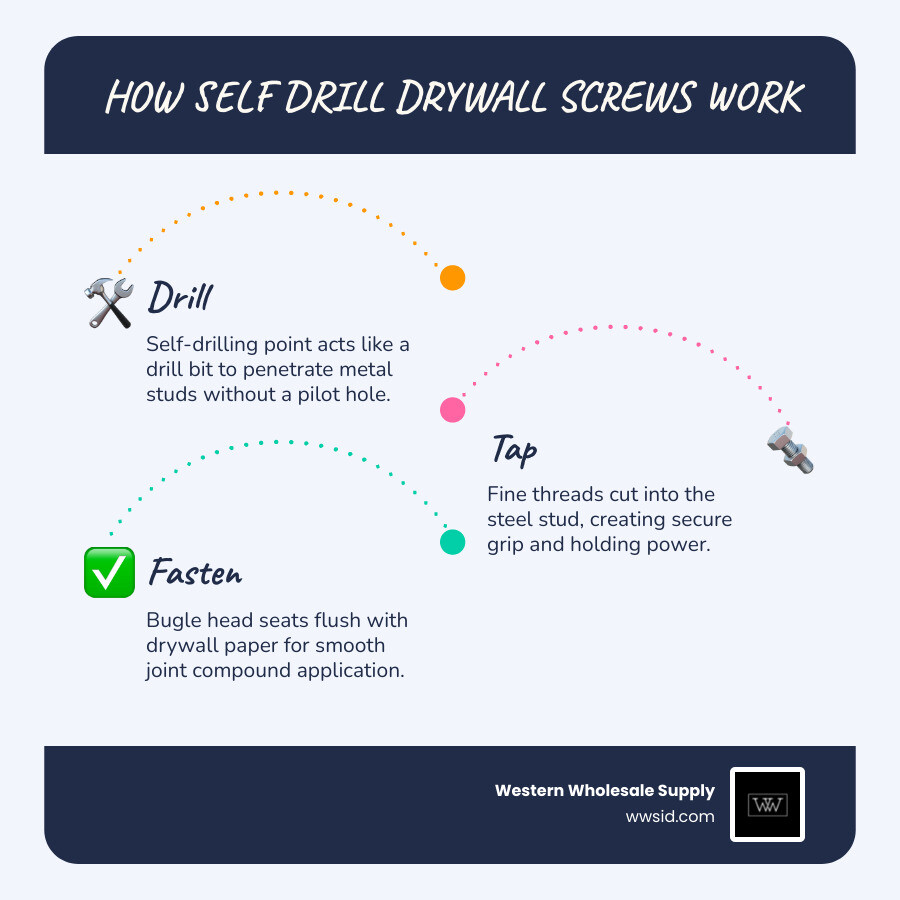
The self-drilling point does three things in one pass: it drills, taps, and fastens. No pilot hole needed. That saves real time on commercial jobs where hundreds of screws go in every day.
At Western Wholesale Supply, we are third-generation building materials professionals — we’ve sourced and supplied self drill drywall screws for residential and commercial projects across Idaho, Wyoming, and Montana, so we know what separates a reliable fastener from one that strips heads and tears paper. Read on for the complete breakdown to help you pick the right screw for your next job.
What Are Self Drill Drywall Screws?
When you are working on a commercial build-out in Idaho Falls or framing a new retail space in Jackson, WY, you quickly realize that traditional wood-framing methods do not translate to steel-stud construction. That is where self drill drywall screws step up to plate.
Unlike standard drywall screws that rely on a sharp, needle-like point to wedge their way into soft wood, a self-drilling drywall screw is engineered with a miniature drill bit at its tip. This specialized point—often referred to in the trades as a TEK point—allows the screw to cut through structural steel studs without requiring you to drill a pilot hole first.
To withstand the intense friction and torque of drilling directly into steel, these fasteners are manufactured from high-quality carbon steel C1022. This high-carbon steel base material provides the structural strength required to pierce metal while preserving the integrity of the screw’s threads. The steel undergoes a dual-stage heat treatment process involving quenching and tempering. This metallurgy creates a dual-property fastener: a super-hard outer surface that can drill through metal and a tough, flexible core that prevents the screw from snapping under high torque.
For a deeper dive into how these fasteners perform in metal framing, check out our comprehensive resource, The Ultimate Guide to Drywall to Metal Screws.
When selecting professional-grade hardware, we look to trusted manufacturers who supply consistent quality. Industry leaders like Pro-Twist offer highly engineered solutions, which you can explore on the Self-Drilling & Tapping Drywall Screws for Metal | Pro-Twist product page. Additionally, manufacturers like Hefeng Group produce excellent high-volume fasteners designed for consistent performance, details of which are highlighted on the Self Drilling Drywall Screws – Hefeng Group technical page.
Key Differences: Sharp Point vs. Self Drill Drywall Screws
It is easy to get confused when standing in front of the fastener aisle. Let’s make the distinction clear:
- Sharp Point Drywall Screws: These feature a needle-sharp tip designed to pierce wood framing or very light-gauge metal (like 25-gauge non-structural steel studs). They rely on the material pushing aside to create a friction fit. If you try to drive a sharp point screw into a heavy 16-gauge steel stud, the tip will burn up, spin endlessly, and leave you with a ruined fastener and a sore shoulder. You can learn more about how sizing impacts these installations in our guide, Size Matters When You Are Screwing Into Sheetrock.
- Self-Drilling Drywall Screws: These are built specifically for metal studs ranging from 20-gauge down to heavy 12-gauge structural steel. The integrated drill point actually carves out tiny metal shavings, creating a perfectly sized hole before the fine threads engage and tap into the steel.
By using self-drilling fasteners, you eliminate the tedious step of pre-drilling pilot holes. On a large commercial warehouse or office partition project, this simple mechanical advantage saves hundreds of labor hours and prevents countless broken drill bits.
Technical Specifications and Sizes
To get a clean, code-compliant drywall installation, you must match the physical dimensions of your screws to the thickness of your drywall and the gauge of your metal studs.
Screw Gauges and Diameters
Self drill drywall screws are primarily available in two common gauge sizes:
- #6 Gauge (3.5mm diameter): This is the industry standard for hanging single-layer drywall sheets (such as standard 1/2-inch panels or 5/8-inch Type X fire-rated drywall) to light-to-medium gauge metal studs.
- #8 Gauge (4.2mm diameter): These thicker screws provide higher shear strength and holding power. They are typically used for heavy-duty structural steel framing, double-layer drywall applications, or when securing denser plasterboards and heavy sheathing.
Common Screw Lengths
Screws are available in lengths ranging from 1 inch up to 3 inches. The most common sizes you will use on the jobsite include:
- 1-1/4 inch (approx. 32mm): The absolute go-to length for securing a single layer of 1/2-inch drywall to metal studs. For general plasterboard projects, you can read our resource on 25mm Plasterboard Screws 101 to understand the basics of short-fastener applications.
- 1-5/8 inch (approx. 41mm): Ideal for hanging thicker 5/8-inch Type X drywall, which is standard in commercial fire-rated assemblies.
- 2 inch (approx. 50mm): Perfect for double-layer drywall installations or when attaching drywall over a thin insulating layer.
- 3 inch (approx. 76mm): Used for multi-layer fire barrier systems or heavy structural attachments. For extremely long fastener applications, check out our Essential Guide to 150mm Drywall Screws.
Head Styles and Drive Types for Self Drill Drywall Screws
The head design of a drywall screw is not an aesthetic choice—it is a functional one. The goal is to hold the drywall firmly in place without breaking the paper face of the gypsum board.
- Bugle Head: The classic tapered head style. As the screw is driven home, the bugle head gently compresses the gypsum core beneath it, drawing the paper face inward without cutting or tearing it. This creates a shallow, clean dimple that is incredibly easy to fill with joint compound.
- Modified Truss Wafer Head: Featuring an oversized, low-profile dome shape, wafer heads provide a much larger bearing surface. These are not meant for hanging drywall that will be mudded and painted; rather, they are designed for securing thin steel tracks, metal framing components, or attaching plaster accessories where pull-through resistance is critical. You can see a great example of this design on the Daggerz #8 x 1/2″ Self-Drilling Drywall Screw, Phillips Modified Truss – Fasteners Plus product page.
- Drive Types: The standard drive style is a #2 Phillips Drive. However, high-production environments often utilize a #2 Reduced Phillips Drive. This specialized recess is designed to minimize the risk of overdriving by allowing the driver bit to cam-out (slip out of the screw head) precisely when the bugle head reaches the correct depth, preventing structural damage to the drywall core.
Thread Patterns and Drill Points
The thread design must match the substrate. For metal studs, fine threads are the industry standard. Fine-thread screws feature a higher thread pitch (typically 18 to 20 threads per inch). This tighter spacing provides more contact points within the thin steel walls of metal studs, maximizing the fastener’s pull-out resistance.
The drill point itself is classified by its capacity:
- Tek #2 Point: Engineered to easily pierce light-to-medium steel thicknesses from 20-gauge down to 12-gauge (or approximately 0.105 inches of metal).
- Tek #3 Point: Designed with a longer unthreaded tip to drill through even thicker structural steel framing before the threads begin to engage.
Materials, Coatings, and Corrosion Resistance
Because joint compound contains water and chemicals that can react with bare steel, choosing the right coating for your self drill drywall screws is vital to prevent rust from bleeding through your beautiful paint job.
- Phosphate Coating (Black or Gray): The most common choice for interior drywall installations. This thin chemical treatment provides a rough, matte finish that offers basic corrosion protection during construction. More importantly, the phosphate layer acts as an excellent bonding agent, ensuring that joint compound and paint adhere perfectly to the screw head.
- Zinc Plating (Clear or Yellow): Provides moderate corrosion resistance by applying a thin layer of electrogalvanized zinc over the carbon steel. Zinc-plated screws are ideal for dry, interior commercial environments where humidity is low. You can view technical details of these zinc-plated options on the Hilti catalog page for PBH SD Z Self-drilling drywall screws – Screws – Hilti USA .
- Exterior Coatings (Dagger-Guard or Ceramic): For areas exposed to high humidity, moisture, or light outdoor exposure, specialty coatings are required. These multi-layer barrier coatings provide superior rust defense. For example, the Daggerz #8 x 1-15/16″ Self-Drilling Drywall Screw, Phillips Bugle Head – Fasteners Plus features a proprietary Dagger-Guard coating designed to handle occasional moisture without rusting.
Selection Guide: Matching Screws to Metal Stud Gauges
To make your next trip to our Western Wholesale Supply showrooms in Idaho Falls, Pocatello, or Twin Falls as seamless as possible, we have put together this handy reference guide.
The table below matches your drywall thickness and stud gauge to the correct self-drilling fastener:
| Drywall Thickness | Metal Stud Gauge | Recommended Screw Size | Thread & Point Type |
|---|---|---|---|
| 1/2 in. Standard | 20 to 25 Ga. (Light Metal) | #6 x 1-1/4 in. | Fine Thread, #2 Drill Point |
| 5/8 in. Type X | 20 to 12 Ga. (Heavy Metal) | #6 x 1-5/8 in. | Fine Thread, #2 Drill Point |
| 1/2 in. or 5/8 in. | 12 to 7 Ga. (Structural Steel) | #8 x 1-15/16 in. | Fine Thread, #2 or #3 Drill Point |
| Double Layer (5/8 in. + 5/8 in.) | 20 to 12 Ga. (Heavy Metal) | #8 x 2-3/8 in. or 3 in. | Fine Thread, #2 Drill Point |
To visualize how these variables interact during your build, use this simple decision path:
Installation Best Practices and Tools
Even the best self drill drywall screws can fail if installed incorrectly. Here are the professional tips we share with crews working across South East Idaho and Western Wyoming:
1. Use the Right Tool for the Job
While a standard cordless drill can drive these screws in a pinch, high-production drywalling demands a dedicated drywall screw gun. These specialized tools operate at high RPMs (typically 4,000 to 4,500 RPM) and feature a depth-sensitive clutch. When the nosepiece presses against the drywall, the clutch engages, drives the screw rapidly, and disengages the moment the head is flush—preventing overdriving. Check out our Ultimate Checklist for Battery Screw Gun Buyers to find the best tool for your crew.
2. Avoid Overdriving and Paper Tearing
The holding power of a drywall screw relies entirely on the paper face of the gypsum board. If you drive the screw too deep and the bugle head ruptures or cuts through the paper, the screw has zero holding power.
- Perfect Depth: The screw head should sit approximately 1/32 inch below the surface of the drywall, creating a shallow dimple without breaking the paper.
- Underdriven Screws: If the head protrudes even slightly, your taping knife will hit it, making it impossible to get a smooth coat of joint compound.
3. Keep Your Finishing Tools Handy
Once your screws are perfectly set, you will need professional-grade finishing tools to complete the job. In our regional showrooms, we carry top-tier brands like Hyde, Columbia Taping Tools, and Marshalltown. Stop by to feel the balance of these tools in your hand before starting your mudding phase. For a full list of must-have gear, read our guide on Drywall Tools 101
Frequently Asked Questions about Self-Drilling Fasteners
Do you need to pre-drill holes when using self-drilling drywall screws?
No! That is the beauty of self drill drywall screws. The integrated drill point acts as its own drill bit, carving out a hole, tapping the threads, and fastening the sheet in one swift motion. This drastically improves jobsite efficiency.
What is the purpose of a bugle head on a drywall screw?
The bugle head features a curved, countersunk shape. This design allows the head to compress the gypsum core and sit slightly below the surface of the drywall without cutting or tearing the protective paper face. This ensures maximum holding power and a flush surface ready for joint compound.
Can you use fine thread self-drilling screws in wood studs?
We do not recommend it. Fine-thread screws do not have deep enough threads to grip wood fibers effectively, resulting in poor withdrawal resistance. For wood framing, you should always opt for coarse-thread drywall screws. You can learn more about regional building codes and fastener selections in our Idaho Fastener Handbook From Roofing Nails to Masonry Anchors.
Conclusion
At Western Wholesale Supply, we have spent over 60 years helping contractors, builders, and DIYers across Eastern Idaho, Western Wyoming, and Western Montana get the job done right. As an independent, veteran-owned, third-generation family business, we pride ourselves on stocking the absolute best building materials and fasteners on the market.
When you are stocking up for a major commercial project or a residential remodel, buying in bulk is the smartest way to keep your unit costs low and ensure your crew never runs out of supplies mid-day. Learn why in our article, Why You Should Always Buy Drywall Screws in Bulk.
Whether you need CertainTeed acoustical ceiling tiles, Quietrock EZ Snap soundproof drywall, Durock cement board, or high-performance fasteners from trusted brands like Grabber and Brighton Best, we have you covered. Before you break ground on your next commercial project, review The Pros Checklist for Commercial Construction Fasteners and Supplies to make sure you have everything you need.
Ready to secure the highest-quality fasteners with reliable, on-time jobsite delivery? Explore our full inventory of professional-grade drywall fasteners or get in touch with our team today through our Western Wholesale Supply Contact Page!
