

What Are Ceiling Mounted Acoustic Panels (And Why They Matter)
Ceiling mounted acoustic panels are sound-absorbing panels installed on or suspended from your ceiling to reduce echo, reverberation, and noise in a room.
Quick answer:
| What they do | How they help |
|---|---|
| Absorb sound waves | Reduce echo and reverberation |
| Control overhead reflections | Improve speech clarity |
| Block noise transfer | Create quieter environments |
| Dampen ambient noise | Improve comfort in busy spaces |
They come in several forms – suspended clouds, hanging baffles, drop-in tiles, and direct-mount panels. Each type works by capturing sound before it bounces back into the room.
The ceiling is one of the largest hard surfaces in any room. That makes it a major source of unwanted sound bounce. Wall panels help, but they can’t fully address what’s happening overhead.
Whether you’re working on a recording studio, an open office, a home theater, or a gymnasium, ceiling treatment is often the most impactful acoustic upgrade you can make.
Western Wholesale Supply is a third-generation building materials provider with decades of hands-on experience sourcing and supplying products like ceiling mounted acoustic panels for contractors and builders across residential and commercial projects. In this guide, we’ll walk you through everything you need to make the right call for your project.
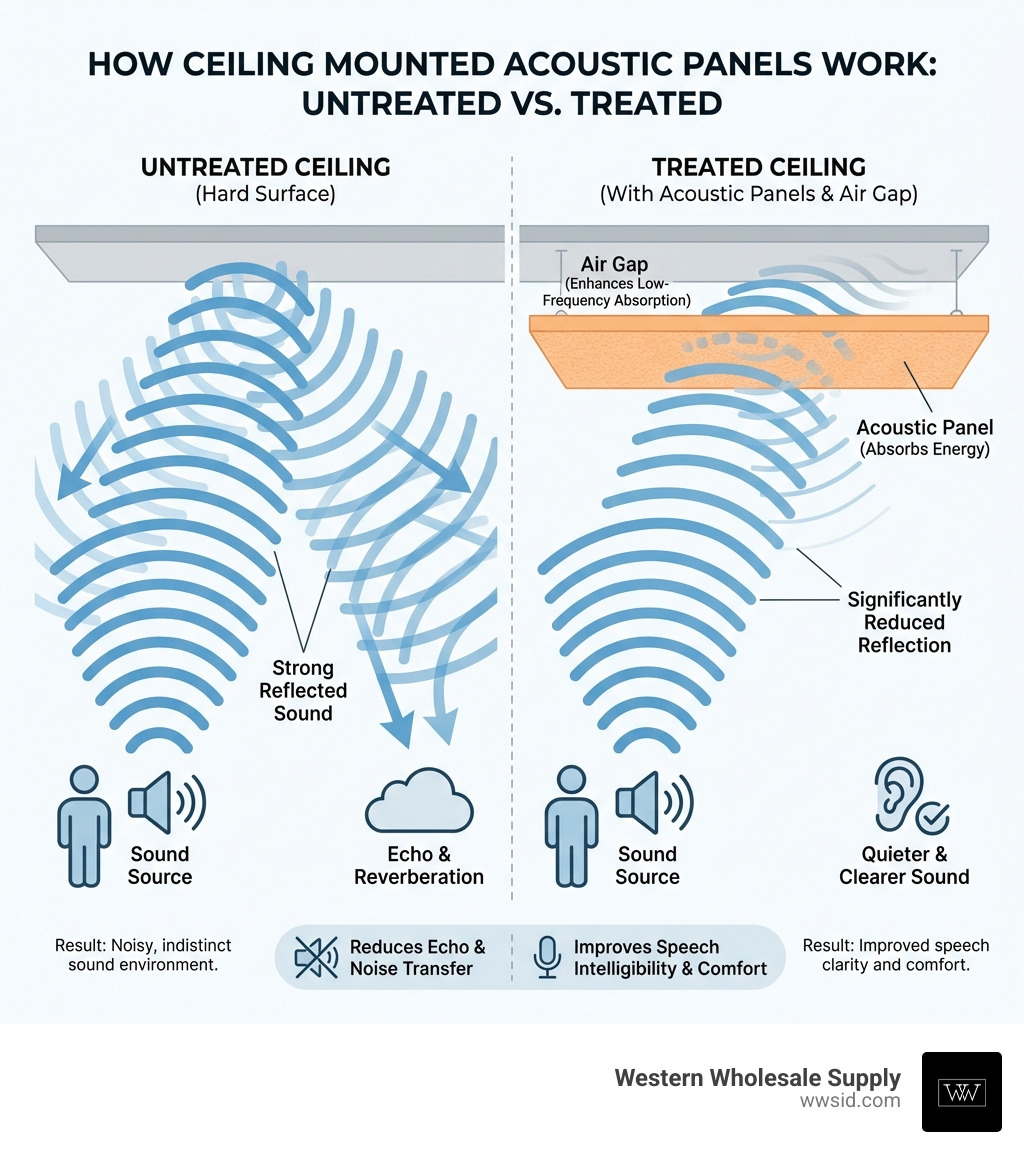
Ceiling mounted acoustic panels basics:
Understanding the Types of Ceiling Mounted Acoustic Panels
When we talk about ceiling mounted acoustic panels, we aren’t just talking about one specific product. Depending on your ceiling height, your aesthetic goals, and the specific “noise problem” you’re trying to solve, you’ll choose from a few different categories.
| Panel Type | Mounting Style | Best For | Noise Reduction (NRC) |
|---|---|---|---|
| Acoustic Clouds | Suspended horizontally | Studios, high ceilings, offices | High (0.85 – 1.15) |
| Acoustic Baffles | Suspended vertically | Gyms, industrial spaces, cafes | Very High (Dual-sided) |
| Direct Mount Tiles | Glued or screwed to ceiling | Low ceilings, home theaters | Moderate to High |
| Drop Ceiling Tiles | Placed in a T-bar grid | Commercial offices, basements | Varies by material |
Each of these systems serves a unique purpose. For instance, if you are working with a standard commercial acoustical ceiling, you might be looking for high-performance tiles that fit into a grid. If you have a trendy open-concept office in Jackson or Idaho Falls with exposed ductwork, you’re likely looking at acoustic solutions from Rockfon to provide that “floating” look.
Acoustic Ceiling Clouds and Baffles
Acoustic clouds are horizontal panels suspended from the ceiling using aircraft cables or chains. They are a favorite in modern design because they look like art while doing heavy-duty work. Because they are “decoupled” from the ceiling (meaning there is an air gap between the panel and the actual roof deck), they catch sound waves on the way up and any waves that manage to bounce off the ceiling and hit the back of the panel. This dual-sided absorption makes them incredibly efficient at controlling low-frequency energy.
Baffles, on the other hand, hang vertically. Imagine rows of panels hanging like banners. These are fantastic for large, high-volume spaces like school gymnasiums or large restaurants. They don’t block lighting or HVAC airflow as much as horizontal clouds do, and they offer a massive amount of surface area to soak up noise. Many of our clients looking for acoustic design by Frasch choose these for their bold colors and unique shapes.
Direct Mount and Drop Ceiling Tiles
If you don’t have the height for suspended clouds, direct mount tiles are your best friend. These are typically fabric-wrapped or made of mineral fiber and are attached directly to drywall or concrete using specialized adhesives or mechanical fasteners.
For commercial spaces, the “gold standard” remains the drop ceiling. Using a grid system, you can install CertainTeed tiles (like their Symphony or Adagio lines) which provide excellent sound absorption (NRC) and sound blocking (CAC). These systems are “a DIYer’s dream” because they allow easy access to plumbing and electrical lines while providing a blueprint for better acoustics.
Key Benefits of Installing Acoustic Panels on the Ceiling
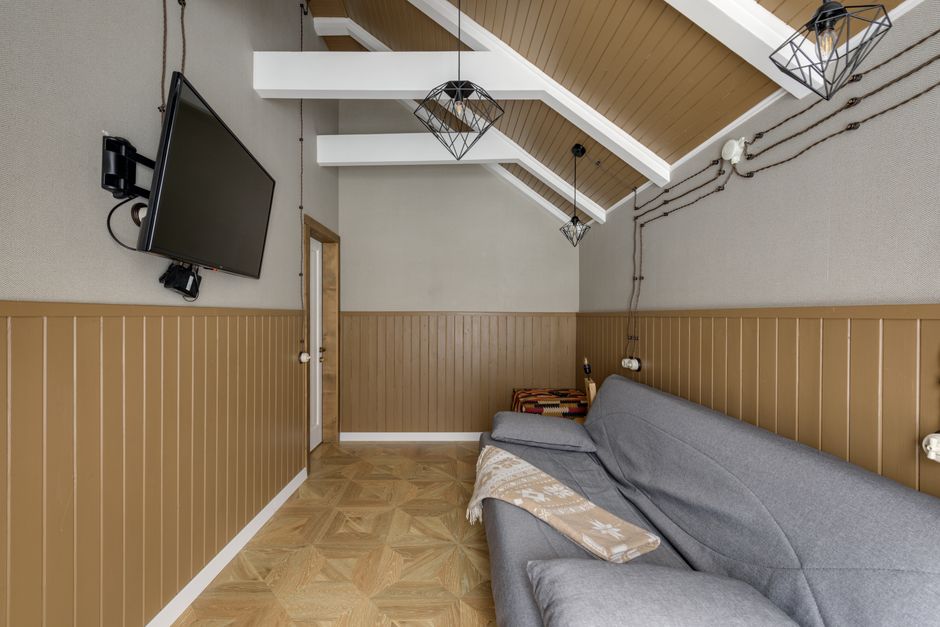
Why go through the trouble of mounting things overhead? Because the ceiling is often the most neglected “acoustic mirror” in a room. Here is why ceiling mounted acoustic panels are a game-changer:
- Improved Speech Intelligibility: In an office or a classroom, sound bouncing off a hard ceiling creates a “muddy” environment where it’s hard to understand the person speaking. Panels stop that bounce.
- Space Optimization: Unlike wall panels, which take up valuable real estate where you might want to hang art, shelves, or windows, the ceiling is usually wide open.
- Aesthetic Versatility: Modern panels aren’t just white squares. They come in wood veneers, custom fabric colors, and even 3D shapes.
- The “Cloud” Effect: Suspended panels can hide unsightly pipes, wires, and ductwork while making a cavernous room feel more intimate.
For those in Eastern Idaho or Western Wyoming looking for the secret to a quieter environment, treating the ceiling is usually the first recommendation we make.
Superior Performance of Ceiling Mounted Acoustic Panels
Performance is measured by two main ratings: NRC (Noise Reduction Coefficient) and STC (Sound Transmission Class).
- NRC tells you how much sound the panel absorbs (on a scale of 0 to 1).
- STC tells you how much sound the panel blocks from traveling to the next room.
When you mount a panel with an air gap (like a cloud), you actually increase its low-frequency absorption. This is because the sound wave has to pass through the panel, bounce off the ceiling, and pass through the panel again on the way down. If you’re looking for high-performance, eco-friendly panels from F-Sorb, you’ll find that their recycled polyester materials are incredibly effective at this.
Planning and Installation for Different Ceiling Types
Installation varies wildly depending on what you’re drilling into. At Western Wholesale Supply, we’ve seen it all—from the historic buildings in Blackfoot to modern builds in Jackson Hole.
- Drywall Ceilings: You’ll need to locate the joists (standard 16″ or 24″ spacing) using a stud finder. If you can’t hit a joist, you must use heavy-duty toggle bolts. Never rely on simple plastic anchors for overhead loads.
- Concrete Ceilings: This requires a hammer drill and masonry anchors. It’s a bit more labor-intensive but provides a rock-solid foundation for heavy clouds or baffles.
- Drop Grids: For existing T-bar ceilings, you can use specialized T-bar clips that snap onto the metal grid. This allows you to hang clouds without drilling into the structure above.
If you’re tackling this yourself, check out our DIY installation guide for more deep-dive tips.
Essential Hardware for Ceiling Mounted Acoustic Panels
Safety is the number one priority when hanging things over people’s heads. Gravity never takes a day off! Here is what you should have in your toolkit:
- Toggle Bolts: For drywall where no joist is present.
- Rotocon Fasteners or Eye Bolts: These screw into the back of the acoustic panel to provide a hook point.
- Aircraft Cable Kits: For adjustable suspension height.
- T-bar Clips: For mounting to suspended grids.
- Masonry Anchors: For concrete applications.
To make sure you order the right amount of material, we recommend using the USG ceiling material estimator. It’s a great way to ensure you aren’t left three tiles short at the end of a long Saturday.
Best Practices for Layout and Maintenance
Where you put the panels is just as important as which panels you buy. In a recording studio or home theater, you want to target “first reflection points.” This is the spot on the ceiling halfway between the sound source (speakers) and the listener’s ears.
Layout Tips:
- Symmetry is Key: Especially in listening rooms, keep your panel layout balanced to ensure the sound stage feels even.
- Spacing: Leave 2 to 4 inches between panels for a clean, professional look.
- Height: In offices, hanging clouds at about 8 or 9 feet creates a “canopy” that traps noise before it spreads across the room.
Maintenance: Most ceiling mounted acoustic panels require very little upkeep. A light dusting or a gentle vacuum with a brush attachment once or twice a year is usually enough. For fabric-wrapped panels, avoid using wet cleaners that could stain the fabric or degrade the internal acoustic core.
Also, always consider safety. If you are in a commercial building, you need to ensure your panels meet local fire codes. We carry a wide range of fire-rated ceiling solutions to keep your project compliant and your occupants safe.
Frequently Asked Questions about Ceiling Acoustics
Do ceiling acoustic panels effectively reduce noise between floors?
While they are excellent at reducing echo within a room, standard acoustic panels are not a complete soundproofing solution for “footfall” noise from the floor above. To block sound from traveling through the ceiling, you need mass and decoupling (like using Quietrock EZ Snap drywall or specialized floor underlayments). However, a high-CAC (Ceiling Attenuation Class) drop ceiling tile from CertainTeed can help block some airborne noise (like voices) from traveling between floors.
How many panels do I need for my space?
A general rule of thumb for effective sound control is to cover about 20% to 30% of the total surface area of the room. If the room is exceptionally “live” (lots of glass and concrete), you might need up to 50% coverage.
Can I install these panels myself?
Yes! Many of our customers in the Idaho Falls and Pocatello areas are DIYers. Direct-mount tiles and drop-grid systems are very user-friendly. However, if you are installing large, heavy clouds or working with high concrete ceilings in a commercial space, we recommend hiring a professional with the right scaffolding and safety equipment.
Conclusion
At Western Wholesale Supply, we’ve been helping the folks of Eastern Idaho and Western Wyoming build better since 1963. Whether you’re in Twin Falls, Rexburg, or Jackson, we understand that every project—whether it’s a basement home theater or a massive commercial office—deserves the best materials and expert advice.
As a veteran-owned, third-generation family business, we pride ourselves on reliable, on-time delivery and a level of customer service you won’t find at the big-box stores. If you’re ready to quiet down your space, elevate your project with Western Wholesale Supply. Give us a call or stop by one of our locations—we’re here to help you get the job done right.
