

Why Drywall Sound Proof Panels Are Worth Getting Right
Drywall sound proof panels are specially engineered gypsum boards that use a viscoelastic polymer layer to dampen noise between rooms — unlike standard drywall, which does little to block sound on its own.
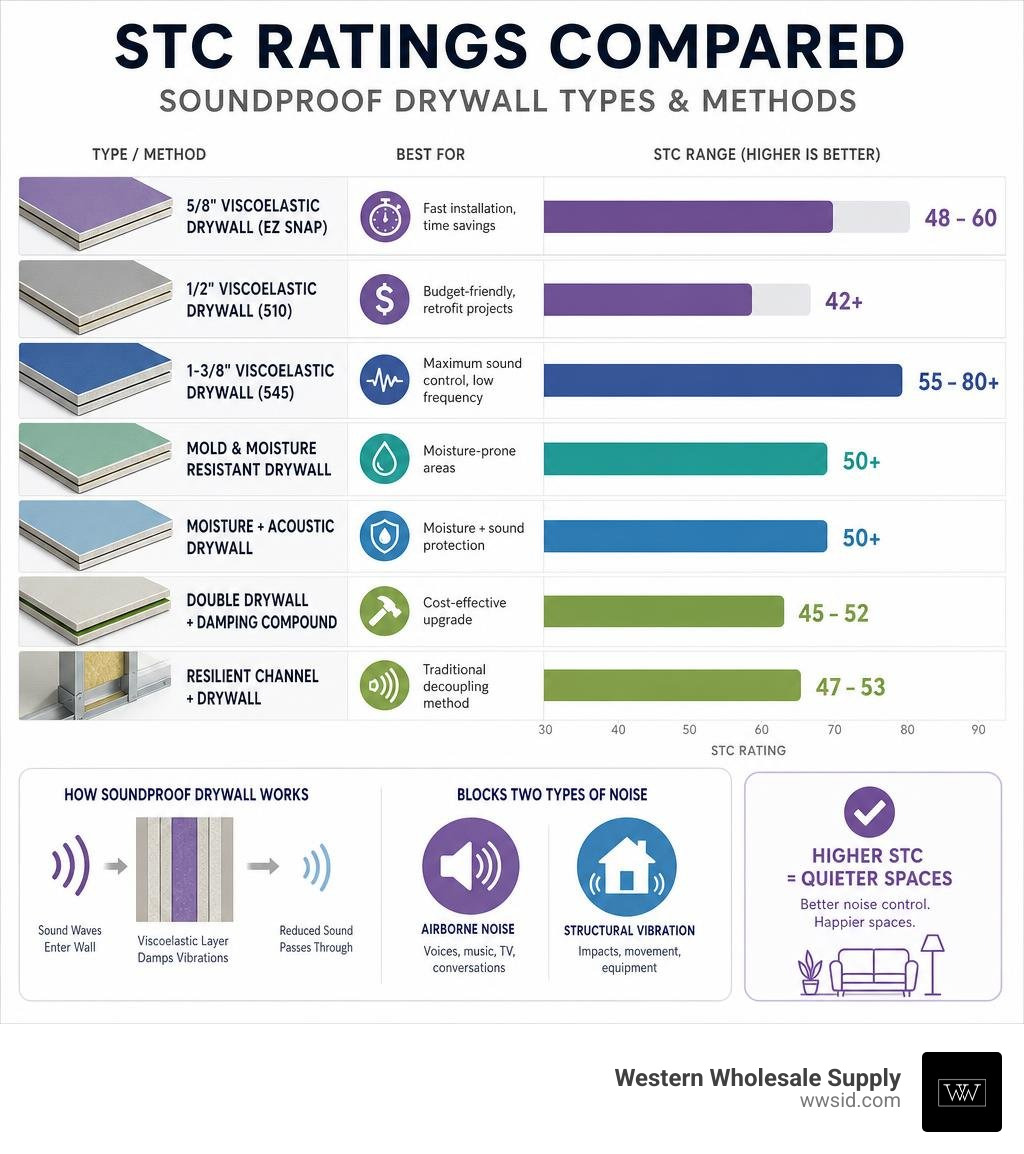
Here’s a quick look at your main options:
| Product | Thickness | Key Feature | STC Range |
|---|---|---|---|
| QuietRock EZ Snap | 5/8″ | Score-and-snap installation | 48-60 |
| QuietRock 510 | 1/2″ | Budget-friendly, retrofit-ready | 42+ |
| QuietRock 545 | 1-3/8″ | Max sound control, low frequency | 55-80+ |
| SoundBreak XP | 1/2″-3/4″ | Mold + moisture resistance built in | 50+ |
| Double drywall + Green Glue | Varies | Low cost, high effort | 45-52 |
Sound travels through walls in two main ways: airborne noise (voices, music, TV) and structural vibration. Standard drywall slows it down a little. Soundproof drywall stops much more of it by converting sound energy into heat — before it ever reaches the next room.
For contractors and builders, getting this choice right matters. Choosing the wrong product means rework, callbacks, and unhappy clients. Choosing the right one means hitting your STC targets in a single layer, saving labor hours, and finishing on schedule.
At Western Wholesale Supply, we are a third-generation building materials supplier with hands-on experience supplying drywall sound proof solutions to contractors across residential and commercial projects in the region. In the sections below, we’ll walk you through how these products work, which ones perform best, and how to install them correctly the first time.
Simple guide to drywall sound proof:
What is Drywall Sound Proof Technology and How Does It Work?
To understand how a drywall sound proof panel blocks noise, you first have to understand how sound behaves. When someone speaks, plays music, or runs a washing machine in the next room, they generate sound waves. These waves strike the wall, turning into mechanical vibrations that pass through the studs and emerge as airborne noise on the other side.
Traditional sound control relied almost entirely on adding heavy mass (like adding multiple layers of standard gypsum board) or decoupling the wall assembly. While these methods work, they consume valuable floor space and require extensive labor.
Modern acoustic panels change the game by integrating advanced damping technology directly into the core of the board. Rather than relying solely on brute mass, they use a specialized construction designed to absorb and dissipate vibrational energy. For a deeper dive into these acoustic concepts, check out our guide on Soundproofing for Drywall – Everything You Need to Know.
Understanding the Science of Drywall Sound Proof Panels
At the heart of high-performance soundproof drywall is a process called constrained layer damping (CLD). Inside each panel, a thin layer of viscoelastic polymer is sandwiched between two dense sheets of gypsum.
When sound waves hit the panel, they force the outer gypsum layers to flex. As they bend, they slide micro-fractionally against the inner polymer layer. This shear force stretches and compresses the polymer molecules. Through molecular friction, the kinetic energy of the sound vibration is converted into microscopic amounts of thermal energy (heat).
Essentially, the wall acts as a giant shock absorber for sound waves. Because the viscoelastic polymer is highly efficient at this conversion, even a single layer of engineered drywall can outperform several sheets of standard drywall. This technology is highly engineered, as detailed by manufacturers featured on QuietRock® Soundproof Drywall | Acoustic Wall Systems for Contractors | Memtech Acoustics.
Standard Gypsum vs. Drywall Sound Proof Alternatives
Standard drywall is relatively light and rigid. When sound waves strike it, it vibrates easily and transfers those vibrations directly to the wall studs. To block sound with standard drywall, you have to stack multiple layers, which adds significant weight and thickness to your partition walls.
A specialized drywall sound proof panel, on the other side, is much denser and incorporates the damping polymer core.
- Mass and Density: Standard 1/2-inch drywall weighs about 1.6 lbs per square foot. Soundproof alternatives like QuietRock EZ Snap (5/8-inch) weigh roughly 2.6 lbs per square foot, providing much higher density in a single sheet.
- Acoustic Behavior: Standard drywall has a natural resonance frequency where it easily lets sound pass through. The polymer core in soundproof drywall dampens this resonance, flattening the sound transmission curve across both high and low frequencies.
- Space Savings: Achieving an STC rating of 50 with standard drywall often requires a double-stud wall or multiple layers of 5/8-inch Type X gypsum board. You can achieve the same acoustic performance with a single layer of soundproof drywall, saving inches of premium floor space.
To compare these systems further, explore A Comprehensive Guide to Sound Dampening Drywall Options.
Top Soundproofing Drywall Products and Methods
When planning your project, selecting the right material depends on your target Sound Transmission Class (STC) rating, your budget, and whether you are working on a new build or a retrofit.
Acoustic performance is measured using the STC scale. An STC rating of 35 means normal speech can be heard but not understood through the wall. An STC of 50 or higher represents high-performance soundproofing, where loud speech is completely inaudible. For more details on selecting the right materials for your project, read Beyond the Buzz – A Guide to Sound Dampening Drywall.
QuietRock EZ Snap and Constrained Layer Damping
For years, the biggest complaint from contractors regarding soundproof drywall was how difficult it was to cut. Early versions contained metal layers or thick, sticky polymers that ruined utility knives and required power saws, which created massive amounts of dust on the jobsite.
Quietrock EZ Snap solved this problem. Featuring patented EZ-SNAP technology, this 5/8-inch Type X panel is designed to score and snap just like standard drywall. It contains no heavy paper or metal in the center, meaning your crew can use standard utility knives and drywall tools without special training.
- Acoustic Performance: QuietRock EZ Snap can achieve STC ratings from 48 to over 60 depending on the stud spacing and insulation used.
- Labor Savings: In a commercial medical center project, using QuietRock ES on one side of a wall assembly achieved an STC rating of 51, compared to STC 50 with multiple layers of standard gypsum board. It eliminated the need for extra layers, saving significant carpenter man-days, reducing material handling, and speeding up clean-up.
- Fire Rating: It is UL certified for use in 1-hour fire-rated assemblies, making it a drop-in replacement for standard 5/8-inch Type X boards in commercial partitions.
Learn more about this product directly on QuietRock® EZ-SNAP® | Products | PABCO Gypsum.
SoundBreak XP Gypsum Board
Manufactured by Gold Bond, SoundBreak XP is another top-tier choice for high-performance sound control. It features a high-density, mold-resistant gypsum core wrapped in heavy, moisture-resistant purple paper.
- Acoustical Damping: It utilizes a viscoelastic polymer layer to deliver high-rated STC values that significantly reduce sound transmission through walls and ceilings.
- Mold and Moisture Resistance: SoundBreak XP features SPORGARD® technology, achieving the highest possible score on mold and mildew resistance tests (ASTM D3273). This makes it the ideal choice for bathrooms, kitchens, basements, and commercial hospitality projects where moisture is a concern.
- Durability: It provides superior resistance to surface abrasion, indentation, and impacts compared to standard drywall, making it perfect for high-traffic school corridors or hospital rooms.
For technical specifications, refer to SoundBreak® XP® Gypsum Board | Acoustical Board.
Comparing Soundproofing Methods and Cost-Effectiveness
To determine the best approach for your project, it helps to compare the total installed cost, which includes both material prices and labor hours.
| Soundproofing Method | Material Cost | Labor Difficulty | Thickness Added | Acoustic Performance (STC) | Best Use Case |
|---|---|---|---|---|---|
| QuietRock EZ Snap | Moderate-High | Low (Installs like standard) | 5/8″ | 48 – 60 | Commercial partitions, multi-family, offices |
| SoundBreak XP | Moderate-High | Low-Moderate | 5/8″ – 3/4″ | 50 – 58 | Bathrooms, kitchens, high-traffic corridors |
| Double Drywall + Green Glue | Moderate | High (Messy, time-consuming) | 1-1/4″ | 45 – 52 | Budget-conscious residential home theaters |
| Standard Drywall Only | Low | Low | 1/2″ – 5/8″ | 30 – 38 | Standard residential interior walls |
While soundproof drywall has a higher upfront material cost than standard gypsum board, it often results in a lower total installed cost. By eliminating the labor-intensive steps of applying liquid damping compounds or hanging multiple layers of drywall, contractors can complete jobs faster and with fewer crew members. To explore these savings in detail, see How to Double Drywall for Soundproofing Without Major Renovations.
Installation Best Practices and Required Accessories
Even the highest-rated drywall sound proof panel will fail to deliver its target STC rating if it is installed incorrectly. Sound is like water; it will find and leak through the smallest gaps in your assembly.
To ensure your soundproofing system performs as designed, we recommend using high-quality fasteners and accessories. For securing your panels, Grabber or Brighton Best fasteners provide the holding power and precision needed for dense, acoustic drywall.
Additionally, don’t overlook the thermal benefits of your insulation in commercial warehouses and large-scale buildings. Installing high-density insulation within the wall cavity is critical for energy efficiency. For optimal thermal performance, we recommend aiming for Walls R-13+ and Ceilings R-30+ to keep your spaces well-insulated and cost-effective. For tips on sourcing these materials in bulk, check out Don’t Get Board – Sourcing Sheetrock in Bulk.
Step-by-Step Drywall Sound Proof Installation
- Framing Inspection: Ensure your wood or steel studs are straight and free of debris. Any bowing in the studs will create tension in the drywall panels, which can degrade acoustic performance.
- Insulation Placement: Install your R-13+ insulation snugly within the stud cavities. Ensure there are no gaps, but avoid compressing the insulation, as packed insulation can actually transfer vibrations.
- Panel Layout: Plan your layout to minimize joints. We recommend installing panels vertically.
- Cutting the Panels: If using QuietRock EZ Snap, score the face paper deeply with a sharp utility knife, snap the panel back, and cut the back paper. For thicker panels like QuietRock 545, use a hand or power saw.
- Hanging the Drywall: Secure the panels to the studs using Grabber or Brighton Best screws. Space your fasteners according to local building codes, taking care not to over-drive the screws and break the paper face.
- Perimeter Gaps: Leave a consistent 1/4-inch gap around the entire perimeter of the wall (where the drywall meets the floor, ceiling, and adjacent walls). This gap prevents the drywall from directly touching the surrounding structure, decoupling the panels and reducing structural vibration.
Sealing Gaps and Penetrations for Maximum STC
The 1/4-inch perimeter gaps you left during installation must be sealed with a non-hardening acoustic sealant, such as QuietSeal Pro. Standard painters caulk will dry out, shrink, and crack over time, letting sound leak through. Acoustic sealant remains flexible for decades, maintaining an airtight, soundproof seal.
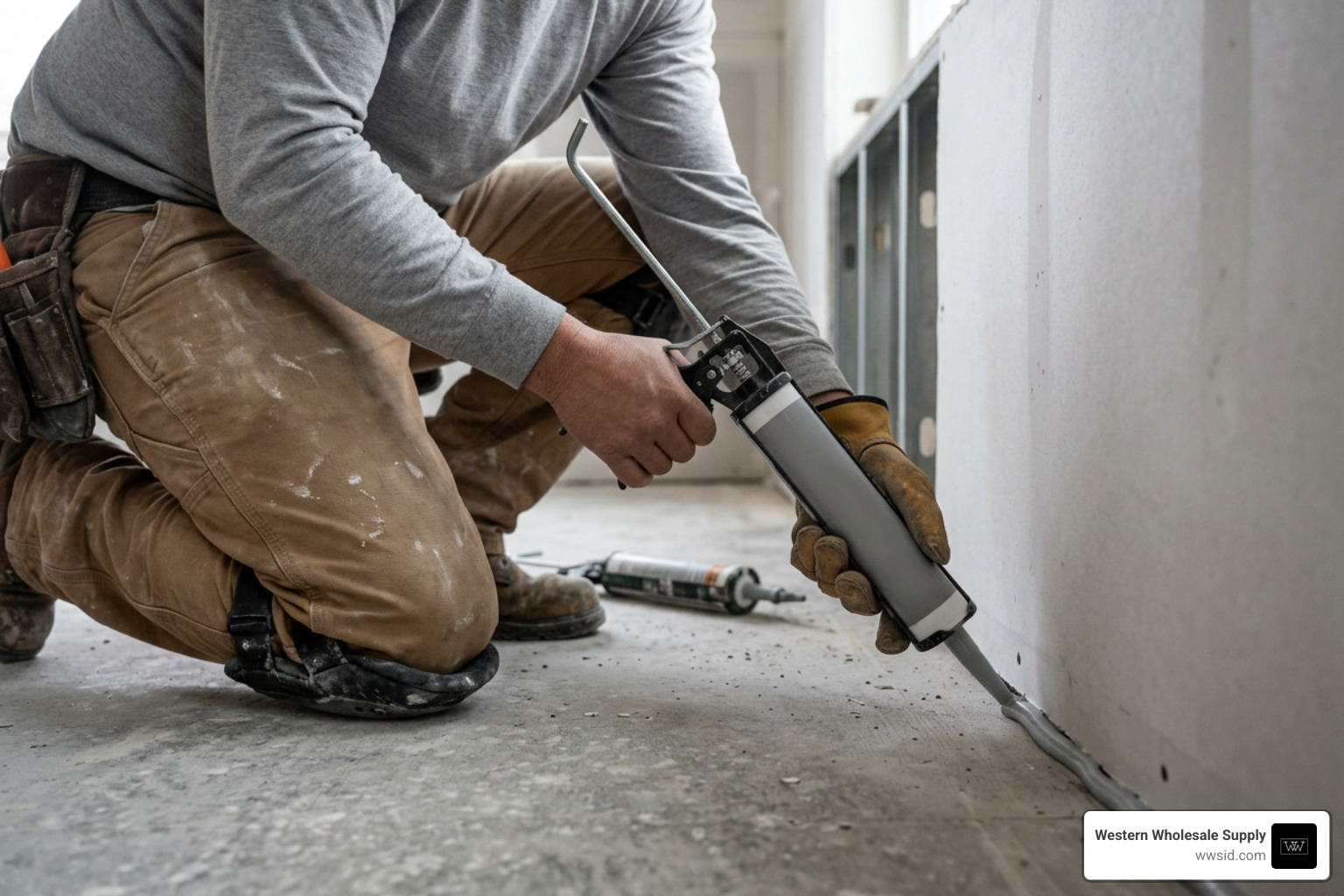
- Electrical Outlets and Switches: Cutouts for electrical boxes are a major source of sound leaks. Wrap the back of all electrical boxes with QuietPutty pads before hanging your drywall. This moldable acoustic putty seals the box and prevents sound from passing through the outlet.
- HVAC Ducts and Pipes: Any penetrations through the wall should be sealed with a generous bead of acoustic sealant where they pass through the drywall.
- Joint Treatment: Tape and finish the drywall joints using standard joint compound and tape. No special acoustic tape is required for vertical joints when using high-performance panels.
Frequently Asked Questions about Drywall Soundproofing
Can you install soundproof drywall over existing walls?
Yes! If you are remodeling a home office, bedroom, or media room and want to avoid the mess of demolition, you can install soundproof drywall directly over your existing standard drywall.
Using a 1/2-inch panel like QuietRock 510 is perfect for this application. Simply locate the wall studs, apply a bead of acoustic sealant or sound-damping compound to the back of the new panel, and screw it directly through the old drywall into the studs using longer Grabber screws. This retrofit method adds significant mass and damping with minimal loss of room space. For a detailed look at panel thicknesses, see Drywall Dimensions Demystified for 1/2 Inch and 5/8 Inch Panels.
Is soundproof drywall fire-resistant and moisture-resistant?
Absolutely. Most professional-grade soundproof drywall products are engineered to meet strict building codes.
- Fire Resistance: 5/8-inch soundproof panels (such as QuietRock EZ Snap and SoundBreak XP Fire-Shield) are classified as Type X gypsum board. They carry a 1-hour fire rating, making them fully compliant with commercial and multi-family residential fire codes.
- Moisture Resistance: Products like SoundBreak XP feature specialized moisture-resistant cores and paper facings designed to inhibit mold growth, making them safe for humid environments like bathrooms and basements under 2026 building standards.
How much does soundproof drywall cost compared to standard drywall?
While soundproof drywall has a higher upfront material cost per sheet compared to standard drywall, it is important to look at the total installed cost.
When you use standard drywall to achieve a high STC rating, you have to pay for multiple layers of drywall, extra joint compound, and the labor hours required to hang, tape, and finish those extra layers. By switching to a single layer of high-performance soundproof drywall, you save on labor, speed up your project timeline, and reduce material waste. For commercial projects, this can result in substantial bottom-line savings.
Conclusion
When it comes to blocking noise and creating quiet, comfortable spaces, choosing the right drywall sound proof system is a smart investment. Whether you are building a commercial office in Idaho Falls, remodeling a home theater in Jackson, or upgrading a multi-family property in Twin Falls, high-performance acoustic panels deliver the peace and quiet your clients expect.
At Western Wholesale Supply, we are an independent, veteran-owned, third-generation family business that has been supplying quality building materials to Eastern Idaho and Western Wyoming since 1963. We carry the industry’s leading brands, including Quietrock EZ Snap and CertainTeed ceiling tiles, ensuring your project has the high-quality materials it needs to succeed.
With over 60 years of experience, our USP is simple: reliable, on-time delivery and exceptional customer service. From our locations across the region, we are ready to supply your next project with the right drywall, steel framing, insulation, and acoustical systems.
Ready to get started? Learn how to choose the right supplier for your build in our guide, Drywall Done Right – Choosing the Best Supplier for Your Project, or Contact Western Wholesale Supply today to request a quote for your next soundproofing project!
