

Why Drywall Mud Is the Wrong Floor Joint Compound
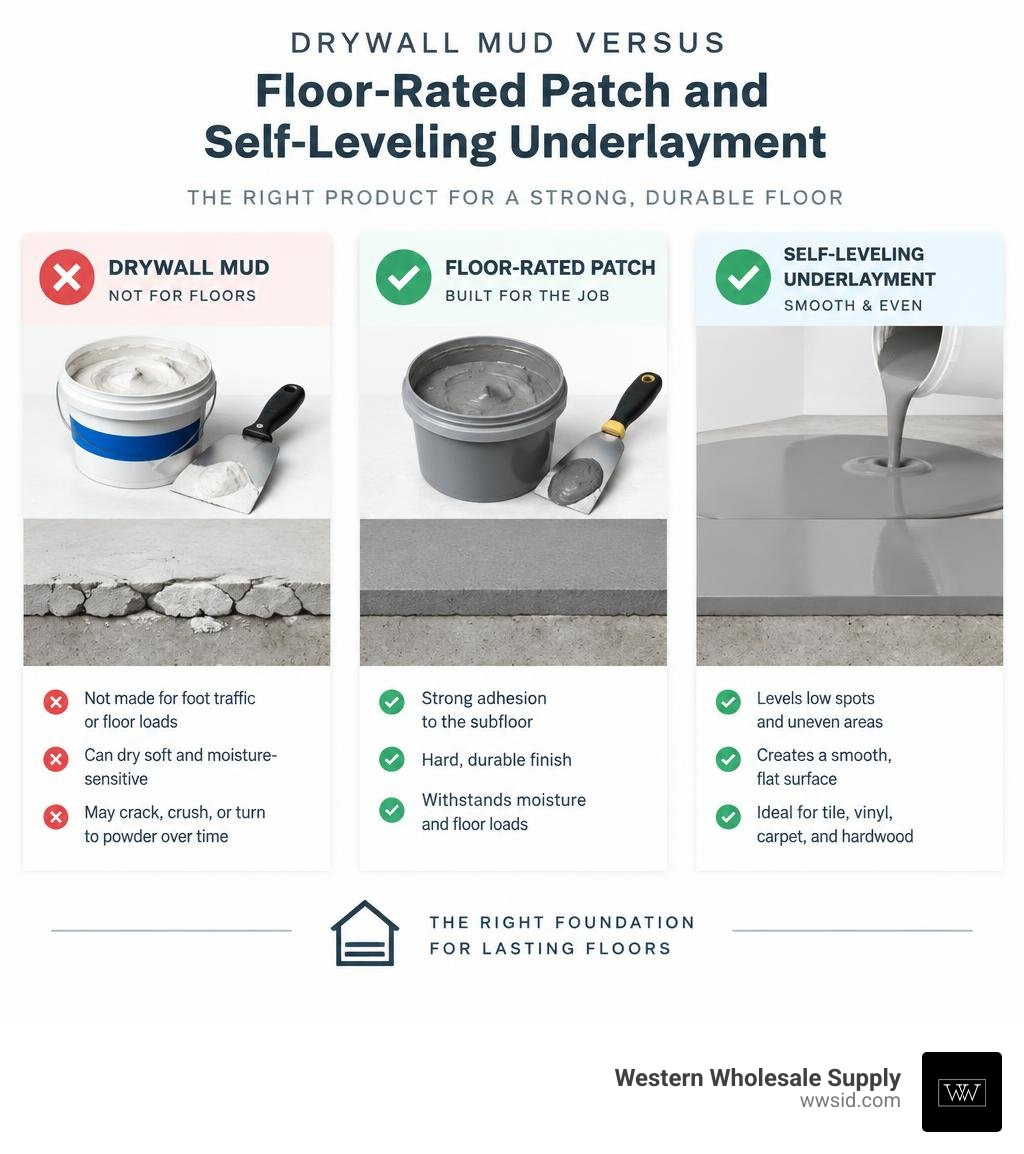
Do not use standard drywall joint compound to level a floor. Ready-mix Sheetrock mud is made to finish drywall seams and fasteners, not to carry foot traffic, furniture, flooring, or rolling loads. For low spots and subfloor joints, use a floor-rated patch, feather-finish compound, or self-leveling underlayment matched to the subfloor and final flooring.
Standard joint compound dries by losing water. Under flooring, that can leave a softer, moisture-sensitive layer that may crack, crush, or turn to powder as the subfloor moves. The failure may not show until after tile, vinyl, carpet, or hardwood is installed – when repairs become far more disruptive.
Some setting-type drywall compounds cure harder and resist humidity better than ready-mix mud. They can be useful for limited, non-structural filling in some situations, but they are still not a substitute for a cementitious, floor-rated leveling product. A proper floor patch needs strong adhesion, hardness, moisture tolerance, and the ability to handle concentrated loads.
For related interior work, Western Wholesale Supply carries CertainTeed ceiling tiles, Quietrock EZ Snap panels, Durock underlayment, and Brighton Best or Grabber fasteners. Drywall finishing tools from Hyde, USG Sheetrock Tools, Columbia Taping Tools, and Marshalltown are ideal for their intended wall-finishing tasks, while floor repairs call for materials specifically rated for the floor assembly.
At Western Wholesale Supply, our team of building materials professionals brings decades of hands-on experience helping contractors choose the right materials for drywall, framing, insulation, and repair work across Idaho and the Intermountain West. When it comes to floor joint compound, the practical rule is simple: use drywall mud for walls and a load-rated patch or underlayment for floors.
Common floor joint compound vocab:
Why Using Standard Drywall Mud as a Floor Joint Compound Fails
When you are in the middle of a home remodel and notice a 1/8-inch dip across a subfloor seam, it is tempting to reach for whatever bucket is sitting nearby. Often, that bucket is all-purpose drywall mud. It spreads easily, feathers like a dream, and sands down in seconds. However, using standard drywall mud as an improvised floor joint compound is one of the most common—and costly—mistakes in residential renovation.
Standard ready-mix drywall compound is engineered specifically for vertical and overhead drywall surfaces. Its primary job is to embed joint tape, conceal fasteners, and create a smooth, paint-ready surface. Conventional all-purpose mud, such as USG Sheetrock® Brand All Purpose Joint Compound or Midweight formulas, complies with ASTM C475 standards for finishing gypsum board. It offers excellent open time and low VOC emissions (such as 2 g/L for GREENGUARD Gold certified formulations), covering roughly 9.4 to 10 gallons per 1,000 square feet of wallboard. However, these formulations are made of calcium carbonate, gypsum, water, and mild binders. They are designed for easy sanding, not compressive strength.
Understanding the process of choosing the right drywall compound highlights why wall formulas fail on horizontal walk surfaces:
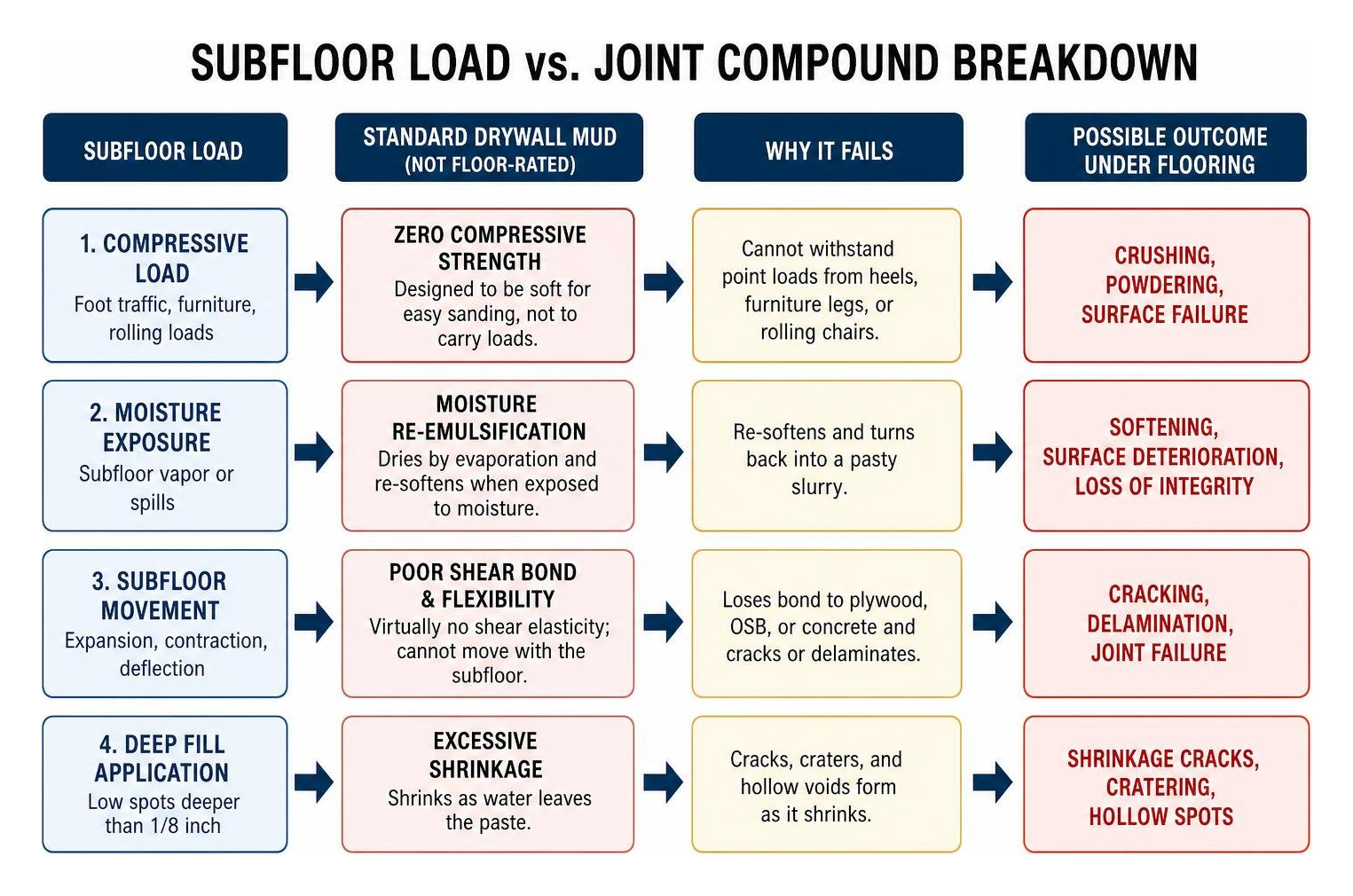
When applied to horizontal subfloors under finished flooring, standard drywall compound fails because of four core material deficiencies:
- Zero Load-Bearing Compressive Strength: Wall mud is designed to be soft enough to sand with light-grit sandpaper. It cannot withstand point loads from high heels, heavy furniture legs, or rolling chairs.
- Moisture Re-emulsification: Ready-mix joint compound dries purely through evaporation. If exposed to subfloor vapor emissions or minor topical spills, it re-softens and turns back into a pasty slurry.
- Inadequate Flexibility and Shear Bond: Subfloors constantly expand, contract, and deflect under dynamic foot traffic. Standard mud possesses virtually no shear elasticity, causing it to delaminate from plywood, OSB, or concrete.
- Excessive Shrinkage in Deep Fills: Standard drying mud shrinks as water leaves the paste. Applying it in low spots deeper than 1/8 inch leads to severe shrinkage cracks, cratering, and hollow voids.
Structural Weaknesses of Floor Joint Compound Under Foot Traffic
The physics of a floor assembly are entirely different from a wall assembly. A drywall partition only needs to support its own dead weight and resist minor surface scuffs. A subfloor, by contrast, experiences continuous dynamic loads, vibration, deflection between floor joists, and environmental shifts in humidity.
When standard evaporative mud dries, microscopic air pockets remain throughout the matrix. Under the repeated impact of footsteps, these fragile air pockets collapse. The compound shatters beneath the underlayment, grinding down into fine gypsum dust.
This pulverization leads to noticeable structural failures depending on the finished flooring installed:
- Luxury Vinyl Plank (LVP) and Laminate: As the drywall mud crushes into powder, a hollow space forms beneath the floating planks. When walked on, the unsupported planks flex downward, putting immense shear stress on the click-lock joints until the plastic tongues snap.
- Ceramic and Porcelain Tile: Tile requires a rigid, non-compressible substrate. When mud gives way beneath thin-set mortar, the tile bridges the void, leading to cracked grout lines and loose, fractured tiles.
- Hardwood Flooring: Direct-nailed or glued hardwood will loosen as the pulverized gypsum breaks the adhesive bond or creates vertical play around subfloor fasteners, leading to squeaks.
Can Setting-Type Mud Act as a Temporary Floor Joint Compound?
Because standard bucket mud fails, many DIYers turn to powder-based setting compounds—often called “hot mud”—such as Sheetrock Brand Durabond or Easy Sand. Setting-type compounds do not dry by evaporation; they harden through a chemical reaction (hydration) when mixed with water.
Products like Sheetrock® Brand Durabond® 90 provide a 60-minute working time and set in 85 to 130 minutes, producing an exceptionally hard, plaster-like surface that resists humidity and check-cracking. Similarly, lightweight setting formulas like Easy Sand 45 weigh 25% less than conventional setting compounds and offer a 45-minute working time. Contractors who want to speed up drywall projects with quick set compounds rely on these products for fast wall repairs and heavy fills.
Can setting mud work as a temporary floor filler for small gaps? In narrow, non-structural situations—such as filling a shallow 1/16-inch screw gouge in an area with zero traffic—Durabond sets remarkably hard. However, setting-type drywall compounds are still gypsum-based and are not engineered or warranted as structural floor underlayments. They lack the polymer-modified Portland cement chemistry necessary to handle floor deflection across wide joints or deep low spots. Under constant rolling loads, even Durabond will eventually micro-fracture if used as a primary floor leveler.
Key Differences: Drywall Joint Compound vs. Floor-Leveling Compounds
To understand why dedicated floor products succeed where wall compounds fail, examine how their base chemistries perform under stress.
| Performance Feature | Standard Ready-Mix Drywall Mud | Setting-Type Compound (e.g., Durabond) | Polymer-Modified Floor Patch / Leveler |
|---|---|---|---|
| Primary Binder | Calcium Carbonate & Gypsum | Plaster of Paris (Hemihydrate Gypsum) | Portland Cement & High-Grade Polymers |
| Curing Mechanism | Evaporative Air Drying (~24 hrs) | Chemical Hydration (5–130 mins) | Hydraulic Cement Hydration (15–60 mins) |
| Compressive Strength | Very Low (< 300 PSI) | Moderate (~ 1,000 PSI) | High (3,500 to 5,500+ PSI) |
| Moisture Resistance | Poor (Re-emulsifies when wet) | Moderate (Humidity resistant, not waterproof) | High (Impervious to water re-emulsification) |
| Flexural / Tensile Bond | Low (Bonds to paper/drywall) | Moderate (Plaster/masonry bond) | Superior (Bonds tenaciously to wood, OSB, concrete) |
| Max Fill Depth | 1/8 in. per coat (shrinks heavily) | 1/4 in. per coat (low shrinkage) | Featheredge up to 1/2 in.+ (neat), up to 2 in. (extended) |
| Industry Standards | ASTM C475 | ASTM C475 | ASTM C1708 / ANSI A118 |
Standard wall compounds are governed by ASTM C475, ensuring they sand easily and hold paper tape. Floor underlayments and patches are formulated with Portland cement, graded silica aggregates, and redispersible liquid polymers. This creates a dense, rock-solid matrix that resists thousands of pounds of compressive force per square inch while flexing slightly with the building’s framing.
Proven Alternatives for Leveling Subfloors and Filling Low Spots
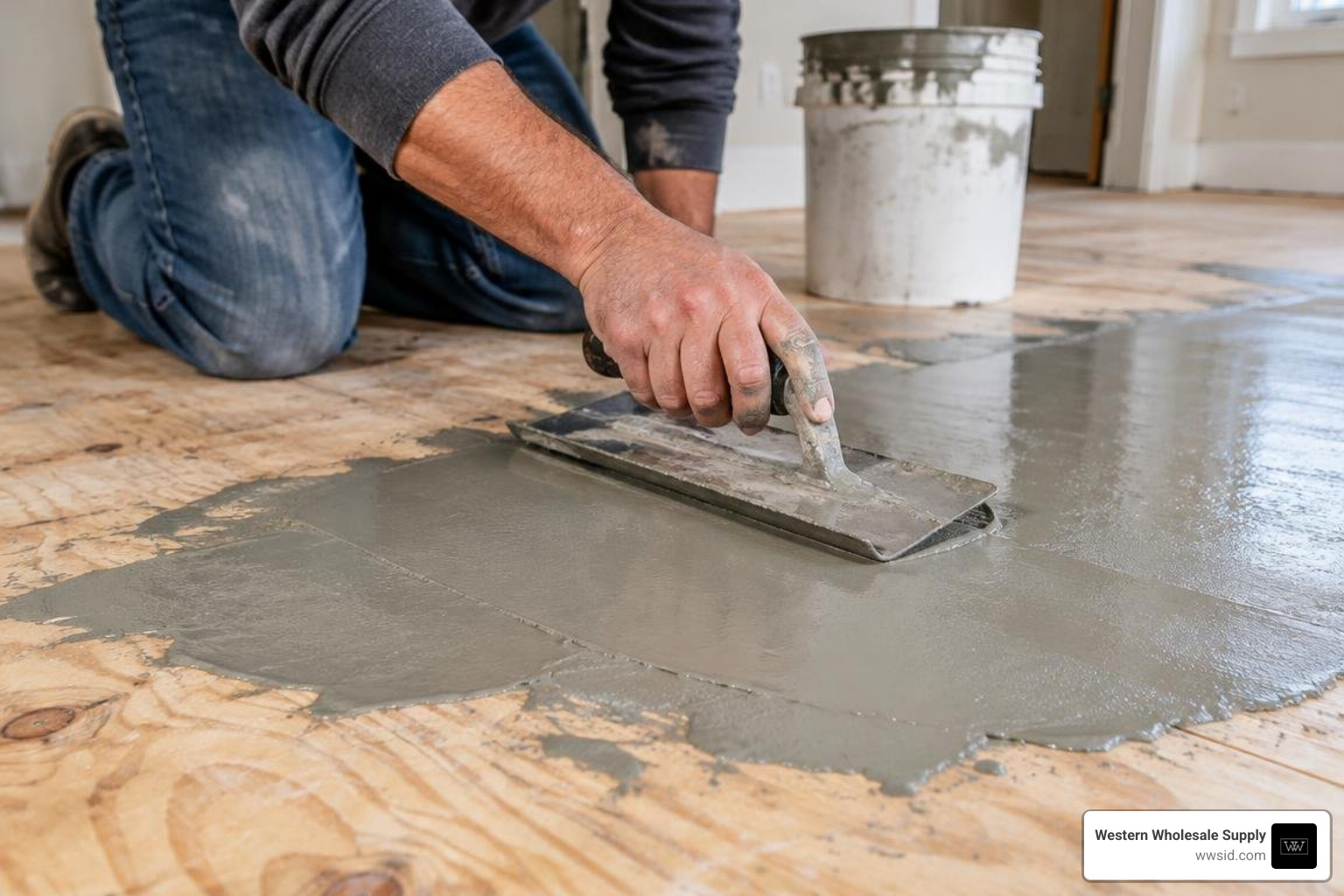
When preparing an uneven subfloor, you must match the product to the substrate material (plywood, OSB, or concrete slab) and the depth of the repair.
1. Polymer-Modified Feather-Finish Floor Patch
Feather-finish patches are the ultimate choice for minor imperfections, seams, and low spots ranging from a true 1/16-inch featheredge up to 1/2 inch deep. These hydraulic cement-based powders mix with water or a latex additive to form a smooth paste that adheres tenaciously to plywood, OSB, and concrete. They dry rapidly (often ready for flooring in 15 to 30 minutes) and will not crumble under rolling loads.
2. Self-Leveling Underlayment (SLU)
For widespread dips, wavy framing, or severely unlevel concrete slabs, self-leveling underlayment is the industry standard. After applying an acrylic substrate primer, this free-flowing, cementitious slurry is poured over the floor. It finds its own level, creating a flat, smooth, ultra-dense surface capable of reaching compressive strengths exceeding 4,000 to 5,000 PSI.
3. Non-Shrinking Water Putty
Products like Durham’s Rock Hard Water Putty are hard-setting, gypsum-rock powders mixed with water. Unlike drywall mud, water putty does not shrink as it cures and hardens into a dense mass. It is suitable for filling gouges, knot holes, and small localized low spots in dry wood subfloors. However, because it is not Portland-based, it should never be used on subfloors exposed to continuous moisture or outdoor conditions.
4. Cementitious Backerboard for Wet Areas and Tile
If you are prepping a subfloor for ceramic, porcelain, or stone tile, liquid compounds alone are not always the answer. Installing Durock cement backerboard over a combed bed of latex-modified thin-set mortar provides an unyielding, water-durable base that isolates tile assemblies from wood subfloor movement.
How to Properly Level Low Spots and Patch Subfloor Joints Step-by-Step
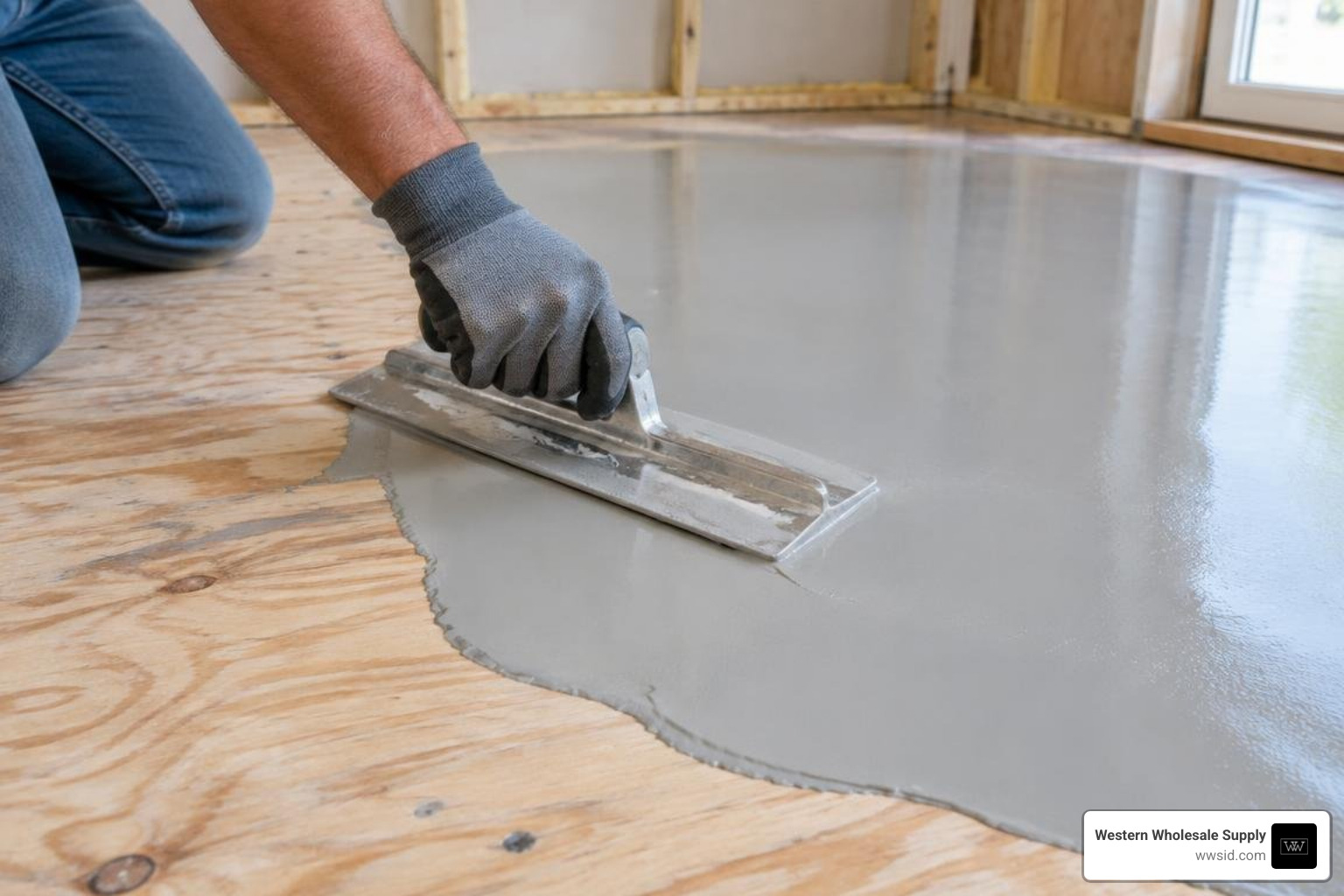
Proper subfloor preparation prevents flooring callbacks. Follow this proven step-by-step process to level low spots and fill seams correctly.
Step 1: Clean and Prepare the Substrate
A patch is only as good as the surface beneath it. Sweep, vacuum, and degrease the subfloor thoroughly. Scrape away old carpet glue, paint drips, or stray drywall mud chunks. Ensure all plywood or OSB subfloor panels are mechanically fastened securely to the joists using high-grade Grabber or Brighton Best subfloor screws to eliminate squeaks and vertical deflection.
Step 2: Identify and Map High and Low Spots
Place a 6-foot or 10-foot precision straightedge across the room. Rotate the straightedge in a star pattern across subfloor seams. Mark the high spots with a carpenter’s pencil and circle low depressions. High spots on wood subfloors should be planed or sanded down flush before applying leveling patches.
Step 3: Apply an Acrylic Subfloor Primer
When working with self-leveling underlayments or porous wood subfloors, apply the manufacturer-specified acrylic latex primer with a paint roller. The primer seals the porous wood, preventing it from sucking water out of the patch prematurely, which ensures proper chemical hydration and maximum bond strength.
Step 4: Mix the Polymer-Modified Patch
Pour clean, cool water into a clean mixing bucket, then add the cementitious patch powder according to the manufacturer’s exact water-to-powder ratio. Use a heavy-duty drill with a mixing paddle running at low speed (around 300 to 500 RPM) to blend until completely lump-free. Only mix what you can spread within a 10-to-15-minute working window.
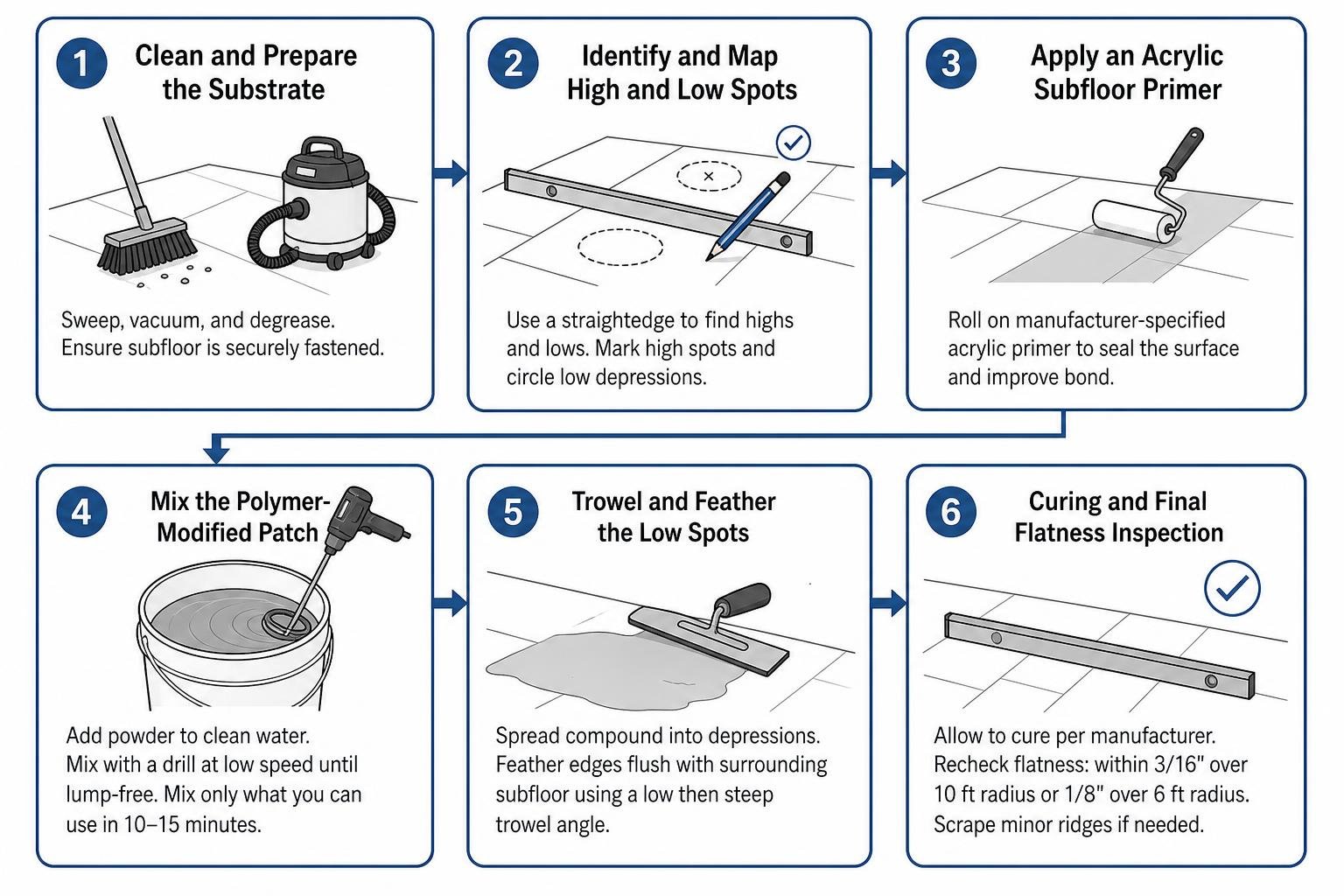
Step 5: Trowel and Feather the Low Spots
Using a flat edge tool or professional-grade trowels from Hyde or Marshalltown, spread the compound across the low spot. Hold the blade at a low angle to float the material into the center of the depression, then steepen the blade angle to firmly feather the perimeter edges flush with the surrounding subfloor.
Step 6: Curing and Final Flatness Inspection
Allow the patch to cure according to manufacturer specifications (typically 30 minutes for feather-finish patches, or 12 to 24 hours for thick self-levelers). Once cured, place your straightedge back across the repaired area. Most modern resilient flooring (such as LVP) requires the subfloor to be flat within 3/16 inch over a 10-foot radius, or 1/8 inch over a 6-foot radius. Lightly scrape any minor trowel ridges with a stiff scraper before laying down underlayment or flooring planks.
Frequently Asked Questions About Subfloor Patching and Leveling
Can I use drywall mud under luxury vinyl plank (LVP) flooring?
No. Luxury vinyl plank requires a completely non-compressible subfloor. Drywall joint compound lacks compressive strength; when subjected to concentrated foot traffic and rolling loads, it pulverizes into dust. This creates a hollow void beneath the plank, causing excessive vertical flex that snaps the fragile click-lock tongue-and-groove joints, ruining the floor installation.
What should I use to fill deep low spots in a wood subfloor?
For depressions deeper than 1/2 inch in a wood subfloor, choose a dedicated cementitious self-leveling underlayment (after applying the appropriate subfloor primer) or a deep-pour polymer-modified floor patch. If the low spot is significant across a wide expanse, consider laying down plywood shims or an additional layer of plywood underlayment fastened securely with Grabber screws to restore structural integrity before skimming.
How does non-shrinking water putty compare to joint compound for floors?
Non-shrinking water putty (such as Durham’s Rock Hard Water Putty) dries into an exceptionally hard, rock-like state through chemical bonding rather than simple evaporative loss. Unlike drywall mud, it will not shrink or dish out in small fills and withstands significant pressure. It is excellent for repairing gouges and holes in dry wood subfloors, though polymer-modified cement patches remain superior for wide transitions, concrete slabs, and moisture-prone areas.
Conclusion
While drywall mud is a staple for creating seamless walls and ceilings, it has no place beneath your flooring. Attempting to use joint compound as an improvised subfloor filler leads to crushed powder, loose tiles, broken vinyl joints, and expensive tear-outs. By choosing dedicated, polymer-modified cementitious floor patches and self-leveling underlayments, you ensure your subfloor remains flat, rigid, and durable for decades.
For your wall and ceiling assemblies, using professional products like 90-minute mud and setting compounds alongside reliable tools from Hyde, USG Sheetrock Tools, Columbia Taping Tools, and Marshalltown delivers flawless results. When it comes to floors, always match the compound to the structural demands of the walking surface.
At Western Wholesale Supply, we are an independent, veteran-owned, third-generation family business that has supplied the Intermountain West with top-tier building materials since 1963. Whether you are framing a warehouse in Idaho Falls, insulating commercial ceilings in Jackson, or prepping residential subfloors in Pocatello, our team delivers the expertise and professional supplies you need.
We proudly stock top-tier building materials including CertainTeed acoustical ceiling tiles, Quietrock EZ Snap sound-damping panels, Durock cement board underlayment, and commercial-grade fasteners from Grabber and Brighton Best. Serving contractors across Eastern Idaho, Western Wyoming, and surrounding communities including Twin Falls, Rexburg, Rigby, Victor, and Driggs, we back every order with reliable, on-time jobsite delivery and unmatched customer service. Visit one of our showrooms today to get the right professional materials for your next build.
