

Why Getting Your Ceiling Grid Estimate Right Saves Time and Money
How to estimate ceiling grid comes down to five core steps (consistent with industry standards):
- Measure your room – Record the length and width in feet, then multiply to get total square footage
- Calculate your perimeter – Add all four wall lengths together
- Count your main runners – Divide room length by 12 (standard runner length), spaced every 4 feet
- Count your cross tees – Based on your tile size (every 2 feet for 2×2 tiles, every 4 feet for 2×4 tiles)
- Add a waste factor – Order 5-10% extra material to account for cuts and mistakes
| Material | Formula |
|---|---|
| Ceiling tiles (2×2) | Total sq ft ÷ 4, + 5-10% |
| Ceiling tiles (2×4) | Total sq ft ÷ 8, + 5-10% |
| Main runners | Room length ÷ 12, rows every 4 ft |
| Cross tees | Row count x room length ÷ 2 or 4 |
| Hanger wire | 4 pieces per main runner |
A drop ceiling looks simple once it’s installed. But before the first tile goes up, you need accurate numbers – or you’ll be making extra supply runs mid-project, which nobody has time for.
Getting the material takeoff right means knowing more than just square footage. You need to account for your room’s shape, joist direction, tile size, border cuts, and obstacles like lights and vents. Miss any of those, and your estimate falls apart fast.
This guide walks you through the whole process, step by step, so you can order the right materials the first time.
At Western Wholesale Supply, we are a third-generation building materials professional team – and knowing how to estimate ceiling grid accurately is something we’ve helped contractors and builders get right across hundreds of residential and commercial projects. Let’s break it down so you can get your order together with confidence.
Essential Components of a Suspended Ceiling System
Before we start crunching numbers, we need to speak the same language. At Western Wholesale Supply, we’ve seen plenty of DIYers and even some pros get tripped up because they didn’t realize how many moving parts are in a standard Acoustical Ceilings setup.
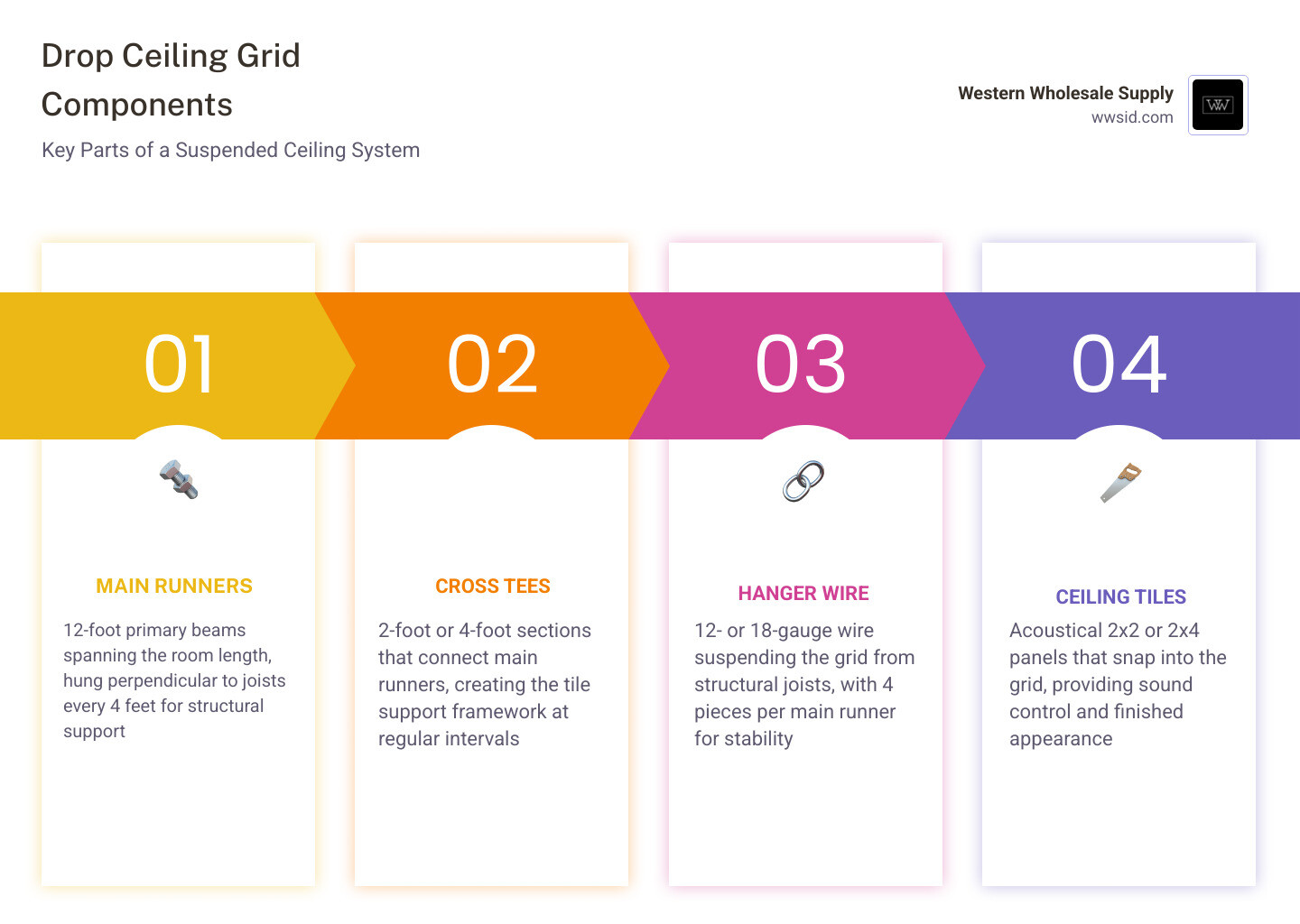
The “skeleton” of your ceiling is the grid. The primary muscle is the Main Runner (sometimes called a main beam or main tee). These are typically 12 feet long and do the heavy lifting. They are suspended from your structural joists by 12-gauge or 18-gauge hanger wire.
Next are the Cross Tees. These snap into the main runners to create the “boxes” that hold your tiles. Depending on whether you want a 2×2 or 2×4 look, you’ll use 2-foot or 4-foot cross tees.
Then, of course, there are the CertainTeed tiles. Choosing the right tile isn’t just about looks; it’s about acoustics, fire ratings, and sag resistance—especially in our variable climate in Eastern Idaho and Western Wyoming.
Finally, don’t forget the Suspension Fasteners. Whether you are attaching to wood joists, steel, or concrete, you need the right eye-screws or clips to anchor that hanger wire.
How to Estimate Ceiling Grid: Step-by-Step Measurement
Accurate estimation starts with a tape measure and a little patience. If you’re working in a basement in Idaho Falls or a commercial space in Jackson, the rules remain the same: precision prevents waste.
Step 1: Measure Room Dimensions
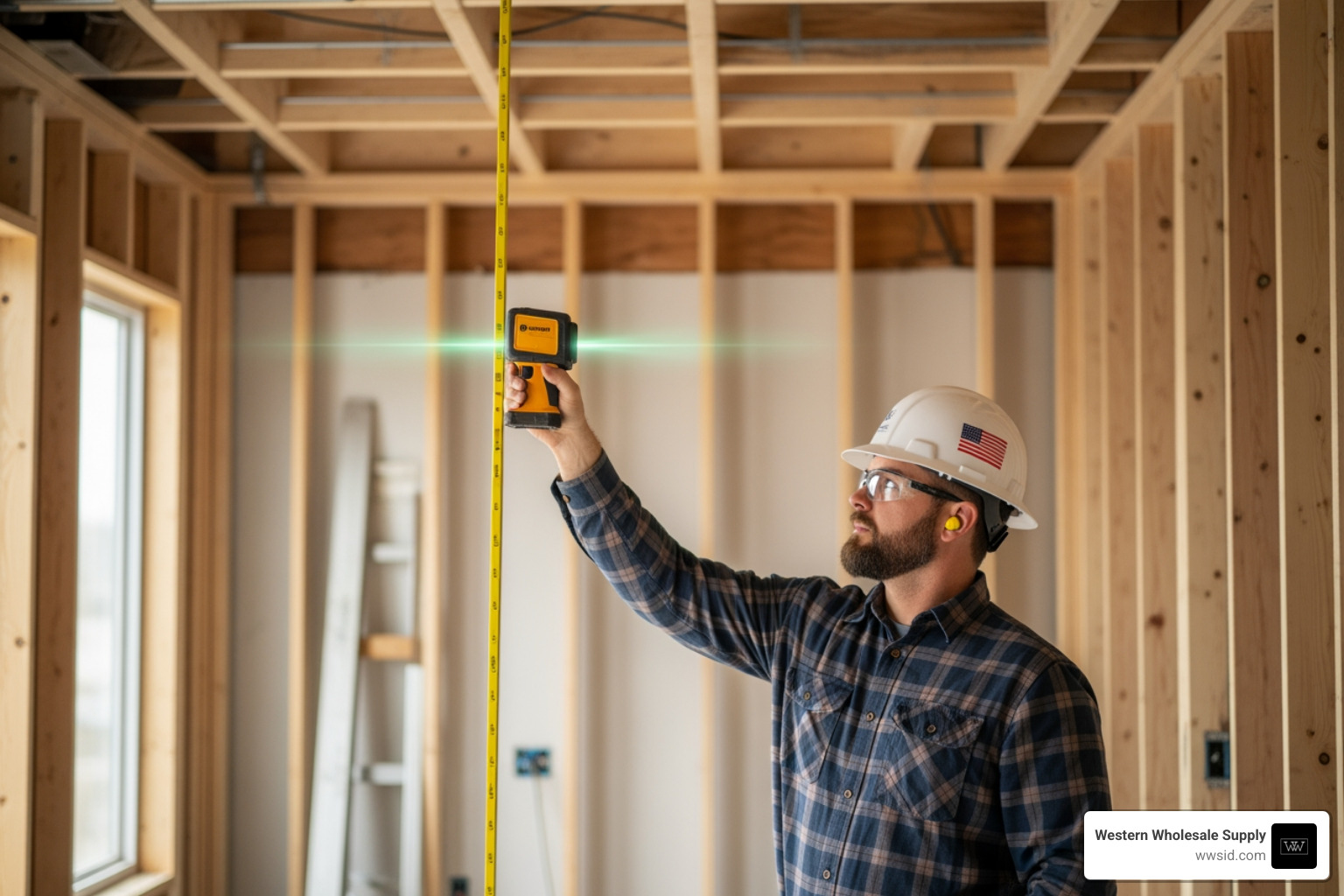
Measure the length and width of the room at the height where the ceiling will actually sit. Why? Because walls aren’t always perfectly plumb. A room that is 12 feet wide at the floor might be 12 feet 2 inches wide near the joists.
Step 2: Calculate Square Footage
Multiply the length by the width. For example, a 10′ x 12′ room is 120 square feet. If your room is L-shaped or irregular, break it into smaller rectangles, calculate each, and add them together.
Step 3: Calculate the Perimeter
Add the lengths of all walls together. This tells you how much wall angle (the L-shaped metal that supports the grid at the edges) you need.
To make your life easier, you can use the Western Wholesale Supply Ceiling Material Estimator to double-check your manual math.
Determining Joist Direction and Main Runner Placement
This is the “pro secret” that most beginners miss. Main runners must run perpendicular to the ceiling joists.
Why? Because you need to attach your hanger wires to the structural joists every 4 feet. If you run your main runners parallel to the joists, you’ll find yourself with nowhere to screw in your hangers between the beams.
- Pro Tip: If you have concrete ceilings, you generally run the main runners along the longest dimension of the room to minimize the number of cuts.
For those looking at high-end commercial finishes, understanding Small Grid Big Impact Everything About 916 Ceiling Systems can help you decide if a slim-line grid is better for your aesthetic than the standard 15/16-inch width.
Using Formulas to Estimate Ceiling Grid Components
If you prefer to skip the online tools and do it by hand, here are the industry-standard formulas for a standard 2×4 tile layout:
- Main Runners: Divide the room width by 4 (since runners are spaced 4 feet apart). Round up. Then multiply that by the number of 12-foot sections needed to span the room length.
- 4-Foot Cross Tees: You generally need one 4-foot cross tee for every 8 square feet of ceiling. (Total Sq Ft / 8).
- 2-Foot Cross Tees: If you are doing a 2×2 grid, you’ll need the same number of 2-foot tees as you have 4-foot tees. If you’re doing 2×4, you don’t need these at all!
- Hanger Wire: Plan for one wire every 4 feet along every main runner.
| Component | 2×2 Layout (per 100 sq ft) | 2×4 Layout (per 100 sq ft) |
|---|---|---|
| Main Runners (12′) | 2-3 pieces | 2-3 pieces |
| 4′ Cross Tees | 12-14 pieces | 12-14 pieces |
| 2′ Cross Tees | 12-14 pieces | 0 pieces |
| Tiles | 25 pieces | 13 pieces |
For the most accurate results, we recommend using Western Wholesale Supply’s Ceiling Material Estimator to verify your counts before placing an order at our Idaho Falls or Pocatello locations.
Planning the Layout for Professional Results
The biggest mistake people make when learning how to estimate ceiling grid is starting with a full tile in one corner. Unless your room dimensions are perfectly divisible by 2 or 4 feet, you’ll end up with a tiny, 2-inch sliver of tile on the opposite wall. It looks terrible.
Centering the Grid
To get a professional look, you want “balanced borders.” This means the tiles on the left wall should be the same size as the tiles on the right wall.
The Math for Balanced Borders:
- Divide your room width by the tile length (e.g., 10 feet / 4 feet = 2.5 tiles).
- Take the remainder (0.5 tiles, which is 2 feet) and add one full tile length (4 feet). Total = 6 feet.
- Divide that by 2. Your border tiles on both sides will be 3 feet wide.
This ensures that even if your walls are slightly crooked, the ceiling looks centered and intentional. For more on achieving this “high-end” look, check out Quiet Comfort A Comprehensive Guide to Acoustic Ceiling Solutions.
How to Estimate Ceiling Grid Waste and Border Tiles
No matter how good you are at math, you will have waste. You’ll drop a tile, mis-cut a cross tee, or realize one of your walls has a weird bump-out.
- Standard Waste Factor: Add 5% for simple, rectangular rooms.
- Complex Waste Factor: Add 10% for rooms with many corners, pillars, or irregular shapes (like L-shaped basements).
When ordering Fire Rated Ceiling Solutions, having that extra 10% is even more critical because fire-rated components must be installed exactly to spec to maintain their rating—there’s no “fudging it” with scrap pieces.
Budgeting and Tools for Your Project
While we won’t quote specific prices here (as they can fluctuate based on material costs in 2025), budgeting for your project involves more than just the grid and tiles.
Required Tools for Estimation and Planning:
- Laser Level: Essential for ensuring your wall angle is perfectly level around the room.
- Aviation Snips: For cutting the steel grid components.
- Tape Measure and String Line: To keep your main runners straight.
- Ladder: Make sure it’s tall enough to reach your joists comfortably.
If you’re tackling this as a weekend warrior, our guide on Acoustic Ceiling Installation A DIYers Dream Come True covers the physical labor side of the job. Once you have your list, you can find Where to Buy Western Wholesale Supply Products at any of our local offices across Eastern Idaho and Western Wyoming.
Frequently Asked Questions about Ceiling Estimation
How much clearance is needed above the grid?
You need a minimum of 4 inches of clearance between the bottom of the joists and the face of the ceiling grid. This space is necessary to tilt the tiles into the grid. If you have large recessed light fixtures or HVAC ducts, you may need 6 to 8 inches of “drop” to accommodate them.
Should I use 2×2 or 2×4 CertainTeed tiles?
2×4 tiles are the most common for residential basements because they are faster to install and generally more cost-effective. however, 2×2 tiles offer a more “upscale” look and are less prone to sagging over time. They are also much easier to handle in rooms with lots of recessed lights, as you have more grid support.
How do I account for obstacles like vents and lights?
When estimating, don’t subtract the square footage of your lights or vents from your tile count. You still need the tiles because you will be cutting the holes out of them. For heavy light fixtures, remember to estimate extra hanger wires to support the grid specifically at the corners of the fixture.
Conclusion
Mastering how to estimate ceiling grid is the difference between a project that glides along smoothly and one that stays stuck in the “planning phase” forever. By measuring twice, centering your layout, and accounting for a healthy waste factor, you’ll be ready to transform any space.
At Western Wholesale Supply, we’ve been the trusted partner for builders in Idaho Falls, Rexburg, Jackson, and beyond since 1963. As a veteran-owned, third-generation family business, we don’t just sell you the metal and tile—we provide the 60+ years of expertise to make sure your project is a success.
Ready to get started? Elevate Your Projects Discover Western Wholesale Supplys Acoustical Ceiling Solutions and let us help you get your material list exactly right. Whether you’re in Twin Falls or over the pass in Western Wyoming, we’re here to deliver quality materials right to your job site, on time, every time.
