

What Is a Perforated Timber Ceiling? A Quick Answer for Builders and Specifiers
A perforated timber ceiling is one of the most effective ways to combine natural wood aesthetics with real acoustic performance in commercial spaces. If you need the short version before diving in, here it is:
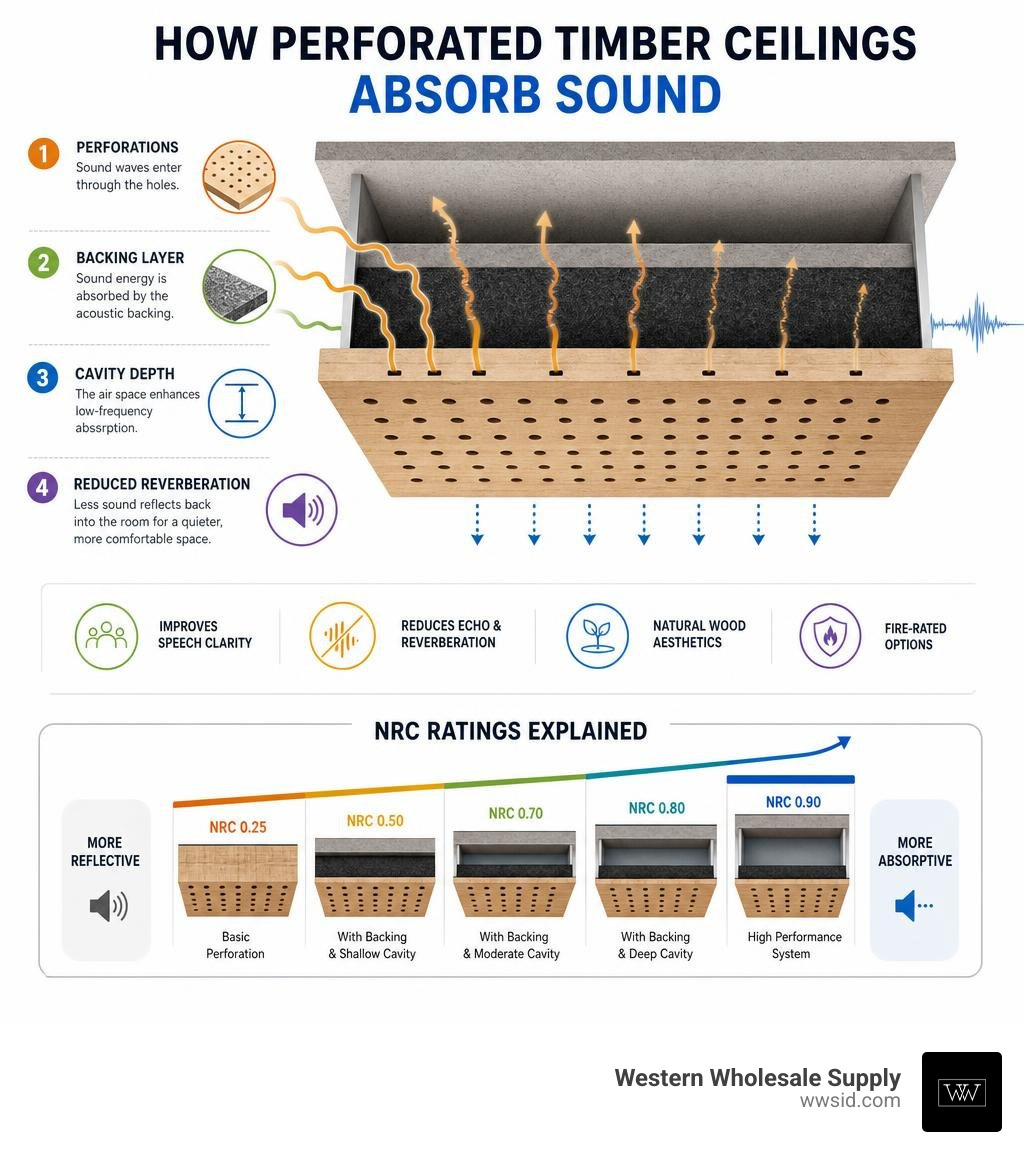
What is a perforated timber ceiling? A ceiling system made from wood or wood-veneer panels with small holes (perforations) drilled through the face. Sound waves pass through the holes into an absorptive backing layer, reducing echo and reverberation. The result is a ceiling that looks like natural wood but performs like an acoustic treatment.
| Feature | Quick Answer |
|---|---|
| Hole sizes | 0.5mm (micro) to 8mm+ (standard) |
| Acoustic performance | NRC 0.70 to 0.90 depending on backing and cavity |
| Common backing materials | Acoustic fleece, mineral wool, polyester fiber |
| Fire rating | Class A (ASTM E84) available |
| Sustainability | FSC-certified, NAF, low-VOC options available |
| Typical applications | Offices, auditoriums, museums, healthcare, education |
| Common installation methods | Lay-in grid, concealed clips, direct mount |
Choosing the right perforated timber ceiling can feel overwhelming. There are dozens of perforation sizes, wood species, backing systems, and mounting methods to sort through — and the wrong call affects both acoustics and appearance for the life of the building.
This guide breaks it all down in plain language so you can spec confidently, avoid costly mistakes, and keep your project on schedule.
At Western Wholesale Supply, we are an independent, veteran-owned, third-generation family business with deep experience supplying acoustic ceiling systems — including perforated timber ceiling products — to contractors across commercial and institutional projects. From our hands-on distribution background since 1963, this guide gives you the practical clarity you need to move forward fast.
Explore more about perforated timber ceiling:
Understanding the Perforated Timber Ceiling and Micro-Perforation Technology

When selecting a perforated timber ceiling, the first design decision centers on how visible you want the perforations to be. Modern manufacturing allows us to control the visual texture of the ceiling by scaling the hole diameters from highly visible architectural patterns down to virtually invisible micro-perforations.
Standard Perforations vs. Micro-Perforations in a Perforated Timber Ceiling
Standard perforations typically feature hole diameters ranging from 4mm up to 8mm or even 10mm. These holes are spaced in linear or staggered grids, creating a distinct, high-texture architectural look. For example, a classic panel with 8mm holes spaced 16mm on center (yielding an open area of roughly 19.6%) makes the perforation pattern a deliberate part of the room’s visual design.
Micro-perforation technology, on the other hand, is engineered to preserve the uninterrupted warmth of real wood. Micro-perforated panels feature ultra-fine holes—typically between 0.5mm and 1.1mm in diameter.
From a normal viewing distance of just two feet or more, these tiny perforations virtually disappear. Systems like the 9Wood Nanoperf utilize this technique to maintain a seamless, solid-wood appearance while still allowing sound waves to pass directly through the face of the panel. This means you no longer have to choose between the rich, continuous grain of natural millwork and high-performance acoustic control.
Acoustic Performance Metrics and Backing Configurations
To design a space that feels as good as it looks, we have to look closely at the acoustic metrics. A perforated timber ceiling is not inherently soundproof; rather, it acts as a decorative filter that lets sound waves pass through to an acoustic absorber hidden in the plenum.
The three primary metrics we use to evaluate these ceilings are:
- Noise Reduction Coefficient (NRC): Measures the amount of sound energy absorbed by the ceiling (ranging from 0.00 for total reflection to 1.00 for total absorption).
- Ceiling Attenuation Class (CAC): Measures the ceiling’s ability to block sound from traveling through a shared plenum between adjacent rooms.
- Absorption Class: Categorizes overall performance from Class A (highest absorption) to Class D.
For a deeper dive into managing sound travel, check out our A Comprehensive Guide to Ceiling Sound Treatment.
How Backing Materials and Cavity Depth Affect a Perforated Timber Ceiling
The physical magic behind a perforated timber ceiling relies on the Helmholtz resonance principle. When sound waves hit the panel, the air in the tiny perforations acts like a spring, vibrating against the larger volume of air in the cavity behind it. This friction converts sound energy into harmless heat.
To maximize this effect, we use factory-applied acoustic fleece (often called Soundtex) on the back of the panels, combined with secondary acoustic insulation in the plenum cavity. The table below illustrates how different cavity depths and backing materials directly impact acoustic performance:
| Panel Type | Perforation Details | Cavity Depth & Infill | NRC / $alpha_w$ Rating | Absorption Class |
|---|---|---|---|---|
| Micro-Perforated (NP-2) | 0.5mm holes @ 1.97mm diagonal spacing | 20mm cavity with 20mm polyester wool | 0.70 | Class C |
| Micro-Perforated (NP-2) | 0.5mm holes @ 1.97mm diagonal spacing | 70mm cavity with 50mm (40kg/m³) mineral fiber | 0.85 | Class B |
| Micro-Perforated (MP-3) | 1.1mm holes @ 3mm spacing | 70mm cavity with 50mm (40kg/m³) mineral fiber | 0.85 | Class B |
| Standard Perforated | 3/4″ thick panel, 0.5mm face | Standard air cavity (no extra infill) | 0.70 | Class C |
| High-Performance Microperf | 1″ thick panel, 0.5mm face | Standard air cavity with fiberglass core | 0.90 (CAC 46) | Class A |
| Standard P16-C | 8mm holes @ 16mm on center | 70mm cavity with 50mm mineral wool | 0.75 | Class C |
By adding a dense mineral wool backer (typically 32kg/m³ to 64kg/m³ density) into the plenum, you can easily elevate a standard Class C layout into a high-performance Class A acoustic environment.
Material Selection, Fire Ratings, and Sustainability
Selecting the right materials for your timber ceiling requires balancing visual goals, fire safety codes, and environmental standards.
Wood Species and Finishes
Perforated panels are typically manufactured using a high-density fiberboard (MDF) or plywood core faced with either natural wood veneer, melamine, or high-pressure laminates (HPL).
- Natural Wood Veneers: Popular species include Ash, Maple, Beech, Walnut, Red Oak, White Oak, Hickory, Cherry, and Bamboo (available in Natural or Caramelized). Natural veneers provide authentic grain variation and can be finished with clear lacquers or custom stains.
- Melamine & HPL Laminates: Excellent for high-traffic or budget-conscious projects, offering highly durable, wood-effect finishes that are exceptionally easy to color-match across large production runs.
Fire and Environmental Certifications
Because ceilings are a critical path for fire safety, commercial interior specifications in Eastern Idaho and Western Wyoming demand rigorous testing.
- Fire Ratings: Look for panels tested to ASTM E84 standards achieving a Class A (or Class 1) Flame Spread Rating. Manufacturers achieve this by utilizing Class A fire-rated particle board or fire-resistant MDF cores. For more on this, read our guide on Building Safety from the Top Down: Fire Rated Ceiling Solutions.
- Sustainability Credentials: Ensure your timber is sourced responsibly by specifying FSC (Forest Stewardship Council) certified products. Additionally, specifying No Added Formaldehyde (NAF) plywood cores and low-VOC finishes helps projects earn LEED credits and supports indoor air quality goals.
Comparing Timber to Alternative Acoustic Ceiling Solutions
When designing a commercial space, it helps to understand how a perforated timber ceiling compares to other common acoustic treatments.
| Material | Aesthetics | Maintenance |
|---|---|---|
| Perforated Timber | Premium, warm, biophilic design | Low (dust/vacuum), highly durable |
| Fabric Panels | Soft, modern, high color variety | High (holds dust, hard to clean) |
| Acoustical Gypsum | Clean, monolithic, drywall-like look | Medium (requires painting over time) |
| Metal Ceilings | Industrial, sleek, ultra-modern | Low (wipeable), prone to scratching |
While fabric panels and metal ceilings offer great acoustic performance, they lack the organic warmth and biophilic benefits of real wood. Wood ceilings also excel in environmental sustainability; timber acts as a natural carbon sink, sequestering carbon dioxide throughout the lifetime of the building.
To compare these options further, check out our resource on Quiet Comfort: A Comprehensive Guide to Acoustic Ceiling Solutions.
Installation Methods, Accessibility, and Service Integration
Installing a perforated timber ceiling requires precision to ensure a flat, stable, and visually seamless plane. There are three primary mounting methods:
- Lay-In & Tegular Grid: Panels rest directly in a heavy-duty 15/16″ or 9/16″ T-bar suspension grid. This is the most cost-effective method and offers 100% upward accessibility to the plenum. We highly recommend using CertainTeed grid systems for a perfectly level, reliable fit.
- Concealed Clips / Torsion Springs: Panels clip onto concealed heavy-duty rails or use torsion springs. This creates a clean, monolithic look with no visible grid lines, while still allowing individual panels to be swung down for maintenance access.
- Direct Mount: Panels are fastened directly to wood furring strips or a drywall suspension system using Z-clips or specialized concealed fasteners.
Typical Concealed Direct-Mount Assembly (from top to bottom):
- Existing Substrate
- Wood Furring Strips
- Concealed Z-Clips / Grabber Fasteners (with Acoustic Mineral Wool)
- Acoustic Fleece Backing
- Perforated Timber Panel (Finished Ceiling Plane)
Integration with Services
Integrating lighting, HVAC diffusers, and sprinkler heads requires careful pre-construction planning. Always coordinate with your manufacturer to have critical penetrations factory-cut, which preserves the structural integrity of the panels and guarantees clean, splinter-free edges.
When securing suspension wires and heavy-duty grid components, rely on professional-grade hardware like Grabber fasteners to ensure the system remains safe and code-compliant. For more details on grid hardware, see The Little Things That Hold It All Together: Hangers, Clips and Tape for Your Grid Ceiling.
Commercial Specification: Costs, Lead Times, and Project Applications
Because timber acoustic systems are highly engineered, they are typically made-to-order. Standard flat panels like ASI Architectural Fusion offer classic wood veneer aesthetics with standard lead times of roughly 5 to 7 weeks. However, if your design calls for custom perforation patterns, non-standard panel sizes, or complex curved profiles, expect to add an extra 2 to 3 weeks to the fabrication schedule.
Minimum Order Quantities (MOQs)
Most specialty manufacturers require a minimum order quantity (typically around 30 to 50 square meters) to set up the precision CNC tooling for a production run. For smaller commercial retrofits, it is best to consult with your distributor early to see if your order can be combined with a larger run to avoid small-batch surcharges.
For a broader look at planning your commercial ceiling budgets and timelines for the coming year, read our Buyer’s Guide: Best Ceiling Supplies for 2026.
Frequently Asked Questions about Perforated Timber Ceilings
What is the typical lead time and minimum order quantity for these systems?
Standard perforated panels carry a lead time of 5 to 7 weeks from the moment shop drawings are approved. Custom designs, unique wood species, or custom stain-matching can extend this by 2 to 3 weeks. Minimum order quantities typically start around 30 square meters (roughly 320 square feet).
Can perforated timber panels be used on both walls and ceilings?
Yes! Most systems are designed to transition seamlessly from the ceiling down to the walls to create a continuous wooden envelope. Wall-mounted panels are usually hung using heavy-duty Z-clips or split-batten systems, and they require a 2.5mm expansion gap per meter to accommodate natural seasonal shifts in humidity.
How do you clean and maintain a perforated wood ceiling?
Maintenance is remarkably simple. Regular cleaning involves light dusting or vacuuming with a soft brush attachment to keep the perforations clear of dust. Avoid using wet mops, harsh chemical cleaners, or excessive moisture, which can cause the natural wood veneers or MDF cores to swell or warp.
Conclusion
A perforated timber ceiling is a premier design choice, bringing unmatched warmth, elegance, and high-performance sound control to modern commercial spaces. By understanding how perforation sizes, cavity depths, and backing materials work together, you can design a space that looks stunning and feels acoustically balanced.
At Western Wholesale Supply, we’ve spent over 60 years helping contractors and architects across Eastern Idaho and Western Wyoming bring their commercial visions to life. From our locations in Idaho Falls and Pocatello to our service areas in Jackson, Twin Falls, and Western Montana, we deliver top-tier materials with the reliable, on-time service you expect from a third-generation family business.
Whether you need high-performance CertainTeed ceiling systems, Grabber fasteners, or expert technical advice, we’re here to help. Contact us today to discuss your next project, or explore our complete catalog of Acoustical Ceilings.
