

Why Ceiling Sound Treatment Makes or Breaks a Room’s Acoustics
Ceiling sound treatment is the practice of applying sound-absorbing or sound-blocking materials to overhead surfaces to control echo, reverberation, and noise within a space.
Here is a quick breakdown of what it does and when you need it:
| Goal | Solution Type | Common Spaces |
|---|---|---|
| Reduce echo and reverberation | Acoustic absorption panels, clouds, baffles | Offices, gyms, home theaters |
| Improve speech clarity | Drop-in ceiling tiles, suspended clouds | Classrooms, conference rooms |
| Block noise between floors | Mass loaded vinyl, decoupled assemblies | Multi-story buildings |
| Even out sound distribution | Ceiling baffles, full-coverage tiles | Warehouses, open offices |
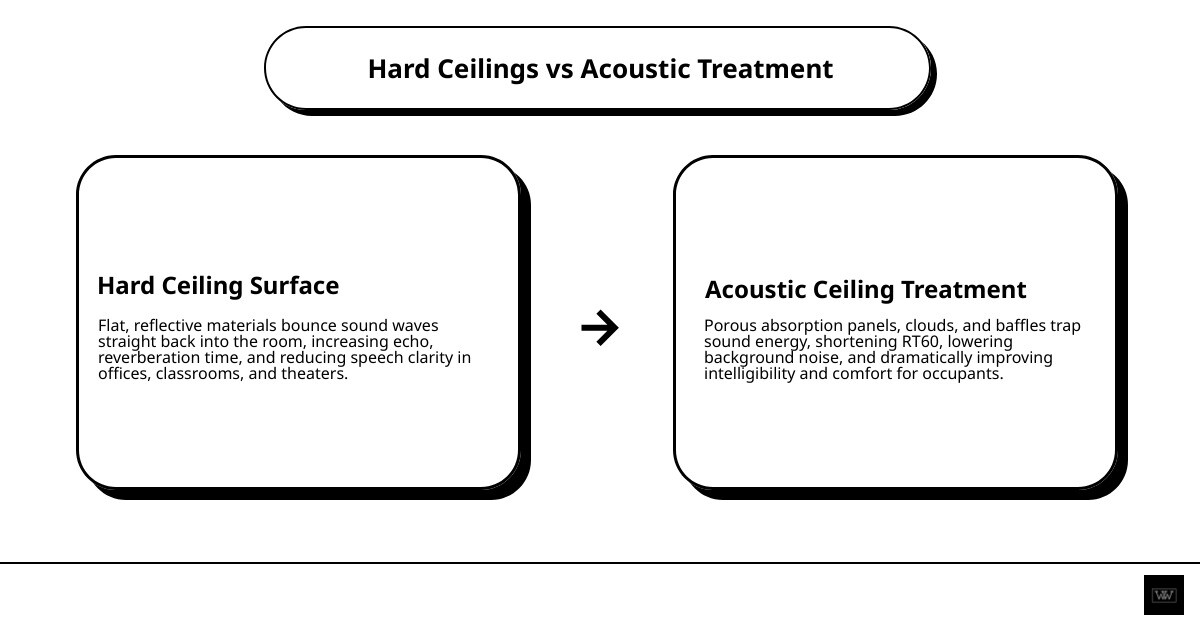
Most people notice the problem before they know the cause. You walk into a gym and every bounce of a basketball trails a flurry of echoes. You sit in a conference room and struggle to follow the conversation. You finish a home theater install and dialogue sounds muddy. In almost every case, the ceiling is a major part of the problem — it is a large, hard, flat surface that reflects sound straight back into the room.
Acoustic ceiling tiles use porous materials to absorb sound waves that would otherwise bounce off hard surfaces, reducing reverberation and improving speech clarity. Treating the ceiling is often the single highest-impact move you can make, especially in rooms where wall space is limited or already in use.
At Western Wholesale Supply, we are a regional building materials supply business with deep roots in construction and distribution, and we’ve helped contractors across the region source effective ceiling sound treatment solutions for everything from commercial office builds to warehouse projects. In the sections ahead, we’ll walk through every option — materials, placement, installation methods, and what actually works.
Ceiling sound treatment helpful reading:
Understanding Ceiling Sound Treatment: Absorption vs. Blocking
When we talk about ceiling sound treatment, it is vital to distinguish between two different goals: absorption and blocking. We often see folks in Idaho Falls or Jackson confuse these two, but they require very different materials and strategies.
Absorption: Killing the Echo
Absorption is all about managing the sound inside the room. When sound hits a hard, flat surface like a standard drywall ceiling, it bounces back. This creates reverberation—the “tail” of sound that makes rooms feel noisy and chaotic. In technical terms, we measure this using RT60, which is the time it takes for a sound to decay by 60 decibels. For a comfortable home theater or office, you generally want an RT60 between 300ms and 500ms. If your room sounds like a cathedral, you need absorption.
Blocking: Stopping the Neighbors
Blocking (or soundproofing) is about preventing sound from traveling between rooms or floors. If you can hear footsteps from the apartment above you in Victor or the TV in the next room in Rexburg, you are dealing with sound transmission. To solve this, you need mass and decoupling. This is where products like Quietrock EZ Snap come into play. Standard soundproofing for drywall techniques involve adding dense materials and breaking the physical connection between the ceiling and the floor joists to stop structural vibrations.
Measuring Success
To know if your treatment is working, experts use clarity plots (C50). A target C50 of greater than 10dB is considered excellent for speech. Whether you are working with Acoustical Solutions or DIYing your space, understanding these metrics ensures you don’t just throw panels at the ceiling and hope for the best.
Types of Ceiling Sound Treatment Solutions
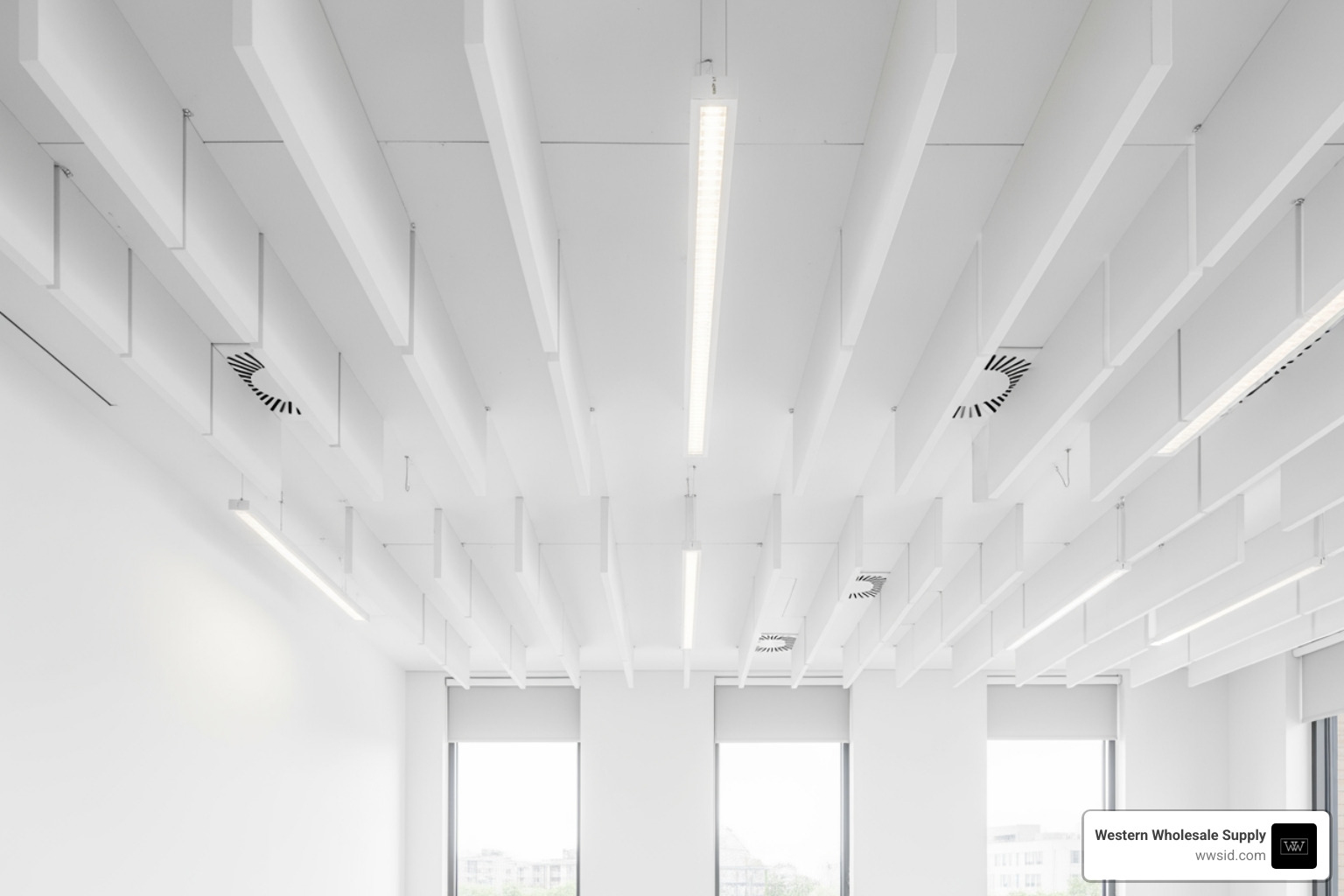
There isn’t a one-size-fits-all solution for ceilings. The “best” method depends on your existing structure and your aesthetic goals.
Drop-in Grid Tiles
This is the gold standard for commercial offices and basements in Pocatello and beyond. Using a suspended T-bar grid, you simply drop in CertainTeed tiles. These are incredibly efficient because they allow for a “plenum” space above the tile, which helps trap sound. They are also easy to replace if one gets damaged.
Acoustic Clouds
Ceiling mounted acoustic panels, often called “clouds,” are suspended horizontally from the ceiling. These are popular in modern restaurants and open-plan offices because they absorb sound from both the front and the back, essentially doubling their efficiency. They are a great way to add ceiling sound treatment without covering the entire surface.
Vertical Baffles
In large, high-ceiling spaces like gymnasiums or warehouses in Burley, vertical baffles are the way to go. These hang vertically in rows, providing a massive amount of surface area to catch sound waves as they travel across the room. They stay out of the way of lighting and HVAC systems while providing significant noise reduction.
Direct Mount and Catenary Banners
For those with low ceilings or limited clearance, direct-mount panels can be fastened right to the drywall using Grabber fasteners. In massive industrial spaces, catenary banners—large sheets of acoustic material draped between mounting points—offer a cost-effective way to treat thousands of square feet. If you are looking for professional help with these complex installs, you can often find acoustic ceilings contractors in Idaho Falls, ID through local networks.
Material Science: NRC Ratings and Fire Resistance
When selecting your ceiling sound treatment, you’ll see a lot of technical specs. Here is what actually matters for your project in Eastern Idaho or Western Wyoming.
The NRC Rating
The Noise Reduction Coefficient (NRC) is a scale from 0 to 1.0 that tells you how much sound a material absorbs. An NRC of 1.0 means the material absorbs 100% of the sound hitting it.
| Material Type | Typical Thickness | NRC Rating | Best Use |
|---|---|---|---|
| Standard Drywall | 1/2″ | 0.05 | Reflecting sound |
| PET Felt | 9mm – 12mm | 0.85 | Modern aesthetics |
| CertainTeed Mineral Fiber | 3/4″ | 0.70 – 0.75 | General office use |
| High-Density Fiberglass | 2″ | 1.0 | Studios & Home Theaters |
| High-Density Fiberglass | 4″ | 1.15+ | Low-frequency/Bass control |
As a rule of thumb, a 2-inch thickness is effective down to about 150Hz, while 4-inch panels extend that control down to 100Hz, which is critical for home theaters.
Fire Safety and Health
In commercial spaces, building safety from the top down is non-negotiable. Most acoustic treatments must meet ASTM E84 Class A fire ratings. Additionally, many modern materials like the VicPattern Ultra Triangles MKII utilize sustainable, formaldehyde-free PET felt or recycled wool, ensuring that your improved acoustics don’t come at the cost of indoor air quality.
Strategic Placement of Ceiling Sound Treatment for Optimal Acoustics
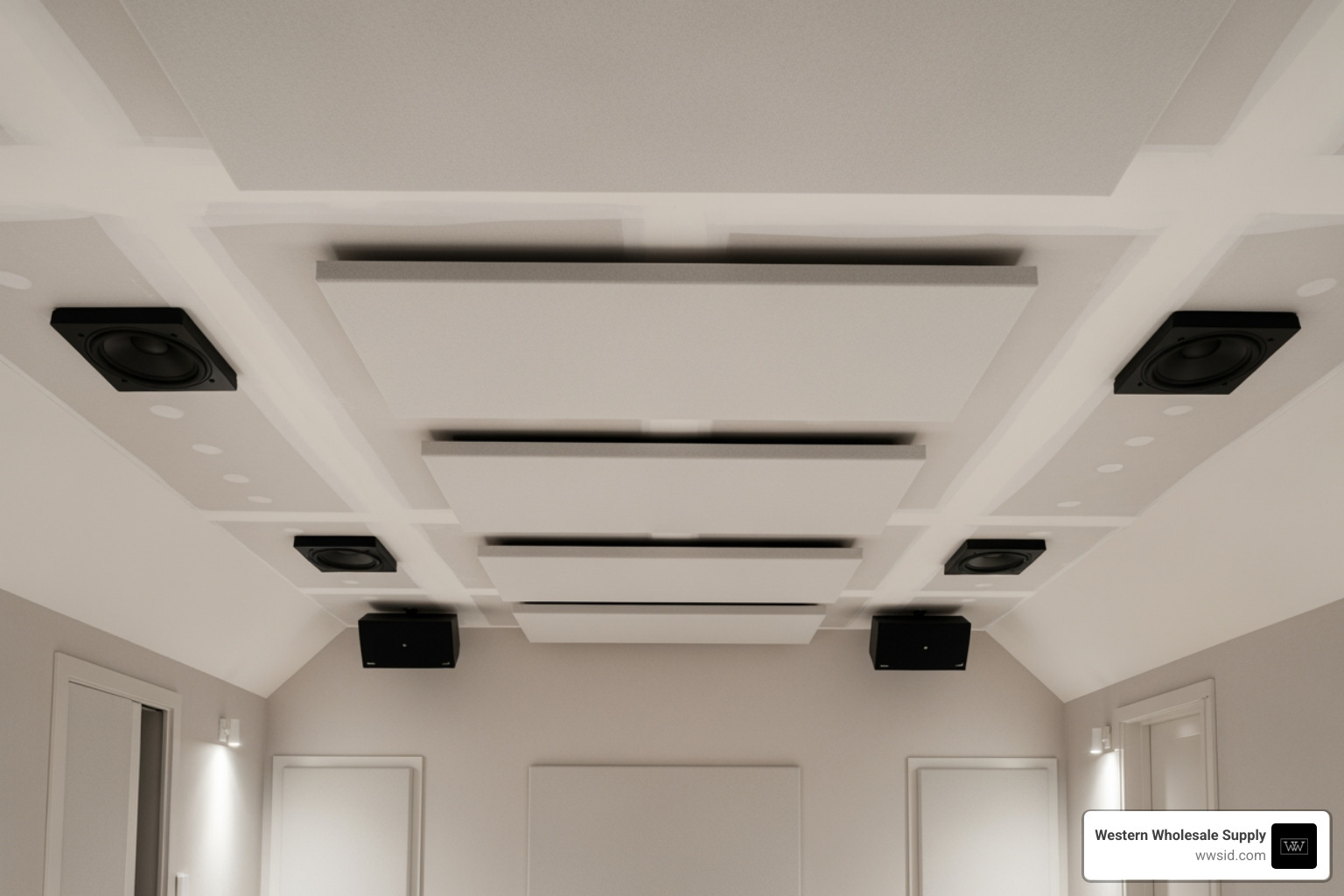
Where you put your panels is just as important as what they are made of. You don’t always need to cover 100% of the ceiling to see a massive improvement.
The First Reflection Point
In a listening room or home theater, the “first reflection point” on the ceiling is where sound from your speakers hits the ceiling before reaching your ears. Treating these specific spots for your Left, Center, and Right (LCR) speakers can achieve near 100% dialogue intelligibility. It eliminates the “blurred” sound caused by the direct signal and the reflected signal hitting your ears at slightly different times.
Coverage Area and “Hot Spots”
For general noise control in an open office in Chubbuck or a restaurant in Jackson, aim for 25-50% coverage of the total surface area. In large, open rooms, treating the ceiling is better than walls because the ceiling is equidistant from the floor across the entire space. This prevents “hot spots” where sound builds up in the center of the room.
Special Surfaces: Porous Concrete and Warehouses
If you have an arched, porous concrete ceiling, you might think you’re safe from echoes. While concrete has some natural diffusion, it is still a hard surface. You’ll still likely need some sound absorbing ceilings to truly tame the space. In warehouses, we often focus on insulation for thermal benefits (aiming for R-30+ in the ceiling), but high-quality insulation also provides a secondary benefit of sound dampening. Using Acoustic Geometry principles, you can balance the room without making it feel “dead” or over-treated.
Frequently Asked Questions about Ceiling Sound Treatment
Can ceiling sound treatment block noise from neighbors upstairs?
Standard sound absorption panels (like clouds or baffles) will not block noise from the neighbors. They only stop sound from bouncing around your room. To block noise from upstairs, you need to add mass and decoupling. This usually involves installing Quietrock EZ Snap or using mass loaded vinyl (MLV) against the joists. Decoupling the drywall from the structure is the most effective way to stop impact noise like footsteps.
How much ceiling sound treatment coverage is needed for a standard office?
For most professional environments, the 25-50% rule is a safe bet. You want enough acoustic ceiling solutions to ensure speech clarity and privacy without making the room feel unnaturally silent. Over-treating can lead to a “dead” room, which can actually be fatiguing for employees.
What are the best fasteners for a DIY ceiling sound treatment project?
Safety is paramount when hanging items over your head. We always recommend using high-quality fasteners like Grabber screws or Brighton Best hardware. For permanent installs into drywall, use heavy-duty anchors or Z-clips fastened directly into the joists. For renters in areas like Victor or Driggs, 3M Command Strips can work for very lightweight PET felt panels, but for anything heavier, you’ll want to consult with insulation contractors or ceiling specialists to ensure the suspension system is rated for the weight.
Conclusion
At Western Wholesale Supply, we’ve spent over 60 years helping the people of Eastern Idaho and Western Wyoming build better, quieter spaces. As a third-generation, veteran-owned family business, we take pride in knowing the specific needs of our climate and our community—from the snowy peaks of Jackson to the growing hubs of Idaho Falls and Pocatello.
Whether you are looking for acoustical ceilings for a new office or trying to fix the echo in your home studio, the right ceiling sound treatment makes all the difference. We focus on reliable, on-time delivery of premium brands like CertainTeed and Grabber, ensuring your project stays on schedule and performs exactly as expected.
If you’re ready to quiet your space, reach out to us. We have the experience and the inventory to help you find the perfect overhead solution.
