

What Is Sound Dampening Drywall — And Do You Need It?
sound dampening drywall is a specialized gypsum panel engineered to reduce noise transmission between rooms. Unlike standard drywall, it contains a viscoelastic polymer layer sandwiched between dense gypsum cores. This layer absorbs sound energy and converts it to heat, dramatically cutting the amount of noise that passes through a wall.
Here’s a quick summary of what you need to know:
| Feature | Sound Dampening Drywall | Standard Drywall |
|---|---|---|
| Core construction | Multi-layer with polymer damping layer | Single gypsum core |
| STC rating (typical) | 48–80+ depending on product and assembly | 33–37 on standard stud wall |
| Low-frequency performance | Significantly better | Poor |
| Installation | Same as standard drywall | Standard |
| Added benefits | Mold resistance, fire rating options | Basic fire resistance only |
It installs just like regular drywall — no special tools, no resilient channels required in most assemblies. That makes it a practical choice for contractors who want high acoustic performance without adding complexity or wall thickness to a project.
It’s most commonly used in bedrooms, home theaters, home offices, healthcare spaces, multifamily housing, and hotels — anywhere noise control directly affects comfort or privacy.
At Western Wholesale Supply, we have decades of hands-on experience sourcing and supplying sound dampening drywall products — including Quietrock EZ Snap — to contractors and builders across residential and commercial projects. In this guide, we’ll walk you through everything you need to make the right product decision for your next job.
Understanding Sound Dampening Drywall and How It Works
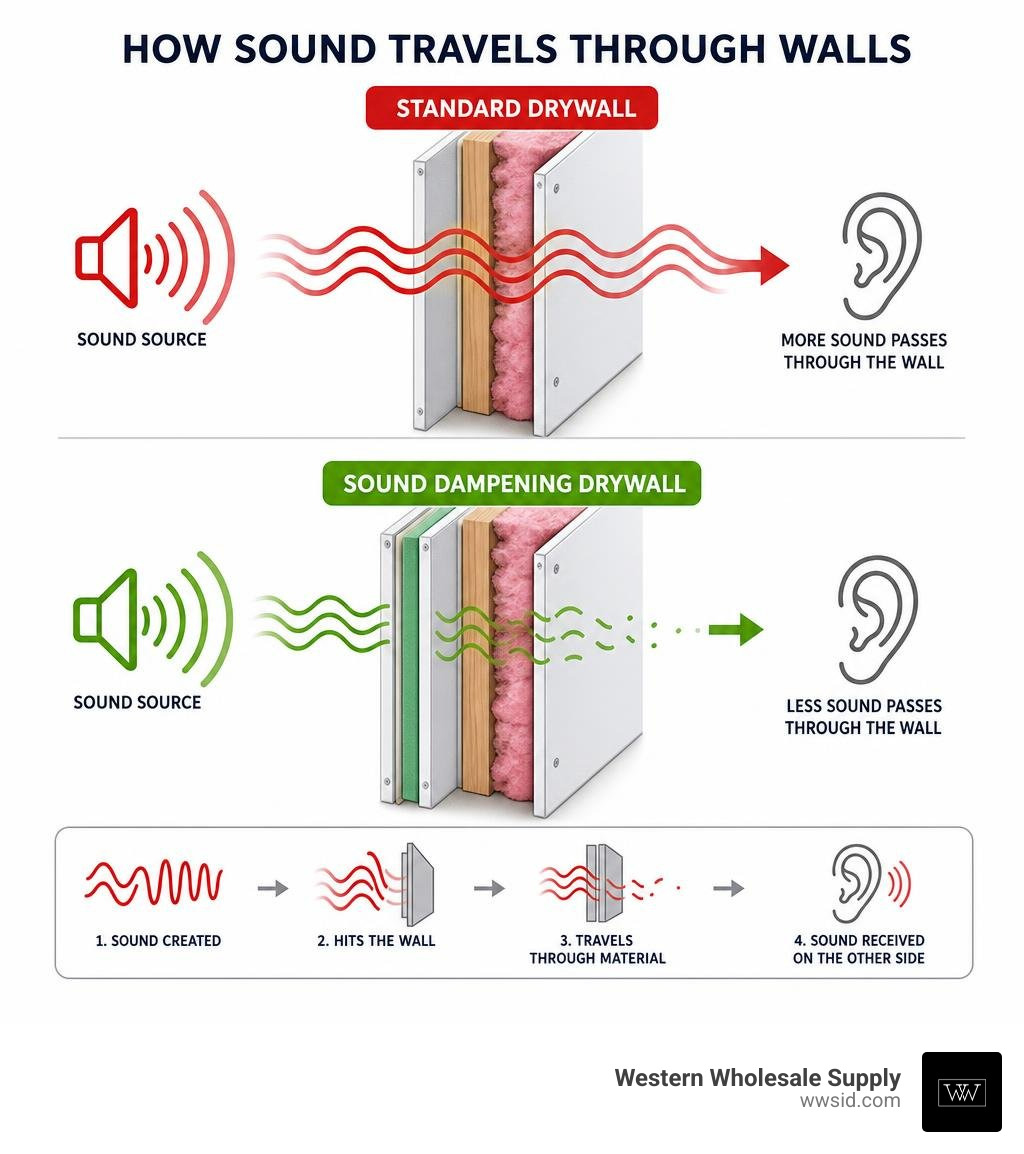
To understand why standard walls let so much noise through, we have to look at how sound behaves. Sound travels in waves, vibrating the air and any physical structures in its path. When those waves hit a standard partition wall, they cause the drywall sheets to vibrate in unison, acting like a giant speaker diaphragm that recreates the sound on the other side.
Traditional methods of stopping this vibration involved adding massive weight (like multiple layers of gypsum board) or decoupling the wall surfaces. While effective, these methods can eat up valuable floor space and drive up labor costs.
This is where specialized sound dampening drywall comes in. Instead of relying solely on raw mass, these engineered panels use internal damping to quiet the vibrations before they can pass through the wall. If you want to dive deeper into the basics of wall acoustics, check out our resource on drywall noise insulation.
Standard Drywall vs. Sound Dampening Drywall
Standard drywall consists of a single, continuous gypsum core encased in paper facings. While gypsum is naturally dense and offers some baseline resistance to sound transmission, standard 1/2-inch or 5/8-inch panels are relatively stiff. This stiffness allows them to vibrate easily when struck by sound waves, particularly at mid-to-high frequencies like human speech or television audio.
In contrast, sound dampening drywall relies on a multi-layer sandwich construction. It features two dense gypsum outer layers separated by an internal viscoelastic polymer core. This structural difference prevents the panel from vibrating as a single rigid unit. To learn more about selecting the right core types and finishes for your project, take a look at our guide on how high quality drywall impacts overall performance.

The Science of Viscoelastic Damping
At the heart of high-performance panels like QuietRock is a process called viscoelastic damping. Viscoelastic materials possess both viscous (fluid-like) and elastic (stretchable) physical properties.
When sound waves strike the face of a sound-damped panel, the energy forces the outer gypsum layers to flex. This flexing movement creates a shearing force across the internal polymer layer. Rather than letting the vibration pass through, the polymer molecules slide against each other. This molecular friction converts the kinetic energy of the sound waves into microscopic amounts of heat, which quickly dissipates harmlessly within the wall.
By converting sound energy into heat, the panel prevents the wall from acting as a transmitter. This advanced polymer technology is what allows thin, single-panel assemblies to match or exceed the acoustic performance of much thicker, multi-layered traditional walls. You can read more about this chemical engineering on the official QuietRock Sound Reducing Drywall technology page.
Top Brands of Sound Dampening Drywall on the Market
When selecting sound dampening drywall for residential or commercial projects in Eastern Idaho or Western Wyoming, two primary brands lead the industry in reliability, testing, and performance: QuietRock and SoundBreak XP. Both brands offer highly engineered solutions, but they target slightly different project requirements.
| Feature | Quietrock EZ Snap | SoundBreak XP |
|---|---|---|
| Thickness Options | 5/8″ | 1/2″, 5/8″, 3/4″ |
| Workability | Patented EZ Snap core (scores and snaps easily) | Standard gypsum scoring |
| Mold Resistance | Available (EZ Snap Mold Resistant) | High (SPORGARD technology, 10/10 score) |
| Fire Rating | Type X (1-hour fire-rated) | Type X and Fire-Shield options |
| Primary Benefit | Fast installation, high STC on single studs | Moisture/mold protection, floor-ceiling options |
Quietrock EZ Snap and High-Performance Panels
QuietRock is widely recognized as a pioneer in the acoustic drywall space. For standard commercial and residential walls, Quietrock EZ Snap is the go-to choice. Historically, soundproof drywall was notoriously difficult to cut, often requiring power saws because of internal metal or fiber layers. Quietrock EZ Snap solved this issue with a patented core formulation that allows installers to score and snap the board using a standard utility knife, saving valuable time on the job site.
For high-end applications like professional recording studios, commercial theaters, or mechanical rooms, PABCO Gypsum manufactures QuietRock 545. This 1-3/8” thick heavy-duty panel features a multi-layer composition of gypsum, a sheet of steel, and a cementitious panel laminated with viscoelastic polymer. It is specifically engineered to provide maximum sound isolation across a broad frequency range, especially targeting low-frequency noise.
To review detailed structural values, check out the Quietrock EZ Snap specifications and the QuietRock® 545 | Products | PABCO Gypsum technical page.
SoundBreak XP and Moisture-Resistant Options
Manufactured by Gold Bond, SoundBreak XP is easily identified by its signature purple paper facing. SoundBreak XP is an excellent option for areas where moisture and mold resistance are just as important as sound control, such as bathrooms, basements, kitchens, and shared laundry walls.
SoundBreak XP features SPORGARD technology, an advanced mold-inhibiting formulation in both the gypsum core and the paper face. It consistently achieves the highest possible score of 10 on mold resistance tests (ASTM D3273 and ASTM G21). It is available in multiple thicknesses, including a 3/4″ variant designed to reduce impact noise in floor-ceiling assemblies.
For more details on how these panels are constructed to handle moisture, visit the SoundBreak® XP® Gypsum Board details page.
Comparing Acoustic Performance: STC Ratings and Alternatives
To compare the effectiveness of different soundproofing methods, the construction industry relies on Sound Transmission Class (STC) ratings. Measured in a laboratory environment according to ASTM E90 standards, the STC rating is a single-number integer that rates how well a building partition attenuates airborne sound.
A higher STC number indicates better noise reduction. For example, a standard interior wall built with 2×4 wood studs and standard 1/2-inch drywall on both sides typically achieves an STC rating of 33 to 37. At this level, normal conversation can be heard and understood through the wall. An STC rating of 50 or higher is generally considered the threshold for high-performance soundproofing, where loud speech becomes inaudible.
If you are weighing your design choices, you can read our comprehensive analysis on A guide to sound dampening drywall alternatives.
Achieving High STC Ratings with Sound Dampening Drywall
By replacing standard gypsum panels with sound dampening drywall, you can drastically increase a wall’s STC rating without changing the framing footprint.
- QuietRock 500 (1/2″ thickness) can deliver an STC rating of 42+ when installed on a basic 16-inch on-center wood stud assembly.
- Quietrock EZ Snap (5/8″ thickness) can achieve STC-rated assemblies ranging from 48 to 60 depending on the stud type and spacing. For instance, a single 3-5/8″ steel stud wall with QuietRock on just one side can achieve an STC of 60.
- QuietRock 545 (1-3/8″ thickness) can achieve STC ratings from 60 all the way up to 80 when used in double-stud wall configurations, making it the highest-performing panel on the market. For technical data on these high-performance assemblies, refer to the QuietRock® 545 high performance documentation.
Sound Dampening Drywall vs. Double Drywall and Green Glue
A common alternative to factory-damped panels is using two sheets of standard drywall with a field-applied viscoelastic damping compound, such as Green Glue, sandwiched between them.
While field-applied compounds are highly effective, they come with substantial labor trade-offs. The compound must be manually applied to the back of the second drywall sheet using a dispensing gun before hanging. This process is time-consuming, messy, and highly dependent on installer precision. If an installer applies too little compound or allows it to dry prematurely, the wall’s acoustic performance will drop significantly.
Using a single layer of factory-engineered sound dampening drywall like Quietrock EZ Snap eliminates this installation variable. It installs in a single step, reducing labor costs, shortening project timelines, and keeping the wall assembly as thin as possible to maximize usable square footage. If you are considering retrofitting an existing wall, read our step-by-step guide on how to double drywall for soundproofing.
Installation Best Practices and Requirements
To achieve the laboratory-tested STC ratings of sound dampening drywall in the real world, proper installation is critical. Sound behaves like water—it will find and leak through the smallest gap in an assembly.
Before starting, it is vital to select the correct panel dimensions for your space. For a breakdown of standard sizing and layout planning, see our guide on Drywall dimensions and panel sizes.
Cutting and Fastening Techniques
While Quietrock EZ Snap is engineered to score and snap like standard gypsum board, thicker or multi-layered specialty panels require different handling:
- Cutting: For Quietrock EZ Snap, score the paper deeply on both sides with a sharp utility knife, snap the core, and cut the remaining paper. For heavy-duty panels like QuietRock 545, use a circular saw or hand saw due to the internal steel sheet and cementitious layers.
- Fasteners: Always use high-quality fasteners. We recommend Grabber or Brighton Best drywall screws. Because sound-damped panels can be heavier than standard drywall (QuietRock 545 weighs 6.3 lbs/sqft), ensure your screws are long enough to penetrate the studs by at least 5/8-inch. Space fasteners according to local building codes, typically 12 inches on center.
- Framing: Ensure precise stud alignment. When working with steel framing, avoid shortcuts and secure all tracks and studs firmly to prevent structural rattles.
Sealing Gaps and Avoiding Flanking Paths
Even a tiny 1/4-inch gap at the bottom of a sheet can drop a wall’s STC rating from 55 down to 30.
- Acoustical Sealant: Leave a 1/4-inch gap around the entire perimeter of the wall (where the drywall meets the floor, ceiling, and adjacent walls). Fill this gap completely with a non-hardening acoustical sealant before taping and finishing.
- Outlet Boxes: Avoid placing electrical outlets back-to-back in the same stud cavity. Wrap the backs of all electrical boxes with acoustical putty pads to prevent sound from leaking through the cutouts.
- Flanking Paths: Sound can bypass a wall by traveling through ductwork, open floor joists, or shared ceilings. In commercial spaces, combining your wall design with high-performance ceiling systems is often necessary. Explore our comprehensive guide to Acoustic ceiling solutions to prevent these flanking paths.
Frequently Asked Questions About Soundproofing Drywall
Does sound dampening drywall block low-frequency bass?
Most standard acoustic panels perform exceptionally well at blocking mid-to-high frequency noises, such as voices, ringing phones, and television audio. However, low-frequency bass (like subwoofers in home theaters or heavy machinery rumble) is much harder to stop because the long wavelengths physically vibrate the entire wall structure.
To block low-frequency bass, you need a combination of damping and serious mass. This is where heavy-duty panels like QuietRock 545 excel. Its multi-layer construction, incorporating a steel sheet and cementitious core, provides the necessary mass and damping to mitigate low-frequency vibrations.
Can sound dampening drywall be used on ceilings?
Yes, sound-reducing panels can be used on ceilings to block airborne noise (like voices or music) from traveling between floors. For floor-ceiling assemblies, 3/4-inch SoundBreak XP is highly recommended because it provides excellent Impact Insulation Class (IIC) values, which measure a structure’s ability to block impact sounds like footsteps.
However, keep in mind that some entry-level panels, like QuietRock 500, are not recommended for ceiling applications due to their weight and structural composition. Always verify the manufacturer’s ceiling specifications before installation. For a complete look at ceiling acoustics, check out our Ceiling sound treatment guide.
Is sound dampening drywall fire and mold resistant?
Yes, many sound-dampening panels offer outstanding fire and mold resistance. Quietrock EZ Snap and SoundBreak XP are both available in 5/8-inch Type X formulations, which are UL-certified for use in 1-hour fire-rated wall assemblies. SoundBreak XP also features SPORGARD technology, achieving a perfect score of 10 on ASTM D3273 mold testing, making it ideal for moisture-prone areas.
Conclusion
When it comes to controlling noise transmission, sound dampening drywall is one of the most effective, space-saving, and labor-efficient materials available. By converting sound energy into heat through viscoelastic damping, panels like Quietrock EZ Snap and SoundBreak XP deliver superior acoustic privacy without the hassle of multi-layered installations.
At Western Wholesale Supply, we’ve spent over 60 years supplying high-quality building materials to contractors, home builders, and commercial developers throughout Eastern Idaho and Western Wyoming. Whether your job site is in Idaho Falls, Pocatello, Jackson, Rexburg, or Twin Falls, our team is committed to providing reliable, on-time delivery and the specialized technical support you need to get the job done right.
Ready to quiet your next space? Explore our drywall products or contact our team today to find the perfect acoustic solutions for your project.
