

Why Wholesale Building Insulation Is the Smartest Move for Contractors in 2026
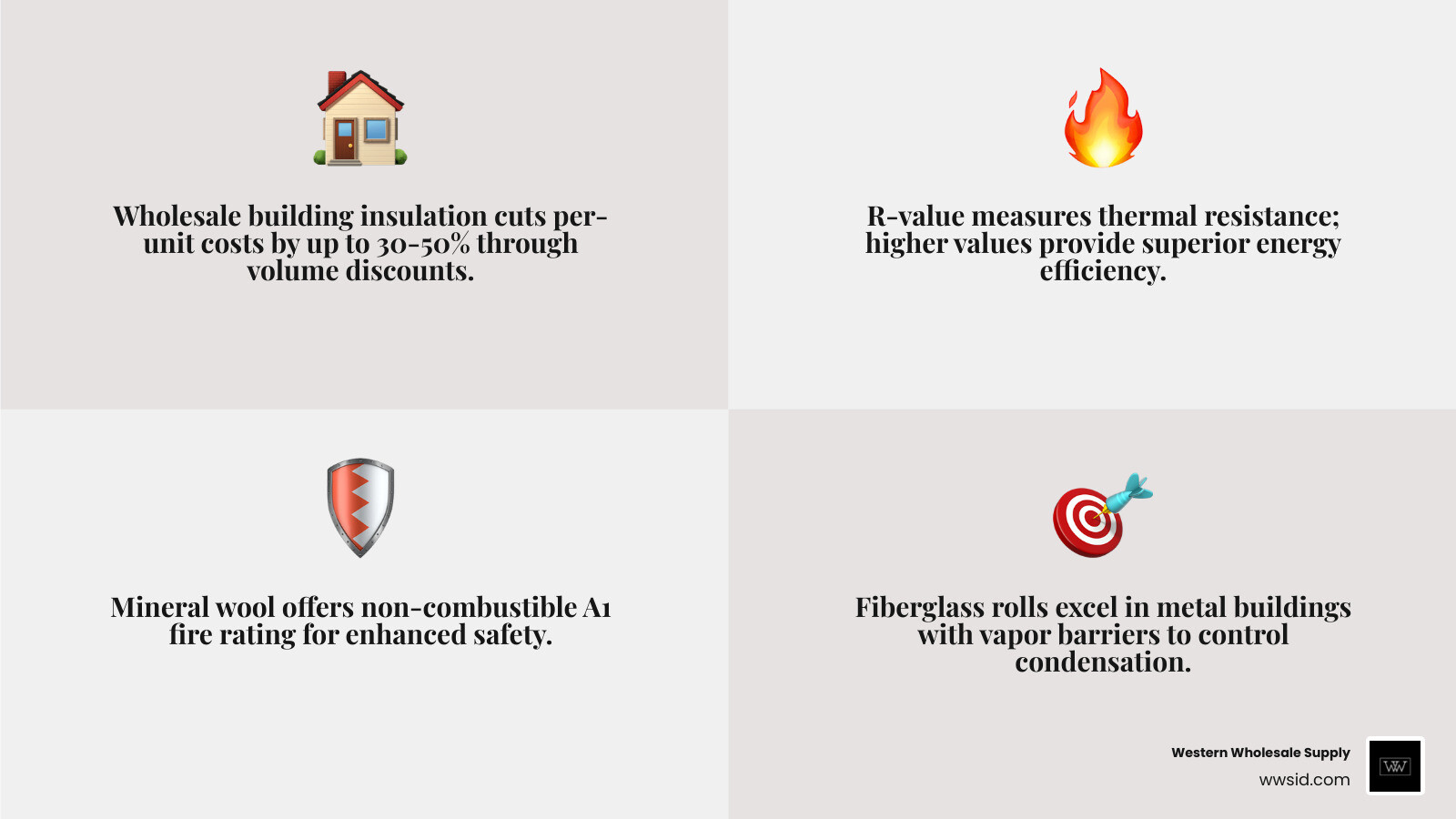
Wholesale building insulation is the most cost-effective way for contractors and builders to source thermal and acoustic insulation materials in bulk — directly from distributors — at significantly lower per-unit costs than retail, as noted by the U.S. Department of Energy.
Here’s a quick breakdown of what you need to know:
| What You Want to Know | Quick Answer |
|---|---|
| Main insulation types | Fiberglass batts, mineral wool, spray foam, rigid foam board, polyiso |
| Key wholesale benefit | Lower per-unit cost, reliable supply, volume discounts |
| Top performance metric | R-value (thermal resistance) — higher = better insulation |
| Best for metal buildings | Unfaced fiberglass rolls or mineral wool with vapor barrier |
| Best for fire resistance | Mineral wool (non-combustible, A1 fire rating) |
| How to buy wholesale | Open a trade/pro account with a regional distributor |
Insulation is one of the most critical materials on any job site. It controls temperature, reduces energy costs, manages moisture, and even affects how a building sounds. Getting it wrong — or running out mid-project — costs time and money.
Buying wholesale changes the equation. Instead of paying retail markups on every pallet, you lock in volume pricing, streamline delivery, and keep your projects moving on schedule.
Western Wholesale Supply is a third-generation building materials professional team with hands-on experience in wholesale building insulation distribution across residential and commercial construction. In the sections below, we’ll walk you through everything you need to know to buy smarter, install better, and cut waste on your next project.
Understanding the Primary Types of Wholesale Building Insulation
When we talk about wholesale building insulation in April 2026, the variety of materials available can be overwhelming. As an independent, veteran-owned business serving Eastern Idaho and Western Wyoming for over 60 years, we’ve seen how the right choice makes or breaks a project’s thermal envelope.
Fiberglass Batts and Rolls
Fiberglass remains a staple in the industry because it is versatile and cost-effective. Composed of inorganic glass fibers, it is available in batts, blown-in, and rolls. It is particularly popular for residential attics, walls, and floors. Because it is non-combustible and offers reliable thermal performance, it is often preferred over more expensive alternatives for standard wood-frame construction.
Mineral Wool
Often referred to as rockwool, this material is formed from minerals or volcanic rock. It is a powerhouse for specialized applications. It boasts an A1 fire rating (non-combustible) and superior sound absorption qualities. For contractors in Jackson, WY, or Idaho Falls looking for high-end fire protection and acoustic dampening, mineral wool slabs are the go-to choice.
Spray Polyurethane Foam (SPF)
Spray foam is a favorite for contractors who need to seal air leaks while insulating. It is lightweight and conforms to any shape, making it ideal for odd-shaped cavities. While it requires specialized equipment, its ability to provide a high R-value in a thin layer is unmatched.
Rigid Foam Board and Polyiso
Rigid boards, including Polyisocyanurate (Polyiso), are closed-cell foam boards used primarily for roofs, walls, and under slabs. They offer some of the highest R-values per inch of thickness. For more details on heavy-duty applications, check out The Ultimate Guide to Warehouse Insulation Materials.
Comparing Performance Metrics
Choosing the right material requires looking at the data. Below is a general comparison of how these materials stack up regarding thermal resistance and safety.
| Material Type | Typical R-Value (per inch) | Fire Resistance | Best Use Case |
|---|---|---|---|
| Fiberglass | 2.2 – 3.8 | Non-combustible | Residential walls/attics |
| Mineral Wool | 3.0 – 3.8 | Excellent (A1 Rating) | Fire-rated assemblies/Acoustics |
| Spray Foam (Closed Cell) | 6.0 – 7.0 | Requires thermal barrier | Air sealing/High efficiency |
| Polyiso Board | 6.0 – 6.5 | Good | Commercial roofs/Exterior walls |
Performance Metrics for Wholesale Building Insulation
In wholesale building insulation, “R-value” is the metric that rules them all. It measures the material’s thermal resistance—essentially, how well it resists heat flow. The higher the R-value, the better the insulating power.
However, R-value isn’t the only factor we consider at Western Wholesale Supply. Vapor barriers and moisture management are equally critical, especially in the variable climates of the Intermountain West. Materials like Bubble Up Your Barrier: Everything You Need to Know About Thermal Bubble Wrap provide unique reflective properties that reduce radiant heat transfer, which is a different beast entirely from conductive heat flow.
We ensure all our products meet rigorous ASTM International standards. Whether you are installing unfaced batts or specialized rigid boards, understanding these metrics ensures compliance with local building codes in places like Rexburg and Twin Falls.
Specialized Wholesale Building Insulation for Metal Buildings
Metal buildings present unique challenges, specifically regarding condensation and thermal bridging. Because metal conducts heat so efficiently, “thermal bridging” can occur where the heat bypasses the insulation through the steel frame.
To combat this, we often recommend specialized Insulation solutions. Unfaced fiberglass rolls are frequently used in metal building roofs and sidewalls, often layered to achieve higher R-values. These systems help regulate the warehouse climate and prevent the dreaded “sweating” that can lead to rust and structural damage. CertainTeed offers several solutions designed specifically for these high-demand environments, ensuring that your metal building stays dry and energy-efficient year-round.
Strategic Advantages of Bulk Purchasing
Why go wholesale? For a professional contractor, the benefits extend far beyond the initial price tag. When you partner with a distributor like us, you are tapping into a supply chain built on over six decades of reliability.
Tiered Pricing and Volume Discounts
The most immediate advantage is the cost savings. Wholesale models often utilize tiered pricing—the more you buy, the less you pay per square foot. For large-scale commercial projects in Pocatello or Idaho Falls, these savings can represent a significant portion of the project’s profit margin.
Supply Chain Reliability
In April 2026, market availability can still fluctuate. By purchasing wholesale building insulation through a trusted partner, you gain access to a network that prioritizes your needs. We maintain an extensive inventory to ensure that when you need R-19 batts or mineral wool slabs, they are ready for on-time delivery to your job site. This prevents costly labor delays.
Inventory Management
Managing a job site is hard enough without worrying about where to store 50 bags of insulation. Wholesale distributors can often coordinate staggered deliveries, allowing you to receive exactly what you need for each phase of the build without cluttering the workspace.
Acoustic and Fire-Resistant Solutions
In modern construction, insulation does more than just keep the heat in. It is a primary component of soundproofing and fire safety. Mineral wool is the gold standard here; its non-directional fiber orientation traps sound waves and dampens vibrations, making it perfect for office partitions and multi-family units.
For those looking to go “beyond the batt,” we offer a variety of advanced materials. You can learn more in our guide, Beyond Batts: A Comprehensive Look at Building Insulation Materials. When sound control is the priority, we recommend pairing high-quality insulation with Quietrock EZ Snap drywall to create high-STC (Sound Transmission Class) walls that provide peace and quiet for your clients.
Installation Best Practices and Accessories
Even the best wholesale building insulation won’t perform if it isn’t installed correctly. Gaps, compression, and moisture can all degrade the R-value of your material.
Vapor Retarders and Moisture Control
In cold climates like Jackson, WY, and Driggs, ID, moisture is the enemy of insulation. If warm, moist air from inside a building hits a cold exterior surface, it condenses. This is why vapor retarders are essential. Choosing the right water-resistant insulation is a key step in preventing mold and structural rot. For more on this, see Banish Basement Blues: Choosing the Right Water Resistant Insulation.
Installation Methods
- Friction Fit: Many batts and mineral wool slabs are designed to stay in place by friction between studs.
- Adhesive Systems: For rigid boards or metal building applications, Tuffbond adhesives or stick pins are often required to prevent sagging.
- Banding: In retrofit projects, especially in pole barns or warehouses, steel or poly banding is used to support the insulation against the roof or walls.
Essential Accessories for Professional Results
To get the job done right, you need more than just the insulation itself. We provide a full range of accessories to ensure a seamless installation:
- Insulation Tape: Used to seal the seams of faced insulation or vapor barriers to maintain a continuous seal.
- Sealants and Caulking: Essential for air sealing around windows, doors, and penetrations before the insulation goes in.
- Dispensing Applicators: These tools ensure quick and accurate application of adhesives and spray foams, reducing waste.
- Safety Gear: Never skimp on protection. High-quality safety glasses, gloves, and respirators are mandatory when handling fiberglass and mineral wool.
Frequently Asked Questions about Wholesale Insulation
How do I calculate the total square footage needed for a bulk order?
Calculating your needs involves more than just measuring the walls. You must account for the “waste factor” (usually 5-10%) and the spacing of your studs or joists. For example, if you are using R-19 batts for 2×6 walls, you need to know if your framing is 16 inches or 24 inches on center. Most wholesale building insulation is sold by the bag or pallet, and each bag will list the square footage coverage based on standard framing.
What are the current pricing trends for April 2026?
As of April 2026, we are seeing steady manufacturer updates from major brands like CertainTeed. While prices fluctuate based on raw material costs and energy prices, buying in bulk remains the best hedge against inflation. We often see seasonal promotions—such as summer sales for warehouse retrofits—that offer additional discounts on large orders.
Which insulation is best for regional climates in Idaho and Wyoming?
In our region, cold-weather performance is the priority. This means aiming for higher R-values than the national average. In areas like Jackson and Rigby, we often recommend a “flash and batt” approach—using a thin layer of spray foam for air sealing, followed by fiberglass or mineral wool batts to fill the cavity. This provides excellent thermal resistance and superior air sealing.
Conclusion
Mastering wholesale building insulation is about more than just finding the lowest price—it’s about finding a partner who understands the unique demands of your project and your climate. At Western Wholesale Supply, we pride ourselves on being that partner.
As an independent, veteran-owned, third-generation family business, we’ve been serving Eastern Idaho, Western Wyoming, and even parts of Western Montana since 1963. Whether you are in Idaho Falls, Pocatello, Twin Falls, or anywhere in between, we are committed to providing reliable, on-time delivery and exceptional customer service. With over 60 years of experience, we don’t just sell materials; we provide the expertise you need to build better, more efficient structures.
Ready to streamline your next project? Contact us for a wholesale quote today and experience the difference that local expertise and professional-grade supplies can make.
