

Why Soundproofing Drywall Matters for Quieter Interiors
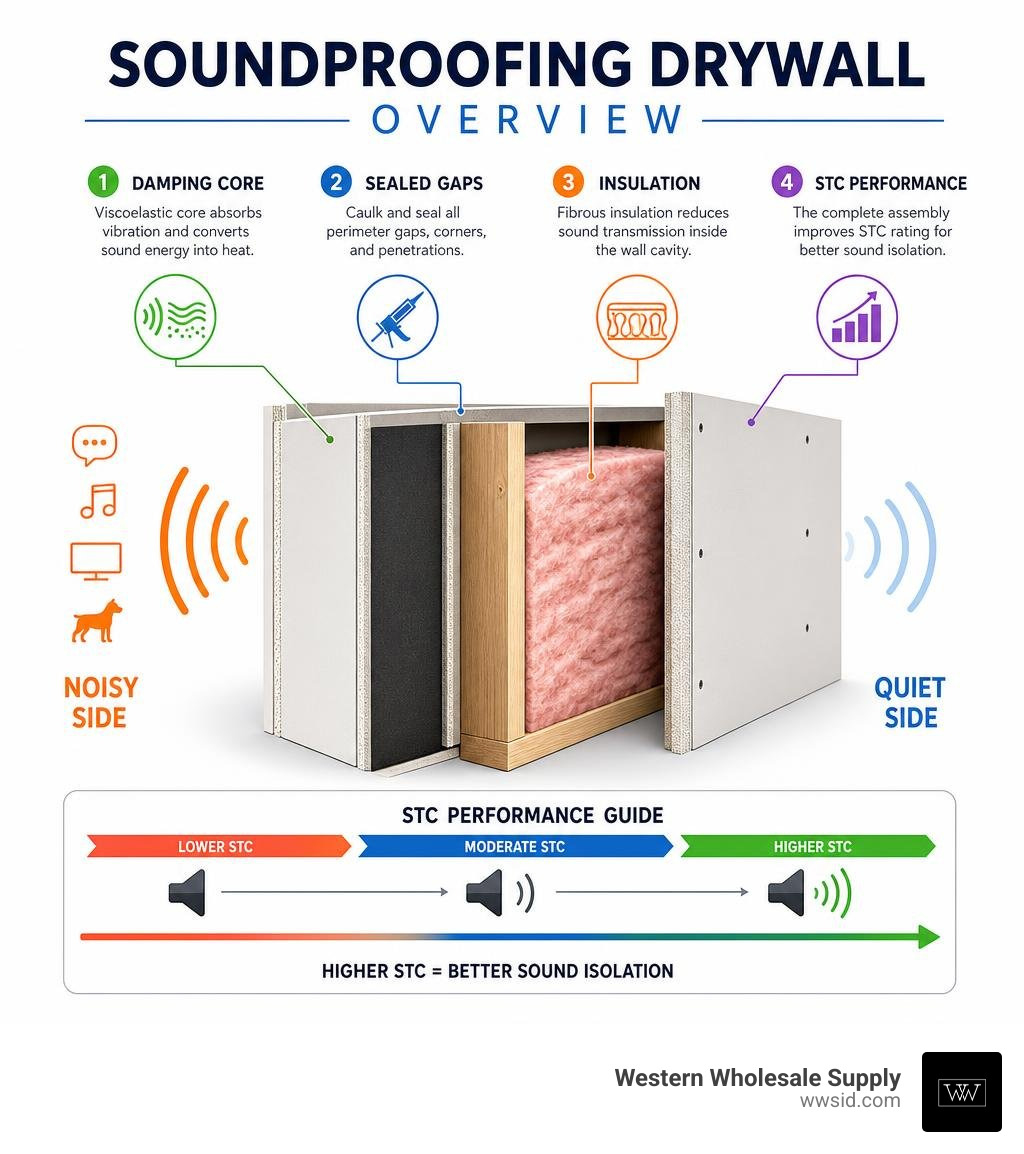
Soundproofing drywall is a high-density gypsum panel designed to reduce airborne noise, such as speech, television, music, and barking dogs, moving through interior walls and ceilings. Unlike standard drywall, many acoustic panels use layered gypsum and a viscoelastic damping core that converts vibration energy into small amounts of heat instead of allowing it to pass through the assembly.
| Quick answer | What it means |
|---|---|
| Best use | Bedrooms, home offices, nurseries, media rooms, theaters, and shared walls |
| How it works | Adds mass and damping to reduce sound vibration through the wall |
| Performance measure | STC ratings measure airborne sound reduction; higher ratings generally mean better isolation |
| Important reality | Drywall alone cannot stop every sound leak. Framing, insulation, outlets, doors, and perimeter gaps affect results. |
The right board can improve sound control without building an unusually thick wall. But real sound isolation comes from the full assembly, not one product: the drywall, stud layout, insulation, sealing, and details around electrical boxes all matter.
At Western Wholesale Supply, we are building-materials professionals serving builders with drywall, framing, and insulation. Our experience with soundproofing drywall comes from helping contractors match practical material choices to real residential and commercial wall systems.
Understanding Soundproofing Drywall and How It Works
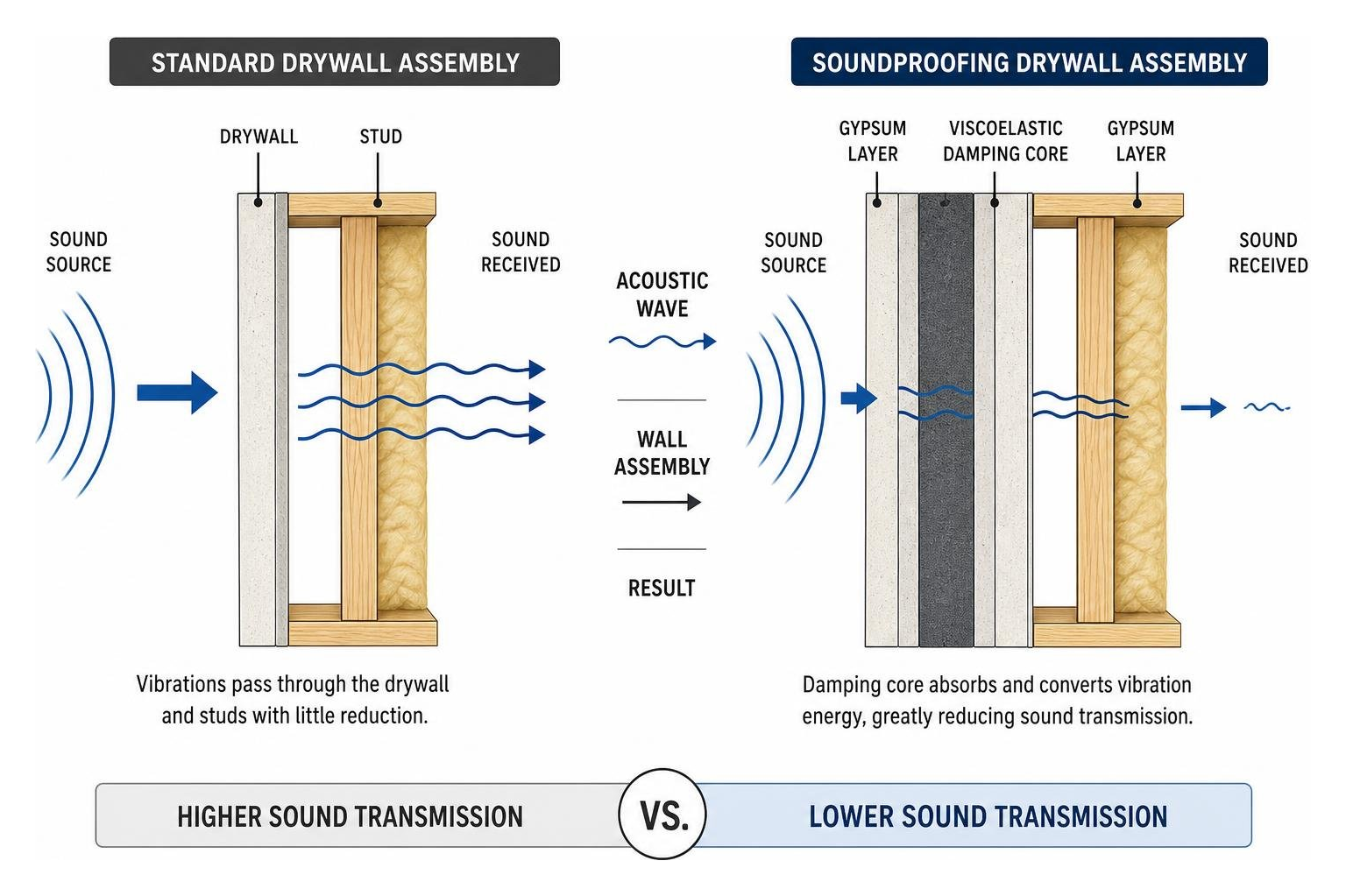
To understand how soundproofing drywall works, it helps to think of sound as physical kinetic energy. When someone talks, plays a bass guitar, or cranks up a movie, the audio creates pressure waves in the air. These airborne waves hit a standard wall, causing the thin drywall panels to flex and vibrate like the head of a drum. That vibration travels straight through the wall studs and radiates into the adjoining room as unwanted noise.
Acoustic gypsum boards change this dynamic through a process known as constrained layer damping. Instead of a single layer of gypsum, advanced sound-dampening panels combine high-density gypsum boards with a specialized viscoelastic damping polymer core sandwiched between them.
When acoustic energy hits a panel built with a viscoelastic polymer layer, the two outer gypsum layers attempt to slide slightly against each other. The internal polymer core absorbs this shear movement, shearing and flexing on a microscopic level. Instead of allowing the vibration to pass right through into the framing studs, the core converts the mechanical sound energy directly into harmless micro-heat energy.
By dissipating acoustic energy right inside the board, soundproofing drywall drastically reduces sound transfer between rooms. If you want a deep dive into the underlying physics of acoustic attenuation, explore our Detailed Guide to Drywall Soundproofing for comprehensive assembly details.
Key Benefits of Soundproofing Drywall for Interior Spaces
Why choose specialized acoustic panels over traditional wall construction? The primary advantage comes down to efficiency and usable floor space.
Historically, achieving serious acoustic isolation required building thick double-stud walls, installing thick layers of mass-loaded vinyl, or stacking multiple layers of standard 5/8-inch gypsum on both sides of a partition. While double layering works, it eats away precious square footage in home offices, nurseries, or multi-family living units. Damped acoustic drywall provides high sound reduction in a slim, thin-wall profile, preserving your usable living area.
In addition to acoustic energy dissipation, top-tier soundproof drywall products offer exceptional durability and environmental protection:
- Mold and Moisture Protection: Modern acoustic boards are engineered to resist moisture and mold growth, far surpassing old-style greenboard. Premium panels achieve maximum scores under ASTM D3273 and ASTM G21 testing, making them safe for humid areas or exterior-facing partitions.
- Fire Safety: Many acoustic boards feature a Type X gypsum core. Because natural gypsum contains chemically combined water, it acts as a built-in fire barrier. When exposed to high heat, the moisture releases as steam to delay heat transfer, meeting strict UL fire-rated assembly specifications.
- Single-Step Installation Efficiency: Damped gypsum panels install directly onto framing studs just like standard gypsum board. Products like Quietrock EZ Snap allow installers to score and snap panels without special power tools, speeding up construction compared to complex multi-layer framing systems.
For an in-depth breakdown of how acoustic gypsum transforms residential layouts, check out our guide on Beyond the Buzz A Guide to Sound Dampening Drywall.
Choosing the Best Soundproofing Drywall Thickness and Specs
Selecting the correct panel thickness depends on your framing design, fire code requirements, and sound isolation targets. Acoustic boards come in several specialized thicknesses, each engineered for specific structural and sound-damping scenarios:
- 1/2-Inch Panels: Ideal for non-fire-rated interior partitions where standard thickness is needed to match existing wall jams or trim.
- 5/8-Inch Type X Panels: The industry standard for fire-rated wall assemblies, commercial partitions, and high-performance residential walls. The added mass of the 5/8-inch Type X core works alongside the viscoelastic core to boost both fire endurance and acoustic damping.
- 5/16-Inch Retrofit Panels: Designed specifically for remodeling projects. These slim panels mount directly over existing standard drywall without requiring tear-out, making them perfect for fast acoustic upgrades.
- 1-3/8-Inch Heavy-Duty Damping Panels: Heavyweight panels designed for maximum acoustic isolation. Weighing upwards of 6.25 lbs per square foot, these thick composite panels target stubborn low-frequency sound waves in professional studios and high-end home theaters.
- 3/4-Inch Panels: Frequently used in floor-ceiling assemblies to improve Impact Insulation Class (IIC) ratings and control footstep vibration between stories.
- Specialized Cement Substrates: For tile applications on acoustic partitions or wet-area installations, heavy-duty cement board options like Durock provide robust, moisture-impervious backing.
When specifying materials across Eastern Idaho and Western Wyoming, matching the board’s physical weight and core specs to the structural framing ensures your wall complies with local building codes while delivering the acoustic comfort you expect.
Performance Factors: STC Ratings and Wall Assemblies
In the acoustic world, performance is measured by the Sound Transmission Class (STC) rating, established through standard ASTM E90 laboratory testing. The STC rating is a single-number integer that rates how well a building partition blocks airborne sound. Higher STC numbers indicate superior sound isolation.
To put STC numbers into practical perspective:
- STC 35: Standard single-stud wall with 1/2-inch regular drywall on each side and no insulation. Loud speech can be heard clearly and understood through the wall.
- STC 42: Baseline wall with a single layer of 5/8-inch Type X drywall on each side over 2×4 wood studs at 16 inches on-center. Normal speech is muffled, but loud speech or music is still easily heard.
- STC 49: Two layers of standard 5/8-inch Type X drywall on each side of a 2×4 stud wall.
- STC 56: A single layer of damped acoustic drywall on one side and 5/8-inch Type X on the other over 2×4 wood studs spaced at 24 inches on-center. Normal speech is completely unheard, and loud music is reduced to a whisper.
- STC 60 to 80: High-performance engineered assemblies using staggered studs, double studs, or specialized multi-layer panels like those profiled in the official Acoustical Gypsum Board Datasheet. At STC 60 or higher, even extremely loud home theater bass or band rehearsals are virtually eliminated in adjacent rooms.
| Wall Assembly Framing | Layer Configuration | Estimated STC Rating | Acoustic Performance Level |
|---|---|---|---|
| Single 2×4 Wood Studs (16″ OC) | Single layer 5/8″ Standard Drywall per side | STC 42 | Basic (Speech easily heard) |
| Single 2×4 Wood Studs (16″ OC) | Double layer 5/8″ Standard Drywall per side | STC 49 | Moderate (Loud speech audible) |
| Single 2×4 Wood Studs (24″ OC) | Single layer Damped Acoustic Board per side | STC 56 | High (Speech completely muted) |
| Staggered 2×4 Wood Studs | Damped Board on one side, Type X on other | STC 64 | Superior (Music & TV blocked) |
| Double 2×4 Wood Studs | Double layer Damped Acoustic Board per side | STC 80 | Maximum (Studio-grade isolation) |
Ideal Applications: From Home Theaters to Offices
Not every wall in a building needs maximum sound isolation, but specific spaces benefit immensely from damped gypsum construction:
- Home Theaters and Media Rooms: Subwoofers generate intense low-frequency sound waves that pass through standard drywall with ease. Heavyweight acoustic boards absorb low-end vibration, allowing you to enjoy action movies without shaking the rest of the house.
- Home Offices: With remote work now standard practice across South East Idaho, high-STC walls prevent household noise, barking dogs, or kitchen dishwashers from interrupting professional video calls.
- Nurseries and Children’s Bedrooms: Soundproofing a nursery wall ensures sleeping infants aren’t awakened by hallway chatter, television audio, or living room noise.
- Multi-Family Living Partitions: Shared demising walls between townhomes, apartments, or duplexes require strict acoustic performance to preserve tenant privacy and meet regional building standards.
- Commercial Practice Spaces & Executive Suites: Medical consultation rooms, legal offices, and music rooms rely on acoustic wall assemblies to maintain strict confidentiality and eliminate ambient distractions.
To evaluate room-by-room soundproofing priorities, read our detailed article on Soundproofing for Drywall Everything You Need to Know.
Comparing Sound Isolation Methods: Damped Gypsum vs. Alternative Options
When planning a soundproof wall, contractors and homeowners often evaluate several competing construction methods. Understanding how acoustic drywall stacks up against traditional sound isolation strategies helps you make the right choice for your project budget and labor timeline.
| Method | Material & Installation Complexity | Thickness Added | Sound Isolation (STC) | Primary Strengths |
|---|---|---|---|---|
| Damped Acoustic Drywall | Low to Moderate (Installs like standard drywall) | Minimal (1/2″ to 5/8″) | STC 52 – 56+ | Fast labor, preserves floor space, built-in mold/fire protection |
| Double Standard Drywall + Damping Compound | Moderate (Requires applying liquid compound on site) | Adds 5/8″ per side | STC 50 – 54 | Flexible material selection, good low-frequency damping |
| Acoustic Insulation in Stud Cavity | Very Low (Friction-fit mineral wool or fiberglass) | Fits inside framing cavity | Adds +4 to +6 STC points | Inexpensive, essential baseline step for all acoustic walls |
| Resilient Channels / Isolation Clips | High (Requires exact framing attachment & screw length) | Adds 1/2″ to 1-1/2″ | STC 55 – 62 | Excellent structural decoupling, breaks sound vibration path |
While adding acoustic mineral wool or glass fiber insulation inside the stud wall cavity is essential, insulation alone only adds about 4 to 6 STC points to a hollow wall. Insulation absorbs sound resonating inside the open cavity, but physical sound vibrations still travel directly through the rigid wood or steel studs. Damped drywall directly stops that structural vibration.
Acoustic Isolation Techniques and Retrofits
For existing structures where tearing down drywall isn’t practical, several retrofit options exist:
- Retrofit Damped Gypsum: Installing a 5/16-inch or 1/2-inch acoustic panel directly over existing 1/2-inch drywall delivers an instant STC upgrade with zero demolition mess.
- Double Layering with Acoustical Glue: Applying a viscoelastic dampening compound between an existing layer of drywall and a new second layer creates an effective field-assembled damped partition.
If you are considering upgrading an existing wall without tearing it down to the studs, explore our step-by-step guide on How to Double Drywall for Soundproofing Without Major Renovations.
For new construction, combining acoustic insulation inside the cavity with damped drywall yields a slim, high-performance assembly. In warehouse or commercial steel structures, pairing proper wall assemblies with proper thermal insulation—aiming for thermal targets like R-30+ in ceilings and R-13+ in wall systems—ensures both acoustic quiet and energy performance.
Best Practices for Soundproof Drywall Installation
Even the highest-rated soundproofing drywall will fail to achieve its listed STC performance if installed incorrectly. Sound behaves exactly like water: if there is even a pinhole leak in the wall assembly, noise will pour right through it.

Follow these proven steps during installation:
- Precision Cutting and Handling: Damped panels with dense polymer cores require deep scoring on both face and back paper before snapping. For ultra-dense 1-3/8 inch panels, use a high-tooth power saw or hand saw.
- Staggered Panel Joints: When installing sheets, offset the vertical and horizontal joints between adjacent panels. Never line up seams directly opposite each other on opposite sides of the wall.
- Fastener Selection: Secure panels using quality drywall screws from reliable brands like Grabber or Brighton Best. Space fasteners according to ASTM C840 standards, driving heads flush without tearing the face paper.
- Finishing and Taping: Finish seams using professional drywall taping tools. Finishing tools from trusted brands like Hyde, USG Sheetrock Tools, Columbia Taping Tools, and Marshalltown ensure smooth joint compound application over paper tape, matching standard Level 4 or Level 5 finishes.
Sealing Air Leaks and Decoupling Wall Structures
Airborne sound easily bypasses solid drywall panels through flanking sound paths—gaps around floor plates, ceiling intersections, corners, and wall penetrations.
To stop flanking sound:
- Continuous Perimeter Sealing: Leave a 1/4-inch gap around the entire perimeter of the drywall assembly (where the board meets adjacent floors, walls, and ceilings). Fill this entire gap with a non-hardening acoustical sealant. Regular painter’s caulk will dry out, shrink, and crack over time, letting sound leak through.
- Acoustic Electrical Outlet Wrapping: Electrical boxes are literal holes cut directly through your sound barrier. Before hanging drywall, wrap the back of every electrical outlet box and switch box with moldable acoustic putty pads. This seals air gaps and prevents sound from telegraphing through the box.
- Structural Decoupling: For ultra-quiet installations, consider staggered stud framing or double stud construction. Decoupling mechanically separates the interior wall surface from the exterior wall surface, completely severing the vibration path.
For specialized ceiling applications, drop-ceiling grid systems paired with high-grade acoustic tiles, such as CertainTeed acoustical ceiling panels, prevent sound from traveling overhead into upper floor spaces. Learn more in A Comprehensive Guide to Ceiling Sound Treatment.
Frequently Asked Questions
How does soundproof drywall compare to standard drywall in sound reduction?
Standard 5/8-inch Type X drywall installed on a single wood stud wall provides a baseline STC rating of around 42. In contrast, replacing standard sheets with damped acoustic drywall increases the rating to STC 56 or higher on identical framing. Because the STC scale is logarithmic, a 10-point increase in STC represents a 50% reduction in perceived human loudness. The dense core and viscoelastic damping layer in acoustic drywall absorb vibrations that standard gypsum allows to pass through effortlessly.
Is soundproof drywall moisture- and fire-resistant?
Yes! Premium acoustic drywall panels feature treated gypsum cores designed specifically for moisture, mold, and mildew resistance, meeting stringent ASTM D3273 standards. Furthermore, 5/8-inch thick acoustic panels built with a Type X core offer certified fire endurance. Gypsum naturally contains chemically combined water that turns to steam when exposed to intense heat, slowing down temperature transmission during a fire. Always verify that your chosen board carries UL GREENGUARD Gold certification for indoor air quality.
Is investing in soundproof drywall worth the extra cost?
While acoustic drywall carries a higher upfront material cost per panel than standard gypsum board, it frequently yields a higher overall return on investment when factoring in total project costs. Achieving an equivalent STC 56 rating using traditional building methods requires labor-intensive double-layer drywall installation, extra structural framing, or resilient clips. Acoustic drywall saves substantial installation time, reduces labor expenses, and preserves valuable room square footage while delivering superior acoustic quiet and increasing long-term property value.
Conclusion
Achieving true room isolation doesn’t require sacrificing interior floor space or over-complicating your framing design. Modern soundproofing drywall combines viscoelastic damping technology, high mass density, and built-in mold and fire resistance into a single, straightforward wall panel. When paired with sound-absorbing cavity insulation, perimeter acoustical sealants, and acoustic putty wraps around electrical boxes, damped drywall delivers peace, quiet, and privacy for any home or commercial space.
At Western Wholesale Supply, we are an independent, veteran-owned, third-generation family business supplying top-quality building materials across Eastern Idaho, South East Idaho, Western Wyoming, and Western Montana since 1963. Whether your project is in Idaho Falls, Pocatello, Twin Falls, Jackson, Rexburg, or anywhere across our region, our team brings over 60 years of hands-on experience to help you choose the right acoustic drywall, steel framing, insulation, and ceiling systems.
Contact our material experts today or stop by one of our regional showrooms to get reliable, on-time delivery for your next sound isolation project! Explore our Detailed Guide to Drywall Soundproofing for more technical insights.
